Iglesia de El Salvador: Seville's Overlooked Baroque Masterpiece
Standing on the site of Seville's former Great Mosque, the Iglesia del Divino Salvador is the city's second largest church and one of its most rewarding visits. With soaring Baroque nave, layers of Islamic and Christian history, and far fewer crowds than the Cathedral, it earns more attention than most itineraries give it.
Quick Facts
- Location
- Plaza del Salvador, s/n, 41004 Seville (Santa Cruz / Historic Centre)
- Getting There
- Walk about 8–10 min from Plaza Nueva; several TUSSAM bus lines stop nearby on Avenida de la Constitución
- Time Needed
- 45–75 minutes for a cultural visit with the included audioguide
- Cost
- €7 online / €8 at the door (individual); combined ticket with Seville Cathedral + Giralda: €13 online / €14 at the door. Free for children under 13 with an adult.
- Best for
- History enthusiasts, Baroque art lovers, travellers wanting cathedral-scale grandeur without cathedral-scale queues
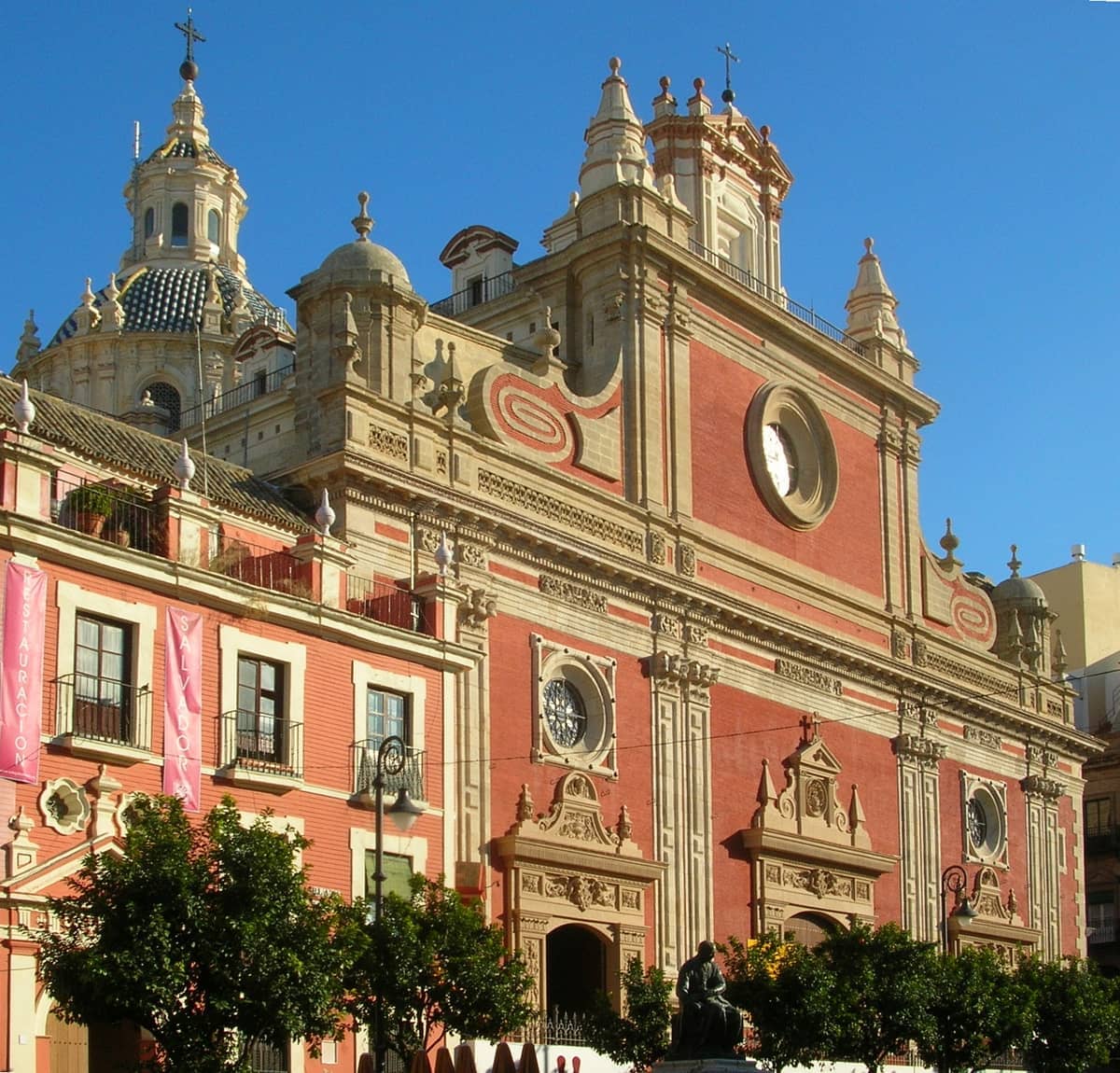
What Is the Iglesia de El Salvador?
The Iglesia del Divino Salvador, known locally simply as El Salvador or Iglesia de San Salvador, occupies one of the most historically loaded plots of ground in Seville. The church stands on Plaza del Salvador in the heart of the historic centre, a short walk from Calle Sierpes and a few minutes northeast of Plaza Nueva. It is the largest church in Seville after the Cathedral, and its Baroque interior rivals anything in the city for sheer theatrical impact.
What distinguishes El Salvador from other Sevillian churches is not just scale but continuity. Before the current building, earlier Christian structures stood here. Before that, this was the site of the main Friday mosque of Islamic Seville. The minaret of that mosque was a direct predecessor of the Giralda, the Cathedral. One visit to El Salvador gives you access to over a thousand years of the city’s religious and architectural evolution. Before that, this was the site of the main Friday mosque of Islamic Seville. The minaret of that mosque was a direct predecessor of the Giralda, the famous bell tower attached to Seville Cathedral. One visit to El Salvador gives you access to over a thousand years of the city's religious and architectural evolution.
💡 Local tip
Buy tickets online in advance at the Cathedral's official website (catedraldesevilla.es) Buy tickets online in advance at the Cathedral’s official website (catedraldesevilla.es) to save on the admission price and avoid queuing at the door. The combined ticket covering the Cathedral, the Giralda, and El Salvador is almost always better value if you plan to visit both sites.
Layers of History: Mosque, Church, and Baroque Transformation
When the Almohad dynasty controlled Seville in the 12th century, this site held the city's principal mosque. After the Christian reconquest under Ferdinand III in 1248, the mosque was converted into a church, as happened throughout Andalusia. What makes El Salvador unusual is that significant traces of the Islamic structure survive. Step into the courtyard on the northern side and you are walking through the former ablutions court of the mosque, When the Almohad dynasty controlled Seville in the 12th century, this site held the city’s principal mosque. After the Christian reconquest under Ferdinand III in 1248, the mosque was converted into a church, as happened throughout Andalusia. What makes El Salvador unusual is that significant traces of the Islamic structure survive. Step into the courtyard on the northern side and you are walking through the former ablutions court of the mosque, with its orange trees and stone columns partially reused from the earlier structure.
The current Baroque church took shape primarily The current Baroque church took shape primarily between 1679 and 1712, designed in large part by the architect Leonardo de Figueroa, one of the defining figures of Sevillian Baroque. Construction proceeded slowly across several decades, constrained by funds and the challenge of building on foundations that had already supported two major religious complexes. An extensive restoration carried out between 2003 and 2008 brought the interior stonework, gilded altarpieces, and painted vaults back to something close to their original intensity., designed in large part by the architect Leonardo de Figueroa, one of the defining figures of Sevillian Baroque. Construction proceeded slowly across several decades, constrained by funds and the challenge of building on foundations that had already supported two major religious complexes. An extensive restoration completed in 2008 brought the interior stonework, gilded altarpieces, and painted vaults back to something close to their original intensity.
The historical layering here is comparable in concept to what you find at the Real Alcázar, where Islamic foundations underpin Christian palatial additions. El Salvador makes this dialogue between civilizations physically readable if you know where to look.
Tickets & tours
Live prices and dates from our booking partner. If you book, we may earn a commission at no extra cost to you.
Seville Archive of Indies, Torre del Oro and Salvador Church tour
From 16 €Instant confirmationFree cancellationGuided tour of the white villages of Andalusia: Ronda, Grazalema and Zahara
From 79 €Instant confirmationFree cancellationSevilla FC Ramon Sanchez-Pizjuan Stadium tour
From 10 €Instant confirmationSevilla Alcazar and cathedral guided tour with priority access tickets
From 59 €Instant confirmationFree cancellation
Inside the Church: What You Actually See
The interior is organized as a three-nave basilica with tall columns supporting rounded arches and a painted barrel vault overhead. The color palette is warm and golden: cream stonework, gilded wood, deep ochres in the painted decoration. At midday, light enters through high windows and catches the gilding on the altarpieces in a way that changes the mood of the space entirely compared to overcast mornings.
The star sculptural work is the Cristo del Amor, a 17th-century polychrome wooden figure carved by Juan Martínez Montañés, arguably the greatest sculptor working in Seville at the time. The piece has a physicality and emotional charge that photographs consistently fail to convey. Stand close and the texture of the painted wood, the attention to musculature and facial expression, makes Montañés's reputation immediately clear.
Several of the lateral chapels contain high-quality retablos (altarpieces) by other significant Baroque artists, and the main altar is a large gilded construction that fills the apse. The audioguide, included in the admission price, provides context on the principal works and is worth using even if you normally skip them in other churches. The information is specific enough to be genuinely useful rather than generically descriptive.
ℹ️ Good to know
Opening hours (2025–2026, cultural visits): Monday to Thursday 10:15–17:30; Friday and Saturday 10:15–16:30; Sunday 14:30–19:00. The church is closed on major public holidays including January 1 and 6, Semana Santa, Corpus Christi, August 15, and December 25. Always verify hours before visiting as they can change.
Time of Day and Crowds: When to Go
El Salvador attracts far fewer visitors than the Cathedral, but it is not deserted. Tour groups tend to arrive between 11:00 and 13:00, following morning visits to the Cathedral and Alcázar. If you arrive at opening, around 10:15 on a weekday, you will often have the nave largely to yourself for the first half hour. The quality of light at this time, low and angled through the east-facing windows, is also at its most interesting.
Sunday afternoons, when cultural visits begin at 14:30, are noticeably quieter than weekdays in practical terms. Locals use the morning mass hours, and the tourist flow on Sunday afternoons is lighter than you might expect. This makes Sunday one of the better options for photography, particularly since the late afternoon light in summer enters from the west and warms the gilded altarpieces considerably.
For context on what the city looks like during peak and off-peak seasons, including how crowd levels shift across the year, the guide on the best time to visit Seville covers temperature, rainfall, and event calendars in practical detail.
The Plaza del Salvador: Before and After Your Visit
Plaza del Salvador is one of Seville's most lived-in squares. Sevillanos of all ages use the steps of the church as informal seating throughout the day and especially in the evenings, when the plaza fills with people from the nearby bars and tapas spots. The church's facade, a pale stone Baroque composition with ornamental detail concentrated around the upper register, is best appreciated in the late afternoon when direct sun catches the carved stonework from the west.
Several popular tapas bars operate on the plaza and the streets immediately adjacent, including on Calle Villegas. If you time your visit to finish around 13:00 or 14:00, the transition from the cool, incense-scented interior to a shaded table outside for lunch is one of those small Sevillian pleasures that doesn't require any planning beyond showing up at the right moment.
The plaza sits within easy walking distance of the Santa Cruz neighborhood, Seville's most historically layered residential district. A short walk in either direction connects you to Casa de Pilatos, the magnificent 16th-century palace that blends Mudéjar and Renaissance styles, or south toward the Cathedral quarter.
Practical Walkthrough: Getting There and What to Bring
El Salvador is centrally located and easy to reach on foot from most points in the historic centre. From the MetroCentro tram stop at Plaza Nueva, the walk takes El Salvador is centrally located and easy to reach on foot from most points in the historic centre. From the MetroCentro tram stop at Plaza Nueva, the walk takes around eight to ten minutes through the pedestrianized shopping streets. From the Cathedral, allow about five to seven minutes walking northeast past the Archivo General de Indias side.
The main entrance for cultural visits is directly on Plaza del Salvador. The floor throughout the nave is stone, mostly level, and the primary visitor route has no significant steps, making wheelchair access to the nave straightforward. Some peripheral areas including the crypt involve stairs. Visitors with reduced mobility should check current access conditions with the Cathedral administration in advance.
Dress code applies as at all active Spanish churches: covered shoulders and knees are required. In summer, carry a light layer if you are arriving in sleeveless clothing. Photography is permitted in the cultural visit, but flash and tripods are generally not allowed in active religious spaces. The interior is cool year-round, which is welcome relief in Seville's summer months when outdoor temperatures regularly exceed 35°C.
⚠️ What to skip
During Semana Santa (Holy Week) and other major religious observances, During Semana Santa (Holy Week) and other major religious observances, the church may adjust cultural-visit access and operates more heavily around parish worship. If your Seville trip coincides with these periods, check the Cathedral’s official schedule well in advance. The Cristo del Amor sculpture is processed through the streets during Holy Week and may not be in its usual chapel position. If your Seville trip coincides with these periods, check the Cathedral's official schedule well in advance. The Cristo del Amor sculpture is processed through the streets during Holy Week and may not be in its usual chapel position.
Is It Worth Your Time?
For travellers who have already seen the Cathedral and are wondering whether another church justifies the time, El Salvador makes a stronger case than its reputation suggests. The combination of verifiable Islamic archaeology in the courtyard, one of Seville's finest Baroque interiors, and exceptional 17th-century sculpture puts it in a different category from the city's other churches. If you are working through Seville's most significant churches, this one belongs near the top of that list.
It is not, however, a place that rewards a rushed half-hour. The works inside are detailed and the historical context genuinely enriches what you see. Visitors who treat it as a quick box-ticking stop between the Cathedral and the Alcázar tend to leave without understanding what they have just seen. Give it at least 45 minutes and use the audioguide.
Those visiting Seville with children may find the Baroque interior engaging if children are old enough to appreciate art and history, but younger children may find the visit slow. For family-focused trip planning, the guide to Seville with kids provides useful context on which sights work best with different age groups.
Insider Tips
- The courtyard on the north side of the church (the former mosque ablutions court) is included in the cultural visit and is easy to miss if you follow other visitors directly into the nave. Spend time here first: the reused Islamic columns and orange trees give the clearest physical evidence of the pre-Christian structure beneath.
- The combined Cathedral and El Salvador ticket costs only marginally more than a Cathedral-only ticket and includes the Giralda tower climb. If you have not yet visited the Cathedral, the combined ticket is almost always the better purchase.
- Weekday mornings between 10:15 and 11:00 consistently see the lowest visitor numbers. Arrive at opening on a Tuesday or Wednesday and you will likely have the nave to yourself for the first twenty minutes.
- The Cristo del Amor by Martínez Montañés is displayed in a lateral chapel with relatively low light. Give your eyes time to adjust after entering from the brighter nave, and position yourself directly in front of the piece rather than viewing it at an angle from the entrance to the chapel.
- If you are visiting during the cooler months (November to March), note that the interior can be notably cold despite looking warm in photographs. The stone floor and thick walls retain the night chill well into midday. A light jacket is worth bringing regardless of outdoor temperatures.
Who Is Iglesia de San Salvador For?
- Travellers with a serious interest in Baroque art and sculpture who want more depth than the Cathedral's compressed visitor flow allows
- Anyone interested in Islamic Seville and the physical archaeology of the city's Moorish period
- Photography-focused visitors seeking dramatic interior light and gilded altarpieces with manageable crowds
- Visitors combining El Salvador with a broader historic-centre walking route through Santa Cruz
- Travellers on a second visit to Seville who have already covered the Cathedral and Alcázar and want to go deeper
Nearby Attractions
Other things to see while in Santa Cruz:
- Archivo General de Indias
Standing beside the Cathedral on Avenida de la Constitución, the Archivo General de Indias holds one of the most significant collections of colonial-era documents in the world. Entry is free, the building is architecturally remarkable, and most visitors leave having completely underestimated what's inside.
- Casa de Pilatos
Casa de Pilatos is a 16th-century palace in Seville's historic centre that quietly outshines many better-known landmarks. Its central courtyard, azulejo-lined rooms and classical statuary collection reward visitors who take the time to look closely.
- Hospital de los Venerables
Built in the late 17th century as a refuge for elderly priests, the Hospital de los Venerables is one of Seville's most rewarding architectural and artistic stops. Its church ceiling, Baroque courtyard, and Focus-Abengoa Foundation art collection combine in a space that feels both intimate and historically weighty.
- La Giralda
La Giralda began as the minaret of a 12th-century Almohad mosque and was later transformed into the bell tower of the largest Gothic cathedral in the world. At 104 metres tall, it dominates the Seville skyline and rewards visitors with a ramp-based ascent unlike any other tower climb in Spain.
Planning a trip? Discover personalized activities with the Nomado app.