Convento de Santa Paula: Seville's Living Convent and Hidden Art Collection
One of Seville's most atmospheric religious sites, the Convento de Santa Paula is a Hieronymite convent founded in the late 15th century that still houses an active community of nuns. Its small museum preserves an unexpectedly rich collection of religious art, tucked inside a quarter of La Macarena that rewards slow exploration.
Quick Facts
- Location
- Calle Santa Paula 11, barrio de San Julián (near La Macarena), Seville 41003
- Getting There
- Walk from the historic centre (20–25 min from the Cathedral) or take a TUSSAM bus toward the San Román / La Macarena area
- Time Needed
- 45 minutes to 1.5 hours
- Cost
- Approx. €3–4 entry (verify on arrival; cash recommended)
- Best for
- Religious art, medieval architecture, quiet corners away from tourist crowds
- Official website
- santapaula.es
What the Convento de Santa Paula Actually Is
The Convento de Santa Paula is not a museum that happens to be inside a convent. It is an active religious community of the Order of Saint Jerome (Jerónimas) that opens a portion of its cloisters and church to visitors during designated visiting hours. That distinction matters before you book a trip here. The nuns still live, pray, and work within these walls. The silence you encounter is not a curatorial effect. It is real.
The building stands on Calle Santa Paula in the San Julián neighbourhood, close to the La Macarena district, about a ten-minute walk from the Basílica de la Macarena and roughly twenty minutes on foot from the Cathedral. The street itself is narrow and shaded, the kind of lane that feels deliberately removed from the tourist loop. You will likely hear bells from nearby churches before you spot the convent's modest entrance portal.
ℹ️ Good to know
Opening hours: Tuesday to Sunday, 10:30–13:00. Closed Mondays. The convent is accessible only in this morning window, so plan accordingly. Entry is approximately €3–4; some sources list €4 as the suggested donation. Bring exact change or small notes.
A Brief History Worth Knowing
The convent was founded in the late 15th century by Doña Ana de Santillán y Guzmán, an Andalusian noblewoman who converted a group of houses in what is now the parish of San Julián into a cloistered female monastery. She placed it under the Hieronymite order, the same order that built El Escorial outside Madrid and the Monastery of Santa María de Guadalupe in Extremadura: a community known for intellectual rigour and artistic patronage.
What makes this founding notable is the degree to which it attracted early donations of high-quality religious art. Noble families of 15th and 16th-century Seville used convents like Santa Paula as spiritual repositories for their most prized devotional objects. That accumulation, preserved across five centuries, forms the nucleus of the small but genuinely impressive museum visitors can see today.
The surrounding La Macarena neighbourhood retains layers of that medieval and early modern city. The old city walls, the Basílica de la Macarena, and the street market on Calle Feria all sit within a few blocks. If you are building a walking itinerary through the district, Santa Paula fits naturally at the start or end of a morning circuit.
Tickets & tours
Live prices and dates from our booking partner. If you book, we may earn a commission at no extra cost to you.
Seville Jewish Quarter tour Santa Cruz neighborhood with optional flamenco show
From 10 €Instant confirmationFree cancellationGuided tour of the white villages of Andalusia: Ronda, Grazalema and Zahara
From 79 €Instant confirmationFree cancellationSevilla FC Ramon Sanchez-Pizjuan Stadium tour
From 10 €Instant confirmationSevilla Alcazar and cathedral guided tour with priority access tickets
From 59 €Instant confirmationFree cancellation
The Architecture: What to Look for at the Entrance
The first thing you notice standing in front of the convent is the ceramic-tiled portal, a layered composition mixing Gothic arches with Renaissance medallions and glazed terracotta figures by Antonio Millán and the ceramist Niculoso Pisano, who also left work in the Real Alcázar. The facade is one of the better examples of the transitional Mudéjar-to-Renaissance style in Seville and it is fully visible from the street without paying any entry fee.
The terracotta figures above the entrance arch have maintained surprising colour saturation despite centuries of sun and rainfall. On a clear morning, with low-angle light hitting the glazed tiles, the portal reads as almost luminously blue and ochre against the pale stone. This is worth pausing over for several minutes before you step inside. Photography is easier from the opposite side of the narrow street, where you can get the full arch in frame without distortion.
💡 Local tip
Photography tip: arrive close to 10:30 on a sunny morning. The entrance portal faces roughly east and catches direct light in the first hour after opening. By midday the facade falls into shade.
Inside: The Church and the Museum
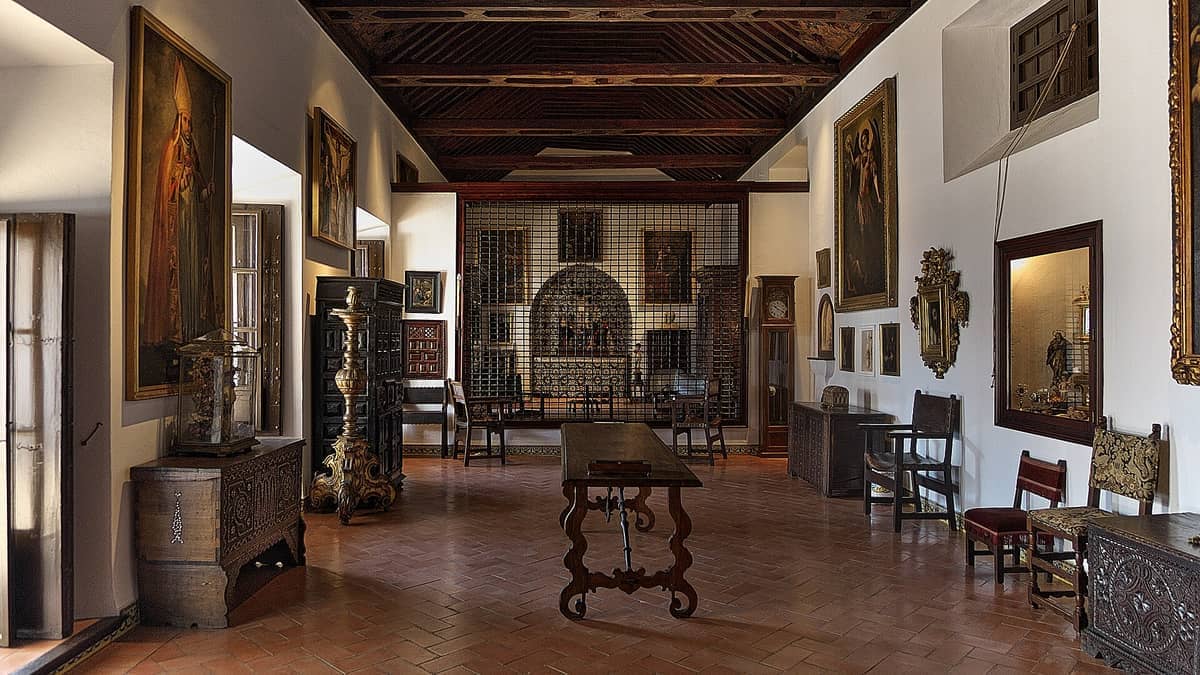
Once through the entrance, visitors move into a sequence of spaces that includes the church interior and the adjoining museum rooms within the cloisters. The church has a single nave with a coffered ceiling and several lateral chapels. It is not as grand as the great parish churches of Seville, but its scale suits the space: intimate enough that you register individual paintings and sculptures without the visual noise of a larger building.
The art collection gathered across the museum rooms includes devotional paintings, carved polychrome figures, silverwork, and religious textiles. Several works belong to the Sevillian school of painting and are attributed to artists active in the 16th and 17th centuries. The lighting in the museum rooms is relatively low, consistent with preservation conditions, so eyes need a moment to adjust when moving between the sunlit courtyard and the interior galleries.
The cloistered courtyard, if accessible during your visit, has the characteristic Sevillian combination of stone columns, terracotta paving, and planted orange trees. In late autumn or winter the scent of orange blossom is absent, but the visual geometry of the arches and the sound of water from a central fountain create a quality of stillness that is increasingly rare to find in the city centre.
If religious architecture and painting are a central interest for your trip, pair this visit with the Iglesia de San Luis de los Franceses, a Baroque church a few streets south that offers a very different but equally rewarding experience. A broader overview of Seville's religious heritage is covered in the guide to the best churches in Seville.
Practical Walkthrough: Timing and Pace
The visit area is not large. Most visitors spend between 45 minutes and an hour and a half inside, depending on how closely they engage with the art collection. There is no audio guide available as a standard offering; information panels in Spanish and sometimes English provide basic context. If you read Spanish, the descriptive labels in the museum rooms carry enough detail to give context to major works.
Crowd levels here are low compared to Seville's main monuments. On a typical Tuesday or Wednesday morning you may share the visit with fewer than ten other people. Saturdays and days coinciding with public holidays or school groups can bring slightly more visitors, but the space never approaches the density you find at the Real Alcázar or the Cathedral. This is one of the quieter paid attractions in the historic centre.
⚠️ What to skip
The convent is a working religious community. Visitors are expected to observe respectful behaviour and dress modestly: covered shoulders and knees are standard practice for entering any active religious building in Seville. Loud conversation and phone calls inside the church or museum rooms are inappropriate.
The building's original 15th-century layout means interior spaces involve steps, uneven stone paving, and narrow doorways. There is no confirmed step-free or wheelchair access route. Visitors with mobility requirements should contact the convent directly before planning a visit, as no official accessibility policy is published on the monastery website.
Seasonal Considerations and Weather
The La Macarena neighbourhood is most comfortable to walk in spring (March to May) and autumn (late September to October), when temperatures in Seville sit between roughly 15°C and 25°C. During July and August, daytime highs regularly exceed 35°C, making the walk from the city centre considerably more taxing. The convent interior, with its thick stone walls, stays noticeably cooler than the street even in summer, which is genuinely welcome.
The morning-only opening window works in your favour in summer: you can visit before the worst heat sets in. In winter, the same window means departing before afternoon, which is less of a constraint since Seville's winters are mild with daytime highs typically around 15–16°C.
If you are visiting during Semana Santa, be aware that La Macarena is one of the most significant neighbourhoods for the processions: the neighbourhood's patron image, the Virgen de la Macarena, processes from the Basílica on Good Friday morning in one of the most attended events of the entire week. Planning any visit to the area during Holy Week requires advance coordination. The Semana Santa guide covers timing and logistics in detail.
Who Should Reconsider This Visit
If your priority in Seville is grand-scale spectacle, the Convento de Santa Paula will feel understated. It does not have the scale of the Cathedral, the garden drama of the Real Alcázar, or the architectural theatrics of the Metropol Parasol. The art collection, while genuine and historically significant, is modest in scope. Visitors expecting a full museum experience with interpretive displays, a café, and a gift shop will find the reality more stripped back.
Children under ten, unless specifically interested in religious settings, are unlikely to find much to engage with here. The limited opening hours also make it logistically inconvenient for travellers on tight morning schedules who have several other morning-only sites to cover.
Travellers building a fuller picture of La Macarena beyond this convent should also look at the neighbourhood guide for La Macarena and consider how the lesser-known corners of Seville connect into a half-day on foot.
Insider Tips
- Arrive at 10:30 when the doors open. On most weekday mornings the first thirty minutes are the least crowded, and the entrance portal light is at its best.
- The nuns of the convent produce and sell preserves and confectionery, a tradition common to Sevillian convents. Check near the entrance for a small sales window where you can buy these products. It is a practical and genuine souvenir.
- The street facade is freely visible at any hour. Even if you decide not to pay entry, walking to Calle Santa Paula to see the ceramic portal up close is worth the detour: it is one of the most intact early Renaissance-Mudéjar facade compositions in the city.
- Combine this visit with the nearby Iglesia de San Marcos or the street market stretch of Calle Feria on a Thursday or Friday morning, when stall density is highest, to make efficient use of a La Macarena morning.
- Closed Mondays for regular visits. Several visitors arrive assuming the convent opens seven days a week as some secondary sources suggest. The municipal tourism listing confirms Monday closure for standard visiting hours, so do not plan this as a Monday activity.
Who Is Convento de Santa Paula For?
- Travellers interested in medieval and early modern religious art who want something beyond the main monuments
- Architecture enthusiasts focused on the Mudéjar-to-Renaissance transition in Andalusia
- Visitors seeking genuine quiet in the historic centre during busy travel periods
- Those exploring La Macarena on foot as a neighbourhood rather than a single-sight destination
- Photographers working with Seville's ornamental ceramic and tile traditions
Nearby Attractions
Other things to see while in La Macarena:
- Alameda de Hércules
Dating to 1574, the Alameda de Hércules is a long tree-lined promenade in Seville's historic centre, anchored by two ancient Roman columns topped with statues of Hercules and Julius Caesar. Free to enter as a public square, it functions as a family park by day and a lively social hub by night.
- Basílica de la Macarena
The Basílica de la Macarena is Seville's most emotionally charged religious site, home to the beloved image of Nuestra Señora de la Esperanza Macarena. Entry to the basilica is free, the attached museum costs €5, and the experience is unlike anything else in Andalusia's religious calendar.
- Calle Feria & El Jueves Market
Every Thursday morning, Calle Feria in the La Macarena district transforms into one of Seville's oldest and most atmospheric street markets. Known locally as El Jueves, it's a free, open-air bazaar of antiques, second-hand curiosities, and neighbourhood life that draws both locals and curious visitors.
- Iglesia de San Luis de los Franceses
Built as a Jesuit novitiate in the early 18th century, the Iglesia de San Luis de los Franceses is among the finest examples of Sevillian Baroque architecture in Andalusia. Managed today by the Diputación de Sevilla, it combines a breathtaking church interior with a restored convent complex, courtyard, and convent complex, all for a modest entrance fee.
Planning a trip? Discover personalized activities with the Nomado app.