Basílica de la Macarena: Seville's Most Revered Shrine
The Basílica de la Macarena is Seville's most emotionally charged religious site, home to the beloved image of Nuestra Señora de la Esperanza Macarena. Entry to the basilica is free, the attached museum costs €5, and the experience is unlike anything else in Andalusia's religious calendar.
Quick Facts
- Location
- Plaza de la Esperanza Macarena 1, 41002 Seville (La Macarena quarter, beside the Puerta de la Macarena)
- Getting There
- TUSSAM city buses serve the Macarena area; the basilica is also walkable from the Casco Antiguo in about 20 minutes
- Time Needed
- 45–90 minutes (basilica + museum)
- Cost
- Basilica: free. Museum (Tesoro): €5 adults, €3 pensioners and ages 7–16, free under 6
- Best for
- Religious heritage, Semana Santa culture, architecture lovers, and anyone curious about Seville's soul
- Official website
- www.hermandaddelamacarena.es
What the Basílica de la Macarena Actually Is
The Basílica de la Macarena is a Roman Catholic basilica in the northern edge of Seville's historic city, formally dedicated to Nuestra Señora de la Esperanza Macarena. That full title matters: this is not simply a church you visit for the architecture. It is the permanent home of one of Spain's most venerated Marian images, a polychrome sculpture of the Virgin Mary whose tearful expression and gilded processional float have defined Seville's Semana Santa for generations.
The basilica sits flush against the ancient Murallas de Sevilla, the Moorish city walls that still stand along the Calle Bécquer side of the complex. The Puerta de la Macarena, one of the best-preserved medieval gates in Spain, is immediately adjacent. That physical pairing, a baroque and neoclassical basilica pressed against 12th-century Islamic military architecture, is itself a compressed history of Seville.
The basilica belongs to and is governed by the Hermandad de la Macarena, one of Seville's most powerful Holy Week brotherhoods. Understanding that relationship is key to understanding the place. The Hermandad is not just a religious confraternity; it is a civic institution with deep roots in the city's identity. For more on how Seville's brotherhoods operate and what Semana Santa looks like from street level, see the guide to Semana Santa in Seville.
ℹ️ Good to know
Opening hours vary slightly by day. Currently, the basilica is generally open daily 09:00–14:00 and 17:00–21:00; Sundays and some holidays may start slightly later in the morning. Hours can shift around liturgical events, so check the official site close to your visit.
The Virgin Herself: What You See Inside
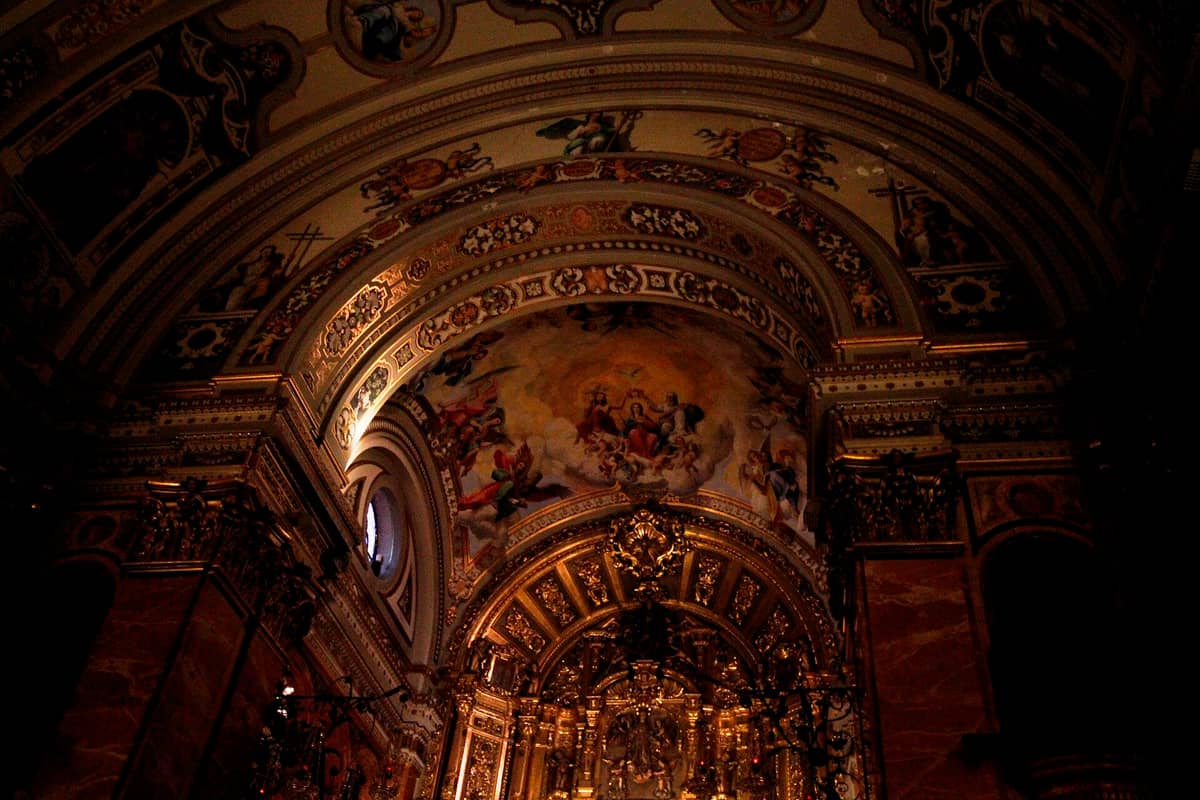
The interior of the basilica is smaller than first-time visitors expect. The building was consecrated in 1949, so it lacks the medieval accretion of age you find in Seville's older churches. The nave is broad and white, its vaulted ceiling decorated with painted panels, the side altars dressed in gilded wood. It feels purposeful rather than overwhelming, a space designed to focus attention on a single thing.
That thing is the image of the Macarena herself, housed in the main retable behind the high altar. The sculpture, attributed to the late 17th century and traditionally said to have been created by the Sevillan sculptor Luisa Roldán (though this attribution remains debated by art historians), shows the Virgin with an expression of grief that Sevillanos describe as heartbreaking in its specificity. Five crystal tears rest on her cheeks. She wears an embroidered mantle, heavily jewelled, and the overall effect in candlelight is one of concentrated, almost theatrical devotion.
Locals come here not as tourists but as faithful. On any given morning you will find elderly women sitting in the front pews in quiet prayer, younger people lighting candles at side altars, and occasional worshippers who have clearly stopped in on a routine basis, greeting the Virgin the way you might greet a known presence. If you visit expecting museum-style detachment, this place will surprise you.
💡 Local tip
Photography inside the basilica is generally tolerated when services are not in progress, but keep the camera quiet and movement respectful. During Mass or novenas, photography is inappropriate. The best light for photographing the retable falls in the late afternoon through the basilica's upper windows.
Tickets & tours
Live prices and dates from our booking partner. If you book, we may earn a commission at no extra cost to you.
Seville Heritage Guided Tour with Macarena Quarter, Moorish Churches and Palaces
From 39 €Instant confirmationFree cancellationGuided tour of the white villages of Andalusia: Ronda, Grazalema and Zahara
From 79 €Instant confirmationFree cancellationSevilla FC Ramon Sanchez-Pizjuan Stadium tour
From 10 €Instant confirmationSevilla Alcazar and cathedral guided tour with priority access tickets
From 59 €Instant confirmationFree cancellation
The Museo del Tesoro: Where the Real Detail Lives
The Tesoro (treasure museum) of the Hermandad de la Macarena occupies a separate section of the complex, entered from the plaza. At €5 for adults, it is one of the better-value museum experiences in Seville, and it is substantially more interesting than the name suggests.
The collection centres on the processional regalia used during Holy Week: the palio (the ornate canopy carried over the Virgin during her procession), the embroidered mantles dating back centuries, the paso (the float platform itself), silver religious objects, and historical records of the brotherhood. The craftsmanship on the embroidered pieces is extraordinary. Some of the silk and gold-thread work represents thousands of hours of labour by Sevillan artisans, and up close you can see that these are objects made with the kind of precision normally associated with jewellery.
There is also a display dedicated to the bullfighter Joselito El Gallo, who died in 1920 and whose funeral was one of the most attended in Seville's history. His connection to the Hermandad de la Macarena, and the fact that the brotherhood still mourns him annually, says something specific about the relationship between popular culture, death, and religious devotion in Andalusia.
How the Experience Changes by Time of Day
Early morning, around 8:30–9:00, the basilica opens to a trickle of locals rather than tourists. The smell of incense from the previous evening's services still hangs faintly in the air. The light is dim and the space feels genuinely contemplative. This is the hour when the place most resembles what it is: a working parish church with a famous resident.
By 11:00 the tourist contingent arrives, particularly in spring and autumn. The plaza outside fills with small tour groups, and inside the pews are occupied by visitors craning to see the retable. The experience remains worthwhile but the devotional atmosphere shifts. Midday is the busiest period and also when the museum queue, if any, is longest.
The evening sessions, particularly from 17:00 onward in winter, are often underused by tourists. The evening light through the upper windows changes the colour of the interior completely, and you are more likely to encounter a scheduled prayer service, which, if you are quiet and respectful, is not an obstacle but an experience in itself. The plaza outside is calmer too, and the adjacent city walls take on a different character in late-afternoon shadow.
💡 Local tip
The basilica closes at 14:00 in the middle of the day before reopening at 17:00. If you arrive at 13:45 expecting a full visit, you will be turned away. Plan for a minimum of one hour, and arrive no later than 13:00 for a morning visit.
Semana Santa: When This Place Becomes the Centre of Seville
During Holy Week, the Basílica de la Macarena transforms from a place of quiet devotion into the focal point of one of the most intense public rituals in Europe. On the early morning of Good Friday, the Macarena Virgin leaves the basilica on her paso and processes through the streets of Seville, accompanied by thousands of costaleros (the bearers who carry the float on their shoulders) and penitents. The route covers several kilometres and the procession can last the entire night. Crowds line the streets from before midnight. For the context and logistics of attending, the Semana Santa guide covers the viewing strategy in detail.
The moment the paso passes through the Puerta de la Macarena at dawn, with the Virgin framed by the ancient gate, is considered by many Sevillanos to be the emotional peak of the entire Holy Week calendar. Whether you are religious or not, the scene carries a genuine charge that is hard to replicate elsewhere. The neighbourhood crowds its balconies and rooftops; people weep openly; the brass band plays a saeta from the street.
If you are visiting during Semana Santa, be aware that the basilica itself has restricted access in the days before and during the procession. The museum may close. Arrive early in Holy Week to see the interior before access tightens.
The Surrounding Quarter and How to Make a Half-Day of It
The La Macarena neighbourhood that surrounds the basilica is one of Seville's most authentic residential districts. It lacks the polished tourism infrastructure of Santa Cruz, which is a reason to spend time here rather than a warning against it. The streets between the basilica and the Calle Feria are lined with local bars, small shops, and markets that operate on a rhythm set by the people who live there, not by visitor footfall.
The stretch of city walls along Calle Bécquer, directly behind the basilica, is among the best-preserved sections of the Murallas de Sevilla. Walking north along the wall toward the Puerta de Córdoba takes about 15 minutes and gives a clear sense of the scale of medieval Seville. The Murallas de Sevilla page covers the full route.
Further into the neighbourhood, the Iglesia de San Luis de los Franceses is a baroque church of exceptional quality that receives a fraction of the visitors it deserves. It is a 10-minute walk from the basilica and makes a logical pairing for anyone interested in Seville's religious architecture.
Practical Information for Your Visit
The basilica is free to enter. The museum costs €5 for adults, €3 for pensioners and visitors aged 7–16, and is free for children under 6 when accompanied by an adult. No advance booking is typically required for either. Payment for the museum is made at the entrance desk.
Getting here without a car is straightforward. TUSSAM city buses serve the Macarena quarter and stop close to the Puerta de la Macarena. From the Cathedral and Santa Cruz, a walk of roughly 20 minutes heading north through the Casco Antiguo brings you directly to the basilica. The route itself passes through interesting streets and is worth doing on foot at least once.
Dress code applies: shoulders and knees should be covered for entry into the basilica. The enforcement varies but the expectation is consistent with all religious sites in Seville. In summer, a light scarf in your bag solves the problem without effort.
Accessibility to the main nave appears to be step-free from the plaza entrance, though comprehensive accessibility data for the museum section is not publicly documented. Visitors with mobility requirements should contact the Hermandad directly via the official site before visiting.
⚠️ What to skip
The basilica and museum close during Holy Week procession periods. If your visit coincides with Semana Santa, check the official site for modified hours. The days immediately before Good Friday often see the interior closed to general visitors.
Insider Tips
- Visit on a weekday morning in October or November, when tourist numbers are low and the neighbourhood feels entirely local. The combination of the basilica, the walls, and a coffee at one of the nearby bars on Calle Feria makes for a genuinely unhurried morning.
- The museum's embroidered mantles are the centrepiece, but look carefully at the silver paso fittings. The detail in the metalwork, made by Sevillan craftspeople, is as fine as anything in the city's secular silversmithing tradition.
- The Puerta de la Macarena immediately beside the basilica is freely accessible and often overlooked by visitors focused on the church. Spend five minutes examining the gate itself: its horseshoe arches and brick coursework are original 12th-century Almohad construction.
- If you are in Seville on the Thursday before Good Friday, the area around the basilica fills from late evening onward with people waiting for the procession to depart. Arriving by 22:00 lets you secure a good position before the serious crowds form after midnight.
- The afternoon closing break (14:00 to 17:00) is genuinely enforced. Plan your day around it rather than assuming you can slip in at 14:10.
Who Is Basílica de la Macarena For?
- Travellers interested in Semana Santa culture and wanting to understand it before or after the event itself
- Anyone exploring Seville's religious architecture beyond the Cathedral circuit
- Visitors who want to see a working-class Sevillan neighbourhood rather than just the tourist centre
- History and craft enthusiasts drawn to embroidery, silverwork, and processional art
- Photographers looking for a combination of baroque interior, medieval walls, and street life in a single visit
Nearby Attractions
Other things to see while in La Macarena:
- Alameda de Hércules
Dating to 1574, the Alameda de Hércules is a long tree-lined promenade in Seville's historic centre, anchored by two ancient Roman columns topped with statues of Hercules and Julius Caesar. Free to enter as a public square, it functions as a family park by day and a lively social hub by night.
- Calle Feria & El Jueves Market
Every Thursday morning, Calle Feria in the La Macarena district transforms into one of Seville's oldest and most atmospheric street markets. Known locally as El Jueves, it's a free, open-air bazaar of antiques, second-hand curiosities, and neighbourhood life that draws both locals and curious visitors.
- Convento de Santa Paula
One of Seville's most atmospheric religious sites, the Convento de Santa Paula is a Hieronymite convent founded in the late 15th century that still houses an active community of nuns. Its small museum preserves an unexpectedly rich collection of religious art, tucked inside a quarter of La Macarena that rewards slow exploration.
- Iglesia de San Luis de los Franceses
Built as a Jesuit novitiate in the early 18th century, the Iglesia de San Luis de los Franceses is among the finest examples of Sevillian Baroque architecture in Andalusia. Managed today by the Diputación de Sevilla, it combines a breathtaking church interior with a restored convent complex, courtyard, and convent complex, all for a modest entrance fee.
Planning a trip? Discover personalized activities with the Nomado app.