Calle Feria & El Jueves Market: Seville's Thursday Antiques Bazaar
Every Thursday morning, Calle Feria in the La Macarena district transforms into one of Seville's oldest and most atmospheric street markets. Known locally as El Jueves, it's a free, open-air bazaar of antiques, second-hand curiosities, and neighbourhood life that draws both locals and curious visitors.
Quick Facts
- Location
- Calle Feria, La Macarena, Seville (41002–41003)
- Getting There
- TUSSAM bus lines to Calle Feria / Alameda de Hércules; no Metro stop directly; walkable from city centre (~20 min)
- Time Needed
- 1–2 hours for the market; longer if exploring the full street
- Cost
- Free entry; bring cash for purchases
- Best for
- Antique hunters, slow travellers, neighbourhood immersion
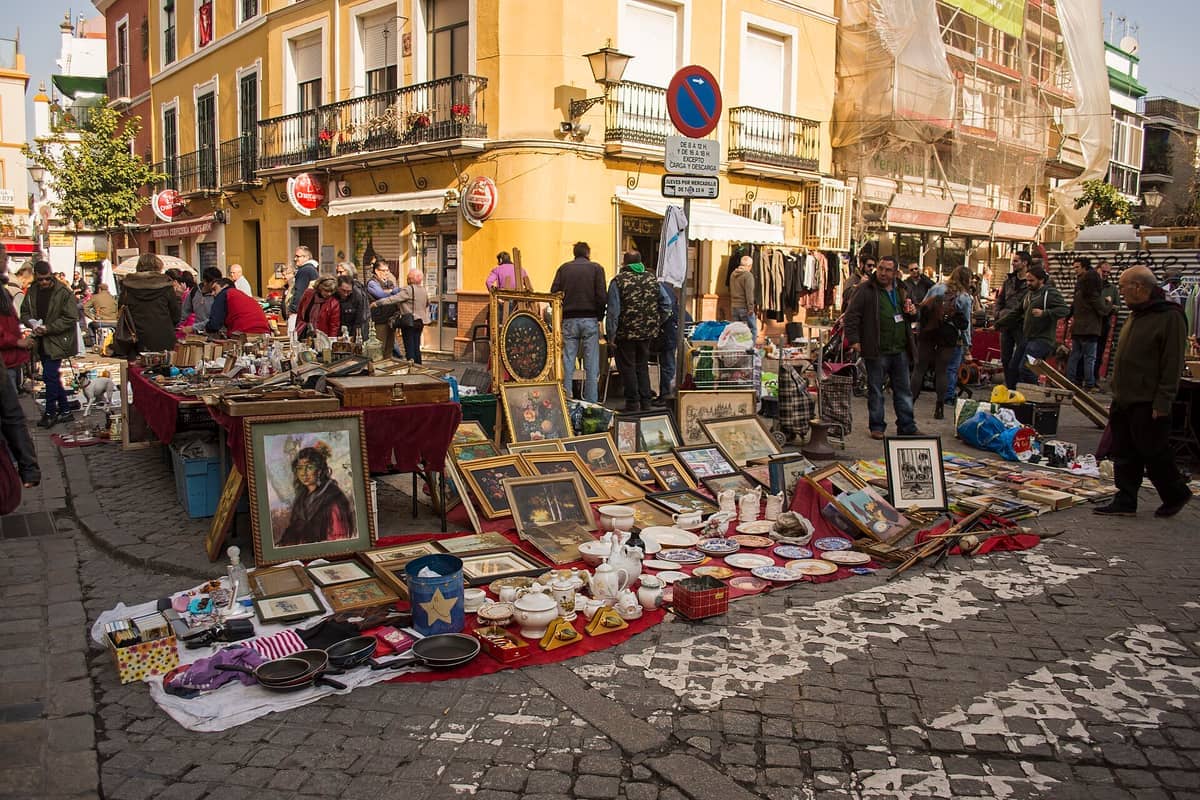
What Is El Jueves and Why Does It Matter?
Calle Feria is one of the longest and most historically layered streets in Seville, cutting through the La Macarena district from south to north. Every Thursday morning, a stretch of this street becomes the Mercadillo El Jueves, a second-hand and antiques market that locals simply call El Jueves, meaning Thursday. The name says it all: this is a market defined by its day, its rhythm, and its refusal to be packaged for tourists.
It is listed officially as the Mercado de Feria on the city's market authority website (mercadosdesevilla.es), but the street market itself is the older, more storied event. Described in various sources as a historic antiques and second-hand bazaar, El Jueves has existed in some form for centuries, though no single verified founding date appears in available records. That longevity is palpable: vendors set up folding tables and blankets on the pavement, piling them with vintage watches, religious prints, mismatched crockery, old coins, Franco-era postcards, vinyl records, and items that defy easy categorisation.
💡 Local tip
Bring cash. Most El Jueves vendors do not accept cards, and there is no ATM in the immediate market stretch. Withdraw euros before you arrive.
The Street Itself: More Than a Market Venue
Even on days other than Thursday, Calle Feria is worth walking. It is a working neighbourhood street with butchers, hardware shops, small bars, and a covered municipal market (the Mercado de Feria, whose stalls are officially listed as open Monday to Saturday, 08:00 to 15:00) that serves the local population rather than visitors. The scale is intimate: narrow pavements, low balconies draped with laundry, and the smell of coffee from bars that open early for construction workers and market stallholders alike.
Calle Feria sits in the La Macarena neighbourhood, the northern quarter of Seville's historic city, and the street runs close to the old city walls. This part of town is less polished than Santa Cruz and less fashionable than the Alameda de Hércules a few blocks away. That is precisely its appeal: it functions as a real urban street, not a heritage attraction.
On a non-Thursday morning, the covered Mercado de Feria draws in local shoppers for fresh produce, fish, and meat from its permanent stalls. The atmosphere is routine and unhurried. On Thursdays, however, the street spills outward, vendors line both sides of the road, and the pace becomes something between a slow browse and a neighbourhood gathering.
Tickets & tours
Live prices and dates from our booking partner. If you book, we may earn a commission at no extra cost to you.
Guided tour of the white villages of Andalusia: Ronda, Grazalema and Zahara
From 79 €Instant confirmationFree cancellationSevilla FC Ramon Sanchez-Pizjuan Stadium tour
From 10 €Instant confirmationSevilla Alcazar and cathedral guided tour with priority access tickets
From 59 €Instant confirmationFree cancellationSevilla Alcazar guided tour with priority access tickets
From 32 €Instant confirmationFree cancellation
What to Expect on a Thursday Morning
El Jueves is generally described as running on Thursday mornings, with official references giving hours roughly between 08:00 and 15:00 every Thursday. In practice, the best merchandise appears early: serious collectors and regular dealers tend to arrive by 08:30 to 09:00, when the stalls are freshest and the light is soft. By 11:00, the market is at full crowd, with a mix of neighbourhood regulars, antique dealers scouting for stock, and visitors who have made the detour specifically for this.
The range of objects on sale is genuinely unpredictable. On any given Thursday you might find: leather-bound books in Spanish from the 1940s, hand-painted ceramic tiles that may or may not be authentic Triana ware, military badges, silver cutlery sold by the piece, old pharmacy bottles, vintage Seville Fair posters, and pocket watches in varying states of repair. Prices are negotiable, and vendors generally expect a polite haggle, not aggressive bargaining.
The quality varies significantly from stall to stall. Some vendors are knowledgeable dealers with specific areas of expertise; others are clearing out household items with no particular curatorial eye. The art is in the browse. If you are looking for authenticated antiques with provenance, this is not the right venue. If you want the experience of finding something unexpected for a few euros, it rarely disappoints.
⚠️ What to skip
El Jueves is a Thursday-only event, except on Jueves Santo (Maundy Thursday), when it does not run. Arriving on any other day means you will find only the covered Mercado de Feria (Monday to Saturday, 08:00–15:00), which is a pleasant local market but not the antiques street market.
How the Experience Changes Through the Morning
Before 09:00, the market has a quiet, preparatory energy. Vendors are still unfolding tables and arranging stock. The street smells of cardboard and old paper, and a few bars are already open serving coffee and tostadas. This is the best time to speak with vendors at length, and occasionally to find an item before it has attracted competition.
Between 10:00 and 12:00, the street reaches its social peak. Conversations overlap: vendors chatting with neighbours, older men discussing a coin's value, a tourist photographing a stack of old magazines. The noise is modest by market standards, more like a large front garden party than a bazaar. Seville's light at this hour, particularly in spring and autumn, is warm and angled, making the objects on display look better than they might deserve.
After 13:00, vendors begin packing up, and the crowd thins. Some stalls disappear entirely. If you arrive late, you will still find activity, but the best pieces are typically long gone. By 15:00 the street has returned to its everyday state. Visiting in summer requires additional planning: by late morning in July or August, temperatures on Calle Feria can exceed 35°C, and there is little shade along the market stretch. Arriving close to opening time is strongly advisable during warm months.
💡 Local tip
Spring and autumn Thursdays offer the most comfortable browsing conditions. October and November mornings on Calle Feria are particularly pleasant, with mild temperatures and lower visitor numbers than in peak season.
Getting There and Navigating the Area
Calle Feria is walkable from the historic centre in around 20 minutes on foot. From the Cathedral or Alameda de Hércules, the walk passes through progressively quieter streets and gives a genuine sense of how Seville transitions from its tourist core into residential La Macarena. TUSSAM urban buses serve the area; the Alameda de Hércules and nearby streets have several stops. There is no Metro de Sevilla station directly serving Calle Feria.
Cycling is a practical option: Seville's bike-share infrastructure extends into La Macarena, and Calle Feria is flat. The street is also close to the Basílica de la Macarena and the surviving section of the old city walls, so a Thursday morning visit can be combined naturally with a walk along the Murallas de Sevilla without adding much distance.
The street address for the Mercado de Feria (the covered market) is Calle Feria, s/n, Sevilla 41003. The open-air El Jueves market extends along the street northward from this point. There is no single entrance or ticket booth; you simply walk in from either end.
El Jueves in the Context of Seville's Market Scene
Seville has a range of markets serving different purposes. The Mercado de Triana is a well-restored covered food market popular with both locals and visitors. The Mercado Lonja del Barranco is a tourist-facing food hall on the riverfront. El Jueves sits at the opposite end of the spectrum from both: it is not particularly photogenic in a curated sense, it does not serve food, and it makes no obvious concession to visitors.
That distinction is what makes it worth seeking out. If you want to understand how a Sevillano neighbourhood actually functions on an ordinary weekday morning, a Thursday on Calle Feria provides more of that than almost any other attraction in the city. The crowd is mixed in age and background, the transactions are mundane and real, and the objects for sale are the accumulated material history of the city rather than souvenirs designed to represent it.
Travellers interested in the broader texture of Seville beyond its major monuments can consult a guide to Seville's lesser-known corners for context on neighbourhoods like La Macarena.
Who May Not Enjoy El Jueves
This is not a market for everyone. Travellers with very limited time who need to prioritise Seville's major monuments will find El Jueves a detour that requires a specific morning commitment. People who dislike rummaging through mixed-quality second-hand goods, or who want guaranteed-quality artisan products, will likely find it underwhelming.
Accessibility along the market stretch can be inconsistent: vendors set up on both sides of the pavement, leaving narrowed walking corridors and occasional uneven surfaces from tables and crates on the ground. No official accessibility audit of the street market is available. The covered Mercado de Feria itself has level entry, but the outdoor market does not maintain controlled pathways.
Insider Tips
- Arrive before 09:30 if you are serious about finding quality pieces. The most knowledgeable dealers arrive early and the best stock moves quickly among traders before the general public arrives.
- The bars along the lower stretch of Calle Feria serve some of the cheapest and most unpretentious breakfast in the city. A coffee and tostada con tomate here costs noticeably less than at the tourist-facing cafés near the Cathedral.
- Prices at El Jueves are generally not fixed. A calm, polite offer slightly below the asking price is standard practice. Very aggressive haggling is considered rude and usually counterproductive.
- The market runs in light rain but vendors begin packing up quickly if a serious shower arrives. Check the forecast before committing Thursday morning to a visit between November and March.
- Combine the visit with a walk north along Calle Feria to the Basílica de la Macarena and the remaining stretch of the medieval city walls. The round trip on foot from the Cathedral to the walls and back typically takes around two to three hours including market time.
Who Is Calle Feria & El Jueves Market For?
- Antique and second-hand collectors looking for unfiltered, authentic finds
- Slow travellers who want neighbourhood immersion over landmark ticking
- Photographers interested in candid street and market scenes
- Budget-conscious visitors: entry is free and browsing costs nothing
- Return visitors to Seville who have already covered the major monuments
Nearby Attractions
Other things to see while in La Macarena:
- Alameda de Hércules
Dating to 1574, the Alameda de Hércules is a long tree-lined promenade in Seville's historic centre, anchored by two ancient Roman columns topped with statues of Hercules and Julius Caesar. Free to enter as a public square, it functions as a family park by day and a lively social hub by night.
- Basílica de la Macarena
The Basílica de la Macarena is Seville's most emotionally charged religious site, home to the beloved image of Nuestra Señora de la Esperanza Macarena. Entry to the basilica is free, the attached museum costs €5, and the experience is unlike anything else in Andalusia's religious calendar.
- Convento de Santa Paula
One of Seville's most atmospheric religious sites, the Convento de Santa Paula is a Hieronymite convent founded in the late 15th century that still houses an active community of nuns. Its small museum preserves an unexpectedly rich collection of religious art, tucked inside a quarter of La Macarena that rewards slow exploration.
- Iglesia de San Luis de los Franceses
Built as a Jesuit novitiate in the early 18th century, the Iglesia de San Luis de los Franceses is among the finest examples of Sevillian Baroque architecture in Andalusia. Managed today by the Diputación de Sevilla, it combines a breathtaking church interior with a restored convent complex, courtyard, and convent complex, all for a modest entrance fee.
Planning a trip? Discover personalized activities with the Nomado app.