Alameda de Hércules: Seville's Oldest Promenade and Its Many Lives
Dating to 1574, the Alameda de Hércules is a long tree-lined promenade in Seville's historic centre, anchored by two ancient Roman columns topped with statues of Hercules and Julius Caesar. Free to enter as a public square, it functions as a family park by day and a lively social hub by night.
Quick Facts
- Location
- Historic centre (Casco Antiguo), Seville (Alameda de Hércules s/n, 41002)
- Getting There
- Walk from Plaza Nueva (approx. 15–20 min northeast) or use TUSSAM bus services toward Pino Montano, getting off near the historic centre and walking to the Alameda
- Time Needed
- 30–60 minutes to walk and absorb; longer if you stop at a terrace bar
- Cost
- Free — open public promenade with unrestricted public access
- Best for
- Evening strollers, architecture lovers, local bar culture, families with children
What Is the Alameda de Hércules?
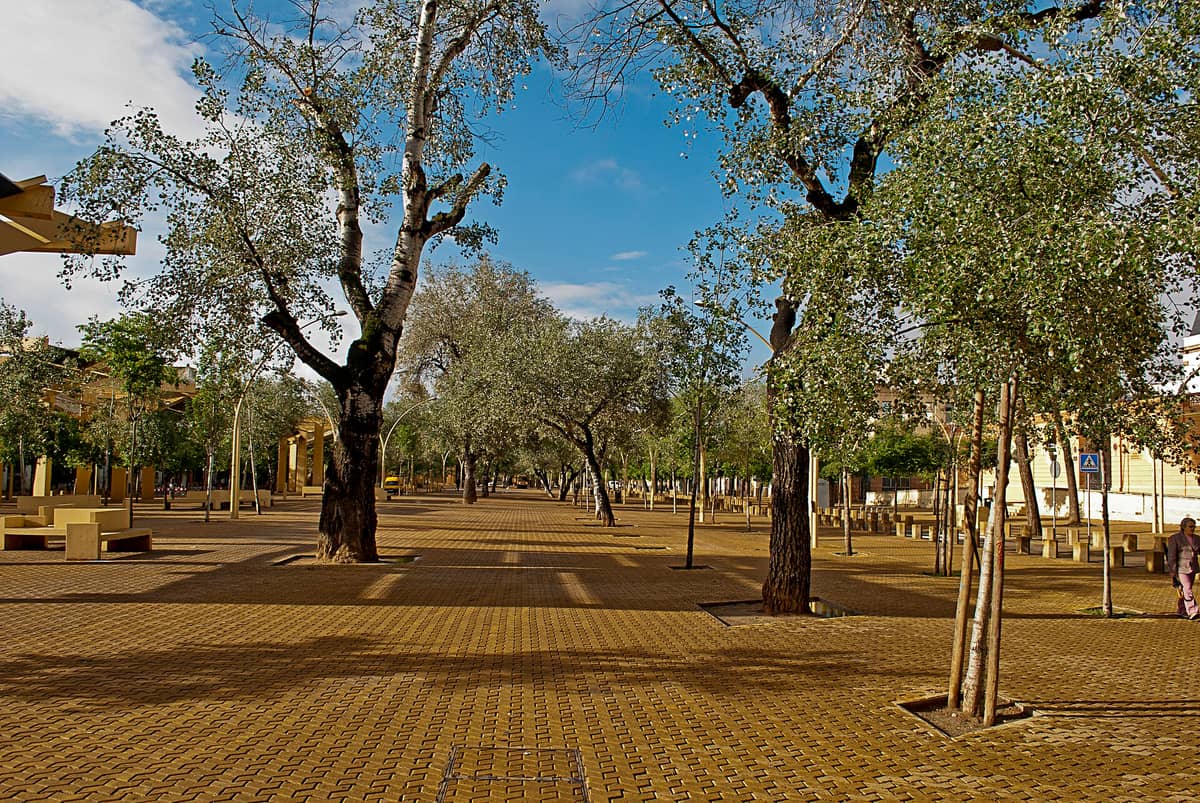
The Alameda de Hércules is a broad, elongated public promenade stretching through Seville's historic centre, roughly 450 metres long and historically flanked by rows of tall poplar trees. Created in 1574 at the direction of Francisco Zapata de Cisneros, Count of Barajas, it is widely recognised as one of the oldest formal public promenades in Spain and in Europe. Its age alone makes it a curiosity. Most European cities did not develop public park culture until the 18th or 19th century; Seville was doing it under Philip II.
The promenade sits in the northern part of Seville's historic core, between Calle Calatrava, Calle Peris Mencheta, Calle Trajano and Calle Amor de Dios. Unlike the cathedral district or the Alcázar, there are no queues, no tickets, and no closing times. What you find depends almost entirely on when you arrive.
💡 Local tip
The Alameda rewards visitors who come twice: once in the late morning when families and dog walkers dominate, and again after 9pm when the terrace bars fill up and the space feels entirely different.
The Roman Columns: Seville's Mythological Anchors
The southern entrance to the promenade is marked by two tall Roman columns, each topped with a statue. One carries Hercules, the mythological founder credited with establishing the city of ancient Híspalis. The other carries Julius Caesar, celebrated as the restorer of that same city. These figures were not placed here as decoration for tourists. They represent a foundational narrative that Sevillanos have maintained for centuries: that their city's origins reach back to antiquity and myth simultaneously.
The columns themselves are genuine Roman stonework, repurposed and elevated when the promenade was laid out in the late 16th century. Standing at the southern end and looking north along the full length of the tree-lined avenue, with these columns framing the view, gives a clear sense of how deliberately theatrical the original design was. The placement was meant to impress, and it still does.
At the northern end of the promenade, two smaller, modern columns echo the classical references of the southern pair, framing the long shaded walk when viewed from end to end. The full colonnade effect, bookending a long shaded walk, is best appreciated in the morning light before the terrace furniture crowds the sightlines.
Tickets & tours
Live prices and dates from our booking partner. If you book, we may earn a commission at no extra cost to you.
Guided tour of the white villages of Andalusia: Ronda, Grazalema and Zahara
From 79 €Instant confirmationFree cancellationSevilla FC Ramon Sanchez-Pizjuan Stadium tour
From 10 €Instant confirmationSevilla Alcazar and cathedral guided tour with priority access tickets
From 59 €Instant confirmationFree cancellationSevilla Alcazar guided tour with priority access tickets
From 32 €Instant confirmationFree cancellation
How the Space Changes Through the Day
In the morning, the Alameda belongs to the neighbourhood. By 8am, the wide central path carries a steady mix of joggers, elderly residents on their daily walk, parents pushing strollers, and café workers setting out chairs. The tall plane trees filter the light, and the air carries the faint smell of damp stone from overnight cleaning. The terrace bars are just opening, and the pace is unhurried.
From midday through late afternoon, particularly in summer, the Alameda quietens noticeably. Seville's heat in July and August often approaches or exceeds 35°C, and even this shaded promenade offers limited relief. The bars stay open, but foot traffic drops. This is the least rewarding time to visit, not because the space is unpleasant, but because the population that gives it energy has retreated indoors.
The real transformation happens from around 7pm. As temperatures ease, residents return in numbers. Children play in the central space while parents occupy the terrace chairs. By 9 or 10pm, the bars along both sides are full. The Alameda has a well-established reputation in Seville's nightlife circuit, particularly among younger locals and the LGBTQ+ community, which has historically claimed this area as a welcoming social space. The noise level rises steadily. By midnight on weekends, the atmosphere is festival-like without being aggressive.
ℹ️ Good to know
In summer, the Alameda hosts outdoor cinema screenings and occasional live events as part of Seville's warm-weather cultural programme. Check the Ayuntamiento de Sevilla's event listings before your visit for current scheduling.
Getting There and Around the Area
The Alameda is about 15–20 minutes on foot from Plaza Nueva, heading northeast through the commercial streets of the historic centre. The route via Calle Sierpes and Calle Cuna is practical and passes through some of Seville's best pedestrian shopping streets. Alternatively, TUSSAM buses toward Pino Montano stop within a short walk of the promenade.
The surrounding streets are worth exploring on foot. Calle Feria runs nearby and hosts one of the city's most authentic street markets every Thursday morning. The Basílica de la Macarena, Seville's most emotionally charged religious site, is a 10-minute walk further north. The neighbourhood as a whole, covered in detail in our La Macarena district guide, offers a noticeably less tourist-concentrated experience than the Santa Cruz quarter to the south.
The promenade itself is flat and paved, following a major renovation between 2006 and 2008 that improved the walking surface and general infrastructure. Wheelchair users and those with pushchairs can move through without difficulty. There are no steps or barriers at the main entrances.
The Bars and Terraces: Part of the Visit, Not an Addition to It
Trying to separate the Alameda from its bar culture is like separating La Boqueria from its food stalls. The terraces lining both long sides of the promenade are not incidental. They are structurally part of how the space functions. Most bars here are independent, neighbourhood-scale operations with plastic chairs on the pavement, cheap draught beer, and no particular interest in attracting tourists.
The drink of choice in the evening is cold beer (una caña) or a glass of local wine. Some bars serve tapas, though the Alameda is less focused on food than on social drinking. Prices are generally lower than in the tourist-heavy areas closer to the cathedral. Expect to pay around 2 euros for a small beer on most terraces.
If you want to combine the Alameda with a broader evening out, Seville's nightlife options extend well beyond this single promenade. Our Seville nightlife guide covers the key areas and what to expect from each.
Historical Context: Why This Promenade Exists at All
When the Alameda was laid out in 1574, the site was reportedly a swamp-prone area of the city linked to former branches or lagoons of the Guadalquivir that flooded regularly. The Count of Barajas ordered the land drained and converted into a formal promenade at a time when Seville was at the peak of its commercial power, thriving from its monopoly on trade with the Americas. The city's population was growing rapidly, and public space for civic life was a genuine need.
The decision to use Roman columns as the promenade's monumental anchors was a deliberate statement of civic identity. Seville under the Spanish Crown positioned itself as the heir to a Roman imperial tradition. The same logic drove the creation of institutions like the Archivo General de Indias and shaped much of the monumental architecture that still defines the city's centre. The Alameda was designed to communicate permanence and prestige to anyone who walked it.
Over the following centuries, the promenade passed through phases of elegance and neglect. It was fashionable in the 17th century, hosted markets and public events in the 18th, declined into a run-down quarter by the late 20th century, and was comprehensively renovated in the 2000s. It now functions as one of the most genuinely mixed public spaces in Seville: architecturally significant, socially inclusive, and entirely local in atmosphere.
Photography, Seasons, and Practical Notes
For photography, the best light falls on the Roman columns in the early morning, when the southern exposure catches low sun and the stone texture is clearly defined. Later in the day, the columns fall into partial shade and the background clutter of café furniture increases. The long tree-lined perspective, shot from the southern entrance looking north, works well in any season, with softer contrasts in autumn when the light is lower.
Spring and autumn are the most comfortable seasons for spending time here. Daytime temperatures in March through May generally range from the high teens into the low- to mid‑20s °C on average, and the trees are in full leaf. October brings similar conditions with the added benefit of lower tourist pressure across the city. For more on seasonal timing, see our best time to visit Seville guide.
⚠️ What to skip
Avoid visiting on very hot summer afternoons. Between roughly 2pm and 7pm in July and August, the Alameda empties out and the terrace bars offer limited shade. The experience is genuinely diminished compared to a morning or evening visit.
There are no formal restroom facilities within the promenade itself. Bar customers typically have access to facilities inside the adjacent establishments. The renovation improved the paving and drainage but did not add public infrastructure of this kind.
Insider Tips
- The Thursday morning flea market on nearby Calle Feria (El Jueves) is one of the oldest street markets in Seville, with medieval origins. Combining it with a morning walk on the Alameda makes for a full half-day in the historic centre without overlapping the standard tourist circuit.
- The northern end of the promenade is consistently less crowded than the southern entrance near the Roman columns. If you want a quieter bench and a clear view of the full length of the avenue, start from the north and walk south.
- Several bars on the Alameda do not appear on major review platforms. The ones with the most local clientele tend to be mid-promenade on the western side. If the chairs are facing inward rather than outward toward the promenade, it is usually a sign the bar is not oriented toward tourists.
- During Semana Santa, the neighbourhood streets around the Alameda carry several of Seville's most important processions. Watching one pass through these narrow residential streets, rather than along the main cathedral route, gives a markedly different and more intimate perspective on the event.
- The renovation completed around 2008 removed decades of accumulated infrastructure from the promenade surface, but also displaced some of the older bar establishments. A handful of the original pre-renovation bars remain and are recognisable by their lack of renovation-era design uniformity.
Who Is Alameda de Hércules For?
- Travellers who want to experience Seville outside the main tourist corridor around the cathedral and Alcázar
- Evening walkers and those interested in authentic local bar culture without tourist pricing
- Architecture and history enthusiasts drawn to Roman column archaeology and 16th-century urban planning
- LGBTQ+ travellers, who have historically found the Alameda to be one of Seville's most consistently welcoming public spaces
- Families looking for a flat, open, free outdoor space where children can move freely while adults sit at terrace bars
Nearby Attractions
Other things to see while in La Macarena:
- Basílica de la Macarena
The Basílica de la Macarena is Seville's most emotionally charged religious site, home to the beloved image of Nuestra Señora de la Esperanza Macarena. Entry to the basilica is free, the attached museum costs €5, and the experience is unlike anything else in Andalusia's religious calendar.
- Calle Feria & El Jueves Market
Every Thursday morning, Calle Feria in the La Macarena district transforms into one of Seville's oldest and most atmospheric street markets. Known locally as El Jueves, it's a free, open-air bazaar of antiques, second-hand curiosities, and neighbourhood life that draws both locals and curious visitors.
- Convento de Santa Paula
One of Seville's most atmospheric religious sites, the Convento de Santa Paula is a Hieronymite convent founded in the late 15th century that still houses an active community of nuns. Its small museum preserves an unexpectedly rich collection of religious art, tucked inside a quarter of La Macarena that rewards slow exploration.
- Iglesia de San Luis de los Franceses
Built as a Jesuit novitiate in the early 18th century, the Iglesia de San Luis de los Franceses is among the finest examples of Sevillian Baroque architecture in Andalusia. Managed today by the Diputación de Sevilla, it combines a breathtaking church interior with a restored convent complex, courtyard, and convent complex, all for a modest entrance fee.
Planning a trip? Discover personalized activities with the Nomado app.