Iglesia de San Luis de los Franceses: Seville's Most Spectacular Baroque Interior
Built as a Jesuit novitiate in the early 18th century, the Iglesia de San Luis de los Franceses is among the finest examples of Sevillian Baroque architecture in Andalusia. Managed today by the Diputación de Sevilla, it combines a breathtaking church interior with a restored convent complex, courtyard, and convent complex, all for a modest entrance fee.
Quick Facts
- Location
- Calle San Luis 37, La Macarena, Seville (Casco Antiguo, 41003)
- Getting There
- 10–15 min walk north from Setas de Sevilla (Metropol Parasol); TUSSAM buses serve the Macarena area. No metro stop nearby.
- Time Needed
- 45–90 minutes (allow longer with audio guide)
- Cost
- General €4; reduced €2 (under 16s, over 65s, students under 25, disabled, unemployed); Seville province residents €1; free Sunday afternoons
- Best for
- Architecture lovers, art history enthusiasts, anyone who finds the main tourist circuit overly crowded
- Official website
- www.dipusevilla.es/sanluisdelosfranceses
Why This Church Deserves Your Attention
Most visitors to Seville work their way through the Cathedral, the Real Alcázar, and Casa de Pilatos, and then wonder what else is worth the walk. The Iglesia de San Luis de los Franceses, on Calle San Luis in the La Macarena district, is a precise answer to that question. It is not especially well known internationally, which means it receives a fraction of the footfall its quality warrants.
The church is an 18th-century Baroque monument of the first order, protected under Spain's highest heritage designation as a Bien de Interés Cultural (BIC). The complex was conceived as a Jesuit novitiate, designed to instill awe in young men entering the Society of Jesus, and every architectural decision was made with that psychological objective in mind. The result is an interior that still produces a visible reaction in first-time visitors, even secular ones with no interest in religious art.
💡 Local tip
Sunday afternoon entry is free for all visitors as part of its BIC heritage status. If your schedule allows, this is the easiest way to avoid paying full price. Arrive shortly after the afternoon opening to avoid any queues.
The Architecture and Interior: What You Are Actually Looking At
The church was designed in the early 18th century and attributed to Leonardo de Figueroa, one of the architects most responsible for the distinctive character of Sevillian Baroque. The facade on Calle San Luis gives a strong first impression: two towers frame a curved entrance bay, and the stonework is dense with decorative carving without tipping into incoherence. It is controlled exuberance, which is a useful phrase for understanding Figueroa's aesthetic approach generally.
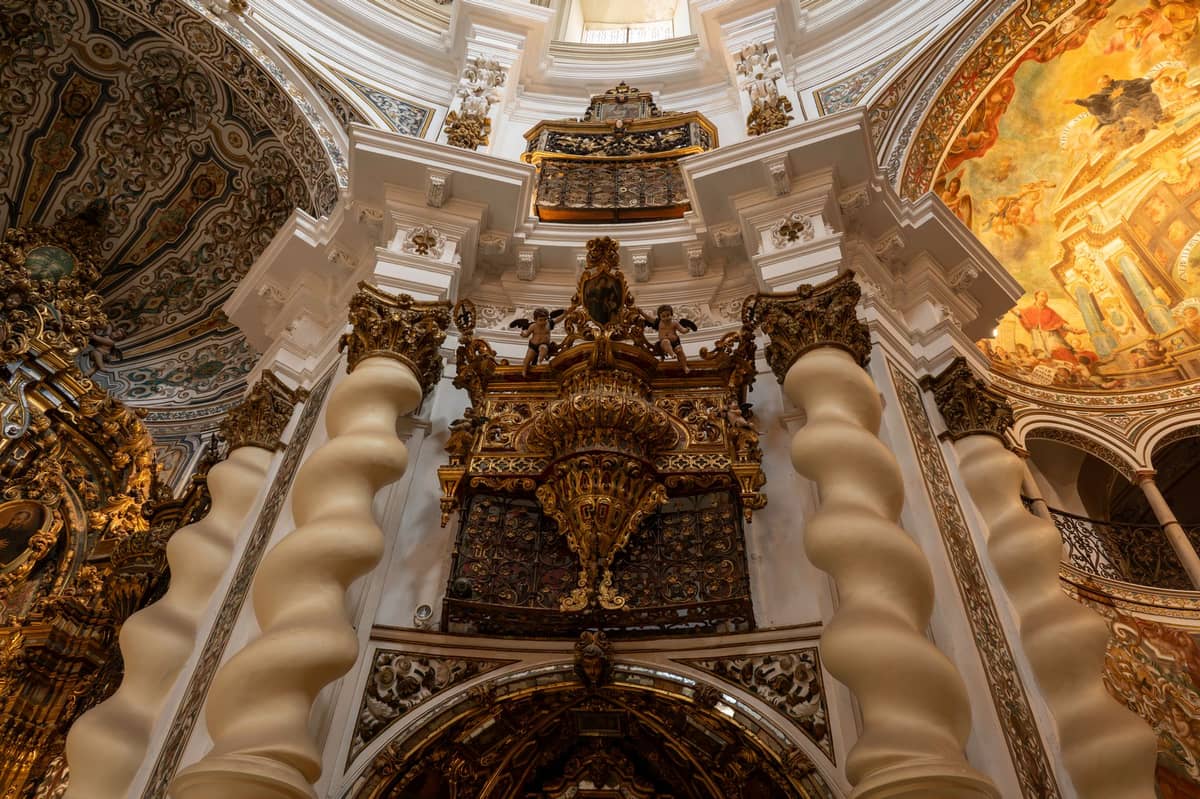
Step through the entrance and the spatial shift is immediate. The plan is an elongated Greek cross topped by a large central dome, with four lateral chapels arranged symmetrically around the crossing. The dome interior carries fresco painting, and the light entering through the lantern and the windows of the drum changes hour by hour. In the morning, the eastern light catches the gilded surfaces of the altarpieces directly. By afternoon, the light becomes more diffuse and the frescoes take on a warmer tone. Both states are worth seeing, but if you have to choose, the morning session is the more dramatic.
The four main altarpieces are the central visual event. They are carved and gilded in the Churrigueresque manner, a Spanish Baroque substyle that takes surface decoration to its logical extreme. The columns twist, cherubs cluster at every cornice, and the overall impression is of ornament so dense it begins to read as texture rather than individual forms. Photography is technically permitted but the interior lighting is challenging: bring a steady hand and expect to work with high ISO settings. Tripods are not practical in the space.
Tickets & tours
Live prices and dates from our booking partner. If you book, we may earn a commission at no extra cost to you.
Guided tour of the Maria Luisa Park and Plaza de Espana
From 12 €Instant confirmationFree cancellationGuided tour of Plaza de Espana and Maria Luisa Park
From 12 €Instant confirmationFree cancellationAlcazar of Cordoba skip-the-line tickets and guided tour
From 19 €Instant confirmationFree cancellationAlcazar of the Christian Monarchs guided tour in Cordoba
From 19 €Instant confirmationFree cancellation
The Novitiate Complex: Beyond the Church
The entrance ticket covers the entire Conjunto Monumental, not just the church nave. The former novitiate buildings wrap around an interior courtyard, and the contrast between the courtyard's calm and the church's intensity is part of what makes a visit here feel complete. The courtyard is arcaded on two levels, the stone worn to a soft grey, with a quiet that the Calle San Luis outside rarely offers. It is the kind of space where you understand why monastic life organized itself around cloistered enclosures.
Upper-floor galleries of the novitiate contain interpretive materials about the history of the complex and the Jesuits in Seville. These rooms also provide elevated views down into the courtyard and, from certain windows, across the rooftops of the Macarena neighborhood toward the city walls. The quality of the interpretation varies, but the spatial experience of moving through these upper levels is worthwhile on its own terms.
ℹ️ Good to know
Audio guides are available in Spanish, English, French, and German for €3. For a building this layered in iconographic detail, the audio guide is a genuine addition rather than a formality: the altarpiece programs are complex and benefit from explanation.
Historical Context: Jesuits, Suppression, and Survival
The Society of Jesus had a complicated history in Seville, as it did throughout Catholic Europe. The novitiate on Calle San Luis was completed in the early 18th century, but the Jesuits were expelled from Spanish territory in 1767 under Charles III, and the complex passed to other uses. This is part of why the building survives as well as it does: it was repurposed rather than demolished, sparing it from the more wholesale destruction that affected some religious properties during later periods of anticlerical legislation in the 19th century.
The name 'de los Franceses' (of the French) reflects the building's subsequent history, when it was used by the French community in Seville during a later period. The Diputación de Sevilla now manages the complex as a cultural monument, which has meant a sustained restoration effort and the conversion of the novitiate spaces into the interpretive site visitors encounter today. The current state of the interior represents the building at probably its best-maintained point in two centuries.
Visiting Practicalities: Hours, Access, and the Surrounding Area
Standard opening hours are Tuesday to Sunday, 10:00 to 14:00 and 16:00 to 20:00, with Monday closed. From 1 July to 31 August, hours shift to 09:00 to 17:00 daily, but these summer hours should be confirmed before visiting as they can change between seasons. The split afternoon schedule means the post-siesta slot, from 16:00 onward, tends to be quieter than the late-morning slot, when any walking tour groups are most likely to pass through.
The church sits on Calle San Luis, which runs north from the Alameda de Hércules toward the old city walls. From the Setas de Sevilla (Metropol Parasol), the walk takes roughly 10 to 15 minutes heading northeast. The street itself is worth walking slowly: it passes several other churches and convents that characterize the Macarena district's density of religious architecture. Dress modestly for entry, meaning covered shoulders and no beachwear, as staff do enforce basic dress standards.
For visitors with mobility concerns, the specific accessibility provisions of the complex are not fully detailed in published materials. The Diputación de Sevilla can be contacted directly at +34 610 10 08 79 or at sanluis_visitas@dipusevilla.es before your visit. The La Macarena neighborhood has uneven pavements in parts, which is worth noting if mobility is a consideration.
⚠️ What to skip
The complex occasionally closes individual spaces for maintenance or private events, reducing the available area. In these cases a partial-entry ticket at €2 is offered. If a full visit is essential to your plans, call ahead or check current information with the Diputación.
Fitting San Luis into a Wider Day in Macarena
The church makes most sense when combined with other stops in the northern historic city rather than treated as a detour from the main tourist core. The Basílica de la Macarena is a 15-minute walk north and represents an entirely different register of religious architecture and popular devotion: less formally Baroque, more emotionally charged with its cult of the Virgen de la Macarena. Combining both in a half-day gives a more complete picture of how religious culture has shaped this part of Seville.
To the south, the Alameda de Hércules provides a natural endpoint for the walk: a long tree-lined promenade with bars and cafes that functions as a neighborhood meeting point from late afternoon onward. It is a good place to decompress after the concentrated visual experience of San Luis. The Iglesia de San Salvador, further south toward the city center, offers another high-quality Baroque interior for comparison, though it operates under different management and admission terms.
If the Macarena area is new to you, the Calle Feria market street and the old city walls along the Avenida de la Macarena reward a longer exploration. This part of Seville has a more residential character than Santa Cruz or the area around the Cathedral, and the atmosphere is noticeably different: fewer souvenir shops, more local bars, and the kind of street life that reflects how Sevillians actually live rather than how tourism has shaped certain central zones.
Who Should Skip This Attraction
If religious Baroque architecture leaves you cold, or if highly decorated interiors produce visual fatigue rather than pleasure, San Luis is not the place to push through. Unlike the Seville Cathedral, which contains a broader range of artwork across different periods, San Luis is intensely focused in its aesthetic: it is Baroque ornament at near-maximum density, and that is either compelling or overwhelming depending on your taste.
Visitors with very limited time in Seville, say one full day, are probably better served prioritizing the Cathedral and Real Alcázar, which cover more ground in terms of historical periods and scale. San Luis rewards visitors who have already done the main circuit and want something more specific, or who are traveling specifically to understand Andalusian Baroque in depth.
Insider Tips
- The morning light entering the dome's eastern windows between roughly 10:30 and 12:00 produces the most dramatic illumination of the gilded altarpieces. If you care about how the space looks, aim for mid-morning on a clear day.
- Sunday afternoon free entry is official policy under BIC heritage rules, not a promotional offer.
- The upper-floor novitiate galleries are often skipped by visitors who spend all their time in the church nave. The elevated courtyard views and the quieter atmosphere up there are worth the extra few minutes.
- Calle San Luis becomes noticeably quieter during the August summer shift in hours. The 09:00 opening means you can arrive before the heat of the day builds, which matters more here than at air-conditioned larger museums.
- The audio guide is worth taking in English even if your Spanish is reasonable: the iconographic program of the altarpieces is specific enough that casual reading of the images misses most of what is going on.
Who Is Iglesia de San Luis de los Franceses For?
- Architecture enthusiasts with a specific interest in Spanish Baroque and the work of Leonardo de Figueroa
- Travelers on a second or third visit to Seville who have already covered the main monuments
- Anyone following a Baroque church trail through the city, pairing San Luis with San Salvador and the Magdalena church
- Budget-conscious visitors who can time a Sunday afternoon visit for free entry
- Photographers looking for a dramatic interior with fewer crowds than the Cathedral
Nearby Attractions
Other things to see while in La Macarena:
- Alameda de Hércules
Dating to 1574, the Alameda de Hércules is a long tree-lined promenade in Seville's historic centre, anchored by two ancient Roman columns topped with statues of Hercules and Julius Caesar. Free to enter as a public square, it functions as a family park by day and a lively social hub by night.
- Basílica de la Macarena
The Basílica de la Macarena is Seville's most emotionally charged religious site, home to the beloved image of Nuestra Señora de la Esperanza Macarena. Entry to the basilica is free, the attached museum costs €5, and the experience is unlike anything else in Andalusia's religious calendar.
- Calle Feria & El Jueves Market
Every Thursday morning, Calle Feria in the La Macarena district transforms into one of Seville's oldest and most atmospheric street markets. Known locally as El Jueves, it's a free, open-air bazaar of antiques, second-hand curiosities, and neighbourhood life that draws both locals and curious visitors.
- Convento de Santa Paula
One of Seville's most atmospheric religious sites, the Convento de Santa Paula is a Hieronymite convent founded in the late 15th century that still houses an active community of nuns. Its small museum preserves an unexpectedly rich collection of religious art, tucked inside a quarter of La Macarena that rewards slow exploration.
Planning a trip? Discover personalized activities with the Nomado app.