Torre del Oro: Seville's Golden Tower on the Guadalquivir
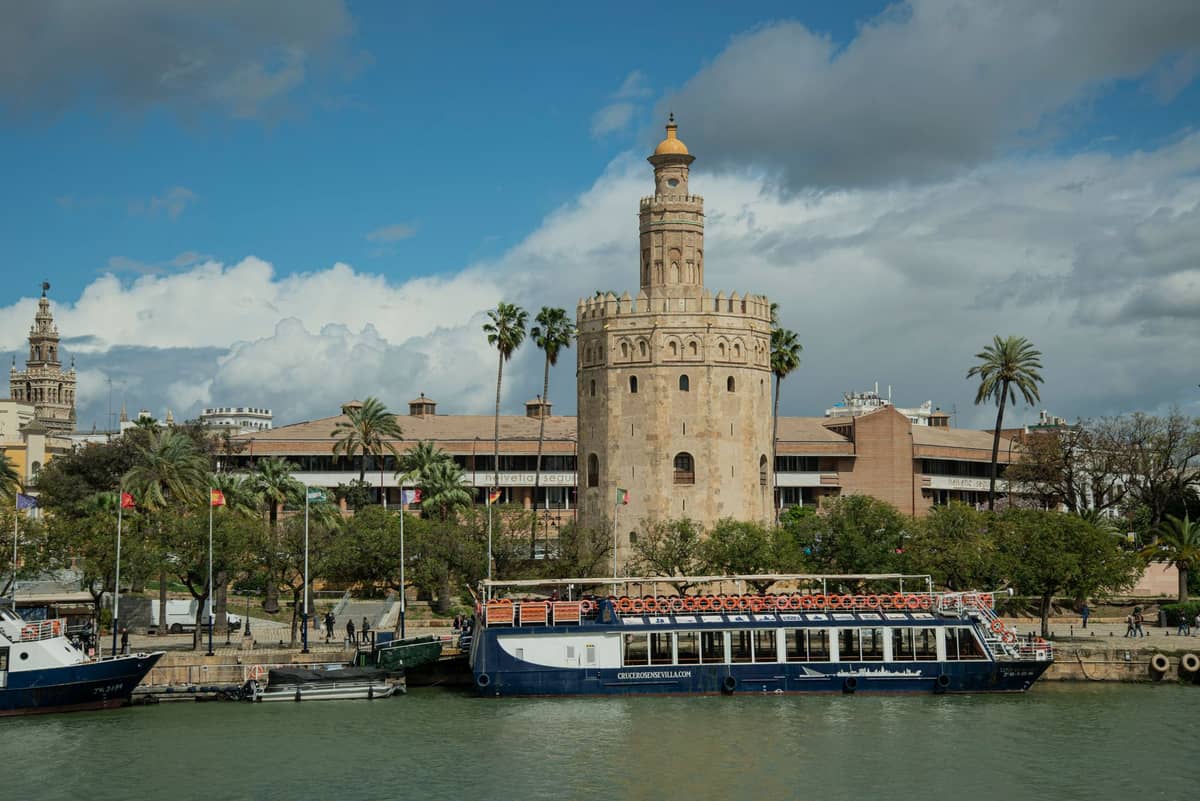
Standing 36 metres tall on the bank of the Guadalquivir River, the Torre del Oro is one of Seville's most photographed landmarks. Built around 1220–1221 as a military watchtower, it now houses a small naval museum and offers some of the most dramatic riverfront views in Andalusia. Admission costs just €3, with €1.50 concessions, making it one of the best-value monuments in the city.
Quick Facts
- Location
- Paseo de Cristóbal Colón, s/n, El Arenal, Seville
- Getting There
- 10–12-minute walk from Plaza Nueva in the historic centre; nearest tram stop Puerta de Jerez (MetroCentro line)
- Time Needed
- 45 minutes to 1 hour
- Cost
- €3 general; €1.50 students and seniors; free on Mondays (visitor day)
- Best for
- History lovers, photographers, solo travellers, first-time visitors to Seville
- Official website
- www.torredelorosevilla.com/en
What Is the Torre del Oro?
The Torre del Oro (Golden Tower) is a 13th-century military watchtower on the western edge of Seville's El Arenal neighbourhood, looking directly across the Guadalquivir River toward the district of Triana. Built around 1220–1221 during the Almohad period, it served as part of the city's defensive perimeter, popularly said to have helped control river access with a chain stretched from the tower to the opposite bank. At about 36 metres tall, the tower is not enormous by cathedral standards, but its position right at the water's edge gives it an outsized presence in Seville's skyline.
Today it functions as a maritime museum, the Museo Marítimo de la Torre del Oro, with three floors of exhibits covering Seville's long relationship with seafaring, the Age of Discovery, and the river that made it one of the wealthiest cities in 16th-century Europe. The museum is modest in scale but well-curated, and the climb to the upper terrace rewards visitors with an unobstructed view along both banks of the Guadalquivir.
💡 Local tip
Monday admission is free. The tower sees noticeably lighter crowds on weekday mornings, making 09:30–11:00 the sweet spot for both short queues and soft morning light on the exterior.
The Setting: El Arenal and the Guadalquivir Riverfront
The tower anchors the southern end of the El Arenal neighbourhood, a strip of historic Seville that includes the city's bullring and a stretch of riverside promenade. The Paseo de Cristóbal Colón, the broad avenue running along the river, is one of the more pleasant walking corridors in Seville: wide pavements, a constant breeze off the water, horse-drawn carriages passing at intervals, and the tower sitting at the end of the sightline like a punctuation mark.
From the riverbank in front of the tower, the view across to Triana is one of the classic Seville panoramas: the white-and-terracotta facades of the opposite bank, the Puente de Triana (Isabel II bridge) to the north, and small tourist boats moving slowly on the brown water below. This is a scene that looks different at every hour. At dawn it is almost completely still. By mid-morning the cyclists and joggers arrive. At golden hour before sunset the light turns the tower's stonework a warm ochre, and the name suddenly feels less like historical metaphor and more like a literal description.
Tickets & tours
Live prices and dates from our booking partner. If you book, we may earn a commission at no extra cost to you.
Seville Archive of Indies, Torre del Oro and Salvador Church tour
From 16 €Instant confirmationFree cancellationCaminito del Rey trekking tour from Seville
From 99 €Instant confirmationFree cancellationGuided tour of the white villages of Andalusia: Ronda, Grazalema and Zahara
From 79 €Instant confirmationFree cancellationSevilla FC Ramon Sanchez-Pizjuan Stadium tour
From 10 €Instant confirmation
History and Architecture: Why This Tower Matters
The Torre del Oro was constructed by the Almohad governor of Seville, and it formed the southern terminus of the city walls. Its distinctive twelve-sided prismatic base, topped by a smaller twelve-sided section and a circular turret added in the 18th century, makes it structurally unusual among Spanish medieval towers. The name may derive from the glazed golden tiles that once covered the exterior, though some historians have linked it to the gold from the Americas that was once stored within its walls after Seville became the sole port authorised for New World trade in the 16th century.
The tower survived Seville's various changes of rule, was used at different points as a prison and a chapel, and was nearly demolished in the 19th century before preservationists intervened. The current turret on top is a baroque addition dating to 1760, giving the structure a layered architectural history that spans roughly 800 years.
For travellers interested in understanding Seville's medieval fortifications more broadly, the surviving sections of the city walls are worth seeking out alongside the tower. The Murallas de Sevilla once enclosed the entire city, and fragments of them remain in the La Macarena neighbourhood.
Inside the Museum: What to Expect on Each Floor
The ground floor introduces the tower's history and architectural evolution. Wall panels are available in Spanish and English, and a scale model shows how the tower related to Seville's broader defensive network. The stone walls here are thick enough to muffle the street noise entirely, and the interior stays noticeably cool even in summer.
The middle floor is dedicated to Seville's naval heritage, with maps, navigational instruments, ship models, and documents tracing the city's role as the gateway for Spanish expeditions to the Americas. The collection is not exhaustive, but there are some genuinely striking pieces: old portolan charts, astrolabes, and replica armour. For anyone with a prior interest in the Age of Exploration, this floor is the most rewarding part of the visit.
The upper terrace is the payoff. The view from the top takes in the Guadalquivir in both directions, the outline of the Real Alcázar and the cathedral tower to the east, and the low terracotta rooflines of El Arenal below. There is no café, no gift shop, and no elaborate infrastructure. It is simply a tower top with a good view, which is exactly what it should be.
ℹ️ Good to know
The tower is not fully adapted for people with reduced mobility. The internal staircase is narrow and steep in places. Visitors with mobility limitations should factor this in before planning the visit.
Best Time to Visit and What to Bring
The Torre del Oro is open Monday to Friday from 09:30 to 18:45, and on weekends from 10:30 to 18:45. It is closed on national and local public holidays. Monday admission is free (visitor day), which draws slightly larger crowds than a typical paid Monday, but nothing unmanageable. Midweek mornings between 09:30 and 11:00 are the quietest windows.
In summer, the interior stays cooler than outside, but the upper terrace gets full sun and can feel oppressive above 35°C. Visiting before 11:00 or after 17:00 in July and August makes a meaningful difference in comfort. In spring and autumn, the tower is pleasant at almost any hour, and the riverside promenade outside is at its most agreeable in the 14–22°C range that characterises those seasons.
Photography from the riverbank in front of the tower is best in late afternoon, when the sun comes from the west and catches the tower's western face. For wider context on Seville's best photo spots, this guide to Seville's best viewpoints covers several options in the same part of the city.
⚠️ What to skip
The tower closes on public holidays, including local Sevillian holidays that may not appear on standard European calendars. Check the official website or museum information before visiting during April (Semana Santa and Feria week) or other festival periods.
How to Get There
The tower sits on Paseo de Cristóbal Colón, directly on the riverfront. From the historic centre, it is roughly a 10-minute walk southwest from the cathedral. From Plaza Nueva, the MetroCentro tram runs to Puerta de Jerez, which is a 5-minute walk from the tower along the river. TUSSAM city buses serve the Paseo de Cristóbal Colón corridor. Taxis and ride-hailing services (including Uber and Cabify, which both operate in Seville) can drop you directly outside.
The riverside promenade is wide and flat, making the approach from either direction easy on foot. Cycling is also straightforward: Seville has one of Spain's most developed urban cycling networks, and the riverbank path runs continuously past the tower.
If you are combining the visit with other sights in the area, the Real Maestranza bullring is a five-minute walk north, and the Mercado Lonja del Barranco food market is just beyond it on the same riverbank stretch.
Honest Assessment: Is It Worth Your Time?
At €3, the Torre del Oro is one of the least expensive monuments in Seville and one of the most immediately recognisable. The museum inside is small and will not detain a casual visitor for more than 30 minutes, but it provides enough historical grounding to make the exterior view more meaningful. Travellers who want a grand museum experience should look elsewhere: the naval exhibits are interesting rather than spectacular.
What the tower does exceptionally well is place you physically in the landscape of medieval and colonial Seville. Standing on the terrace, looking at the curve of the Guadalquivir and thinking about the fleets that once passed below, the history of the city becomes legible in a way that standing in a square does not quite achieve. For that reason, it earns its place on a first visit to Seville, particularly for travellers who care about how a city arrived at what it looks like today.
Travellers with very limited time who must choose between the tower and Seville's major monuments should note that the Seville Cathedral and the Real Alcázar both offer significantly deeper historical experiences. The Torre del Oro works best as a complementary visit on the same day, not as a standalone destination for a short trip.
Insider Tips
- The best exterior photograph of the tower is taken from the Triana side of the river, looking back across the Guadalquivir toward El Arenal. Walk over the Puente de Triana and turn left along the opposite bank for a clear, unobstructed angle.
- Free Monday admission is noted on the official website, but a prior reservation is required due to limited capacity; the ticket queue is still shorter at opening time (09:30) than at midday. Arriving at opening also gives you the top terrace nearly to yourself.
- The tower's phone number is 954 222 419 if you need to confirm holiday closures, which are not always listed clearly on third-party booking platforms.
- The riverside bench directly in front of the tower is one of the few spots in central Seville with a westward river view, making it an excellent place to sit at sunset without entering any paid attraction.
- Boat tours of the Guadalquivir depart from the pier adjacent to the tower. If you want a different perspective on the city, booking a one-hour river tour from this point typically includes a close pass under or alongside the Torre del Oro from the water.
Who Is Torre del Oro For?
- First-time visitors to Seville wanting a quick orientation to the city's riverside history
- History and architecture enthusiasts with an interest in medieval Andalusia or the Age of Exploration
- Photographers looking for golden-hour riverside shots
- Budget travellers: at €3, or free on Mondays, it delivers strong value
- Travellers combining a half-day walk through El Arenal with the bullring and river market
Nearby Attractions
Other things to see while in El Arenal:
- Iglesia de la Magdalena
The Real Parroquia de Santa María Magdalena stands as one of Seville's great Baroque achievements, a richly decorated 18th-century church tucked into the El Arenal district just minutes from Plaza Nueva. Entry is free, crowds are thin, and the interior rewards anyone who takes the time to look up.
- Mercado Lonja del Barranco
Housed in a 19th-century iron fish market beside the Guadalquivir, Mercado Lonja del Barranco brings together over 20 food and drink stalls under one beautifully restored roof. Entry is free, the hours run late, and the location next to the Triana Bridge makes it one of the most atmospheric food stops in central Seville.
- Museo de Bellas Artes de Sevilla
The Museo de Bellas Artes de Sevilla holds one of Spain's finest collections of Golden Age painting, housed in a former Baroque convent at Plaza del Museo. Admission is just €1.50 for non‑EU visitors, and EU citizens enter free. Here is everything you need to visit well.
- Real Maestranza de Caballería de Sevilla (Bullring)
The Real Maestranza de Caballería de Sevilla is one of the oldest and most architecturally significant bullrings in Spain, standing on the Guadalquivir riverfront since the 18th century. Whether you follow bullfighting or not, the arena offers a serious window into Andalusian history, art, and civic identity. This guide covers the visit in honest detail.
Planning a trip? Discover personalized activities with the Nomado app.