Museo del Baile Flamenco: Seville's Living Tribute to Flamenco Dance
Founded by celebrated Sevillian dancer Cristina Hoyos, the Museo del Baile Flamenco occupies a restored historic palace in Seville’s historic center, near the Cathedral. It combines interactive exhibitions on flamenco's history and culture with nightly live performances, making it one of the most purposeful cultural stops in Andalusia's capital.
Quick Facts
- Location
- Calle Manuel Rojas Marcos 3, 41004 Seville
- Getting There
- Short walk from Plaza Nueva tram stop and Avenida de la Constitución bus stops
- Time Needed
- 1–1.5 hrs for museum; add ~1 hr for the evening show
- Cost
- Currently Museum: €10 adults / Show: €25 adults / Combined: €29 adults (verify prices before visiting)
- Best for
- Flamenco enthusiasts, culture seekers, first-time visitors to Seville
- Official website
- museodelbaileflamenco.com
What Is the Museo del Baile Flamenco?
The Museo del Baile Flamenco Cristina Hoyos, to use its full official name, is the only museum in the world devoted exclusively to flamenco as a dance form. It sits at Calle Manuel Rojas Marcos 3, tucked inside a quietly restored 18th-century palace in Seville's Barrio de Santa Cruz. The building itself is part of the experience: whitewashed walls, a central courtyard open to the sky, and stone staircases that predate the art form the museum celebrates.
The museum was founded by Cristina Hoyos, a Sevillian dancer widely regarded as one of the defining figures of 20th-century flamenco. Her stated aim was not to freeze flamenco in a cabinet of curiosities, but to give it a physical home where its evolution could be traced and its living presence felt. The result is a four-floor institution that moves between archive and performance space without feeling like either.
Flamenco was granted UNESCO Intangible Cultural Heritage of Humanity status in 2010, recognition that validated what Sevillians had long argued: this is not entertainment, it is culture with deep roots in the Romani, Moorish, and Andalusian Jewish communities that shaped southern Spain over centuries. The museum places that history front and center. For visitors who have already booked a show at a tablao, the museum provides the context that transforms a performance from spectacle into something more legible. For a broader look at Seville's performing arts scene, the Seville flamenco guide covers tablaos, classes, and free performances across the city.
Inside the Museum: What You Actually See
The permanent exhibition is spread across four floors and organized thematically rather than strictly chronologically, which keeps the experience from feeling like a textbook. The ground floor and courtyard introduce the fundamentals: what flamenco is, where it came from, and how its three core elements (cante, toque, and baile, meaning song, guitar, and dance) interrelate. Interactive panels are available in Spanish and English, and the audiovisual material is well-produced rather than the dusty screen installations common in underfunded cultural spaces.
Upper floors carry the visual weight of the collection. Costumes from major performances fill glass cases, and the craftsmanship is striking even to visitors with no prior interest in fashion: the handwork on the bata de cola (the long-trained skirt) dresses alone justifies pausing. Photographs document performances from the mid-20th century onward, and short video loops show the footwork patterns of different palos, the distinct rhythmic forms within flamenco. Soleá, bulerías, siguiriyas: the museum maps these not as abstract terminology but as living expressions with different emotional registers.
💡 Local tip
Start on the upper floors immediately after entry and work your way down. Most visitors instinctively descend, which means the upper rooms are quieter early in your visit, giving you more time with the costumes and photography without crowds pressing in.
The building's central courtyard is used for the evening shows and occasionally for smaller daytime events. Even when empty, it has the quality of a stage waiting for something to happen. The acoustics, shaped by stone walls and a rectangular open roof, explain why the space was chosen: sound carries with unusual clarity.
Tickets & tours
Live prices and dates from our booking partner. If you book, we may earn a commission at no extra cost to you.
Live flamenco show and entrance tickets to Seville Flamenco Dance Museum
From 29 €Instant confirmationFree cancellation'Flamenco Dreams Show' at Seville Flamenco Dance Museum
From 25 €Instant confirmationFree cancellationSeville Evening Tour Discovering Tapas and Flamenco
From 109 €Instant confirmationFree cancellationSeville Archive of Indies, Torre del Oro and Salvador Church tour
From 16 €Instant confirmationFree cancellation
The Evening Show: Sueños Flamencos
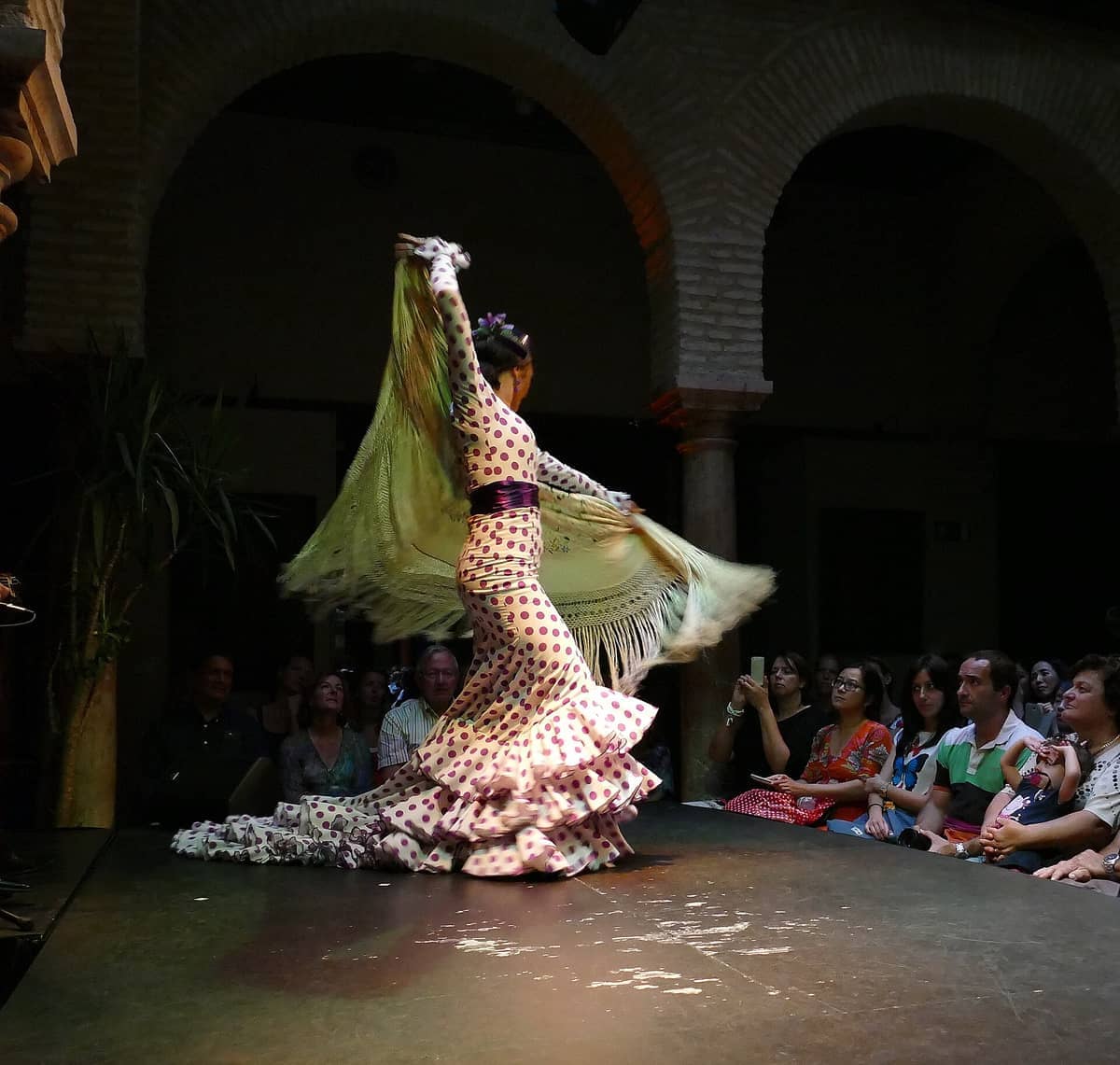
The museum's nightly performance, titled Sueños Flamencos, runs approximately one hour and takes place in the courtyard. The format is intimate: seating is arranged close to the performers, and the absence of a raised proscenium stage means you are watching flamenco at near eye-level. The sound of footwork on stone, the scrape of a chair used as a prop, the precise moment a singer's voice cracks under the weight of a siguiriya: none of this is muffled by theatrical distance.
Ticket prices for the show are €25 for adults, with reduced rates of €18 for students and visitors with disabilities, and €12 for children aged 6 to 12. A combined museum and show ticket costs €29 for adults, with corresponding reduced and child rates, which represents straightforward value if you plan to do both on the same day. Show times vary by date and season, so checking the official site before visiting is essential. Booking in advance is advisable, particularly between March and June and in September and October when tourism in Seville is at its most concentrated.
⚠️ What to skip
The courtyard show is open-air. On cooler winter evenings (November through February, when temperatures in Seville can drop to around 8–12°C at night), bring an extra layer. The museum does not provide blankets or heating in the courtyard.
Visiting Hours, Prices, and Practical Details
The museum is open every day of the year, including public holidays. Museum visiting hours are 11:00 to 18:45, with last entry at 18:00. The exception is the first Monday of each month, when the museum opens at 14:30 due to maintenance work. Museum-only admission is currently €10 for adults, €8 reduced (students and visitors with disabilities), and €6 for children aged 6 to 12. Children under 6 enter free. All prices should be verified on the official site before your visit, as admission fees are subject to change.
The museum is fully accessible for wheelchair users and visitors with reduced mobility. Elevator access serves all four floors, and a special reduced tariff applies for visitors with disabilities. For accessible activity inquiries, the museum can be contacted at comunicacion@museoflamenco.com.
The building is about a 5 to 10 minute walk from Plaza Nueva, the main tram terminus, and from the bus stops along Avenida de la Constitución. From the Seville Cathedral and the Giralda, it is about five minutes on foot through the narrow streets of the historic center. There is no dedicated parking nearby, and the surrounding medieval street grid makes this an entirely pedestrian experience by default.
Best Time to Visit and How the Experience Changes
Timing your visit to the museum affects the experience more than most indoor cultural spaces. Mornings between 11:00 and 13:00 are the quietest window, especially on weekdays in winter. The Santa Cruz neighborhood draws heavy foot traffic through the summer months, and the museum fills accordingly in the afternoons. If you are visiting Seville in spring, the weeks surrounding Semana Santa and the Feria de Abril bring the city to unusual intensity, which is worth understanding: the Semana Santa guide covers timing and crowds in detail.
Summer in Seville, particularly July and August, produces daytime highs that regularly exceed 37°C. The museum's interior offers air-conditioned relief, which makes it a logical anchor point for a mid-afternoon pause. If you are planning a summer trip and organizing your days around the heat, the guide to visiting Seville in summer has practical strategies for managing the temperature.
For the evening show, the courtyard setting means the experience is at its most atmospheric between late spring and early autumn, when the air is warm enough to sit outside comfortably without a jacket and the sky above the open roof holds the last light of a long Andalusian evening. Arrive 15 to 20 minutes before the show begins to find good seats, as there is no reserved seating within the general admission category.
Cultural Context: Why This Museum Exists Here
Seville's claim on flamenco is not exclusive, but it is foundational. The art form developed across Andalusia, drawing on the musical cultures of communities that have lived in the region for centuries, but Seville produced some of its most important practitioners and remains the city most associated with its continuation. The Triana neighborhood across the Guadalquivir has a specific historical association with flamenco, and the tradition of the peña flamenca, the private club where flamenco is practiced and debated among insiders, remains alive in the city.
Against that background, a museum dedicated to flamenco dance in particular, rather than flamenco in general, makes a specific argument: that the body in motion is the central text. The museum does not compete with a live tablao show, but it prepares you to understand one. If you are planning to attend a performance at one of Seville's established tablaos after your visit, the Tablao Los Gallos in Santa Cruz is among the most respected venues for its performers' technical standard.
Who Will Get the Most From This Museum (And Who Might Not)
The museum works well for visitors who bring some curiosity about flamenco as a form, whether as music, dance, or cultural history. You do not need prior knowledge: the exhibition is well-calibrated for newcomers. It also rewards repeat visitors to Seville who have seen live flamenco before and want a more analytical frame for what they experienced.
It is less compelling for visitors who are specifically seeking a high-energy performance environment rather than a reflective cultural space. The museum's show is intimate and genuine, but it is not a large-scale theatrical production. If a full-scale nighttime performance in a large venue is the priority, the museum's courtyard show may feel understated by comparison. Similarly, visitors with very young children (under 6) may find the exhibition floors better suited to older attention spans, though entry for under-6s is free and the courtyard can hold pushchairs.
Insider Tips
- The combined ticket (museum plus show) costs only €4 more than the show alone. Even if you plan to visit the museum quickly, the combined ticket is worth it purely on price.
- On the first Monday of each month, the museum opens at 14:30 instead of 11:00. If you are planning a Monday visit, check this before setting out: it is not prominently displayed in all third-party listings.
- Photography of the costumes and exhibition materials is generally permitted without flash. During the evening show, photography and video recording are typically prohibited; ask at the ticket desk before the performance begins.
- The museum shop carries a curated selection of flamenco-related books, recordings, and accessories. It is one of the more reliable places in Seville to find serious reference material on flamenco history rather than souvenir-grade items.
- If you arrive and the courtyard is being set up for that evening's show, staff may redirect you through slightly different routes on the lower floors. This is routine and does not affect access to the main exhibition areas.
Who Is Museo del Baile Flamenco For?
- First-time visitors to Seville who want context before attending a live flamenco show
- Travelers interested in Spanish cultural history, dance, or performing arts
- Visitors looking for an air-conditioned, substantive indoor activity during the hottest part of a summer afternoon
- Couples or small groups wanting an intimate evening performance rather than a large tourist-oriented show
- Travelers with limited mobility, given the museum's full wheelchair accessibility across all four floors
Nearby Attractions
Other things to see while in Santa Cruz:
- Archivo General de Indias
Standing beside the Cathedral on Avenida de la Constitución, the Archivo General de Indias holds one of the most significant collections of colonial-era documents in the world. Entry is free, the building is architecturally remarkable, and most visitors leave having completely underestimated what's inside.
- Casa de Pilatos
Casa de Pilatos is a 16th-century palace in Seville's historic centre that quietly outshines many better-known landmarks. Its central courtyard, azulejo-lined rooms and classical statuary collection reward visitors who take the time to look closely.
- Hospital de los Venerables
Built in the late 17th century as a refuge for elderly priests, the Hospital de los Venerables is one of Seville's most rewarding architectural and artistic stops. Its church ceiling, Baroque courtyard, and Focus-Abengoa Foundation art collection combine in a space that feels both intimate and historically weighty.
- Iglesia de San Salvador
Standing on the site of Seville's former Great Mosque, the Iglesia del Divino Salvador is the city's second largest church and one of its most rewarding visits. With soaring Baroque nave, layers of Islamic and Christian history, and far fewer crowds than the Cathedral, it earns more attention than most itineraries give it.
Planning a trip? Discover personalized activities with the Nomado app.