Tablao Los Gallos: Seville's Oldest Flamenco Tablao
Founded in 1966, Tablao Flamenco Los Gallos holds its shows in a compact, atmospheric sala in the Santa Cruz quarter, steps from the Alcázar walls. Two nightly performances bring together professional dancers, singers, and guitarists in one of the most acoustically intimate flamenco settings in the city.
Quick Facts
- Location
- Plaza de Santa Cruz, 11, 41004 Seville (Barrio Santa Cruz)
- Getting There
- 10 minutes' walk from Puerta de Jerez tram stop; closest bus lines stop at Puerta de Jerez or along Avenida de la Constitución
- Time Needed
- Approximately 75 minutes per show
- Cost
- Adults €38; children ages 6–11 €20, usually including one drink (verify before booking)
- Best for
- First-time visitors to Seville wanting a serious introduction to flamenco in a historic setting
- Official website
- tablaolosgallos.com
What Is Tablao Los Gallos?
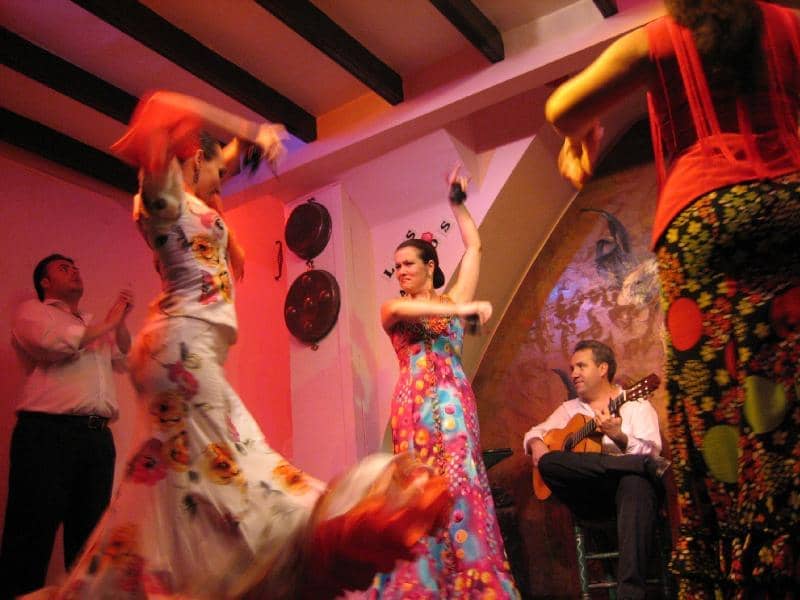
Tablao Flamenco Los Gallos has operated on Plaza de Santa Cruz since 1966, making it the oldest continuously running flamenco tablao in Seville and one of the longest-established tablaos in Spain. The word tablao refers specifically to the wooden performance platform used in flamenco — a detail that matters, because not every flamenco show in Seville is a tablao. A tablao is a dedicated, purpose-built venue where professional artists perform in an intimate, seated room with no theatrical distance between performer and audience.
The setting reinforces this intensity. The sala is small by design, with tiered seating arranged close around the stage, bare brick walls that trap and amplify the sound of footwork, and lighting focused tightly on the performers. When a bailaora stamps into a footwork sequence, the percussion resonates through the floor and into your seat. That physical proximity is central to what Los Gallos offers — and what distinguishes a tablao from a theatre show.
ℹ️ Good to know
Two shows run nightly: 19:00 and 20:45, with the same professional company. Book in advance — shows regularly sell out, especially in spring and autumn, and times may vary seasonally.
The Location: Santa Cruz After Dark
Plaza de Santa Cruz sits at the quieter, residential heart of the Santa Cruz quarter, a few minutes' walk from the back wall of the Real Alcázar. By the time the evening shows begin, the busiest tourist streets nearby have thinned out. The plaza itself is planted with orange trees and lit by low lanterns; arriving early gives you a few minutes to sit on one of the stone benches and absorb the neighbourhood before the doors open.
The walk from the cathedral area to Los Gallos takes around ten minutes on foot through narrow lanes — Calle Mateos Gago, then south through Callejón del Agua or Calle Vida. Navigation apps work reliably here, though the street names can be difficult to spot at night. Wear comfortable shoes: the cobblestones in this part of the quarter are uneven.
If you are coming directly from a meal, the streets between Calle Santa María la Blanca and the plaza are lined with restaurants. The local food scene around Santa Cruz leans heavily toward tourist-oriented spots, so plan your dinner choice with some care if you want something more local.
Tickets & tours
Live prices and dates from our booking partner. If you book, we may earn a commission at no extra cost to you.
Tablao Palacio Andaluz flamenco show with cava
From 54 €Instant confirmationFree cancellationTablao La Cantaora flamenco show with optional dinner
From 25 €Instant confirmationFree cancellationTablao Palacio Andaluz flamenco show with tapas dinner of Andalusian cuisine
From 86 €Instant confirmationFree cancellationAlcazar of Cordoba skip-the-line tickets and guided tour
From 19 €Instant confirmationFree cancellation
Inside the Show: What to Expect
The programme at Los Gallos typically cycles through the major palos — the traditional forms of flamenco. You will hear soleá, bulería, and seguiriya performed live, supported by a guitarist and a cantaor (singer) seated at the back of the stage. The bailaores and bailaoras take turns in solos and grouped sequences, with the cast rotating so that no single style dominates the entire show.
The duration is roughly 75 minutes. There is no interval. Drinks are sometimes available for purchase before the show or during seating, but the performance itself is uninterrupted. The proximity to the stage means even the subtler elements — the tension in a dancer's hands, the guttural catch in a singer's phrase, the near-silence before a footwork burst — land with full force.
Audience etiquette is relatively informal compared to a theatre, and experienced flamenco audiences will call out jaleo — encouragement, like 'olé' or 'agua' — during powerful moments. If you are new to flamenco, following that cue when the energy in the room lifts is part of the experience, not an interruption.
💡 Local tip
Seating is usually assigned on arrival rather than by printed tickets. Arrive at least 15 minutes before the show starts to get a good position. Front and side seats give you the best view of footwork; central rows are best for taking in the full stage picture.
Historical and Cultural Context
Los Gallos opened in 1966, during a period when the tablao format was being formalized across Andalusia as a dedicated performance context for professional flamenco artists. Seville's role as a center of flamenco culture is rooted in centuries of development across Andalusia, drawing on traditions associated with Roma communities, Moorish musical influences, and the cultural mix of the region. For a deeper look at how flamenco is embedded in Seville's identity, the flamenco in Seville guide covers the historical background and maps out the main venues across the city.
For visitors who want to go beyond watching and understand the dance form more analytically, the Museo del Baile Flamenco is a short walk away and offers context on the history, technique, and regional variations of the art form. Combining an afternoon at the museum with an evening show at Los Gallos gives you a more grounded experience than the show alone.
Honest Assessment: Is It Worth It?
At €38 per adult ticket, usually with one drink included except in April and May, Los Gallos sits at the upper end of the tablao price range in Seville. The question of value depends largely on what you are after. If you want a technically serious performance in an intimate room with no gimmicks — no dinner show format, no theatrical production design — then the price is fair for what you receive. The performers are professionals, the acoustics of the small sala reward the minimalism, and the venue's longevity means the programming has been refined over decades.
That said, a tablao is not the same as seeing flamenco in a peña (a private club where aficionados gather informally) or at a festival. The format is designed for an audience that includes many first-time viewers, which means the pacing is calibrated for accessibility rather than pure artistic depth. Experienced flamenco followers may find the programme slightly predictable, though the quality of individual performers varies by night and the format remains legitimate.
People who will not enjoy this: visitors who find sitting still in a confined space difficult, those sensitive to loud percussion or singing at close range, and anyone expecting background music at a dinner. This is a dedicated performance — silence from the audience is expected.
Practical Details and Accessibility
The venue is generally reported to be wheelchair accessible in the sala and entrance, though the bathrooms are not fully accessible; if you have specific mobility requirements, contacting the venue directly before booking is advisable to confirm the current configuration of the seating area.
The 19:00 show suits families with older children — children aged 6 to 11 pay €20 and younger children are not admitted. The later show at 20:45 runs to around 21:15–21:30, which may be better suited to adults. For broader planning around what to do with younger visitors in Seville, the Seville with kids guide has practical suggestions for pairing cultural experiences with child-friendly logistics.
Photography during the show is generally restricted or discouraged out of respect for the performers. Check the venue's current policy when you arrive. Mobile screens lit up during a performance are a distraction in a room this small, and it is worth leaving your phone in your pocket for the duration.
⚠️ What to skip
Ticket prices and show times listed here are based on information available at time of writing. Always verify current pricing and availability on the official website before booking, as these details change.
Insider Tips
- The 19:00 show tends to attract a slightly younger, more mixed crowd; the 20:45 show sometimes draws a more local audience. Both feature the same company, but the energy in the room can differ.
- Plaza de Santa Cruz has limited street signage visible at night. Screenshot the map before leaving your hotel — mobile data can be slow in the narrow lanes of this quarter during peak season.
- If you book directly through the official website rather than a reseller, you avoid third-party fees and can sometimes select seating zone preferences that aggregator platforms do not offer.
- Arriving 20 minutes early lets you choose your seat, order a drink, and settle in before the lights drop. The transition from the warm night air outside into the concentrated atmosphere of the sala is part of the experience — do not rush it.
- Combining Los Gallos with a visit to the Museo del Baile Flamenco earlier the same day gives you conceptual context that makes the live performance considerably more legible, especially if you are new to flamenco.
Who Is Tablao Los Gallos For?
- First-time visitors to Seville wanting a serious, commercially uncluttered introduction to flamenco
- Travellers with one evening who want to spend it on something culturally specific rather than broadly sightseeing
- Couples looking for a high-quality shared experience in an atmospheric setting
- Families with children aged 6 and older who are ready to sit through a focused 90-minute performance
- Repeat visitors to Seville who have not yet seen flamenco in a dedicated tablao context
Nearby Attractions
Other things to see while in Santa Cruz:
- Archivo General de Indias
Standing beside the Cathedral on Avenida de la Constitución, the Archivo General de Indias holds one of the most significant collections of colonial-era documents in the world. Entry is free, the building is architecturally remarkable, and most visitors leave having completely underestimated what's inside.
- Casa de Pilatos
Casa de Pilatos is a 16th-century palace in Seville's historic centre that quietly outshines many better-known landmarks. Its central courtyard, azulejo-lined rooms and classical statuary collection reward visitors who take the time to look closely.
- Hospital de los Venerables
Built in the late 17th century as a refuge for elderly priests, the Hospital de los Venerables is one of Seville's most rewarding architectural and artistic stops. Its church ceiling, Baroque courtyard, and Focus-Abengoa Foundation art collection combine in a space that feels both intimate and historically weighty.
- Iglesia de San Salvador
Standing on the site of Seville's former Great Mosque, the Iglesia del Divino Salvador is the city's second largest church and one of its most rewarding visits. With soaring Baroque nave, layers of Islamic and Christian history, and far fewer crowds than the Cathedral, it earns more attention than most itineraries give it.
Planning a trip? Discover personalized activities with the Nomado app.