Barcelona to Seville: How to Get There & What to Expect
The journey from Barcelona to Seville covers roughly 830 km across Spain. This guide breaks down every transport option, from the high-speed AVE train to budget flights, with practical tips on cost, comfort, and what awaits you in Andalusia's capital.
Tickets & tours
Live prices and dates from our booking partner. If you book, we may earn a commission at no extra cost to you.
TL;DR
- The fastest option is flying: Barcelona (BCN) to Seville (SVQ) takes around 1 hour 40 minutes, with low-cost fares starting under €25.
- The high-speed train (AVE) takes around 5 hours 30 minutes to 5 hours 50 minutes on the fastest services, with advance tickets from around €18-€58.
- Buses are the cheapest option in theory but take around 21 hours — only worth considering for extreme budget travel.
- Driving is possible but covers over 1,000 km by road and takes roughly 9-10 hours; it is not a practical day option.
- Once in Seville, see our guide to things to do in Seville and where to stay to plan the rest of your trip.
The Distance in Perspective

Barcelona and Seville sit at opposite corners of Spain. The straight-line distance is about 830 km, but the road distance is closer to 1,000 km, routing through Madrid or across the interior of the peninsula. This is not a weekend drive. It is a serious cross-country journey that requires either a flight, a long train ride, or an acceptance that you will spend the better part of a day in transit. The good news: Spain's transport infrastructure makes all three options genuinely viable, and in some cases, surprisingly affordable.
Seville (Sevilla in Spanish) is the capital of Andalusia, Spain's southernmost autonomous community. It sits at roughly 37° N latitude, just 7-10 metres above sea level in the broad valley of the Guadalquivir river. After weeks in Barcelona's Catalan-inflected urban energy, arriving in Seville feels like a genuine cultural shift. For context on what to expect when you land, here is an honest assessment of whether Seville lives up to expectations.
Option 1: Flying Barcelona to Seville (BCN to SVQ)
The flight is the obvious choice when time matters more than budget, and it is frequently competitive on price as well. Vueling, Iberia, and Ryanair all operate direct services between Barcelona El Prat (BCN) and Seville Airport (SVQ, Aeropuerto de Sevilla), which sits roughly 10 km from the city centre. Block time on the route is around 1 hour 40-50 minutes, though check-in and airport transit add at least 90 minutes on each end.
- Flight time Approximately 1 hour 40-50 minutes nonstop.
- Carriers Vueling, Iberia, and Ryanair operate direct flights. Connecting itineraries via Madrid are available but rarely worth considering given the frequency of direct services.
- Fares Low-cost one-way fares start around €23-€30 on sale. Average prices vary significantly by season, with November among the cheapest months and July among the most expensive. Always compare across Skyscanner, Kayak, and direct airline sites.
- Airport transfer in Seville The EA airport bus runs to Santa Justa station, Puerta de Jerez, and Plaza de Armas for around €4 per trip, taking approximately 35 minutes. A taxi to the centre costs roughly €25-€35 and takes 15-25 minutes depending on traffic.
⚠️ What to skip
Don't count only flight time. BCN is a large airport and low-cost carriers often use Terminal 2, which may require a separate transfer from Terminal 1. Add at least 2 hours before your flight and 45-60 minutes for airport-to-centre transfer in Seville. Door-to-door, the cheapest flights rarely save you more than 30-60 minutes over the train.
One genuine advantage of flying in July or August: you avoid the interior heat of Spain's railway corridors and arrive at a time when Seville's early-morning coolness is worth every minute of saved travel time. That said, summer fares can jump sharply. Budget travellers who book 6-8 weeks ahead typically find the best value.
Option 2: High-Speed Train Barcelona to Seville (AVE)
The train is the most comfortable way to travel between the two cities, and for many travellers it is the most practical. Renfe operates high-speed AVE and long-distance services departing from Barcelona Sants, with the fastest trains reaching Seville Santa Justa in around 5 hours 30 minutes to 5 hours 50 minutes. The average across all services is closer to 6 hours 40 minutes, as not all trains take the fastest routing. Around 19 trains operate on the route daily, with first departures around 05:50 and the last typically mid-afternoon.
Prices follow a dynamic pricing model, so advance booking is essential. The cheapest Turista class tickets start around €18-€58 when booked weeks ahead. Walk-up fares are usually much higher. Book directly through Renfe's website or via Rail Europe for international credit cards. Note that Spanish train tickets at the cheapest fare tiers are often non-refundable, so check the conditions before purchasing.
✨ Pro tip
The 05:40 or early-morning trains out of Barcelona Sants tend to offer good value and get you into Seville by early afternoon, leaving a full evening free. Avoid booking the cheapest fare on a day when you need flexibility: upgrades or changes can cost more than the original ticket.
Arriving at Seville Santa Justa station puts you about 1.5 km northeast of the historic centre. The EA airport bus stops here too, so you can connect onward, but the neighbourhood around the station is modern and walkable. Taxis queue outside and the MetroCentro tram is accessible nearby. If you plan to explore Seville beyond the main sights, read our overview of getting around Seville before you arrive.
- Journey time Fastest services: 5 hours 15-30 minutes. Average: 6 hours 40 minutes.
- Frequency Around 19 trains per day, though this varies by date and season.
- Fares Advance Turista from €18-€58. Average flexible fares €100-€120. Book via Renfe or Rail Europe.
- Station in Seville Sevilla-Santa Justa, approximately 1.5 km from the cathedral district.
- Why choose train over flight City-centre to city-centre with no baggage restrictions beyond what fits overhead, no liquid rules, more legroom at standard prices, and reliable punctuality on the AVE network.
Option 3: Bus from Barcelona to Seville
The bus exists as an option but deserves an honest assessment: average journey times run around 21 hours. That is an overnight trip plus most of the following day. Ticket prices can be much lower than train fares, but the trip still takes far longer and arrives at an outer bus station. The bus makes sense only in very specific circumstances: if you have a Eurail-style flexibility pass that does not cover buses, or if every train and flight on your target dates is genuinely sold out.
⚠️ What to skip
Bus fares on this route are not consistently cheaper than advance train tickets. Always compare before assuming the bus saves money. An advance AVE fare booked a few weeks ahead will often undercut the bus both on price and journey time.
Option 4: Driving Barcelona to Seville
Driving is rarely the right choice as a direct A-to-B journey. The road distance via the AP-7 and A-4 motorways is over 1,000 km and takes 9-10 hours of solid driving, excluding rest stops and tolls. Toll costs alone on the AP-7 through Catalonia and Valencia can add about €30-€50. Fuel, food, and parking in Seville turn it into a genuinely expensive option once totalled up. The one scenario where driving makes sense: if you are travelling with a group of four or five, have a car already rented in Barcelona, and plan to make stops along the way, perhaps through Valencia, Murcia, or Cordoba. In that case, the road trip becomes the point, not just the journey.
If you are considering a multi-city route that includes stops between Barcelona and Seville, the broader Andalusia itinerary from Seville may help you structure a loop that avoids doubling back.
Which Transport Option Is Right for You?
The decision comes down to three variables: time, budget, and how much you value comfort. Here is a direct comparison to cut through the noise.
- Best for speed Flight (BCN-SVQ). Under 2 hours in the air, though door-to-door adds 3-4 hours.
- Best for comfort and experience AVE train. Arrives city centre to city centre, no security queues, generous seats, dining car available. The 5.5-hour journey passes quickly.
- Best for budget (advance booking) Train and flight are competitive. Book 3-6 weeks ahead on both and compare. Cheapest train fares (€18-€30) can beat flights once airport transfers are priced in.
- Avoid unless circumstances are unusual Bus (21-hour journey) and solo driving (1,000+ km, €100+ in tolls and fuel).
💡 Local tip
If you are travelling in July or August, book the Seville to Barcelona return journey before you leave Barcelona. Both train and flight fares often spike during peak summer, and last-minute tickets in either direction can cost several times the advance price.
What to Expect When You Arrive in Seville

Seville has a population of approximately 688,700 in the city proper (INE data, 2025), making it one of Spain's largest cities. It operates on Central European Time (CET, UTC+1, or UTC+2 in summer). The currency is the Euro. The city's climate is classified as hot-summer Mediterranean (Köppen Csa): winters are mild at 10-12°C mean, but summers are genuinely extreme, with daytime highs commonly above 35°C in July and August. If you are arriving in summer from Barcelona, the heat is a significant adjustment.
Spring (March-May) and autumn (late September-October) offer mean temperatures of 14-22°C, making them the most practical seasons for exploring the city on foot. The major annual events that affect both crowds and prices include Semana Santa (Holy Week, dates vary annually) and the Feria de Abril, which falls two weeks after Easter. If your Barcelona to Seville trip aligns with either event, book accommodation and train tickets as early as possible. Prices double or more.
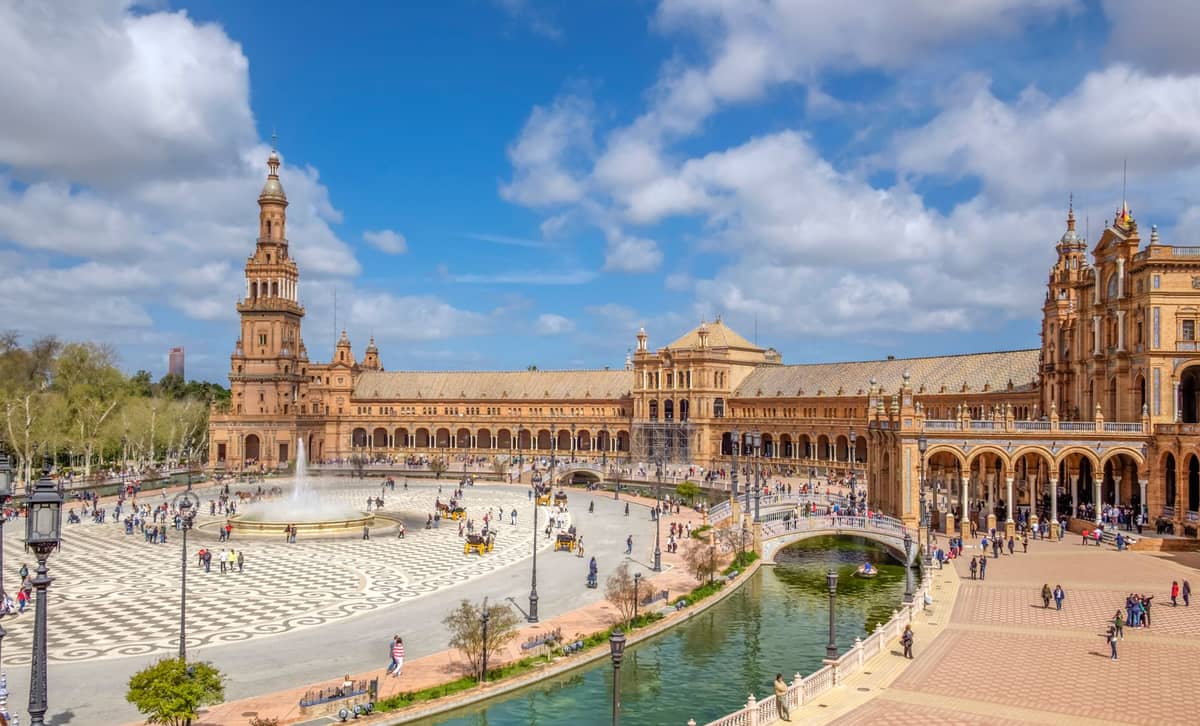
The historic centre is compact and walkable. The main sights, including the Seville Cathedral, the Real Alcázar, and the Plaza de España, are all within walking distance of Santa Justa station on a clear day, though the walk takes 25-30 minutes in summer heat. The Santa Cruz neighbourhood sits immediately east of the cathedral and is the most logical base for a first visit.
If you have limited days, the 3-day Seville itinerary is a practical starting point. For those who want to use Seville as a base for the wider region, our guide to day trips from Seville covers Cordoba, Cadiz, and other reachable destinations by train or bus.
FAQ
What is the fastest way to get from Barcelona to Seville?
Flying is the fastest in terms of time in transit: approximately 1 hour 40-50 minutes nonstop with Vueling, Iberia, or Ryanair. However, door-to-door (including check-in, security, and airport transfers at both ends) typically adds 3-4 hours. The fastest AVE trains complete the journey in around 5 hours 30 minutes, arriving directly in the city centre.
How much does the Barcelona to Seville train cost?
Advance Turista class tickets on Renfe's AVE service start around €18-€58 when booked several weeks ahead. Flexible or last-minute tickets are usually much higher. Book via Renfe's official website or international resellers like Rail Europe. Prices increase significantly in the weeks before travel.
Is the Barcelona to Seville train direct or does it require a change?
Most services are direct, running from Barcelona Sants to Seville Santa Justa without a change. Some services may have intermediate stops, but passengers do not usually need to change trains. Always check the specific service when booking to confirm.
How long does it take to get from Seville airport to the city centre?
The EA airport bus takes approximately 35 minutes to central stops including Santa Justa station and Plaza de Armas, at a fare of around €6 (verify current price before travel). A taxi takes 15-25 minutes depending on traffic and costs roughly €25-€35.
When is the cheapest time to travel from Barcelona to Seville?
For flights, November tends to offer lower fares, while July is typically among the most expensive months. For trains, the cheapest fares are available on advance purchase regardless of season, though summer and major festival periods (Semana Santa, Feria de Abril) see fares rise across all transport options. Book ahead for the best prices.
Tickets & tours
Live prices and dates from our booking partner. If you book, we may earn a commission at no extra cost to you.
Planning a trip? Discover personalized activities with the Nomado app.