Plaza de España, Seville: The Complete Visitor Guide
Built for the 1929 Ibero-American Exposition, Plaza de España is one of the most architecturally ambitious public spaces in Spain. A semi-elliptical sweep of towers, tiled alcoves, a canal, and a central fountain, it sits at the northern edge of Parque de María Luisa and is completely free to enter.
Quick Facts
- Location
- Avenida de Isabel la Católica, s/n, 41004 Sevilla — northern edge of Parque de María Luisa
- Getting There
- TUSSAM bus lines stop on Avenida de Isabel la Católica; also served by tourist bus (Bus Turístico). Roughly 20–25 minutes on foot from the Cathedral.
- Time Needed
- 45 minutes to 2 hours depending on pace; add time if you rent a boat or explore María Luisa Park
- Cost
- Free entry. Rowing boat rental approx. €6 for 35 min (max 4 people); motor boat approx. €12 for 15 min (max 12 people). Verify prices locally.
- Best for
- Architecture enthusiasts, families, photographers, and anyone wanting a long outdoor walk without paying entry fees
- Official website
- www.visitasevilla.es/en/plaza-de-espana
What Is Plaza de España and Why Does It Matter
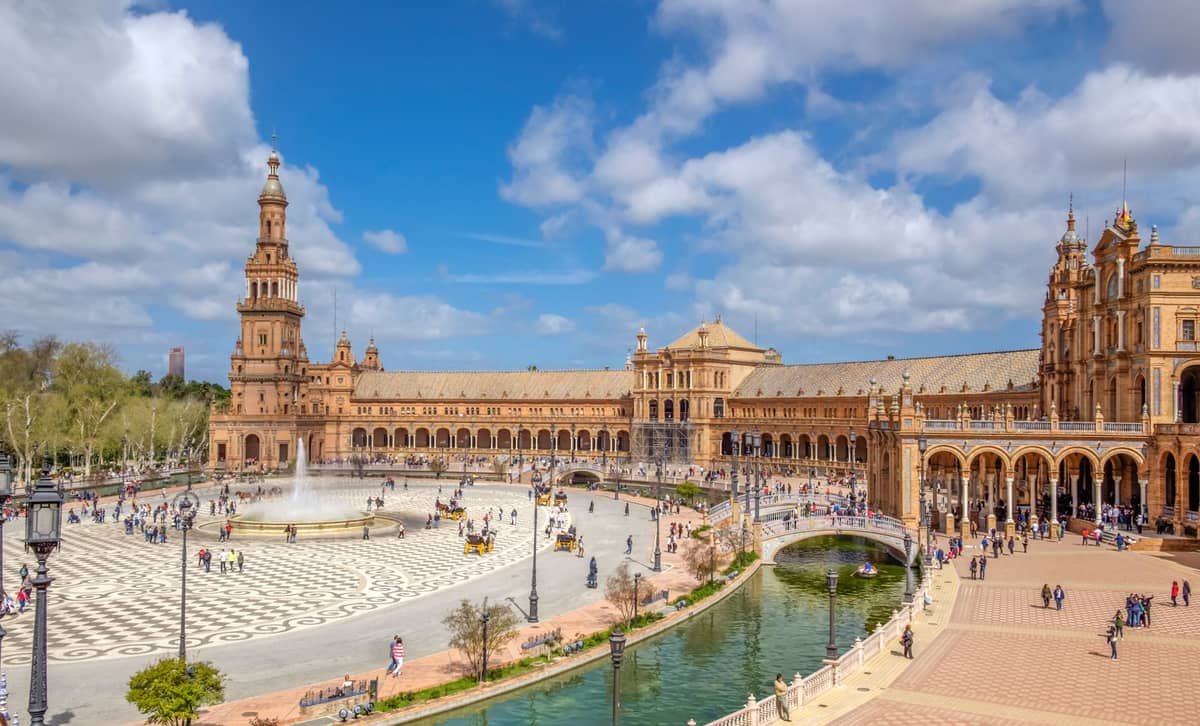
Plaza de España is a semi-elliptical complex of buildings, tiled alcoves, bridges, and a navigable canal constructed for the Ibero-American Exposition of 1929. Designed by architect Aníbal González, it was the centerpiece of a world's fair that also gave Seville the broader redesign of its southern parks. The scale is immediately disorienting in the best way: the curved façade runs roughly 200 meters across, flanked by two 74-meter towers at either end, and the whole thing wraps around a plaza wide enough that the far edge appears slightly blurred on a hazy morning.
The building was built to impress foreign delegations, and it still does. The style blends Renaissance Revival with Moorish Revival elements, a combination Spaniards call Regionalist Architecture. Horseshoe arches, ceramic azulejo tile-work, and brick facades sit alongside colonnaded galleries. The result feels neither purely historical nor obviously modern, which is part of why it photographs so well and feels so unusual to walk through.
The complex sits at the northern end of Parque de María Luisa, Seville's main urban park, and the two are best visited together. After the 1929 Exposition, the main building became government offices for the Junta de Andalucía's military delegation, which is still partially in use today. This means certain interior corridors and rooms are not open to the public, something a number of first-time visitors find confusing when they try to go deeper into the building.
What You Actually See When You Walk In
Approach from Avenida de Isabel la Católica and the plaza opens in front of you all at once. There is no staged reveal; it simply appears, full-width, when you step through one of the entrance gaps in the curved colonnade. The central fountain is large and always running. The canal that curves around the inner edge of the building is about three meters wide and crossed by four small ceramic-tiled bridges, each representing one of the old kingdoms of Spain: Castile, León, Navarre, and Aragon.
The most photographed feature is the series of 48 alcoves, or hornacinas, that line the base of the curved building. Each one represents a different Spanish province. Every alcove contains a painted ceramic panel depicting a key historical moment from that province, plus a ceramic map and a bench. The tile-work is genuinely detailed and worth slowing down to read. If you have a loose connection to a particular Spanish region, finding its alcove and reading the map becomes a small pleasure.
💡 Local tip
The alcoves are arranged alphabetically by province. If you want to find a specific province, start from the correct tower and count along rather than scanning the whole façade.
The towers at each end of the building are the tallest structures in the complex. Both are visible from the interior colonnade and from across the canal. Only the exterior of the towers can be appreciated freely; accessing any upper-level interior spaces via stairs is not consistently available to walk-in visitors, so do not plan your visit around tower access.
Tickets & tours
Live prices and dates from our booking partner. If you book, we may earn a commission at no extra cost to you.
Guided tour of the Maria Luisa Park and Plaza de Espana
From 12 €Instant confirmationFree cancellationGuided tour of Plaza de Espana and Maria Luisa Park
From 12 €Instant confirmationFree cancellationGuided tour of the white villages of Andalusia: Ronda, Grazalema and Zahara
From 79 €Instant confirmationFree cancellationSevilla FC Ramon Sanchez-Pizjuan Stadium tour
From 10 €Instant confirmation
How the Experience Changes by Time of Day
Plaza de España attracts serious crowds from mid-morning to late afternoon, particularly between April and October. By 10:00, organized tour groups are already present. By 11:30 on a sunny Saturday in spring, the inner colonnade can feel quite congested near the most-photographed spots. The light at this hour is also not especially flattering for photography: high overhead, casting flat light on the curved façade.
Early morning is a different proposition entirely. Between 08:00 and 09:30, especially on weekdays, the plaza is almost empty. The low morning light hits the eastern tower directly and the warm brick and tile tones come alive. Dog walkers cross the outer path. A few joggers pass through. The canal reflects the colonnade without distortion. This is the window that photographers specifically target.
Evening brings a second quieter period. In summer, the plaza is accessible until midnight, and the building is lit from below after dark. The illuminated towers are visible from the park paths and from Avenida de Isabel la Católica. The light is warm and slightly dramatic without being overdone. Families and couples tend to gather here in the hour before closing, particularly on weekends, and the atmosphere is calmer than the midday rush.
⚠️ What to skip
In July and August, daytime temperatures regularly exceed 38°C in Seville. The plaza is almost entirely open to the sky with very little shade inside the main bowl. A midday visit in peak summer requires sun protection, water, and a tolerance for significant heat. The early-morning or evening window is not optional in those months; it is genuinely the only comfortable time to be here.
The Canal and Boat Hire
The ornamental canal that curves along the inner base of the building is navigable by small boats, and a rental operation typically runs from a dock on the canal. As of sources updated in 2026, rowing boat hire costs approximately €6 for 35 minutes (plus a €4 deposit), accommodating up to four people. Motor boats cost approximately €12 for 15 minutes and can take up to 12 people. Verify prices at the dock before hiring, as these are subject to change.
The boat ride is short but genuinely enjoyable for families with children. The canal passes under all four decorative bridges, each with colorful tilework overhead. The view of the curved building from the water is different from anything you get on foot: low and close, with the colonnade rising above you. For adults without children, it is entirely optional. For anyone traveling with kids under 12, it tends to be a highlight.
ℹ️ Good to know
The ornamental bridges over the canal require steps to cross and may not be accessible for wheelchairs. The main plaza surface and the ceramic bench alcoves are flat and accessible, but upper levels of the building and the bridges are not suitable for all visitors.
Getting There and Practical Logistics
Plaza de España is around a 25-minute walk from the Seville Cathedral and the Real Alcázar along Avenida de Isabel la Católica, heading south. The route is flat and straightforward. Several TUSSAM bus lines stop along this avenue, and the tourist bus (Bus Turístico / Sevirama) includes a stop near the plaza. There is no metro station nearby; the nearest metro stop is a significant walk away, so bus or foot are the practical options from the city center.
Parking is limited and the surrounding streets are often congested during peak hours. Arriving by bicycle is practical; the area around Parque de María Luisa has cycling infrastructure and the park itself has wide, smooth paths. Seville's public bike-hire network, SEVICI, has docking stations nearby.
Opening hours for general public access are officially listed as 08:00 to 24:00 from April through October, and 08:00 to 22:00 from November through March. As an unfenced public plaza, access is technically continuous, but security and maintenance staff are present during official hours. There is no ticket booth and no reservation system; you simply arrive and walk in.
💡 Local tip
Combine the visit with Parque de María Luisa immediately to the south. The park contains fountains, shaded pathways, and the Plaza de América with its ceramic pavilions. Add at least 45 minutes if you plan to walk through both.
Photography: What Works and What Doesn't
Plaza de España is one of the most photographed locations in Andalusia, and it earns that status. The curved geometry, the reflective canal, and the ceramic detail all respond well to camera work. The challenge is crowds and light.
The golden hour after sunrise gives you warm directional light on the curved façade and very few people in frame. A wide-angle lens captures the full sweep of the colonnade. A telephoto compresses the towers against the sky. The canal surface is calmest in the morning before wind picks up, giving cleaner reflections.
Overcast days are actually useful here. The building's color palette, warm terracotta bricks and saturated blue, yellow, and green ceramic tiles, photographs with more even color saturation under soft diffused light than under harsh midday sun. If your Seville visit coincides with a cloudy morning, the plaza is one of the best places to be with a camera.
For context on how Plaza de España fits into Seville's broader monumental landscape, the best viewpoints in Seville guide covers elevated perspectives across the city that complement a ground-level visit here.
Who This Attraction Is and Isn't For
Plaza de España works well for architecture enthusiasts, families with children who will enjoy the boat hire and the tiled maps, photographers at any level, and anyone who wants to spend significant time outdoors without paying entry fees. It also suits travelers who appreciate craftsmanship at large scale: the azulejo tile-work across 48 province alcoves represents an enormous labor of ceramic art.
If you are primarily interested in Seville's Islamic heritage, the Real Alcázar and the Giralda offer more direct engagement with that history. Plaza de España's architecture, while incorporating Moorish decorative elements, is a 20th-century interpretation rather than a surviving medieval structure.
Travelers with very limited time who are working through a tightly packed itinerary sometimes find that the plaza demands more walking than they expected for a single sight. The sheer scale means a quick 15-minute stop feels unsatisfying. If you cannot give it at least 45 minutes, consider whether another attraction closer to the historic center might be a better use of your window.
Insider Tips
- The province alcoves are arranged alphabetically starting from the northwestern corner (near the Castile tower). Find your own region's alcove by counting along from that anchor point rather than wandering the whole façade.
- Weekday mornings between 08:00 and 09:30 see almost no visitors. If getting a photograph without crowds is a priority, this is the only reliable window during spring and autumn.
- The building's interior galleries are partially occupied by government offices. Doors that appear to lead deeper into the building are often restricted to staff. Do not count on interior access beyond the public arcade.
- Combine your visit with Parque de María Luisa directly to the south. The park's shaded paths and ceramic fountains provide relief from the open sun of the plaza, and the contrast between the formal architecture of the square and the informal greenery of the park is worth experiencing together.
- In summer, bring significantly more water than you think you need. The open bowl of the plaza traps heat and reflects light off the stone paving. The canal's small trees provide almost no shade for standing visitors.
Who Is Plaza de España For?
- Architecture and design enthusiasts drawn to early 20th-century Regionalist style and large-scale ceramic craftsmanship
- Families with children, especially for the canal boat hire and the tile map treasure hunt across 48 province alcoves
- Photographers looking for a high-reward location with strong geometry, color, and multiple lighting opportunities
- Travelers on a tight budget who want a grand, unhurried outdoor experience at no cost
- Visitors pairing the plaza with Parque de María Luisa for a half-day walking itinerary in the southern part of the city
Nearby Attractions
Other things to see while in Parque de María Luisa & Plaza de España:
- Acuario de Sevilla (Seville Aquarium)
Housed in the historic port of Seville, the Acuario de Sevilla takes visitors on a journey through 33 tanks organized around the Magellan-Elcano circumnavigation route. It is one of Andalusia's more thoughtfully designed family attractions, with full wheelchair and stroller access and a setting right on the Guadalquivir waterfront.
- Casa de la Ciencia (Science Museum)
Housed in the Peru Pavilion from the 1929 Ibero-American Exposition, Casa de la Ciencia is Seville's public science museum run by Spain's National Research Council (CSIC). With a planetarium, interactive exhibits, and tickets starting at €3, it stands by Parque de María Luisa and works especially well as a family stop or a cultural detour when the afternoon heat peaks.
- Palacio de San Telmo
The Palacio de San Telmo is one of Seville's most ornate Baroque monuments, built in the 17th century and today serving as the seat of the Junta de Andalucía. Free guided tours are available by prior reservation, offering rare access to a working government palace that most visitors only admire from the street.
- Parque de María Luisa
Donated to the city in 1893 and redesigned for the 1929 Ibero-American Exposition, Parque de María Luisa is Seville's most significant public garden. Spanning 34 hectares of shaded paths, ornamental ponds, and tiled pavilions, it anchors the southern edge of Seville’s historic centre. Admission is free.
Planning a trip? Discover personalized activities with the Nomado app.