Parque de María Luisa: Seville's Grand Historic Park
Donated to the city in 1893 and redesigned for the 1929 Ibero-American Exposition, Parque de María Luisa is Seville's most significant public garden. Spanning 34 hectares of shaded paths, ornamental ponds, and tiled pavilions, it anchors the southern edge of Seville’s historic centre. Admission is free.
Quick Facts
- Location
- Paseo de las Delicias s/n, 41013 Seville
- Getting There
- Metro L1 to Prado de San Sebastián; Tram T1 to Puerta de Jerez; Buses 1, 5, 21, 30, 31, 34, 37
- Time Needed
- 1.5 to 3 hours depending on pace and whether you visit adjacent plazas
- Cost
- Free entry, no ticket required
- Best for
- Morning walkers, families, architecture lovers, photography, picnics
What Parque de María Luisa Actually Is
Parque de María Luisa is Seville's largest and oldest public park, covering 34 hectares of formal gardens, woodland groves, and ceremonial plazas on the southern edge of the city centre. It is not just green space. The park is a layered landscape where Romantic garden design meets early 20th-century Andalusian architecture, and where two of Seville's most photographed structures, Plaza de España and Plaza de América, stand at opposite ends of the same axis.
The land was originally part of the gardens of the Palacio de San Telmo, the Baroque palace that still stands at the park's northern entrance. In 1893, Infanta María Luisa Fernanda de Borbón y de Orleans donated the grounds to the city of Seville. The park was then comprehensively redesigned by French landscape architect Jean-Claude Nicolas Forestier in preparation for the 1929 Ibero-American Exposition, the world fair that left a permanent mark on southern Seville's urban fabric.
ℹ️ Good to know
Opening hours: daily 08:00 to 22:00 in winter, 08:00 to 24:00 in summer. The seasonal boundary is not always precisely signposted, so check the city's official parks page before an evening visit in shoulder months.
The 1929 Exposition and Why the Park Looks the Way It Does
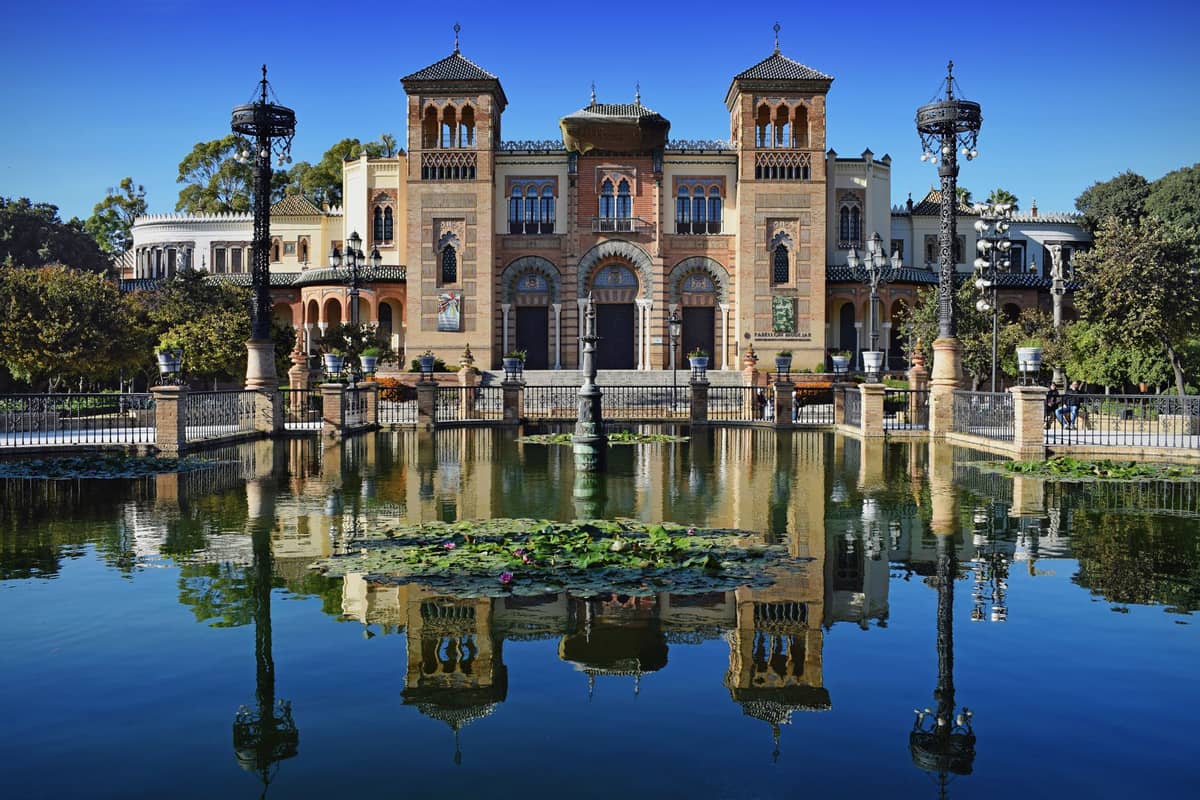
Understanding the park's layout requires understanding 1929. The Ibero-American Exposition was a showcase of Spanish and Latin American culture, and Seville invested heavily in infrastructure, pavilions, and public space to host it. Forestier's design for María Luisa drew on the Moorish garden tradition of the Alhambra and the Alcázar, incorporating geometric water channels, ceramic tile benches, and dense plantings of orange trees, palms, and pines to create shade corridors that would function in Seville's fierce summer heat.
The exposition pavilions that once lined the park perimeter have taken on new lives. The Plaza de América, at the park's southern end, was the centrepiece of the exposition's Spanish Pavilion complex, and today it houses the Museo Arqueológico and the Museo de Artes y Costumbres Populares. The buildings themselves, designed by Aníbal González in a hybrid Neo-Mudéjar and Plateresque style, are as worth examining as anything inside them.
North of the park, immediately adjacent, the Plaza de España was built for the same exposition and is technically a separate space, though most visitors treat it as an extension of the park experience. The two together form the most concentrated example of early 20th-century monumental architecture in Seville.
Tickets & tours
Live prices and dates from our booking partner. If you book, we may earn a commission at no extra cost to you.
Guided tour of the Maria Luisa Park and Plaza de Espana
From 12 €Instant confirmationFree cancellationGuided tour of Plaza de Espana and Maria Luisa Park
From 12 €Instant confirmationFree cancellationGuided tour of the white villages of Andalusia: Ronda, Grazalema and Zahara
From 79 €Instant confirmationFree cancellationSevilla FC Ramon Sanchez-Pizjuan Stadium tour
From 10 €Instant confirmation
Moving Through the Park: What You Will Find
Entering from the Puerta de Jerez end, via the Paseo de las Delicias, you pass through a canopy of mature plane trees before the path opens into the first formal garden zone. The smell here is earthy and faintly sweet, especially in spring when the orange trees are in flower. The noise of the city drops noticeably within a hundred metres of the gate.
The park's internal path network is extensive enough to get slightly lost in, which is not unpleasant. Key focal points include the Estanque de los Patos, a large ornamental pond where white ducks and resident pigeons compete for attention from visitors with bread. Nearby, the Glorieta de Bécquer is one of the park's most photographed corners: a circular clearing with a monumental sculpture dedicated to the Romantic poet Gustavo Adolfo Bécquer, surrounded by cypress trees and tiled benches. It has a theatrical quality, particularly in lower light.
The ceramic tile work throughout the park is one of its defining details. Benches, fountains, and decorative alcoves are faced in the hand-painted azulejo tilework for which Seville is known, and many of the park's glorietas (named clearings) feature tiled tributes to Spanish writers, artists, and historical figures. These are easy to walk past without registering, but worth slowing down for.
💡 Local tip
Wear comfortable shoes with grip. Some of the ornamental paths use rounded cobblestones or fine gravel, which can be slippery after rain or uncomfortable over long distances.
How the Park Changes by Time of Day
Early morning, between 08:00 and 09:30, is when the park functions as a neighbourhood resource. You will encounter runners, dog walkers, elderly residents doing slow circuits on the wider avenues, and occasional cyclists. The light is low and directional, which is excellent for photography of the fountain sculptures and tiled benches. The air smells of damp earth and cut grass.
Midday in summer is when the park justifies its design. The dense tree canopy, deliberately planted by Forestier to create shade tunnels, means that even in July temperatures under the pines and palms are measurably lower than on the surrounding streets. This is one of the few outdoor spaces in central Seville where a July noon visit is not purely unpleasant, though it remains warm. Bring water.
Late afternoon, from about 17:00 onwards, brings school groups, families with pushchairs, and larger tourist clusters, particularly around the Plaza de América and the duck pond. The park stays active into the evening in summer, when the extended opening hours mean locals use it as an evening promenade space. The fountain at the Glorieta de la Infanta is lit, and the atmosphere becomes more social.
⚠️ What to skip
In July and August, daytime highs in Seville regularly exceed 35°C. Even with tree cover, visiting between 12:00 and 16:00 in midsummer requires adequate sun protection, hydration, and realistic expectations. The park is not air-conditioned.
Practical Details for Getting There and Getting Around
The most convenient public transport options are Metro Line 1 to Prado de San Sebastián, a five-minute walk to the park's northeast entrance, or the MetroCentro tram (T1) to Puerta de Jerez, which deposits you directly at the Paseo de las Delicias edge of the park. Multiple TUSSAM bus lines also serve the perimeter. For a fuller picture of transit options across the city, see the guide to getting around Seville.
The park is described as accessible to visitors with mobility impairments, and the main avenues are wide and paved. Some inner paths, particularly those with gravel or uneven tilework, are less manageable with wheelchairs or pushchairs, but the core routes between major focal points are navigable.
Horse-drawn carriages operate routes that pass through or alongside the park, particularly along the Paseo de las Delicias. They add to the period atmosphere but are primarily a tourist service rather than practical transport, and pricing should be confirmed directly with operators before boarding.
Photography Notes and What Actually Photographs Well
The park rewards patient photographers more than it rewards those rushing between highlights. The strongest images tend to come from the tiled benches in the named glorietas, where geometric patterns and warm colour contrast well against the surrounding greenery. The duck pond reflects the surrounding trees cleanly on still mornings. The Glorieta de Bécquer works best in overcast light, which softens the sculpture and the surrounding cypress geometry.
The Plaza de América, at the park's southern end, is best photographed in the early morning before tour groups arrive. The white doves that congregate around the central fountain are a photographic cliché, but they are genuinely there, and in good morning light the scene is as striking as the photographs suggest.
Who This Park Suits and Who Might Not Enjoy It
Parque de María Luisa works well for visitors who want unhurried time outdoors, for families with children who need space to move, and for anyone interested in the intersection of landscape design and architectural history. It pairs naturally with the nearby Palacio de San Telmo at its northern edge and with the museums housed in the Plaza de América pavilions.
Visitors looking primarily for flamenco, nightlife, or concentrated historic monuments may find the park less central to their itinerary. It is not the most time-efficient stop if your schedule is tight. That said, for anyone following a three-day Seville itinerary, it slotted naturally into an afternoon that includes Plaza de España and a walk along the Guadalquivir.
Visitors with very limited mobility may find some of the interior paths challenging despite the park's general accessibility. The main perimeter avenues are smooth, but the inner network varies significantly in surface quality.
Insider Tips
- The named glorietas, small circular clearings dedicated to Spanish cultural figures, are marked on the park map available at the main entrance boards. Most visitors walk past them without stopping, which means they are reliably quiet even on busy afternoons.
- If you are visiting Plaza de España on the same trip, enter the park from the Plaza de España side rather than the Paseo de las Delicias gate. The approach through the park to Plaza de América, walking south from Plaza de España through the avenue of palms, gives a much better sense of the 1929 exposition's spatial logic than arriving by either landmark in isolation.
- The duck pond (Estanque de los Patos) is one of the few spots in the park with reliable seating in the shade and a view of open water. It is a good rest stop in the middle of a longer visit, particularly in warm weather.
- Weekday mornings between Tuesday and Thursday see the lowest visitor density. Weekend afternoons, especially in spring, bring significant crowds to the Plaza de América and the main fountain areas.
- The park sits within the Parque María Luisa district, which is a quieter residential zone with several good neighbourhood cafés along Avenida de la Borbolla and the streets behind it. These are noticeably less expensive and less tourist-oriented than the cafés around Plaza de España.
Who Is Parque de María Luisa For?
- Families with children who need room to run and explore without traffic concerns
- Architecture and design enthusiasts interested in the 1929 Ibero-American Exposition legacy
- Photographers looking for tile work, garden geometry, and ornamental water features
- Visitors seeking shade and cooler temperatures during Seville's summer months
- Travellers combining a morning or afternoon walk with visits to the adjacent museums and Plaza de España
Nearby Attractions
Other things to see while in Parque de María Luisa & Plaza de España:
- Acuario de Sevilla (Seville Aquarium)
Housed in the historic port of Seville, the Acuario de Sevilla takes visitors on a journey through 33 tanks organized around the Magellan-Elcano circumnavigation route. It is one of Andalusia's more thoughtfully designed family attractions, with full wheelchair and stroller access and a setting right on the Guadalquivir waterfront.
- Casa de la Ciencia (Science Museum)
Housed in the Peru Pavilion from the 1929 Ibero-American Exposition, Casa de la Ciencia is Seville's public science museum run by Spain's National Research Council (CSIC). With a planetarium, interactive exhibits, and tickets starting at €3, it stands by Parque de María Luisa and works especially well as a family stop or a cultural detour when the afternoon heat peaks.
- Palacio de San Telmo
The Palacio de San Telmo is one of Seville's most ornate Baroque monuments, built in the 17th century and today serving as the seat of the Junta de Andalucía. Free guided tours are available by prior reservation, offering rare access to a working government palace that most visitors only admire from the street.
- Plaza de América
Plaza de América sits at the southern heart of Parque de María Luisa, framed by three landmark pavilions designed by Aníbal González for the 1929 Ibero-American Exposition. Entry to the square is free, peacocks wander the central gardens, and two of the pavilions now house museums with surprisingly low admission fees.
Planning a trip? Discover personalized activities with the Nomado app.