Palacio de San Telmo: Seville's Baroque Palace Open to Visitors (Free, by Reservation)
The Palacio de San Telmo is one of Seville's most ornate Baroque monuments, built in the 17th century and today serving as the seat of the Junta de Andalucía. Free guided tours are available by prior reservation, offering rare access to a working government palace that most visitors only admire from the street.
Quick Facts
- Location
- Avenida de Roma s/n, 41013 Seville — near Puerta de Jerez, opposite Jardines de Cristina
- Getting There
- Tram T1 or buses C3, C4, 3, 6, 40, 41 — alight at Puerta de Jerez, 3-minute walk
- Time Needed
- 1 to 1.5 hours for a guided tour
- Cost
- Free — advance reservation required via Junta de Andalucía's San Telmo Abierto platform
- Best for
- Architecture lovers, history enthusiasts, travellers seeking free cultural access beyond the standard tourist circuit
What Is the Palacio de San Telmo?
The Palacio de San Telmo is a Baroque palace whose construction began in the late 17th century and continued into the 18th, standing on Avenida de Roma, between the Guadalquivir riverfront and the entrance to Parque de María Luisa. It is one of the most architecturally ambitious buildings in Seville, and also one of the least visited by tourists — not because it lacks merit, but because it requires a reservation to enter. Today it serves as the official seat of the Presidency of the Junta de Andalucía, the executive government of the autonomous region of Andalusia.
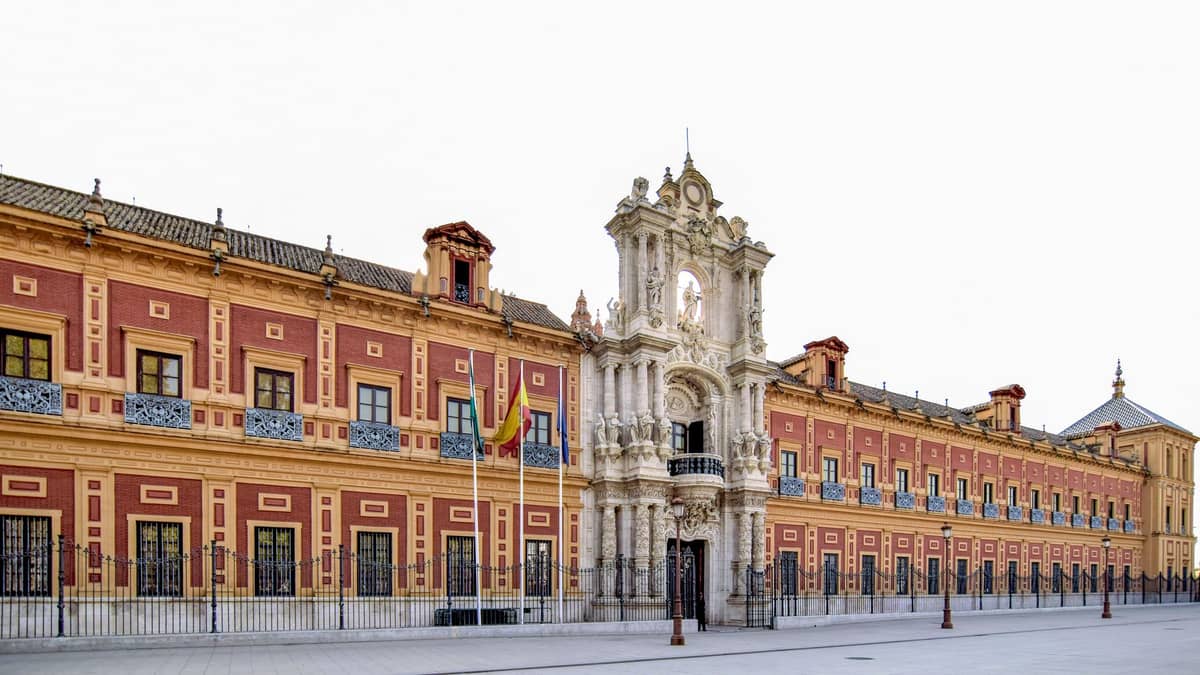
From the street, the palace is immediately striking. The south-facing main façade is a riot of churrigueresque ornament: saints and allegorical figures crowd the portal, stone drapery appears almost to billow in the light, and the whole composition feels more like a stage set than a government building. Most people walking between Puerta de Jerez and the park simply stop, photograph the façade, and move on. The guided tour is worth arranging in advance if architecture or Andalusian history is your focus.
ℹ️ Good to know
Booking note: Tours are free but require prior reservation. The palace operates the 'San Telmo Abierto' programme through the Junta de Andalucía website. Tours typically run on specific days — check current availability before visiting, as schedules change around official events. Reservations can also be made by phone at +34 955 001 010.
History: From Naval School to Seat of Government
Construction of the Palacio de San Telmo began in 1682, commissioned as a school for the training of pilots and navigators for Spain's Atlantic fleet. The college took its name from Saint Elmo (San Telmo), the patron saint of sailors, a fitting dedication for an institution that prepared men to navigate the trade routes between Seville and the Americas. The building was designed by Leonardo de Figueroa and his son Matías, members of the Figueroa dynasty responsible for several of Seville's finest Baroque monuments.
The most celebrated visual element, the main doorway completed around 1734, is attributed to Matías de Figueroa. It represents the high-water mark of churrigueresque Baroque in Seville: an extravagance of carved stone that includes twelve figures representing illustrious sailors and navigators linked to the maritime world, each identified by attributes and inscriptions. The quality of execution is extraordinary, and it rewards close inspection rather than a cursory glance.
After the naval school closed, the palace passed to the Duchess of Montpensier in the mid-19th century and underwent significant renovation, including the addition of the distinctive corner turrets. In 1901 it was donated to the Church and became a seminary before being ceded to the regional government in 1989. The transformation into the seat of the Junta de Andalucía meant extensive restoration work, the results of which can be seen on the guided tour. For context on Seville's other great Baroque churches from the same architectural period, Iglesia de San Luis de los Franceses — also by Leonardo de Figueroa — offers a direct comparison and is open for visits with less scheduling friction.
Tickets & tours
Live prices and dates from our booking partner. If you book, we may earn a commission at no extra cost to you.
Palacio de Duenas Guided Tour
From 25 €Instant confirmationFree cancellationTablao Palacio Andaluz flamenco show with cava
From 54 €Instant confirmationFree cancellationFlamenco Show entrance tickets at El Palacio Andaluz
From 32 €Instant confirmationFree cancellationTablao Palacio Andaluz flamenco show with tapas dinner of Andalusian cuisine
From 86 €Instant confirmationFree cancellation
The Façade: What to Look For Before You Even Book a Tour
Even if you cannot secure a tour slot, the exterior of the Palacio de San Telmo justifies a deliberate detour. The main portal faces south onto Avenida de Roma and receives direct sunlight through most of the morning. Around 9:00 to 11:00 on a clear day, the light picks out the layered relief carving at its best, and the stone takes on a warm ochre tone that deepens the drama of the composition. By midday the façade falls into flatter light, and by afternoon the sun has moved around entirely.
Stand at a moderate distance, roughly 20 to 30 metres, to take in the full vertical hierarchy of the portal before moving closer to read the individual figures. Twelve statues occupy niches and pedestals across the composition: look for the allegorical figures of Cosmography, Arithmetic, and Navigation — each holds a symbolic object. The very apex is crowned by a figure of Saint Elmo, the building's patron. Photographers using a telephoto lens from across the avenue can isolate individual carvings against the sky with good results in morning light.
Inside the Palace: What the Guided Tour Covers
Access to the palace interior is exclusively through the official guided tour programme, known as San Telmo Abierto. Tours are conducted in Spanish by default; check availability for guided visits in other languages when booking. The tour covers the principal ceremonial spaces: the central courtyard (patio), the grand staircase, the chapel, and a selection of the main reception and working rooms that are available depending on official government schedules. Not every room is accessible on every visit.
The chapel is the interior highlight for most visitors. It retains elaborate polychrome decoration and gilded stucco work from the Baroque period, and the spatial contrast between the relatively restrained courtyard and the richness of the chapel is considerable. The main staircase, lined with period tilework, gives a sense of the ceremonial scale the building was designed to project. Note that because this is a functioning seat of government, tours may be curtailed, rescheduled, or cancelled at short notice when official events are underway.
⚠️ What to skip
Access limitation: The Palacio de San Telmo is an active government building. Unannounced visits are not permitted. If you arrive without a confirmed reservation, you will not be admitted. Confirm your booking and check for last-minute cancellations the day before your visit.
Getting There and the Surrounding Area
The palace sits at a natural crossing point in the city's south. The tram line T1 runs along Avenida de la Constitución and terminates at San Bernardo; the Puerta de Jerez stop is the most practical arrival point, placing you at the northern edge of the palace grounds within a few minutes' walk. Multiple bus lines (C3, C4, C5, 3, 6, 40, 41) also stop at Puerta de Jerez. From the historic centre on foot, the walk from the Seville Cathedral takes roughly ten minutes along Avenida de la Constitución, passing the Torre del Oro and the riverside.
The palace's location makes it easy to combine with several other significant sites. Immediately to the south, the grounds open toward Parque de María Luisa and the Plaza de España, both part of the same district. To the north, the Torre del Oro is visible from the palace forecourt. This stretch of the city between Puerta de Jerez and the park is one of Seville's most coherent monumental corridors and rewards a slow walk rather than a rush between sights.
The neighbourhood around the palace is relatively quiet by Seville standards. Unlike the lanes around the cathedral or the Santa Cruz district, there is little commercial pressure here: a few café terraces face the river, the pace is calmer, and the crowds thin noticeably just one block from the main avenue. In summer, when temperatures routinely exceed 35°C in the afternoon, this area can feel punishing between 13:00 and 18:00. Plan your visit to the palace for morning hours, and consider retreating to the shade of Parque de María Luisa for the midday heat.
Practical Considerations and Who Should Visit
The visit is free of charge, but the reservation requirement makes it unsuitable for spontaneous itineraries. If you are spending multiple days in Seville and have a particular interest in Baroque architecture, Andalusian political history, or simply want to access a space that most visitors pass by without entering, this is a worthwhile use of an hour. The tour is conducted at a measured pace with a guide and does not involve extensive walking or stairs that would be prohibitive for most visitors, though those with specific mobility requirements should confirm accessibility arrangements when booking.
Travellers with only one or two days in Seville face a genuine prioritisation question. The Real Alcázar and the cathedral are more immediately spectacular interiors and should take precedence if time is short. The Palacio de San Telmo rewards those who have already covered the primary monuments and are looking for depth rather than additional headline sights. If you are planning your first visit to the city, the guide to things to do in Seville offers a structured overview that helps set priorities.
Photography inside the palace may be subject to restrictions set by the guides on the day. Outside, there are no limitations, and the exterior is freely accessible at all hours. The main façade is on a wide enough avenue to photograph without obstruction. Evening light from the west in late afternoon can produce warm tones on the stone, though the full portal faces south and is not optimally lit at dusk.
Insider Tips
- Tour availability on the San Telmo Abierto platform can fill quickly for popular dates, especially in spring and autumn. Book at least one week in advance, or check for cancellations midweek when slots sometimes reopen.
- The building's main portal is best photographed between 9:00 and 11:00 on a sunny morning, when direct light hits the south-facing façade and the carved stone reads with maximum contrast.
- Tours can be cancelled without much notice when official government events are scheduled. Check your booking confirmation again the morning of your visit and have the phone number (+34 955 001 010) ready in case you need to confirm.
- The gardens facing the Jardines de Cristina, on the river side of the palace, are accessible without a tour and offer a quieter perspective of the building's lateral façades, which are less photographed but architecturally interesting.
- Combine the visit with a walk through Parque de María Luisa immediately to the south — the two sites together make for a coherent half-day without any transit needed between them.
Who Is Palacio de San Telmo For?
- Architecture enthusiasts interested in Spanish Baroque, particularly the churrigueresque style
- History-minded travellers who want to understand Andalusia's institutional heritage beyond the Moorish monuments
- Repeat visitors to Seville looking for experiences beyond the main tourist circuit
- Travellers on a tight budget who want meaningful cultural access — the tour is entirely free
- Photographers seeking monumental Baroque stonework with minimal crowd interference
Nearby Attractions
Other things to see while in Parque de María Luisa & Plaza de España:
- Acuario de Sevilla (Seville Aquarium)
Housed in the historic port of Seville, the Acuario de Sevilla takes visitors on a journey through 33 tanks organized around the Magellan-Elcano circumnavigation route. It is one of Andalusia's more thoughtfully designed family attractions, with full wheelchair and stroller access and a setting right on the Guadalquivir waterfront.
- Casa de la Ciencia (Science Museum)
Housed in the Peru Pavilion from the 1929 Ibero-American Exposition, Casa de la Ciencia is Seville's public science museum run by Spain's National Research Council (CSIC). With a planetarium, interactive exhibits, and tickets starting at €3, it stands by Parque de María Luisa and works especially well as a family stop or a cultural detour when the afternoon heat peaks.
- Parque de María Luisa
Donated to the city in 1893 and redesigned for the 1929 Ibero-American Exposition, Parque de María Luisa is Seville's most significant public garden. Spanning 34 hectares of shaded paths, ornamental ponds, and tiled pavilions, it anchors the southern edge of Seville’s historic centre. Admission is free.
- Plaza de América
Plaza de América sits at the southern heart of Parque de María Luisa, framed by three landmark pavilions designed by Aníbal González for the 1929 Ibero-American Exposition. Entry to the square is free, peacocks wander the central gardens, and two of the pavilions now house museums with surprisingly low admission fees.
Planning a trip? Discover personalized activities with the Nomado app.