Plaza de América: Seville's Most Elegant Square Inside Parque de María Luisa
Plaza de América sits at the southern heart of Parque de María Luisa, framed by three landmark pavilions designed by Aníbal González for the 1929 Ibero-American Exposition. Entry to the square is free, peacocks wander the central gardens, and two of the pavilions now house museums with surprisingly low admission fees.
Quick Facts
- Location
- Plaza de América, 41013 Sevilla — inside Parque de María Luisa, Sur district
- Getting There
- TUSSAM buses 1, 22, 25, 26, 28, 29, 30, 31, 37, 38, 38A, C1, C2, EA, LE, LN, T1; walk from Prado de San Sebastián stop
- Time Needed
- 45–90 minutes for the square alone; add 1–2 hours if entering a museum
- Cost
- Square: free. Museo de Artes y Costumbres Populares: free for accredited EU citizens; €1.50 for non-EU visitors
- Best for
- Architecture lovers, families, photography, park walks, history
- Official website
- visitasevilla.es/en/plaza-de-america
What Plaza de América Actually Is
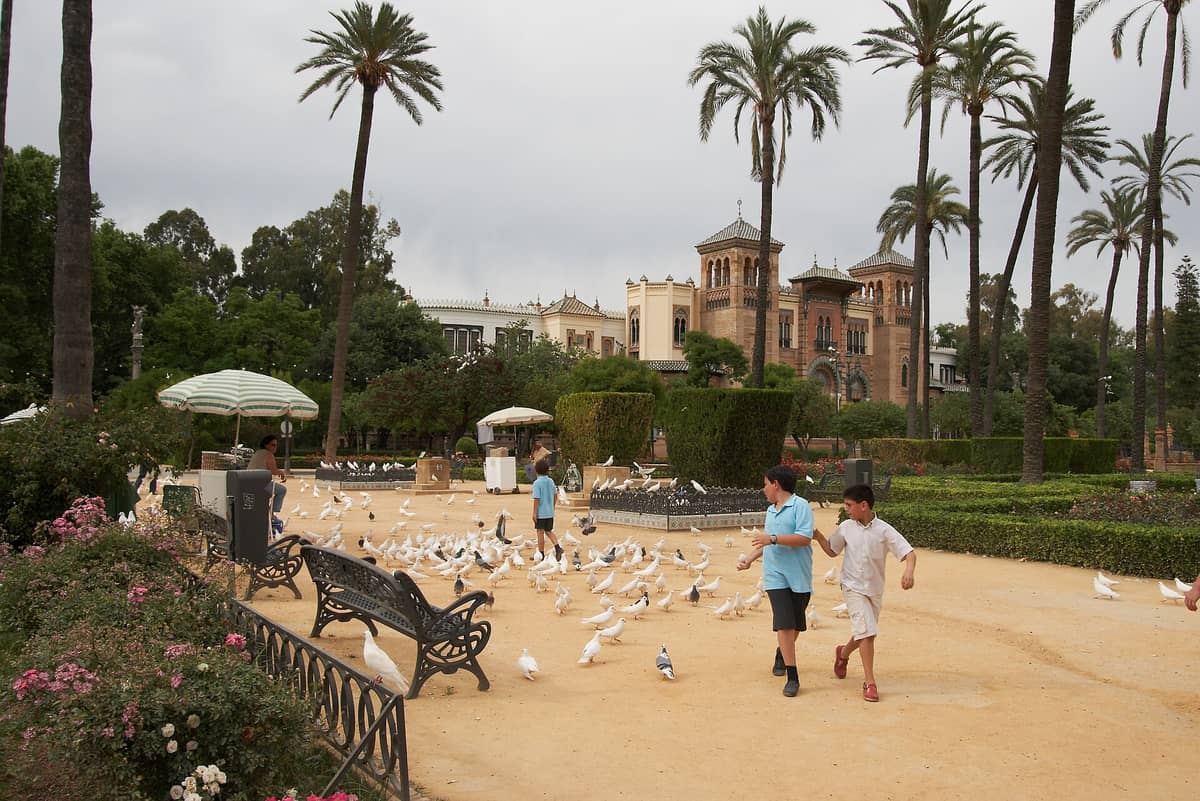
Plaza de América is a formal public square at the southern end of Parque de María Luisa, enclosed by three monumental pavilions commissioned for the 1929 Ibero-American Exposition. Architect Aníbal González designed all three between 1913 and 1916, each in a deliberately distinct style: the Mudéjar-inspired Pabellón Real (Royal Pavilion), the Gothic-Renaissance Pabellón de las Bellas Artes (now the Museo Arqueológico de Sevilla), and the Renaissance-Plateresque former Pabellón Mudéjar or Palace of Ancient Art (now the Museo de Artes y Costumbres Populares). The square was inaugurated on 25 April 1916 and later became a centerpiece of the 1929 exposition grounds.
The layout is formal but not cold. A large central oval garden, divided by gravel paths, sits at the heart of the square. Peacocks roam freely among the flowerbeds, which makes the plaza immediately distinctive, especially for visitors arriving with children. The surrounding arcaded facades create a sense of enclosure that filters out the noise of the city, even though you are only a 15-minute walk from the cathedral area.
ℹ️ Good to know
The square itself is always free and has no entry barriers. The two functioning museums (Museo de Artes y Costumbres Populares and Museo Arqueológico) have separate hours and admission. Check current seasonal schedules before visiting, as museum hours shift significantly between summer and the rest of the year.
The Three Pavilions: A Closer Look
Pabellón Real (Royal Pavilion)
The Royal Pavilion is the most ornate of the three structures and the one that best represents González's Mudéjar revival approach. Its brick facade is layered with geometric tilework, arched loggias, and decorative ironwork, combining Islamic and Christian Andalusian motifs in a way that feels deliberately referential rather than historicist. The building is not regularly open to the public as a museum, which means most visitors photograph it from the central garden without going inside. Even viewed externally, the quality of the ceramic detailing is worth examining up close.
Museo de Artes y Costumbres Populares
The former Palace of Ancient Art, now the Museo de Artes y Costumbres Populares, occupies the north side of the square. Its collection documents Andalusian traditional culture: costumes, crafts, domestic objects, agricultural tools, and festival traditions. It is not a large or flashy museum, but the quality of the exhibits is solid and the building itself adds considerable value to a visit. General admission is €1.50 for non-EU visitors and free for accredited EU citizens and residents. Standard hours run Tuesday to Saturday 09:00–21:00 and Sunday and public holidays 09:00–15:00 from 16 September to 15 June, but between 16 June and 15 September the museum shifts to a summer schedule of 09:00–15:00 Tuesday through Sunday. The museum is closed on Mondays, with the exception of the Monday immediately preceding a public holiday.
Museo Arqueológico de Sevilla
The Museo Arqueológico occupies the Gothic-Renaissance pavilion on the opposite side of the square and holds one of the most significant archaeological collections in Andalusia, but its building has been closed to the public for renovation since January 2020.
For context on the Roman city that supplied much of this museum's collection, see the guide to Italica Roman Ruins, located just outside Seville and reachable on a half-day trip.
Tickets & tours
Live prices and dates from our booking partner. If you book, we may earn a commission at no extra cost to you.
Guided tour of the Maria Luisa Park and Plaza de Espana
From 12 €Instant confirmationFree cancellationGuided tour of Plaza de Espana and Maria Luisa Park
From 12 €Instant confirmationFree cancellationGuided tour of the white villages of Andalusia: Ronda, Grazalema and Zahara
From 79 €Instant confirmationFree cancellationSevilla FC Ramon Sanchez-Pizjuan Stadium tour
From 10 €Instant confirmation
How the Plaza Changes Through the Day
In the early morning, Plaza de América is quiet enough to feel almost private. The light comes in low and warm from the east, raking across the terracotta facades and illuminating the tilework in a way that midday sun flattens entirely. The peacocks are most active before the heat builds, and you can often hear them calling before you see them. The gravel paths are damp with overnight moisture and the scent of orange blossom or jasmine drifts across the central garden depending on the season.
By mid-morning, particularly on weekends and during spring and autumn peak season, the square fills with visitors arriving from the main park paths. School groups arrive regularly on weekday mornings, drawn by the museums. By early afternoon in summer, the plaza can feel genuinely hot: the open geometry that makes it so photogenic also means limited shade in the central area. The arcaded facades offer some relief, but if you are visiting between June and August, the early-morning or late-afternoon window is markedly more comfortable.
Late afternoon light in autumn and spring is excellent for photography. The low western sun catches the warm brick of the pavilions differently from morning, producing longer shadows and richer color from the ceramic tiles. This is also when the peacocks tend to settle near the central fountain, which makes for better photographs than the chaotic midday encounters.
💡 Local tip
Best photography window: arrive between 08:00–09:30 in summer, or 09:00–11:00 in spring and autumn. The angle of light and the relative quiet together make early morning the most rewarding time to visit. In summer, the midday heat on the open plaza is significant; plan accordingly.
Historical and Cultural Context
The plaza was conceived as part of a broader redesign of Parque de María Luisa that began in earnest after the park, formed from the San Telmo Palace gardens donated to the city in 1893 and incorporated into the municipal heritage in 1911, was selected as the main exhibition site. The French landscape architect Jean-Claude Nicolas Forestier was commissioned to redesign the park as a whole, and González's three pavilions were integrated into his plan as the architectural anchor of the southern end. The 1929 Ibero-American Exposition, which brought large-scale construction across what is now the park district, gave the square its final ceremonial character.
González's other defining work from this period is the Plaza de España, completed for the 1929 exposition and located at the northern edge of the same park. The two plazas are architecturally complementary and are usually visited together.
González was a central figure in the Sevillan Regionalist architecture movement, which sought to revive Andalusian architectural traditions, particularly Mudéjar and Renaissance forms, at a time when much of Spain was adopting modernist and international styles. Plaza de América represents an early and relatively pure expression of that vision, predating the larger and more theatrical compositions he would produce for 1929.
Getting There and Navigating the Area
Plaza de América sits inside Parque de María Luisa, accessible from multiple entry points around the park's perimeter. The most direct approach from the city center is via Paseo de las Delicias along the Guadalquivir riverfront, entering the park near the Torre del Oro side and walking south through the park for around 15 minutes. This route passes through shaded avenues and gives a good sense of the park's scale before arriving at the square.
TUSSAM city buses serving the area include lines 1, 6, 30, 31, 33, 34, 37, C1, and C2. The stop nearest the square is at or near Prado de San Sebastián, from which the plaza is a short walk into the park. The MetroCentro tram connects Plaza Nueva to San Bernardo, from which buses or a longer walk can continue south. There is no direct metro station adjacent to the park.
If you are combining this visit with the wider park district, the full Parque de María Luisa covers substantially more ground than most visitors expect. Allow extra time if you plan to explore beyond the main plazas.
The plaza is flat and laid with gravel and paved paths, making it reasonably accessible for visitors with mobility needs. The surrounding park paths connect to the square without significant gradient changes. However, detailed step-free or wheelchair-specific accessibility data is not published by the municipal authority; visitors with specific requirements should contact the Ayuntamiento de Sevilla or check current local guidance before visiting.
Practical Details and What to Bring
There are no ticket booths, entry gates, or queues for the square itself. You walk in from the park paths. The museums on the square have their own entrances with separate ticketing, though the low price point (€1.50 for non-EU visitors, free for EU citizens) means admission is not a meaningful barrier for most travelers. Bring cash for museum entry in case card readers are unavailable, though cards are generally accepted.
Comfortable walking shoes are practical given the gravel paths. In summer, bring water and sun protection; the central oval has limited shade. The park has drinking fountains in various locations but not immediately adjacent to the square. There are no food vendors within the plaza itself, but the park's main entrance areas closer to Glorieta de San Diego have small kiosks.
⚠️ What to skip
Museum hours are seasonal and closed on Mondays. If the Museo de Artes y Costumbres Populares or the Museo Arqueológico is a specific goal, confirm current hours on the official Visita Sevilla website before traveling to the park.
For a broader orientation to the park district and what surrounds it, the Parque de María Luisa district guide covers the area's history, key sights, and how it connects to the rest of the city.
Insider Tips
- The peacocks are not a managed attraction — they are permanent residents of the square and behave unpredictably. Do not feed them or attempt to corner them for photographs; they will move on their own schedule and will often approach if you stay still.
- The Museo Arqueológico's Roman sculpture hall, containing finds from Italica, is one of the least crowded rooms of its caliber in Seville. On a weekday morning you can often have it almost to yourself.
- If you enter the park from the Paseo de las Delicias riverfront rather than from Prado de San Sebastián, the walk through the park to Plaza de América is more scenic and gives better spatial context for how González's pavilions relate to the broader exposition layout.
- The Royal Pavilion (Pabellón Real) facade is best photographed from the central fountain position, slightly off-center to the east, where the tilework catches morning light without being directly backlit.
- Combining Plaza de América with Plaza de España in a single park visit works well logistically — they are at opposite ends of the same park, roughly 10 minutes apart on foot — but the architectural contrast between the two is as informative as either individually.
Who Is Plaza de América For?
- Architecture enthusiasts interested in Sevillan Regionalism and Aníbal González's work
- Families with young children who will respond to the free-roaming peacocks and open garden space
- Photography visitors seeking Andalusian ornamental tilework in good natural light
- Travelers combining a morning park walk with low-cost museum visits
- Anyone building a full day around Parque de María Luisa and the 1929 exposition sites
Nearby Attractions
Other things to see while in Parque de María Luisa & Plaza de España:
- Acuario de Sevilla (Seville Aquarium)
Housed in the historic port of Seville, the Acuario de Sevilla takes visitors on a journey through 33 tanks organized around the Magellan-Elcano circumnavigation route. It is one of Andalusia's more thoughtfully designed family attractions, with full wheelchair and stroller access and a setting right on the Guadalquivir waterfront.
- Casa de la Ciencia (Science Museum)
Housed in the Peru Pavilion from the 1929 Ibero-American Exposition, Casa de la Ciencia is Seville's public science museum run by Spain's National Research Council (CSIC). With a planetarium, interactive exhibits, and tickets starting at €3, it stands by Parque de María Luisa and works especially well as a family stop or a cultural detour when the afternoon heat peaks.
- Palacio de San Telmo
The Palacio de San Telmo is one of Seville's most ornate Baroque monuments, built in the 17th century and today serving as the seat of the Junta de Andalucía. Free guided tours are available by prior reservation, offering rare access to a working government palace that most visitors only admire from the street.
- Parque de María Luisa
Donated to the city in 1893 and redesigned for the 1929 Ibero-American Exposition, Parque de María Luisa is Seville's most significant public garden. Spanning 34 hectares of shaded paths, ornamental ponds, and tiled pavilions, it anchors the southern edge of Seville’s historic centre. Admission is free.
Planning a trip? Discover personalized activities with the Nomado app.