Itálica Roman Ruins: The Emperor's City Just Outside Seville
Founded in 206 BCE and birthplace of two Roman emperors, the Conjunto Arqueológico de Itálica in Santiponce is one of the most significant Roman sites in Spain. Less than 10 km from Seville, it rewards visitors with a vast amphitheatre, intricate floor mosaics, and the ghostly grid of a once-thriving imperial city.
Quick Facts
- Location
- Avenida de Extremadura 2, Santiponce, ~9 km northwest of Seville
- Getting There
- Bus M-170A or M-170B from Plaza de Armas station; by car via A-66/N-630 toward Mérida
- Time Needed
- 2 to 3 hours for a thorough visit
- Cost
- Free for EU citizens/residents with ID; €1.50 for non-EU visitors
- Best for
- History enthusiasts, archaeology fans, families, photographers
What Is Itálica and Why Does It Matter?
The Conjunto Arqueológico de Itálica is not just another scattering of stone in a field. It is one of the oldest Roman cities in the Iberian Peninsula and the birthplace of two of Rome's most celebrated emperors: Trajan, who expanded the empire to its greatest extent, and Hadrian, who built the wall across northern Britain and rebuilt the Pantheon in Rome. This is where they came from. That context alone gives the site a weight that is hard to fully appreciate until you are standing inside the amphitheatre looking up at the empty arches.
The city was founded in 206 BCE by the Roman general Publius Cornelius Scipio, later known as Scipio Africanus, to house soldiers injured at the Battle of Ilipa. It grew steadily over the following centuries, but it was under Hadrian in the 2nd century CE that Itálica was dramatically expanded, gaining grand public buildings, sweeping colonnaded streets, and enormous private townhouses paved with detailed mosaic floors. Many of those mosaics have survived, protected under shelters within the excavated urban quarter known as the Nova Urbs.
ℹ️ Good to know
Itálica is a state-managed archaeological site operated by the Junta de Andalucía. Opening hours vary by season: roughly Tuesday to Saturday 09:00–18:00 or 21:00 depending on the time of year, and Sundays and public holidays 09:00–15:00. The site is closed on most Mondays and on major holidays such as 1 January, 6 January, 1 May, 24–25 December, and 31 December. Always verify current hours before visiting.
The Amphitheatre: Scale That Still Stuns
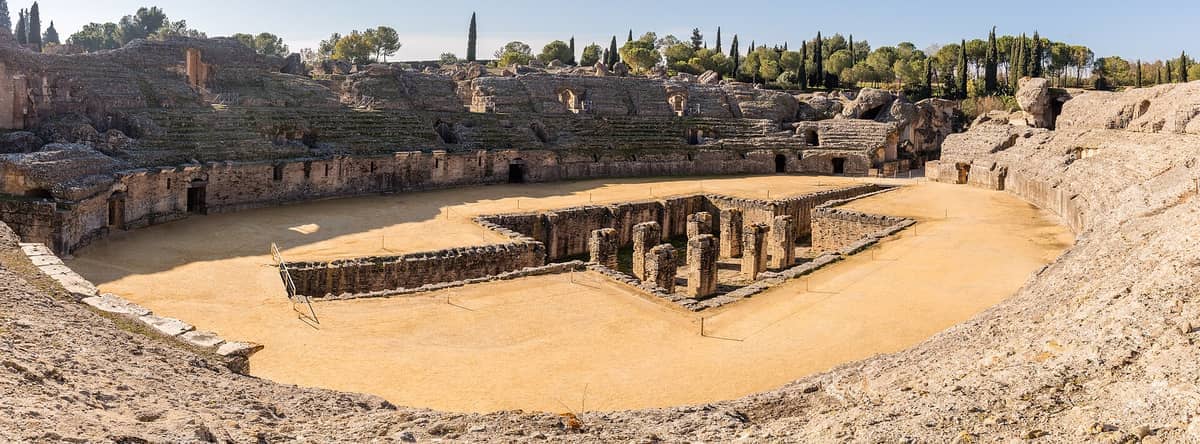
Most visitors arrive expecting something modest and leave slightly stunned by the amphitheatre. With an estimated original capacity of around 25,000 spectators, it ranks among the largest amphitheatres built anywhere in the Roman Empire, comparable in ambition if not in preservation to better-known examples in Italy and North Africa. The oval arena floor is fully exposed, and the tunnels and chambers beneath it, where animals and gladiators were held before their entrance, are partially accessible and give the structure a different dimension from the seating tiers above.
What strikes visitors most is not the scale alone but the quiet. On weekday mornings, before tour groups arrive around mid-morning, the amphitheatre can be almost empty. The stone absorbs the heat and the surrounding scrub vegetation gives off a dry, slightly herbal smell, rosemary and wild grasses baked by Andalusian sun. Early arrivals, around 09:30, will often have the arena to themselves for a stretch of fifteen or twenty minutes. By 11:00 on weekends, the atmosphere shifts considerably.
Photography here works best in the morning when the low sun rakes across the stone arches from the east, creating strong shadow lines. By midday in summer, the light is flat and the heat can be brutal, with surface temperatures on the stone well above ambient air. The site has almost no shade in the amphitheatre area, so sun protection is not optional in the warmer months.
⚠️ What to skip
From June through August, midday temperatures at Itálica can exceed 38°C. The site is almost entirely unshaded. Bring water, a hat, and sunscreen. Visiting before 11:00 or after 17:00 in summer is strongly recommended. This is not a suitable midday activity in high summer for young children or anyone with heat sensitivity.
Tickets & tours
Live prices and dates from our booking partner. If you book, we may earn a commission at no extra cost to you.
Self-guided audio tour of the Roman city of Italica in Seville
From 9 €Instant confirmationHistorical Italica half-day guided tour from Seville
From 39 €Instant confirmationFree cancellationGuided tour of the white villages of Andalusia: Ronda, Grazalema and Zahara
From 79 €Instant confirmationFree cancellationSevilla FC Ramon Sanchez-Pizjuan Stadium tour
From 10 €Instant confirmation
The Urban Quarter: Mosaics, Streets, and Domestic Life
Beyond the amphitheatre, a short walk leads into the excavated residential quarter of the Nova Urbs. Here the Roman street grid is intact enough that you walk along the actual ancient roads, the ruts worn by cart wheels still visible in the stone paving. The houses, identified by name based on the mosaic themes found inside them, such as the Casa de los Pájaros (House of the Birds) and the Casa del Planetario, are open structures with the sky as their ceiling, but their mosaic floors are protected under modern shelters.
The mosaics deserve unhurried attention. The Pájaros mosaic depicts dozens of bird species in crisp tesserae work, each one identifiable and rendered with a precision that reflects the genuine wealth and sophistication of the household that commissioned it. The Planetario mosaic represents the seven Roman deities associated with the days of the week, arranged in a circular composition. These are not reproductions. You are looking at original Roman floors from the 2nd century CE, in the rooms where they were laid.
The spatial layout of the houses also tells a story about how wealthy Romans actually lived: the sequence of public reception rooms, private dining areas, and interior gardens follows a logic that becomes readable once you understand what you are looking at. Information panels throughout the site are available in Spanish and English, though the quality of explanation varies by zone. Visitors with a particular interest in Roman domestic architecture will find it worth downloading a site map from the official website in advance.
Getting to Itálica from Seville
The site is located in Santiponce, roughly 9 kilometres northwest of central Seville. The most practical option without a car is the M-170 bus line, which departs from the Plaza de Armas bus station and stops near the site entrance in Santiponce. Journey time is typically around 30 minutes. Check current timetables at Plaza de Armas before going, as frequencies vary by day and season.
By car, the route via the A-66 or N-630 toward Mérida is well signposted once you leave Seville's northern outskirts. Parking in Santiponce is generally available near the entrance without charge. Some visitors combine the trip with a stop at the nearby Monasterio de San Isidoro del Campo, a 14th-century monastery in Santiponce that has its own considerable historical interest.
If you are planning a broader trip around the Seville region, Itálica fits naturally into a longer day that also includes other sites in the province. The day trips from Seville guide covers Itálica alongside other excursions, including Carmona and the Roman theatre at Écija.
How the Experience Changes by Time of Day and Season
Spring, specifically March through May, is the most comfortable season to visit. Temperatures are mild, typically between 16°C and 24°C, the site vegetation is green rather than scorched, and the light in late afternoon has a warmth that makes the ochre stone of the amphitheatre glow. Autumn, from late September through October, shares similar advantages: the heat has broken, the crowds are lighter than summer, and the lower sun angle creates better photographic conditions throughout the day.
Winter visits, from December through February, are viable and often rewarding for independent travelers. The site is rarely crowded in these months, the air is cool and clear, and the absence of foliage makes the structural outlines of the ruins more legible. Average temperatures sit around 10 to 16°C, so a light jacket is advisable. Rain is more likely in this period, with December being the wettest month, but a light shower rarely lasts long and the stone takes on a different, more saturated tone when wet.
For a broader view of when to plan your trip to the region, the best time to visit Seville guide lays out the seasonal trade-offs in detail, including festival dates and peak pricing periods.
Practical Details: Tickets, Accessibility, and What to Bring
Admission is free for EU citizens and residents on presentation of a valid identity document. Non-EU visitors pay €1.50, which is one of the most modest entry fees in Spanish heritage tourism. There are no timed entry slots required for standard individual visits, though organized guided tours are available through licensed agencies and cost extra.
The site covers considerable ground, and a thorough visit to both the amphitheatre and the urban quarter involves at least two kilometres of walking on uneven surfaces. Comfortable, closed-toe shoes with grip are worth wearing; sandals and flip-flops are genuinely uncomfortable on the irregular stone paving. The site has some ramps and wide paths, but terrain accessibility is limited in parts of the excavated areas. Visitors with mobility concerns are advised to contact the site directly in advance for current accessibility information. Assistance dogs are permitted throughout.
There is a small information area and toilets near the entrance. The site does not have a full café or restaurant on the grounds, so bringing water is essential, particularly from April through October. Santiponce village has a few bars and small restaurants within walking distance of the entrance if you want a meal before or after.
💡 Local tip
Pick up the free printed site map at the entrance ticket desk. The signage within the urban quarter is useful but not always sequential. Having the map helps you locate the best-preserved mosaic houses without backtracking.
Itálica and Seville's Broader Roman and Archaeological Story
Itálica sits at the beginning of a long Roman presence in what is now Seville province. The city that became Hispalis, the Roman precursor to modern Seville, lay just southeast of Itálica on the Guadalquivir, and many of the artifacts recovered from Itálica are now displayed in the Museo Arqueológico in the city's Parque de María Luisa. If the mosaics and sculptures at Itálica leave you wanting more context, that museum is the logical next stop.
Visitors tracing Spain's imperial history in one trip often pair Itálica with a visit to the Archivo General de Indias in central Seville, which documents the later, Spanish chapter of empire in the Americas. The contrast between Rome's physical remains in Santiponce and the paper records of Spain's own imperial era, a short bus ride away in the city centre, makes for a surprisingly coherent narrative about Seville's place in the history of western power.
For those spending several days in the city and building a full itinerary, the 3 days in Seville itinerary includes Itálica as a recommended half-day excursion, pairing it with other major sites in a logical geographic sequence.
Insider Tips
- Arrive at opening time on a weekday, around 09:00 to 09:30. The amphitheatre is often empty for the first 45 minutes, and you can walk the arena floor and explore the underground chambers without anyone else around. The light at this hour is also the best for photography.
- The site entrance is in the town of Santiponce, not visually dramatic from the street. Look for the brown heritage signage rather than expecting a grand gateway. First-time visitors sometimes walk past it.
- EU residents get in free, but you must show a valid national identity card or passport. A driving licence is not sufficient. Non-EU visitors pay €1.50, but do not expect card readers at the ticket desk; bring a small amount of cash to be safe.
- The Monasterio de San Isidoro del Campo is less than 10 minutes' walk from the Itálica entrance and is worth combining on the same trip. It is a 14th-century monastery with exceptional altarpieces and is often overlooked entirely by visitors who come only for the Roman ruins.
- In summer, the site can feel oppressively hot by 10:30 even on a mild day. If you visit in July or August, the late afternoon slot, from around 17:00 until closing, is significantly more comfortable and the evening light on the amphitheatre stone is exceptional.
Who Is Itálica Roman Ruins (Santiponce) For?
- History and archaeology enthusiasts who want depth beyond Seville's central monuments
- Families with older children interested in Roman history, gladiators, and imperial-scale engineering
- Photographers looking for dramatic ancient architecture without the crowds of Rome or Athens
- Budget travelers: at €1.50 for non-EU visitors, or free for EU residents, this is exceptional value for the scale of the site
- Travelers combining a half-day in Santiponce with a broader Seville itinerary, given how easily it pairs with the city centre
Nearby Attractions
Combine your visit with:
- Carmona Historic Town
Perched on the ridge of Los Alcores some 30 km east of Seville, Carmona is one of Andalusia's most complete historic towns. Roman walls, a Moorish gate, Gothic churches, and a Roman necropolis all sit within a walkable medieval core that most Seville visitors miss entirely.
- Doñana National Park
Doñana National Park is one of Europe's most ecologically significant protected areas, covering over 54,000 hectares of wetlands, dunes, and scrubland across the provinces of Huelva and Seville. A UNESCO World Heritage Site and Ramsar wetland, it rewards patient visitors with sightings of rare birds, Iberian lynx, and landscapes that feel genuinely untouched.
Planning a trip? Discover personalized activities with the Nomado app.