Carmona Historic Town: The Ancient Hilltop City Worth the Day Trip
Perched on the ridge of Los Alcores some 30 km east of Seville, Carmona is one of Andalusia's most complete historic towns. Roman walls, a Moorish gate, Gothic churches, and a Roman necropolis all sit within a walkable medieval core that most Seville visitors miss entirely.
Quick Facts
- Location
- Carmona, Province of Seville, Andalusia — approx. 30 km east of Seville city centre
- Getting There
- Regular bus services from Seville (check CASAL or ALSA timetables); by car approx. 30 min via A-4 motorway
- Time Needed
- Half day (3–4 hrs) minimum; full day recommended to include the Roman Necropolis
- Cost
- Free to walk the historic town; individual monuments approx. €2–3 per adult (verify locally)
- Best for
- History lovers, architecture, photography, and travellers who want depth beyond Seville's city centre
- Official website
- turismo.carmona.org/en
What Carmona Actually Is
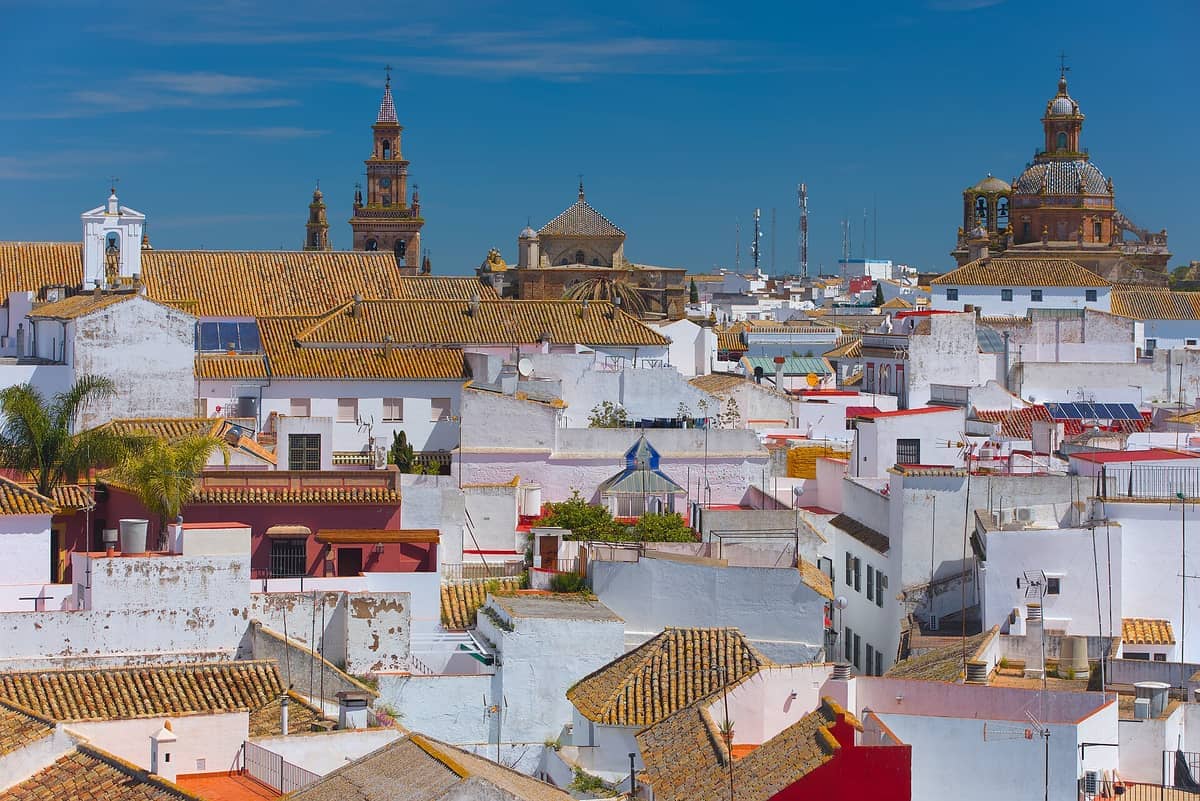
Carmona is a working Andalusian town of roughly 29,000 people, and its historic centre, the casco histórico, sits on the high limestone ridge of Los Alcores above the wide agricultural plain of La Vega. From almost anywhere in the old town, the land falls away sharply to fields of sunflowers, wheat, and olive groves stretching toward Seville. That geography is not just scenic. It explains everything about why Carmona exists: the ridge was defensible, visible for kilometres, and strategically placed on the ancient road between Hispalis (Roman Seville) and Corduba (Córdoba).
The result is a historic town that reads like a compressed archaeological timeline. Roman walls and towers form the base of medieval fortifications. A Moorish gate was converted into a Christian fortress. Gothic churches were built on Almohad foundations. And the whole thing is still inhabited, with neighbourhood bars, school runs, and laundry on balconies. Carmona is not a museum town. It happens to contain an extraordinary amount of history inside a living community.
Carmona's cultural landscape was added to Spain's UNESCO Tentative List in 2023, recognising the density and integrity of its historic environment. For visitors already exploring day trips from Seville, it ranks as one of the most rewarding options within 50 km.
Arriving: The Puerta de Sevilla Sets the Tone
Most visitors approach from Seville, which means entering through the Puerta de Sevilla, the main western gate of the historic town. This is not a decorative arch. It is a layered military structure built on Roman foundations, modified by the Moors as an alcázar, and subsequently adapted through the medieval period. The Tourist Office operates from inside this gate complex, making it a logical first stop to pick up maps and check current monument opening hours.
ℹ️ Good to know
Tourist Office hours: Mon–Sat 10:00–18:00, Sun and public holidays 10:00–15:00. In July and August: Mon–Fri 09:00–15:00, Sat/Sun/holidays 10:00–15:00. Always confirm at turismo.carmona.org before travelling.
The Alcázar de la Puerta de Sevilla charges a small admission fee of around €2–3 for access to its upper levels and towers. From the battlements, the view west toward the plain where Seville sits in the distance gives immediate context for Carmona's strategic importance across two millennia. Morning light hits this facade cleanly, which is worth knowing if photography matters to you.
If you arrive by bus, you will be set down near the foot of the hill or at the edge of the historic core. The walk upward into town is short but involves an incline. Wear shoes with grip, especially if the stones are damp.
Tickets & tours
Live prices and dates from our booking partner. If you book, we may earn a commission at no extra cost to you.
Seville Old Town exploration game and tour
From 10 €Instant confirmationFree cancellationTriana historical quarter with Guadalquivir river walking tour
From 20 €Instant confirmationFree cancellationCarmona and Necropolis: guided day tour from Seville
From 49 €Instant confirmationFree cancellationHistorical Italica half-day guided tour from Seville
From 39 €Instant confirmationFree cancellation
The Streets: What the Walk Looks and Feels Like
Entering through the Puerta de Sevilla, the main pedestrian artery, Calle Prim, climbs gently through the lower historic quarter before opening onto Plaza de San Fernando, the town's main square. The buildings here range from 16th-century civic architecture to later Baroque and neoclassical facades, but the scale stays human throughout. Nothing towers over you. The streets are narrow enough that you are almost always in partial shade, which matters significantly in summer when temperatures can exceed 38°C.
The paving throughout the old town is traditional stone and cobblestone, uneven in places and polished smooth by centuries of foot traffic. This is genuinely difficult terrain for anyone with mobility limitations. There is no flat, smooth route through the historic centre; even the wider streets have gradients and surface irregularities. Visitors using wheelchairs or pushchairs should plan conservatively and consider focusing on the lower parts of the old town closest to the Puerta de Sevilla rather than attempting the full circuit.
⚠️ What to skip
The historic centre is a steep, cobbled hilltop town. Closed-toe shoes with non-slip soles are strongly recommended. Sandals and heels are a poor choice here, regardless of the heat.
On weekday mornings, the streets carry ordinary town life: schoolchildren, delivery vans squeezing through passages designed for mules, elderly residents on their way to market. By late morning on weekends, day-trippers from Seville begin to arrive. By early afternoon, especially in summer, the streets go quiet as locals retreat indoors. If you want the town without the midday heat or the crowds, aim to arrive before 10:00 or after 17:00.
The Key Monuments Inside the Historic Core
The Iglesia Prioral de Santa María is the dominant religious building in town. Construction ran from 1424 to 1518, and the church incorporates an earlier mosque courtyard, the so-called Patio de los Naranjos, whose horseshoe arches and orange trees are visible before you even enter the nave. The interior is late Gothic with Renaissance additions, and the altarpiece is the kind of densely carved, gilded structure common to Andalusian churches of that period. No single element is revolutionary, but the cumulative richness of the space reflects how much ecclesiastical wealth passed through Carmona during the late medieval period.
The church of San Pedro, begun in 1466, stands near the Puerta de Sevilla and has an octagonal tower that deliberately echoes Seville's Giralda in miniature. This is a deliberate reference, not coincidence: civic and ecclesiastical patrons in Andalusian towns frequently commissioned towers that signalled their connection to Seville's prestige. The comparison is instructive rather than competitive; San Pedro's tower is modest, and the building as a whole suits the scale of the town.
At the eastern end of the old town, the ruins of the Alcázar de Arriba occupy the highest point of the ridge. This was the citadel of King Peter I of Castile, known as Peter the Cruel, who ruled from 1350 to 1369 and used Carmona as a royal residence. The site is partially ruined and partly incorporated into the Parador de Carmona, a state-run luxury hotel that occupies the restored sections of the fortress. Non-guests can sometimes access the parador's courtyard and terraces, where the views over La Vega are the best in town. This is worth attempting even if accommodation here is outside your budget. If you are planning a broader Andalusian itinerary, the Andalusia itinerary from Seville covers how Carmona fits into a longer regional trip.
The Roman Necropolis: Outside the Walls but Essential
The Roman Necropolis of Carmona sits a short walk west of the historic centre, outside the ancient walls, as Roman burial grounds typically did. It is one of the most important Roman funerary sites in Spain, with several hundred tombs cut into the soft rock of the hillside, some with frescoed chambers, banqueting rooms, and carved stone details intact. The scale and preservation level make it genuinely impressive rather than just archaeologically significant.
The necropolis is managed separately from the town monuments, with its own opening hours and admission fee. Check the municipal tourism schedule before visiting, as hours vary by season and the site has historically closed on certain weekdays. A visit adds at minimum 45 minutes to your itinerary, and realistically an hour if you read the site carefully. It is not optional if Roman history is why you came to Carmona.
💡 Local tip
Photography inside the tomb chambers is usually permitted without flash. The interior light is dim and cool even in summer, so give your eyes a moment to adjust before trying to photograph the frescoes.
Timing, Weather, and When to Go
Carmona sits at a slightly higher elevation than Seville and catches more breeze, but in July and August the hilltop location offers no real protection from Andalusian summer heat. Daytime highs regularly exceed 35°C in those months, and the stone streets radiate heat by afternoon. If you visit in summer, go early and finish by noon. Spring (March to May) and autumn (late September to October) offer the most comfortable walking conditions, with temperatures typically between 16°C and 24°C. For context on how Seville's regional climate affects day-trip planning, the best time to visit Seville guide applies equally to towns in the province.
Rain is concentrated between October and April, with December being the wettest month. A wet day in Carmona is atmospheric rather than disastrous: the stone darkens, the streets empty, and the churches feel cavernous. But the cobblestones become slippery, and some of the steeper lanes need careful navigation. Bring waterproof footwear if visiting in the wetter months.
Weekday visits are noticeably quieter than weekends. Spanish domestic tourism peaks on Saturday and Sunday, when Seville families come for lunch and a walk. If you visit on a weekday morning, you may have significant stretches of the old town largely to yourself.
Who This Town Is Not For
Carmona rewards slow walkers and people who like to read buildings. If you prefer art museums, contemporary architecture, or nightlife, this is not the right day trip. The town's charm is cumulative and quiet: it builds through layers of observation rather than arriving in a single spectacular moment. It also requires walking on difficult terrain for two to three hours. Travellers with significant mobility limitations will find it frustrating. For visitors with children, the open plazas and the novelty of the old gate are engaging, but the necropolis and church interiors are better suited to older children with some historical interest. The guide to Seville with kids has more on managing pace and expectations for family day trips in the province.
Carmona is also sometimes described as being similar to other Andalusian hilltop towns like Écija or Osuna. That is a fair comparison in structural terms. What distinguishes it is the density of well-preserved monuments within a compact area and its position on Spain's UNESCO Tentative List, which reflects institutional recognition of its integrity as a historic landscape. Whether that makes it worth choosing over, say, a longer morning at the Real Alcázar in Seville is a question of preference. For travellers who have already seen Seville's main monuments, Carmona represents a qualitatively different kind of experience rather than more of the same.
Insider Tips
- The Parador de Carmona occupies the restored Alcázar de Arriba at the eastern end of the old town. Even if you are not staying there, walk to the entrance and ask politely if you can step through to the courtyard. The view over La Vega from the terrace is the single best panorama in Carmona, and the parador sometimes allows non-guests access during quiet periods.
- The municipal tourist office inside the Alcázar de la Puerta de Sevilla distributes a seasonal PDF schedule of all monument opening hours and prices. Pick one up on arrival rather than relying on information found online, which can lag behind seasonal changes.
- Most of the monument tickets in Carmona cost around €2–3, making the full circuit of paid sites very affordable. Some sites have free-entry days or free hours; ask at the tourist office when you arrive, as these are not always prominently advertised.
- The town's main square, Plaza de San Fernando, has several café terraces that are in shade by mid-morning. This is the best place for a coffee stop before tackling the upper town in summer. Avoid the obvious tourist-facing bars immediately inside the Puerta de Sevilla; prices are higher and quality is unremarkable.
- If you are driving from Seville, the approach road from the west gives a dramatic view of the entire ridge with the town silhouetted above the plain. Pull over briefly before reaching the car parks below the old town to appreciate the full topographic logic of the site.
Who Is Carmona Historic Town For?
- Travellers who have already covered Seville's central monuments and want historical depth beyond the city
- Architecture and history enthusiasts interested in Roman, Moorish, and Gothic layers within a single compact site
- Photographers looking for panoramic Andalusian landscape shots and textured historic streetscapes
- Visitors planning an Andalusia road trip who want a meaningful stop between Seville and Córdoba
- Anyone who prefers a quieter, less tourist-saturated alternative to Seville's most crowded attractions
Nearby Attractions
Combine your visit with:
- Doñana National Park
Doñana National Park is one of Europe's most ecologically significant protected areas, covering over 54,000 hectares of wetlands, dunes, and scrubland across the provinces of Huelva and Seville. A UNESCO World Heritage Site and Ramsar wetland, it rewards patient visitors with sightings of rare birds, Iberian lynx, and landscapes that feel genuinely untouched.
- Itálica Roman Ruins (Santiponce)
Founded in 206 BCE and birthplace of two Roman emperors, the Conjunto Arqueológico de Itálica in Santiponce is one of the most significant Roman sites in Spain. Less than 10 km from Seville, it rewards visitors with a vast amphitheatre, intricate floor mosaics, and the ghostly grid of a once-thriving imperial city.
Planning a trip? Discover personalized activities with the Nomado app.