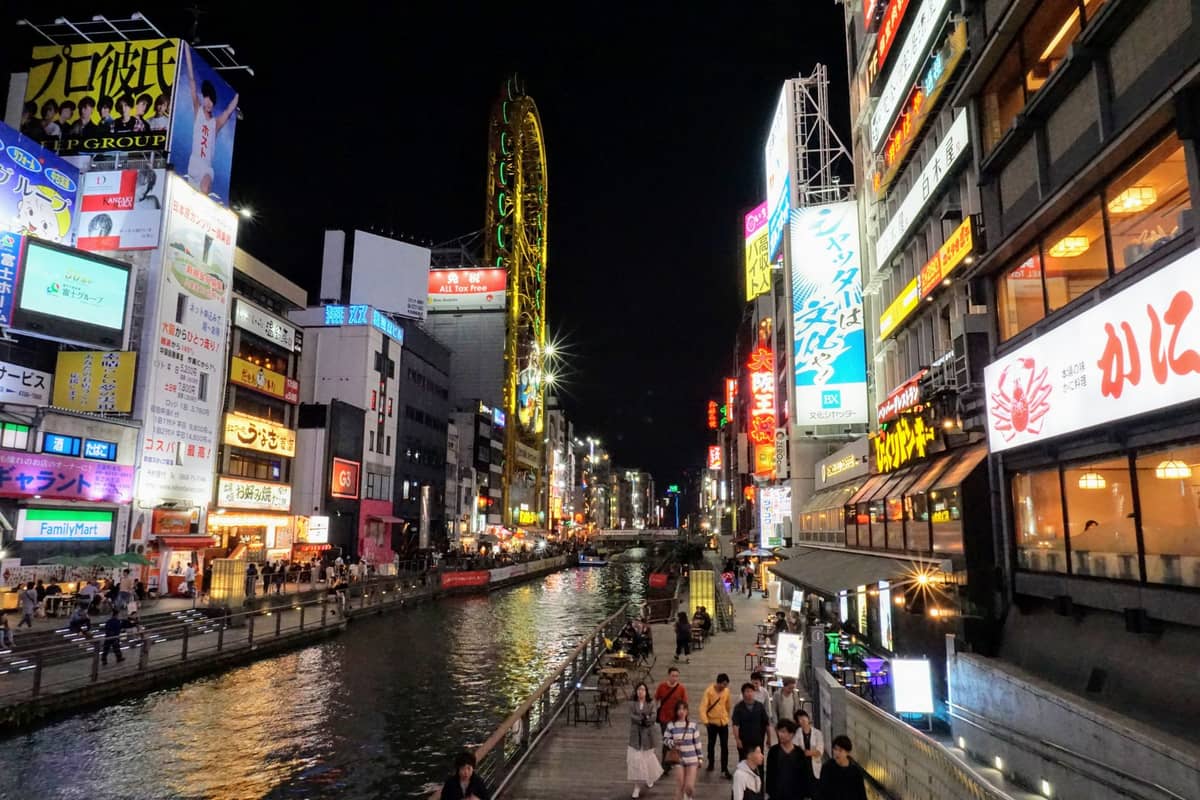
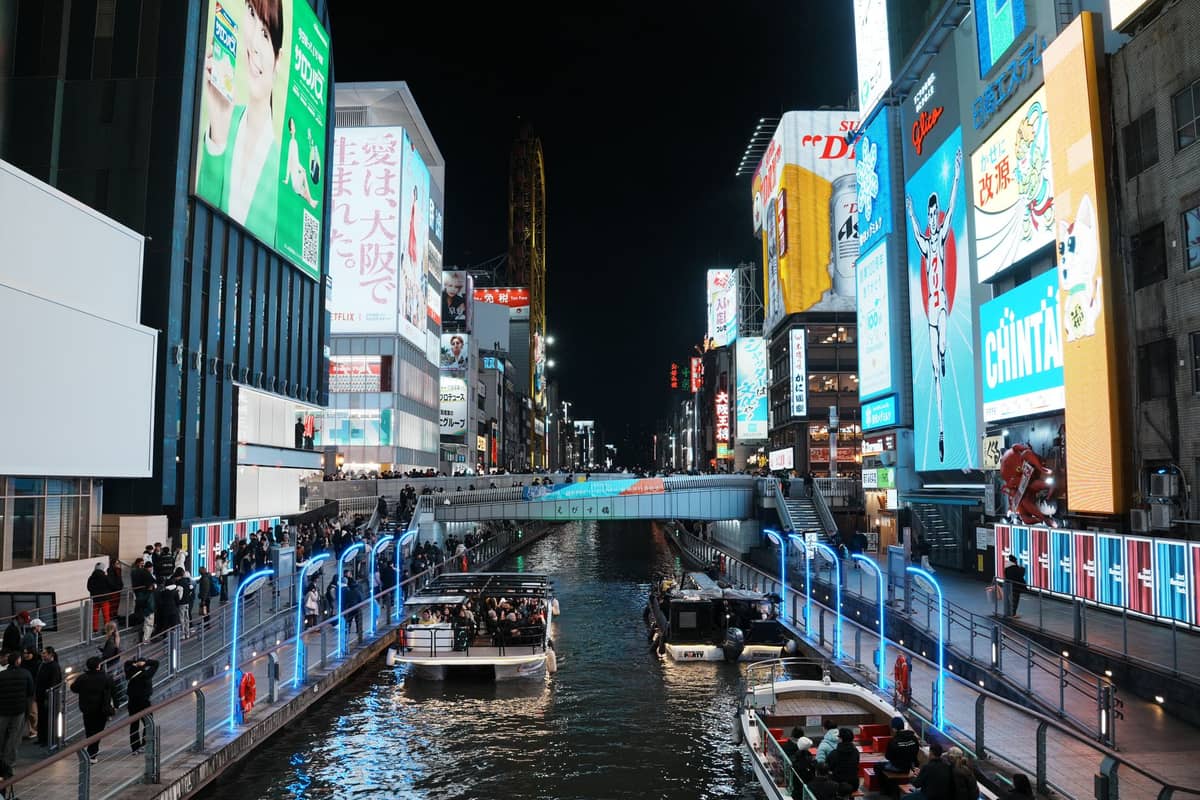
Dotonbori is the electric heart of Osaka's Minami district, strung along the canal that shares its name. From the iconic Glico Running Man sign to narrow alleyways packed with takoyaki stands and ramen counters, it's where the city's famous food culture and after-dark energy converge in one dense, sensory-overload stretch.
Dotonbori is the neighborhood that most visitors picture when they think of Osaka: a canal-front strip of giant neon signs, animatronic crabs, and the kind of street food density that makes it almost impossible to walk a full block without stopping. It has been an entertainment district since 1662, and that identity has only intensified over the centuries.
Orientation
Dotonbori sits in Chuo Ward, in the southern half of central Osaka known collectively as Minami. The neighborhood is anchored by the Dotonbori Canal, a narrow east-west waterway, and its most famous stretch runs from roughly Ebisubashi Bridge westward toward Dotonboribashi Bridge. The canal-front promenade, locally called the Tombori River Walk, forms the spine of the district, with restaurant terraces and illuminated signboards facing the water on both sides.
To the north, Dotonbori blurs into Shinsaibashi, Osaka's premier shopping corridor, connected via the covered Shinsaibashi-suji shopping street. To the south, it transitions into Namba, the transport hub for the entire Minami district. To the east, the district softens into quieter backstreets that eventually reach Nippombashi and Den Den Town, Osaka's electronics and anime quarter. Understanding these adjacencies matters because most visitors combine Dotonbori with at least one or two of these surrounding areas in a single outing.
The core Dotonbori addresses fall within 1-chome and 2-chome Dotonbori, Chuo Ward. The area is compact: you can walk its full length in under ten minutes. But the side streets, covered arcades, and canal access points add enough complexity that it rarely feels like a single straight line.
Character & Atmosphere
Dotonbori at 9am is a different place from Dotonbori at 9pm. In the morning, the canal promenade is almost peaceful. The neon signs are still lit but feel faded against the daylight. Delivery trucks idle at the curb. A few early risers queue outside a popular ramen shop before the lunch rush builds. The smell that hits you is soup stock and frying oil, already warming up for the day.
By early afternoon the crowds arrive in force. Ebisubashi Bridge becomes a slow shuffle of visitors photographing the Glico Running Man sign across the water. The canal-front restaurants open their terrace seating. Takoyaki vendors fire up their griddle plates and the scent of octopus batter browning in hot oil drifts down the promenade. The covered side streets fill with groups moving between food stalls, and the giant animatronic crab above the Kani Doraku restaurant entrance begins its slow mechanical wave.
After dark, Dotonbori becomes the version of itself that photographs best. The neon reflects across the canal, the crowds thicken to weekend-festival density on Friday and Saturday nights, and the noise level rises to something between a sports bar and a food market. This is genuinely what the neighborhood is designed for, and it delivers. But it is worth being honest: on peak evenings, especially during Golden Week, Obon, or the winter holiday period, the canal promenade can feel more like crowd management than atmosphere. If sensory overload bothers you, a weekday evening is significantly more comfortable.
💡 Local tip
For the best balance of atmosphere and manageability, aim for a weekday evening arrival around 6–7pm. The neon is in full effect, the food stalls are open, but the bridge-to-bridge crowds haven't yet reached their weekend peak.
The district has been an entertainment zone since 1662, when the area around the canal developed as a theater quarter. Several of Osaka's historic kabuki and puppet theaters were based here, and that performance-oriented identity never really left. Today the theaters are mostly replaced by restaurants with elaborate facades, but the sense that Dotonbori is a place where Osaka puts on a show for itself, not just for tourists, still holds.
What to See & Do
The Dotonbori Canal and Ebisubashi Bridge are the obvious starting point. The Glico Running Man sign, which has stood in some form since 1935 and been updated several times since, is one of the most photographed spots in Japan. The best angle is from Ebisubashi Bridge looking east across the water. The canal itself is walkable on both banks, with the south promenade offering the better views of the illuminated restaurant facades.
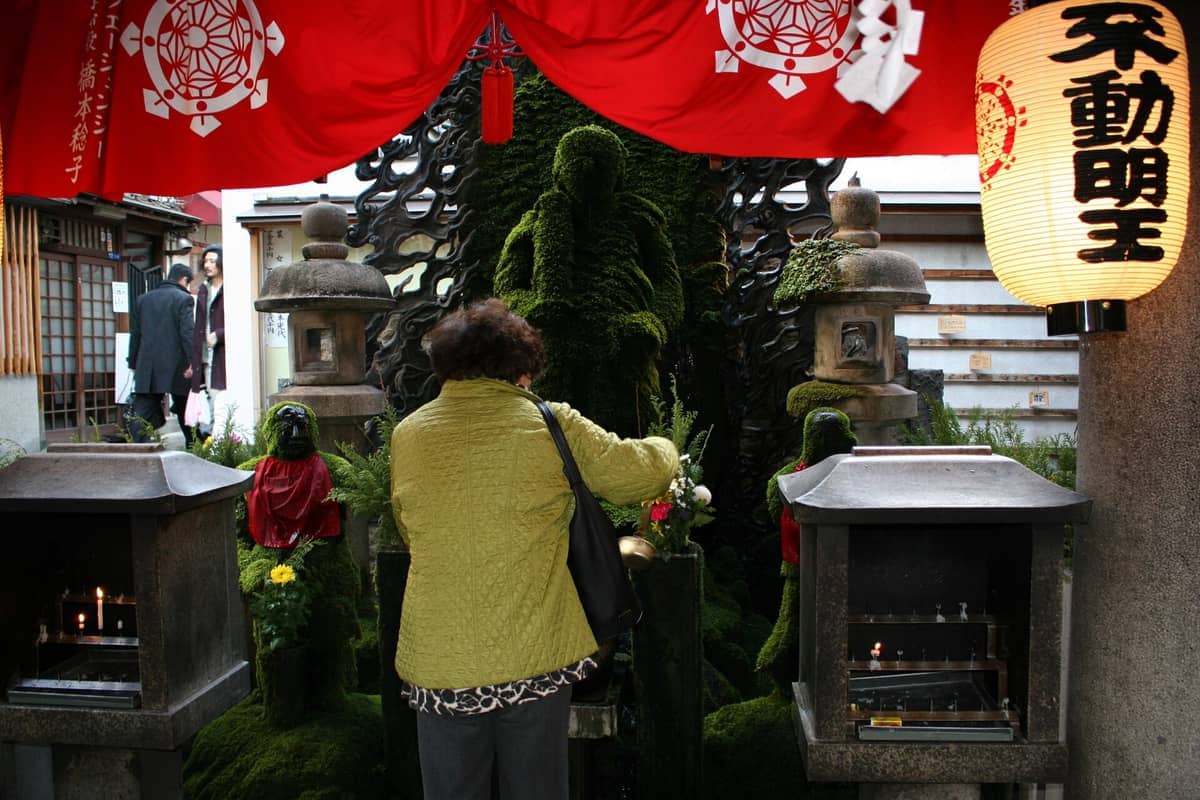
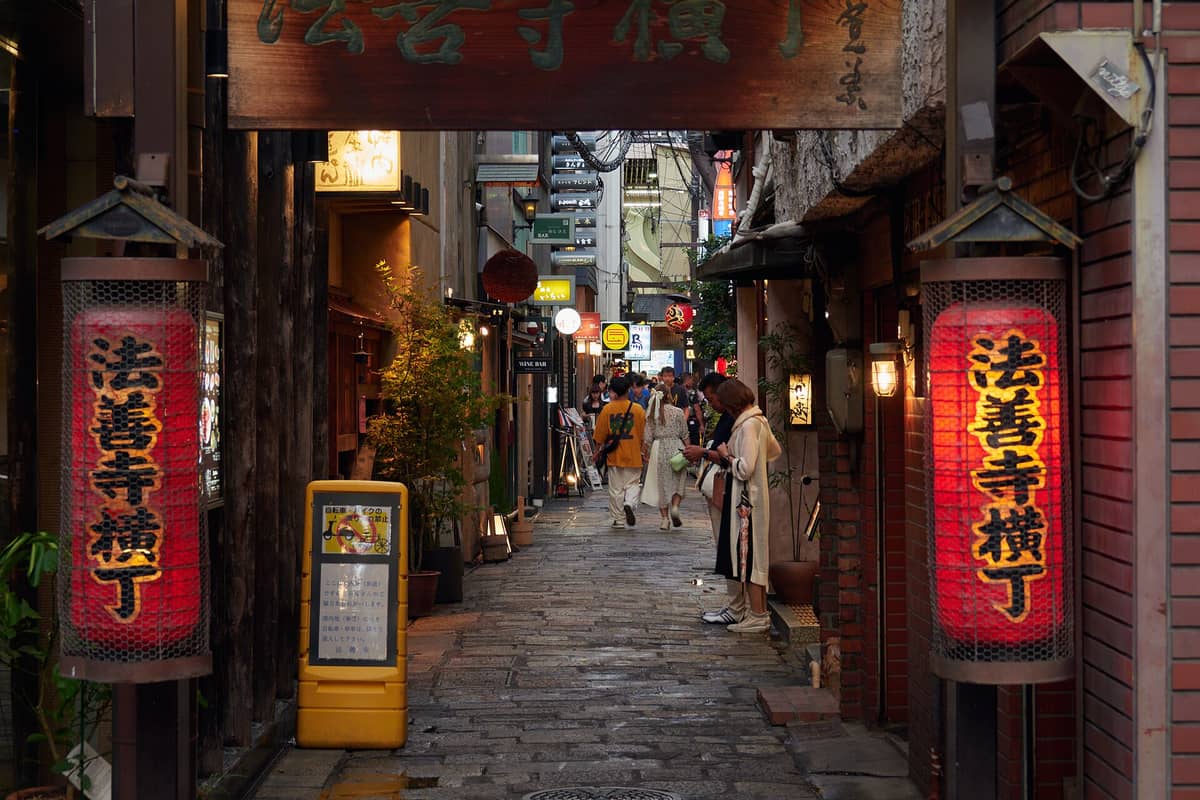
One block south of the canal, tucked between restaurant alleys, is Hozenji Yokocho, a narrow stone-paved lane that feels completely at odds with its surroundings. The alley runs between two rows of traditional wooden restaurant facades and leads to Hozenji Temple, a small but significant shrine whose moss-covered stone figure of Fudo Myo-o is one of Osaka's most quietly atmospheric spots. Visitors pour water over the statue as an offering, and centuries of this have left it covered in thick green moss. It draws a genuinely mixed crowd of tourists and locals at all hours.
Ebisubashi Bridge: the canal-front photo spot, best at dusk when the Glico sign reflects on the water
Tombori River Walk: the canal promenade, particularly the south bank between Ebisubashi and Taikoubashi bridges
Hozenji Temple and Hozenji Yokocho: the quiet counterpoint to the neon, one block south of the canal
Kani Doraku: famous for its moving mechanical crab sign on the main drag, a Dotonbori landmark since 1960
Sennichimae Doguyasuji: a covered arcade just south of the main strip, lined with professional kitchen equipment and cookware shops — an interesting detour for food-curious travelers
If you're visiting with children, note that Kids Plaza Osaka is a short metro or taxi ride north, and the National Bunraku Theatre is within walking distance to the east, near Nippombashi. Bunraku, Japan's traditional puppet theater, is a UNESCO Intangible Cultural Heritage, and performances here are a genuinely rare experience. Check the schedule before your visit, as performances run in seasonal programs rather than continuously.
ℹ️ Good to know
Dotonbori's entertainment history is directly connected to the development of Osaka's theater culture. The district's name comes from Doton Yasui, a merchant who helped excavate the canal in the early 17th century, and the area became the city's cultural center for kabuki and puppet theater for over two centuries before evolving into its current form.
Eating & Drinking
Dotonbori is the most concentrated expression of Osaka's reputation as Japan's food capital, a reputation the city has held long enough that the local phrase 'kuidaore' — roughly 'eat until you drop' — has become a kind of civic motto. Osaka's food scene is built on accessible, bold flavors, and Dotonbori is where that ethos is most visibly on display.
For street food, the canal promenade and the covered arcade streets running parallel to it are the main territory. Takoyaki (octopus balls) are the signature item: batter-filled, topped with bonito flakes, pickled ginger, and sauce, eaten from small trays directly outside the shop. Okonomiyaki, a savory pancake layered with cabbage and various fillings, is widely available at sit-down restaurants where staff often cook it at the table. Kushikatsu, deep-fried skewers of meat and vegetables, is another staple. Prices for street food items typically run from around ¥300 to ¥800 per serving.
Sit-down restaurants in Dotonbori range from ramen shops with long queues outside to mid-range izakayas, sushi counters, and specialist restaurants focused on a single dish. The famous crab restaurants along the main strip are a genuine tourist experience: elaborate, photogenic, and priced accordingly, with set menus often starting above ¥5,000 per person. Budget dining is easy, and a full meal at a casual ramen or udon shop rarely exceeds ¥1,000–¥1,500.
The bar and late-night drinking scene is dense, particularly in the side streets south of the canal. Izakayas dominate at the lower price end, with drinks from around ¥400–¥600 per glass and food meant for sharing. Be aware that some bars in the immediate Dotonbori area — especially those with touts actively recruiting foreign visitors from the street — have added undisclosed cover charges or 'system fees' to bills. This is well-documented enough to warrant a specific warning. Choosing bars where you walk in independently, see a visible menu with prices posted, or receive a recommendation from your accommodation significantly reduces this risk. More on Osaka's broader nightlife options is covered in the Osaka nightlife guide.
⚠️ What to skip
Avoid bars and clubs where street touts approach you and offer 'free entry' or 'first drink free.' Hidden cover charges and inflated prices are a documented issue in the tourist-facing bar strip around Dotonbori. Always ask to see a menu with prices before ordering, and clarify whether a cover charge applies.
For a more thorough food exploration, the Kuromon Ichiba Market, a large covered market with over 150 stalls selling fresh seafood, produce, and prepared foods, is about a ten-minute walk east from the canal. It operates primarily in the morning and early afternoon and offers a different, more wholesale-oriented food culture than the tourist-facing strip.
Getting There & Around
Dotonbori is easy to reach from almost anywhere in central Osaka. The primary transit gateway is Namba Station, one of the largest interchange stations in the Kansai region. It connects the Osaka Metro Midosuji Line, Yotsubashi Line, and Sennichimae Line with Nankai Railway services (including the direct airport express from Kansai International Airport) and Kintetsu Railway lines. From Namba Station Exit 14, the walk to Ebisubashi Bridge takes about three to five minutes following the signs for Dotonbori.
From Kansai International Airport, the Nankai Railway Airport Express runs directly to Namba Station in approximately 44 to 50 minutes. The faster Rapi:t limited express covers the same route in around 35 to 40 minutes. Both services deposit you at Namba Station within easy walking distance of the canal. Fares should be verified before travel as they are subject to change. Full transport options from the airport are covered in the Osaka airports guide.
Shinsaibashi Station on the Midosuji Line is roughly eight minutes on foot from the canal via Exit 4-B, approaching from the north through the Shinsaibashi-suji arcade. This route is useful if you're combining shopping in Shinsaibashi with an evening in Dotonbori. Nippombashi Station (Osaka Metro Sennichimae Line and Kintetsu Line) provides access from the east, with a seven-minute walk from Exit 2.
Within the district, everything is on foot. The canal-front area is flat, paved, and well-lit. For wheelchair users and those with mobility considerations, Namba Station Exits 10 and 25 have elevator access; Exit 25 is the more direct route to the canal promenade. Note that some of the narrow side alleys around Hozenji Yokocho have uneven stone paving that can be difficult with wheeled luggage or mobility aids.
💡 Local tip
If you're arriving with luggage, most hotels and hostels in the area can store bags until check-in. Coin lockers are also available at Namba Station in multiple sizes. Dragging a suitcase through peak-hour Dotonbori is an experience worth avoiding.
For broader navigation across Osaka, including how to use the metro system, IC cards, and day passes, the getting around Osaka guide covers the logistics in detail. The Osaka Amazing Pass may also be worth evaluating depending on your itinerary, as it includes unlimited metro rides and free entry to a number of attractions.
Where to Stay
Dotonbori itself is a relatively small district, and most accommodation options marketed as 'Dotonbori' are technically in the surrounding Namba or Shinsaibashi area. This is fine in practice: staying anywhere within a ten-minute walk of the canal puts you at the center of the Minami district with excellent metro access. For a broader look at accommodation options across the city, the where to stay in Osaka guide breaks down the main neighborhoods and what type of traveler each suits.
Staying in or immediately adjacent to Dotonbori suits travelers whose priority is nightlife, food exploration, and maximum access to Minami's entertainment density. Hotels here tend to lean mid-range to upscale, with smaller boutique properties and a growing number of design hotels that have opened in the area over the past decade. Budget travelers will find hostels in Namba that offer a similar location at significantly lower nightly rates.
The main practical drawback of staying in Dotonbori proper is noise. The streets remain active until well past midnight on weekends, and some of the canal-facing hotel rooms can be affected by sound from the promenade below. If light sleepers, a room facing away from the canal, or a property a few streets back from the main strip, is worth requesting when booking.
Travelers who want easier access to quieter streets, parks, and a slightly more local feel might consider basing themselves in Shinsaibashi to the north or in the Tennoji area to the south, both of which are one or two metro stops from Namba and offer a broader range of accommodation at varying price points.
Practical Notes & Safety
Dotonbori is, by any reasonable measure, a safe place to visit at night. Foot traffic remains dense through the late evening, the streets are brightly lit throughout, and violent crime in the area is rare by international standards. Solo travelers, including solo women, routinely move through the district after dark without issue.
The realistic concerns are more about crowd density than crime. On weekends and public holidays, the canal promenade around Ebisubashi Bridge can become genuinely difficult to move through, particularly around 8–10pm. Pickpocketing risk rises in proportion to crowd density, so secure pockets or a bag worn across the front is sensible. Keep valuables accessible but not loose.
The tout situation around some bars is worth taking seriously: it's not dangerous, but it is a reliable source of frustrating or expensive evenings for unprepared visitors. The simplest countermeasure is to ignore approaches from people actively recruiting outside bars and to choose venues with visible, posted pricing at the entrance. Tipping is not practiced in Japan, including in Dotonbori restaurants and bars. Service is included, and attempting to tip can occasionally cause confusion.
For travelers building a broader Osaka itinerary, Dotonbori makes a natural evening anchor while daytime hours are spent further afield at places like Osaka Castle or on day trips to Nara or Kyoto. The Midosuji Line from Namba connects directly to the castle area and northward to Umeda, making Dotonbori a logical base for a wide-ranging itinerary.
TL;DR
Dotonbori is Osaka's most concentrated entertainment and food district, built around the canal that runs through Chuo Ward, and active from morning through late night.
Best for: first-time visitors to Osaka, food-focused travelers, anyone who wants the full neon-and-street-food experience the city is known for.
Honest drawback: weekend crowds on the canal promenade can be genuinely overwhelming, and the tourist density means some businesses are priced and pitched accordingly.
Namba Station is the main transit hub, served by Osaka Metro (Midosuji, Yotsubashi, Sennichimae lines), Nankai Railway, and Kintetsu, with direct airport express connections from Kansai International Airport.
Skip it if: you want a quieter, more residential Osaka experience — but most visitors should at least spend an evening here, even if they choose to sleep elsewhere.
Three days is enough time to cover Osaka's essential neighbourhoods, eat your way through its famous food scene, and still avoid the rookie mistakes that waste half a day. This itinerary is built around the city's subway network, logical geographic clusters, and the real trade-offs between tourist staples and worthwhile alternatives.
Osaka is a dense urban city, but it hides some genuinely excellent green spaces. From the riverside sakura corridors of Kema Sakuranomiya to the sweeping grounds of Expo '70 Commemorative Park, here are the best gardens and parks the city has to offer, organized by type and neighborhood.
Osaka holds its own against much larger museum cities as a museum city. Whether you're drawn to ancient Japanese history, world-class contemporary art, or interactive science, these are the museums worth building your itinerary around.
Osaka is better known for neon signs and street food than spiritual sites, but its temples and shrines are among the most rewarding in western Japan. This guide covers the best sacred places to visit, from ancient foundations to architecturally daring modern complexes, with practical tips on when to go and what to expect.
Osaka rewards visitors year-round, but the experience changes dramatically depending on when you go. This guide breaks down each season's weather, crowd levels, price patterns, and standout events so you can choose the timing that suits your priorities.
Osaka rewards those who look up, look out, and look down from its rooftops, towers, and waterways. This guide covers the best viewpoints in Osaka, from 300-meter observatories to lantern-lit alleys that frame the city in a completely different way.
Osaka sits at the heart of the Kansai rail network, putting some of Japan's greatest destinations within an hour's reach. This guide covers the best day trips from Osaka with precise travel times, fare comparisons, rail pass breakdowns, and a clear take on what each destination is actually worth.
Osaka rewards travelers who explore on foot. From the neon-lit canal at Dotonbori to ancient shrines, riverside parks, and covered shopping streets that double as social spaces, the city is packed with free experiences. This guide covers the best of them, organized by type.
Osaka has one of the most efficient urban transport networks in Japan, with nine color-coded metro lines, overlapping JR and private railways, and a tap-and-go IC card system that connects virtually every corner of the city. This guide covers everything from airport transfers to day passes, so you spend less time figuring out tickets and more time exploring.
Osaka is Japan's third-largest city and one of Asia's most compelling urban destinations. But is it worth your limited travel time? This guide cuts through the noise with a clear look at what Osaka delivers — and where it falls short.
Osaka is served by two airports with very different purposes. Kansai International (KIX) handles almost all international flights, while Itami (ITM) is a domestic-only hub. This guide breaks down every transport option, current fare ranges, journey times, and which airport actually makes sense for your trip.
The Osaka Amazing Pass bundles unlimited transit with free attraction entry across the city. This guide breaks down current prices, what the pass actually covers, how to buy the new e-ticket version, and whether the math works out for your itinerary.
Osaka's anime scene is anchored by Den Den Town in Nipponbashi, a compact district packed with over 150 specialist shops covering manga, figures, retro games, doujinshi, and cosplay. This guide covers every key spot, the best stores, practical logistics, and where to find anime culture outside the main district.
Osaka's cherry blossom season typically peaks in early April, but the full picture is more nuanced than most guides admit. From riverside parks with 5,000 trees to a rare late-blooming tunnel at the Mint Bureau, this guide covers exactly when to go, where to stand, and how to avoid the most crowded mistakes.
Osaka rewards couples who look beyond the neon and crowds. This guide covers the most romantic experiences in the city, from panoramic observatory dates and evening bay cruises to quiet temple lanes and seasonal illumination events, with a clear take on what's worth it and what to skip.
Osaka rewards those who look beyond Dotonbori and Osaka Castle. This guide uncovers the city's overlooked shrines, nostalgic neighborhoods, market streets, and natural escapes that locals actually love.
Autumn is one of Osaka's strongest seasons, with koyo (fall foliage) peaking from mid-November into early December across parks, castle grounds, and riverside paths. This guide covers the best viewing spots, seasonal weather, crowd patterns, and practical logistics so you can plan with confidence.
Thinking about visiting Osaka between December and February? This guide covers the real winter weather, what's open, the best seasonal events, crowd patterns, and a clear take on whether a winter trip makes sense for you.
Osaka after dark is a different city entirely. From the neon-lit canal banks of Dotonbori to the whisky bars of Kitashinchi and the club floors of Shinsaibashi, this guide covers every tier of Osaka nightlife with practical logistics, practical recommendations, and the local knowledge to do it right.
Osaka rewards budget travelers more than almost any other major Japanese city. Between free parks, cheap street food, and the right transit pass, you can cover the highlights without spending a fortune. This guide breaks down exactly where to spend, where to save, and what the tourist traps actually cost.
Osaka has a surprisingly strong onsen scene for a major urban center, ranging from the enormous themed Spa World to sleek modern complexes and neighborhood sento. This guide covers the top facilities, realistic pricing, tattoo policies, seasonal timing, and everything else you need before you strip down and soak.
Osaka and Kyoto sit just 30 minutes apart by train, but they offer very different experiences as a home base. This guide breaks down transport links, accommodation costs, crowd dynamics, and the kind of traveler each city suits best, so you can make the right call before you book.
Osaka is one of Japan's great shopping cities, with distinct districts for every budget and interest. This guide breaks down the best areas, what to buy in each, how tax-free shopping works, and the traps to avoid — so you spend time buying, not wandering.
Osaka has one of the most serious street food cultures in Japan, built around the local philosophy of kuidaore: eat until you drop. This guide covers the essential dishes, the best areas to find them, practical logistics, and a clear take on what lives up to the hype.
The Sanyo Shinkansen makes Osaka to Hiroshima one of Japan's most rewarding day trips, covering roughly 342 km in around 80 minutes. This guide breaks down every transport option, real fare ranges, booking strategy, and what to prioritize once you arrive in Hiroshima.
Kyoto is just 24 minutes from central Osaka by train, but choosing the wrong route can cost you time and money. This guide covers every transport option, from the cheapest private railways to the shinkansen, plus practical advice on where to go in Kyoto once you arrive.
Nara is one of the most rewarding day trips from Osaka, with ancient temples, free-roaming deer, and journey times under an hour. This guide breaks down every transport option, compares costs, and gives you the practical detail to make the day run smoothly.
Osaka rewards walkers more than almost any city in Japan. This guide breaks down the best self-guided walking routes by neighborhood, covers the transit passes that make hopping between areas affordable, and gives you the practical detail you need to plan a full day on foot without second-guessing yourself.
From the whale sharks of Kaiyukan to the Mushroom Kingdom at Universal Studios Japan, Osaka delivers serious family fun across every age group. This guide covers the best kid-friendly attractions, current admission prices, crowd patterns, and practical logistics to make your family trip run smoothly.
Tenjin Matsuri is one of Japan's three great festivals, held every July at Osaka Tenmangu Shrine. This guide covers the 2026 dates, the land and boat processions, fireworks timings, viewing options, and everything you need to plan your visit without the usual tourist pitfalls.
Osaka rewards visitors with a rare combination of serious history, world-class food, and nightlife that runs until dawn. This guide covers the top things to do in Osaka Japan, from feudal castles and temple districts to canal-side street food and sweeping city views, with up-to-date prices, the best times to visit each attraction, and a clear take on what is worth your time.
Universal Studios Japan is one of the most-visited theme parks in Asia, and also one of the most misunderstood. This guide covers everything first-timers get wrong: dynamic ticket pricing, Super Nintendo World timed entry, Express Pass strategy, and the fastest routes from central Osaka.
Osaka has earned its reputation as Japan's kitchen over centuries, and the city's food culture runs far deeper than the few dishes that dominate travel blogs. This guide covers the essential Osaka foods every visitor should try, with real prices, the best areas to eat them, and practical advice on what to skip.
Choosing where to stay in Osaka shapes your entire trip. This guide breaks down every major neighborhood by vibe, price, and practicality — so you can book the right area, not just the cheapest room.