Hozenji Yokocho: The Stone Alley That Time Forgot in Osaka
Hozenji Yokocho is a pair of narrow, moss-draped lanes tucked beside a centuries-old temple just minutes from Dotonbori's neon. Free to enter and open around the clock, it offers one of the most evocative glimpses of old Osaka that survives in the city center today.
Quick Facts
- Location
- Namba, Chuo-ku, Osaka (near Dotonbori Canal)
- Getting There
- Namba Station (Osaka Metro Midosuji/Yotsubashi/Sennichimae Lines; Nankai; Kintetsu; Hanshin) — 3–5 min walk
- Time Needed
- 20–40 min to walk through; longer if dining
- Cost
- Free to enter the alley; individual restaurants and bars vary
- Best for
- Evening atmosphere, solo travellers, couples, photography, traditional dining
- Official website
- houzenji.jp
What Is Hozenji Yokocho?
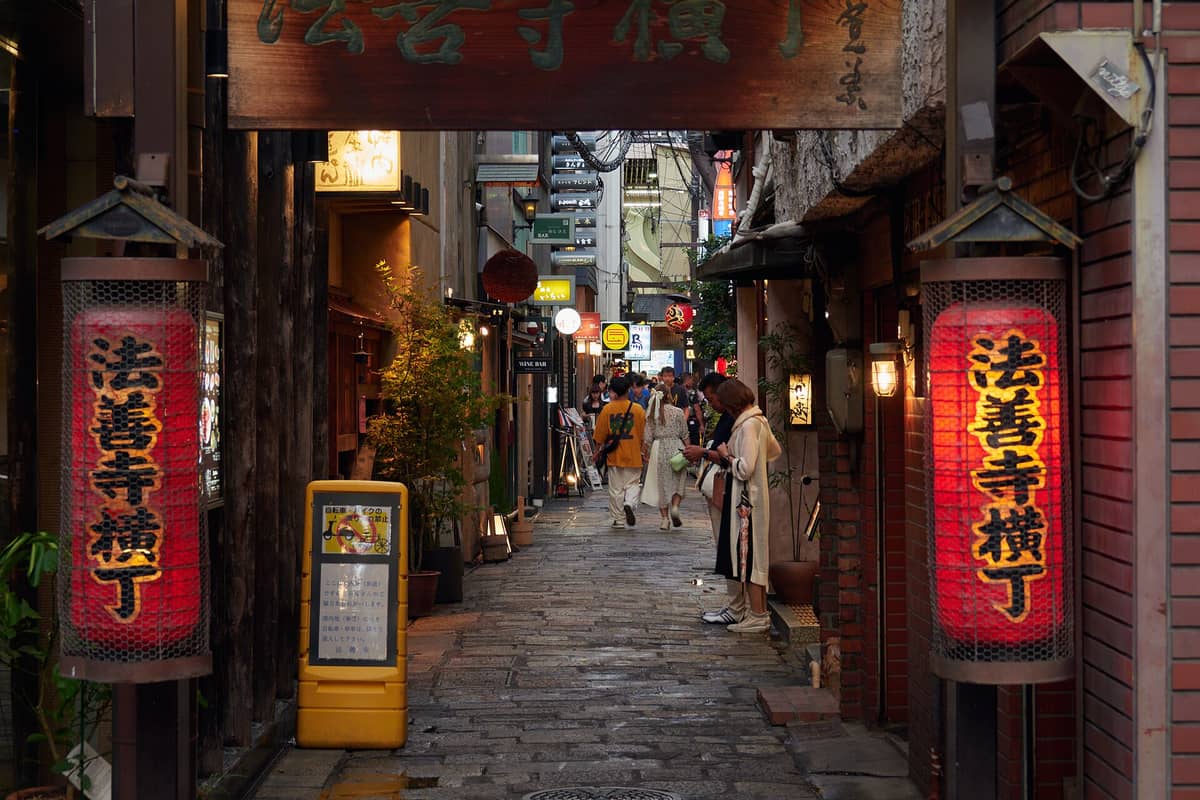
Hozenji Yokocho — written in Japanese as 法善寺横丁 — is a pair of narrow stone-paved lanes running east to west along either side of Hozenji Temple in Namba, Osaka. The alley is roughly 80 metres long in total, lined on both sides with small restaurants, izakayas, and bars that operate out of low-ceilinged buildings with wooden facades and paper lanterns. The lanes themselves are public, free to enter, and open at all hours.
Despite sitting less than two minutes' walk from the commercial roar of Dotonbori Canal, Hozenji Yokocho operates at an entirely different frequency. The stone underfoot is uneven and worn smooth by decades of foot traffic. The walls of adjacent buildings are colonised by thick green moss, which glistens after rain. At night, the lanterns cast amber light across the stones, and the smell of grilling meat and sake drifts out from narrow doorways barely wide enough for two people to pass comfortably.
💡 Local tip
The alley is open 24 hours, but most restaurants begin service from around 17:00 and many close by midnight or 01:00. If you want to see the alley at its liveliest, arrive between 19:00 and 21:00 on a weekday, when it is busy but not overcrowded.
The Experience: What You Actually See and Feel
Walking into Hozenji Yokocho from the Dotonbori end feels like stepping through a volume dial. The street noise drops, the scale shrinks, and the pace of people around you slows. The lane is narrow enough that you instinctively lower your voice. On either side, establishments are no wider than a single room, with handwritten menus posted outside in brushed ink or sliding wooden boards. There are no chain restaurants here.
The central feature is Hozenji Temple itself, where a small stone figure of Fudo Myo-o stands behind a curtain of thick moss — the result of decades of visitors splashing water on it as part of their prayers. This moss-covered deity is one of the most photographed spots in the entire Namba area, and for good reason: it has the kind of quiet, weathered presence that no amount of urban development has managed to erase. The temple grounds are free to enter and open 24 hours, though the temple office keeps standard daytime hours of approximately 10:00 to 18:00.
In summer, heat rises from the stone and the smell of charcoal is thick in the air. In winter, condensation fogs the windows of tiny counter-seating restaurants, and you can see diners hunched over bowls through the glass. Autumn rain makes the moss glisten and the lantern reflections stretch across the wet stones in long orange streaks. Each season changes the alley's character considerably, but the structural atmosphere remains consistent: intimate, worn, and thoroughly Osaka.
Tickets & tours
Hand-picked options from our booking partner. Prices are indicative; availability and final rates are confirmed when you complete your booking.
Kobe: Mt. Rokko Night View, Kitano Ijinkan, Arima Onsen Full Day Tour
From 47 €Instant confirmationFree cancellationOsaka local food tour in Dotonbori and Shinsekai
From 51 €Instant confirmationFree cancellationGuided day tour from Osaka to Nara Park, Arashiyama and Fushimi Inari
From 59 €Instant confirmationFree cancellationShiga Day Trip with Miho Museum, Lake Biwa and Waterbird Shrine
From 70 €Instant confirmationFree cancellation
History and Cultural Context
The alley takes its name from Hozenji Temple, which has stood in the Namba area since the Edo period. The lanes around it developed organically as small food and drink establishments settled close to a place that drew steady foot traffic from worshippers and theatre-goers at the nearby Bunraku puppet theatre district.
Hozenji Yokocho's literary reputation was cemented by the Osaka-born writer Sakunosuke Oda, whose novel 'Meoto Zenzai' (published in 1940) used the alley and its surroundings as a backdrop for a story of love and self-destruction. The novel is still in print and is considered a defining work of Osaka literature. The National Bunraku Theatre is a short walk away, and the cultural triangle between the temple, the alley, and the theatre gives this corner of Namba a depth of history that the newer entertainment districts around it lack.
The alley and temple burned in the 1945 Osaka air raids; the moss-covered Fudō statue survived, and the lane was rebuilt afterward with the same narrow stone-paved character. The paving, the moss, and the low building heights are now protected, so the alley looks broadly similar to photographs taken here in the decades after reconstruction. That continuity is still rare in a city that otherwise rebuilt itself comprehensively after the war.
Time of Day: How the Alley Changes
In the morning, Hozenji Yokocho is almost completely quiet. The restaurants are shuttered, the lanterns are unlit, and the stone lanes are washed clean. This is actually an excellent time to photograph the alley and the temple without crowds or clutter, particularly on weekdays. The moss on the Fudo statue is at its most vivid in morning light, when the colour has a blue-green intensity that the warmer tones of evening lanterns flatten out.
By late afternoon, the first kitchens begin to open, and staff start setting out wooden stools and lighting the paper lanterns. There is a specific transitional hour around 17:30 to 18:30 when the alley is warming up but not yet full: establishments are open, staff are attentive, and there is no wait for seats. This window is ideal for travellers who want to eat at a counter-seat restaurant without queuing.
After 20:00 on weekends, the alley fills to its comfortable limit. The lanes are narrow enough that even moderate crowds create a sense of density. Groups of office workers in suits cluster outside izakayas with drinks, couples queue outside older restaurants that don't take reservations, and the sound of conversation and distant kitchen noise layers into a consistent hum. It is atmospheric in the best sense, but it is not a peaceful experience at peak hours.
ℹ️ Good to know
Hozenji Yokocho is also worth visiting in light rain. The stone paving and moss absorb rain without flooding, and most establishments have short roof overhangs or are fully covered inside. Wet weather thins the crowd noticeably and makes the lantern reflections particularly striking.
Getting There and Getting Around
The alley sits in the Namba neighbourhood, roughly 200 metres south of the Dotonbori canal. From Namba Station, exit 14 puts you closest to the alley; it is a 3 to 5 minute walk south along Sennichimae-dori, then turn right at the entrance signs for Hozenji. The route is well-signposted in English.
Once inside, navigation is simple: the alley is essentially two parallel lanes of about 80 metres each, connected at both ends. You can walk end to end in under two minutes when it is quiet. The lanes are pedestrian-only, and there is no vehicle access. Footwear matters: the stone paving is uneven and becomes slippery when wet, so shoes with decent grip are advisable, particularly in rainy conditions.
⚠️ What to skip
Hozenji Yokocho is not suitable for wheelchairs or prams. The stone paving is uneven, the lanes are narrow, and there are no ramp access points. Travellers with mobility limitations may find it frustrating rather than enjoyable.
The alley is part of a broader walkable area that includes Hozenji Temple and connects easily to the Shinsaibashi-suji shopping street to the north and Namba Yasaka Shrine to the southwest, making it natural to combine all three into a single afternoon or evening walk.
Food and Drink: What the Alley Is Known For
The restaurants in Hozenji Yokocho specialise primarily in traditional Osaka dishes: fugu (puffer fish), kushikatsu (skewered and deep-fried meat and vegetables), obanzai (Kyoto-Osaka style small dishes), and kaiseki-influenced counter dining. Most are small operations with fewer than 15 seats, often arranged around a single counter where the chef works directly in front of you.
Prices in the alley are not tourist-trap elevated, but they are not bargain dining either. A proper sit-down dinner at one of the older, more established restaurants will cost roughly ¥4,000 to ¥10,000 per person depending on what you order and how much you drink. Counter seats at smaller izakayas can be considerably cheaper. Most establishments display menus outside with prices; if they do not, it is reasonable to ask before sitting down.
For budget-conscious travellers, the area around Hozenji Yokocho is surrounded by more affordable options. The Osaka street food guide covers the broader Namba and Dotonbori area in detail, and there are takoyaki and okonomiyaki stalls within a few minutes' walk.
Photography Tips
The alley photographs best at two specific times: early morning in dry conditions (for clarity and colour saturation on the moss), and during the evening lantern hours in wet weather (for reflections and atmospheric amber light). In both cases, a wide-angle lens or a phone with a wide mode will serve you better than a telephoto, since the lanes are too narrow to step back far.
The moss-covered Fudo statue inside the temple is the single most compelling subject in the alley. Position yourself slightly to one side rather than directly front-on to capture the depth of the water basin and surrounding stone. In the evening, the lantern light on the moss creates a warm contrast that is difficult to replicate with flash — turn your flash off entirely and let the available light do the work.
Be considerate when photographing the space. The alley is working premises for small restaurants, and lingering in narrow doorways to frame shots can genuinely obstruct customers and staff. Move through, photograph naturally, and step aside if diners are trying to enter or exit.
Who Should Skip Hozenji Yokocho
Travellers who are primarily interested in Osaka's modern food scene, its department store basement food halls, or its well-lit international-facing restaurants may find the alley underwhelming. The appeal here is the atmosphere and the sense of historical continuity, not novelty or spectacle. If you need scale, activity, or a party atmosphere, the Dotonbori strip 200 metres away will serve you far better.
Visitors with limited mobility should plan for the fact that the stone paving makes this a difficult space, and no accessible route through the alley exists. Families with young children in strollers will likely find it impractical during busy evening hours when the lanes fill quickly and manoeuvrability becomes nearly impossible.
Insider Tips
- The moss on the Fudo Myo-o statue is maintained by visitors splashing water on it before praying — this is an active religious custom, not decoration. Joining in is welcome; staring or photographing worshippers at close range is not.
- Several of the older restaurants in the alley do not take reservations and operate on a first-come basis. If you have a specific place in mind, arriving when doors open (around 17:00–17:30) is the only reliable way to guarantee a seat without waiting.
- The alley entrance from the Dotonbori side is easy to miss because it is set back slightly from the main road. Look for the stone lantern post and the small wooden signboard reading '法善寺横丁' at the opening — not all mapping apps pin the entrance correctly.
- On the last Sunday of January, the alley area around Hozenji Temple is associated with the Toka Ebisu festival period nearby — the streets fill with additional food stalls and foot traffic from the shrine celebrations. It is worth timing a visit accordingly or actively avoiding if you dislike extreme crowds.
- Cash is the standard payment method at most of the smaller establishments in the alley. While some newer places accept cards, many older restaurants and bars are cash-only. Bring enough yen before entering rather than relying on finding an ATM nearby.
Who Is Hozenji Yokocho For?
- Couples looking for an atmospheric evening walk away from the main Dotonbori crowd
- Solo travellers who want to eat at a traditional counter-seat restaurant in a genuine setting
- Photographers interested in texture, low-light lantern scenes, and moss-covered architectural detail
- Travellers with an interest in Osaka's literary or cultural history, particularly the Sakunosuke Oda connection
- Anyone wanting to understand what the Namba area looked like before the neon era
Nearby Attractions
Other things to see while in Dotonbori:
- Dotonbori Canal & Ebisubashi Bridge
The Dotonbori Canal is the beating heart of Osaka's entertainment district, a stretch of neon-lit canal flanked by massive advertising signs, open-air restaurants, and one of the most photographed bridges in Japan. Free to enter at any hour, the experience shifts dramatically depending on when you arrive.
- Hozenji Temple
Tucked behind the neon glare of Dotonbori, Hozenji Temple is a small Jodo-sect Buddhist temple famous for its thick-mossy Fudō Myōō statue and the narrow lantern-lined alley that frames it. Entry is free, the grounds are open around the clock, and the contrast with the surrounding entertainment district is so sharp it feels like stepping through a curtain.