Hozenji Temple: Osaka's Most Atmospheric Pocket of Quiet
Tucked behind the neon glare of Dotonbori, Hozenji Temple is a small Jodo-sect Buddhist temple famous for its thick-mossy Fudō Myōō statue and the narrow lantern-lined alley that frames it. Entry is free, the grounds are open around the clock, and the contrast with the surrounding entertainment district is so sharp it feels like stepping through a curtain.
Quick Facts
- Location
- 1-2-16 Namba, Chuo-ku, Osaka 542-0076 (Dotonbori district)
- Getting There
- Namba Station (Osaka Metro Midosuji / Yotsubashi / Sennichimae lines) – 3 to 5 min walk south
- Time Needed
- 20–40 minutes for the temple; longer if you linger in Hozenji Yokocho
- Cost
- Free entry. Amulets sold at the office (10:00–18:00).
- Best for
- Night visits, quiet moments between sightseeing, cultural context, photography
- Official website
- http://houzenji.jp
What Hozenji Temple Actually Is
Hozenji Temple, formally known as Jodo Sect Tenryuzan Hozenji Temple (浄土宗 天龍山 法善寺), is a small Buddhist temple belonging to the Jodo sect, set within a narrow stone-paved alley barely wide enough for four people to walk abreast. Its official address places it in Namba, Chuo-ku, but experientially it exists in its own dimension: surrounded on three sides by restaurants, bars, and the overflow crowds of Dotonbori, yet somehow quiet once you step inside.
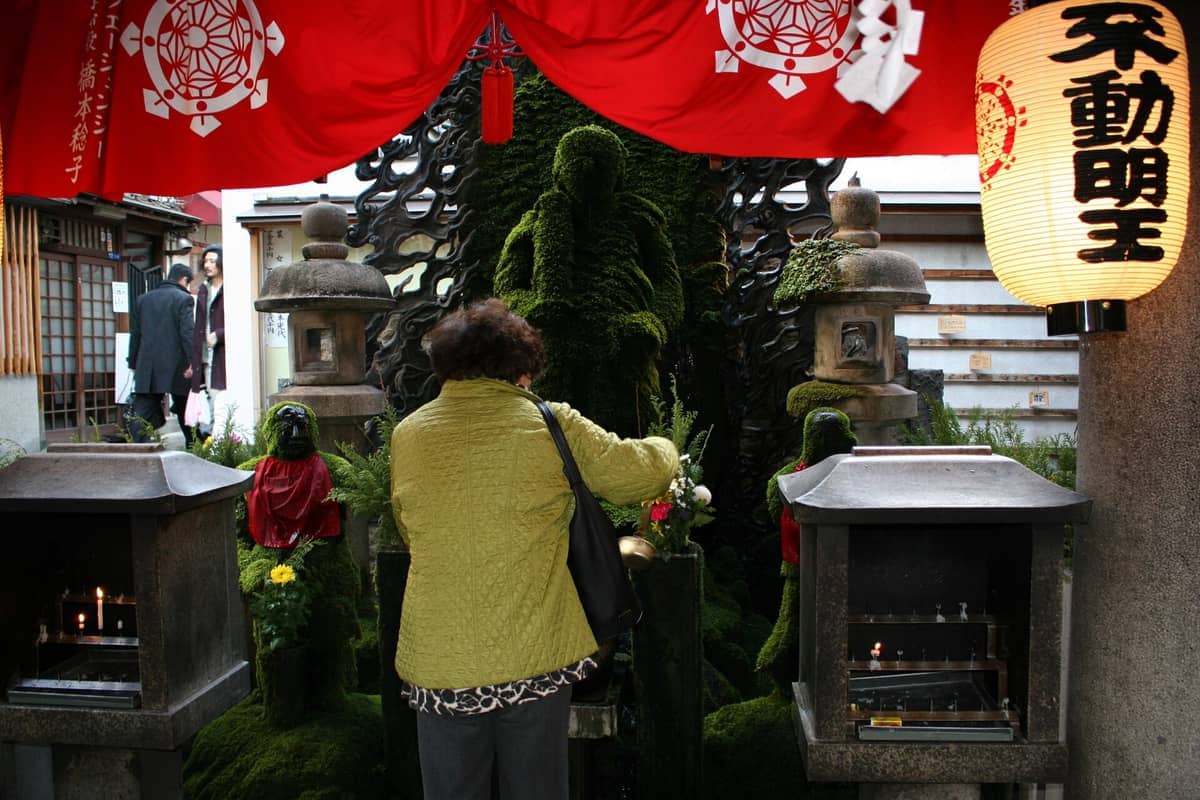
The temple's focal point is the Mizukake Fudō, a stone statue of Fudō Myōō that worshippers ladle water over as part of their prayers. Decades of this ritual have produced something visually striking: the statue is now almost entirely concealed beneath a thick, almost geological layer of bright green moss. Up close, the texture is extraordinary, the kind of layered growth you would expect on a centuries-old forest stone rather than a religious icon in the middle of a city.
💡 Local tip
The temple grounds are open 24 hours a day, year-round, and free to enter. Amulets and goshuin (temple seals) are available at the office from 10:00 to 18:00.
The Alley: Hozenji Yokocho
The experience of visiting Hozenji Temple is inseparable from the alley that frames it. Hozenji Yokocho is a stone-paved lane lined with traditional-style restaurants and small bars, their red lanterns casting a warm amber light on the damp cobblestones. The atmosphere here has a quality that the surrounding Dotonbori streets completely lack: it is deliberate, contained, and oddly intimate.
The alley runs roughly parallel to the Dotonbori canal, connecting Sennichimae-dori to the north with a quieter backstreet to the south. Many of the restaurants here have been operating for generations, their wooden facades darkened with age. The smell of grilling food mingles with incense smoke from the temple. Even on a Saturday night, when the surrounding streets are thick with noise, the alley has a muted quality that makes conversations feel private.
Note that the stone surface is uneven and there are steps at the temple entrance itself. Visitors using wheelchairs or pushchairs will find access difficult. The alley is narrow enough that it can feel crowded during peak evening hours, typically 19:00 to 21:00, when restaurant traffic and temple visitors overlap.
Tickets & tours
Hand-picked options from our booking partner. Prices are indicative; availability and final rates are confirmed when you complete your booking.
Kobe: Mt. Rokko Night View, Kitano Ijinkan, Arima Onsen Full Day Tour
From 47 €Instant confirmationFree cancellationOsaka local food tour in Dotonbori and Shinsekai
From 51 €Instant confirmationFree cancellationGuided day tour from Osaka to Nara Park, Arashiyama and Fushimi Inari
From 59 €Instant confirmationFree cancellationShiga Day Trip with Miho Museum, Lake Biwa and Waterbird Shrine
From 70 €Instant confirmationFree cancellation
History and Cultural Context
The temple is associated with Osaka's old Minami (south) entertainment district, which has occupied this area for several centuries. The Jodo sect, to which Hozenji belongs, is one of Japan's largest Pure Land Buddhist schools, with a focus on devotion to Amida Buddha. The Fudō Myōō (Acala in Sanskrit), however, is a deity associated with the esoteric Shingon tradition, indicating the syncretic religious character that is common in Japanese popular Buddhism.
The temple and its surrounding alley were devastated during the Allied air raids on Osaka in 1945, which caused widespread destruction across the Minami district. The temple was rebuilt in the postwar period, and the current structure preserves the traditional atmosphere of the original while the city around it transformed into the commercial district it is today. The rebuilt temple's ability to feel ancient despite this history is itself part of what makes it culturally interesting.
Hozenji has a particular association with artisans, entertainers, and workers from the nearby theater and food districts, who have historically visited to pray before performances or during difficult times. This connection to Osaka's merchant and entertainment culture gives it a different social character from a formal pilgrimage temple.
Best Time to Visit: Morning vs. Night
Hozenji Temple is one of those rare attractions that genuinely rewards two visits at different times of day. In the morning, between 7:00 and 9:00, the alley is nearly empty. The cobblestones are still damp from overnight cleaning, the lanterns are unlit, and the moss on the statue catches whatever early light filters between the buildings. The incense from overnight offerings still lingers faintly. If you want a contemplative experience and the best photography conditions, this is the window.
At night, specifically from around 18:00 onward, the lanterns along Hozenji Yokocho are lit and the contrast between the glowing amber light, the dark stone, and the green moss becomes visually pronounced. The sounds of restaurant kitchens and the distant roar of Dotonbori create a layered urban atmosphere that is genuinely distinctive. This is the version of Hozenji that most visitors encounter, and it earns the attention.
ℹ️ Good to know
Weekday evenings (Tuesday through Thursday) see noticeably thinner crowds in both the alley and the surrounding Dotonbori area. Weekend nights can be congested enough that the alley loses some of its intimacy.
Getting There and Practical Navigation
Hozenji Temple is a 3 to 5 minute walk from Namba Station, which is served by the Osaka Metro Midosuji, Yotsubashi, and Sennichimae lines, as well as Nankai, Kintetsu, and Hanshin railways. From Exit B16 of Namba Walk or Exit B18 at Nipponbashi Station, the walk is closer to one minute. The area sits just south of the Dotonbori canal, so most visitors approach after walking along the canal's south bank.
There is no on-site parking and the surrounding streets have limited vehicle access. The entire visit is on foot. From the Dotonbori main street, look for the gap in the restaurant facades along Sennichimae-dori and follow the stone-paved alley inward. Signage in both Japanese and English is present at the entrance.
If you are planning a wider walk through the Namba district, Hozenji fits naturally into a route that includes Shinsaibashi to the north and Shinsekai to the south, without adding significant walking distance.
Photography Notes and What to Expect
The moss-covered statue is the obvious photographic subject, and it is genuinely photogenic. The challenge is light: the statue sits in a recessed area that receives very little direct sunlight, so a camera or phone that handles low-light reasonably well will produce better results than one that does not. Flash photography at the statue should be avoided out of respect for worshippers, particularly when others are actively praying.
The alley itself photographs best with a slightly wider angle that captures the lanterns, the wet stone, and the narrow framing of the buildings on either side. In rain, the reflections on the cobblestones add considerable visual interest. Light rain is not a reason to skip the visit; it is arguably an improvement.
⚠️ What to skip
Hozenji is an active place of worship. Visitors should be respectful near the statue, particularly when locals are offering water or incense. Speaking quietly and not crowding the worship area when prayers are in progress is expected.
Honest Assessment: Who This Is For and Who Should Skip
Hozenji Temple delivers something rare in central Osaka: a moment of genuine quiet and cultural texture that requires no queuing, no ticket, and less than an hour of your time. It pairs well with a broader exploration of Dotonbori and works particularly well as an opening or closing point for an evening in the area.
That said, if your travel style prioritizes scale and spectacle, Hozenji may feel slight. The grounds are compact, the structures modest, and the experience is about atmosphere rather than exhibition. Travelers expecting something comparable in size or grandeur to Shitennoji Temple or Osaka Castle will be underwhelmed. For those visitors, it is worth a five-minute detour at most.
It is also worth noting that the area around Hozenji Yokocho is well documented in travel media, so it is not obscure. On busy weekend evenings, there can be enough visitors photographing the alley that the atmosphere feels performed rather than organic. If you are sensitive to that kind of crowd, a weekday morning visit is strongly preferable. For a wider view of Osaka's lesser-known spiritual sites, the guide to best temples and shrines in Osaka offers additional context.
Insider Tips
- Arrive before 8:00 on a weekday morning and you may have the entire alley to yourself. The moss on the statue catches the soft early light better than at any other time of day.
- Incense and candles are available near the statue. Participating in the water-pouring ritual (ladling water over the Fudō statue) is open to anyone and adds a tactile dimension to the visit that simply observing does not.
- The restaurants along Hozenji Yokocho are generally more expensive than the surrounding Dotonbori area, but several have been operating for decades and offer Osaka cuisine in a setting worth paying a small premium for. Booking ahead on weekends is advisable.
- Goshuin (the ink seal stamps collected at temples and shrines) are available at the office between 10:00 and 18:00. If you are maintaining a goshuin-cho (stamp book), Hozenji's seal is considered distinctive.
- Light rain transforms the alley. The stone becomes reflective, the lantern light scatters across the wet surface, and crowds thin noticeably. A small umbrella improves rather than diminishes the visit.
Who Is Hozenji Temple For?
- Travelers wanting a quiet contrast to the surrounding Dotonbori crowds
- Night photographers looking for lantern-lit atmospheric shots
- Cultural travelers interested in how Buddhism integrates into urban commercial life in Japan
- Anyone with 20–30 minutes between meals or activities in Namba
- Couples looking for a quieter, more intimate detour from the main entertainment streets
Nearby Attractions
Other things to see while in Dotonbori:
- Dotonbori Canal & Ebisubashi Bridge
The Dotonbori Canal is the beating heart of Osaka's entertainment district, a stretch of neon-lit canal flanked by massive advertising signs, open-air restaurants, and one of the most photographed bridges in Japan. Free to enter at any hour, the experience shifts dramatically depending on when you arrive.
- Hozenji Yokocho
Hozenji Yokocho is a pair of narrow, moss-draped lanes tucked beside a centuries-old temple just minutes from Dotonbori's neon. Free to enter and open around the clock, it offers one of the most evocative glimpses of old Osaka that survives in the city center today.