Dotonbori Canal & Ebisubashi Bridge: Osaka's Iconic Waterfront District
The Dotonbori Canal is the beating heart of Osaka's entertainment district, a stretch of neon-lit canal flanked by massive advertising signs, open-air restaurants, and one of the most photographed bridges in Japan. Free to enter at any hour, the experience shifts dramatically depending on when you arrive.
Quick Facts
- Location
- Dotonbori, Chuo Ward, Osaka, Japan
- Getting There
- Osaka Metro Namba Station (Exit 14), approx. 3 min walk; JR Namba Station, approx. 9 min walk
- Time Needed
- 1–3 hours for a casual walk; longer if dining or shopping
- Cost
- Free to enter the canal area and cross Ebisubashi Bridge; costs only apply for food, drinks, or optional attractions
- Best for
- First-time visitors to Osaka, food lovers, night photography, evening strolls
- Official website
- http://www.dotonbori.or.jp
What Is Dotonbori, Exactly?
The Dotonbori Canal (道頓堀, Dōtonbori) is a canal dating back over 400 years in the Minami district of central Osaka, excavated in the early 17th century and today surrounded by one of Japan's densest concentrations of restaurants, entertainment venues, and oversized commercial signage. Ebisubashi Bridge (戎橋, Ebisu-bashi), a 26-meter pedestrian span crossing the canal at its most recognizable point, has been a landmark since the canal itself was built, historically serving as part of the approach route toward Imamiya Ebisu Shrine.
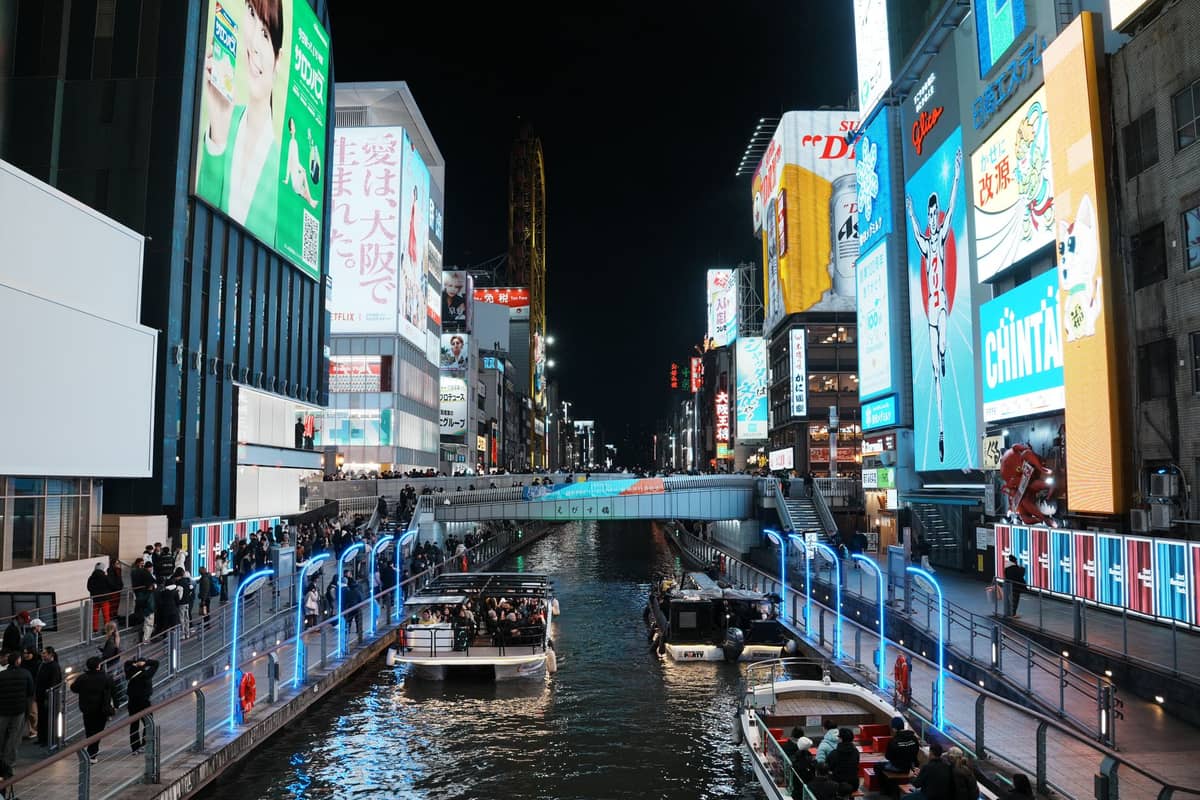
The district sits between Daikokubashi and Nippombashi bridges, running roughly east to west. On the north bank, the Tombori Riverwalk provides a lower-level promenade directly alongside the water. Above, on street level, the main Dotonbori strip is a pedestrian-priority street packed with takoyaki counters, ramen restaurants, crab-claw signs the size of small buildings, and the ubiquitous Glico Running Man LED billboard that has anchored the view from Ebisubashi for decades.
💡 Local tip
The area is open 24 hours with no admission fee. Shops and restaurants generally run from around 10:00–11:00 until 23:00, though some bars and street-food stalls stay open later. There is no single entrance or gate — you simply walk in.
How the Experience Changes by Time of Day
Arriving in the morning, around 9:00–10:00, is a genuinely different experience from arriving at 20:00. The canal walk is quiet enough that you can hear water lapping against the stone embankment. Delivery crews unload restaurant supplies. A few photographers position themselves on Ebisubashi without having to fight for space. The Glico sign is visible but subdued — it needs the darkness to fully perform.
By early afternoon, foot traffic builds steadily. Food vendors begin full operations, and the smell of frying batter becomes a constant. Takoyaki stalls heat their iron molds; the scent of soy-glazed skewers drifts from kushikatsu counters. At this hour, the canal reflections are cleaner, the pavement less crowded, and the restaurant facades easier to read without the crowds pressing in.
From 18:00 onward, Dotonbori becomes the version most people picture when they think of Osaka after dark. The neon signs ignite, the canal surface fractures into orange and red reflections, and the density of people on Ebisubashi Bridge increases significantly. This is the hour for photography if you want the full electric-city effect, but it requires patience to find a clean angle. By 21:00 on a weekend, the bridge is genuinely packed and moving through at pace is necessary rather than optional.
ℹ️ Good to know
For photography: the best light-to-crowd ratio on Ebisubashi is typically around 18:30–19:00 on a weekday, just after the signs light up but before weekend-level crowds arrive. Bring a wide-angle lens or use the Tombori Riverwalk below for lower, less-obstructed canal shots.
Tickets & tours
Hand-picked options from our booking partner. Prices are indicative; availability and final rates are confirmed when you complete your booking.
Osaka local food tour in Dotonbori and Shinsekai
From 51 €Instant confirmationFree cancellationKobe: Mt. Rokko Night View, Kitano Ijinkan, Arima Onsen Full Day Tour
From 47 €Instant confirmationFree cancellationGuided day tour from Osaka to Nara Park, Arashiyama and Fushimi Inari
From 59 €Instant confirmationFree cancellationShiga Day Trip with Miho Museum, Lake Biwa and Waterbird Shrine
From 70 €Instant confirmationFree cancellation
The Canal Walk and Tombori Riverwalk
Most visitors experience Dotonbori from street level, which is perfectly valid. But the Tombori Riverwalk, accessible by stairs at several points along the canal, places you at water level, where the scale of the signage above becomes more dramatic and the noise of the street recedes slightly. Small boats occasionally pass. The stone embankment is well-maintained, and the walk spans a meaningful stretch of the canal's length.
The riverwalk is less crowded than the street above, making it more comfortable for slow walkers, families with strollers, or anyone wanting a clearer view of the water and reflections without constant jostling. It connects naturally to the bridge stairs, so you can move between levels without backtracking far.
Ebisubashi Bridge: History and Present Use
Ebisubashi is not merely decorative. It is a functioning pedestrian crossing and historically significant structure, built around the same time the canal was excavated in the early 17th century. Its original purpose was partly ceremonial, serving pilgrims heading toward Imamiya Ebisu Shrine, a major commercial-deity shrine whose traditional foundations are said to date back to around the year 600.
Today, the bridge connects two distinct shopping corridors: Shinsaibashi-suji Shopping Street to the north and Ebisubashi-suji Shopping Street to the south. Standing on the bridge mid-span, you are at the junction of those two retail worlds, with the canal below and the Glico Running Man directly in your sightline to the east. It is, functionally, one of the best orientation points in the Minami district.
Ebisubashi is also a convenient starting point for exploring the wider Namba area. From the bridge, Shinsaibashi-suji Shopping Street is immediately to your north, while Hozenji Yokocho, one of Osaka's most atmospheric narrow lanes, is a short walk east of the canal.
Food, Crowds, and What You're Actually Getting Into
Dotonbori is where Osaka's food reputation is most loudly expressed. Takoyaki (octopus balls), kushikatsu (battered and fried skewers), and ramen dominate, but the strip also contains okonomiyaki restaurants, crab specialty houses, and dessert shops with queues that extend onto the pavement. Eating while walking is common here and not frowned upon the way it is in some other Japanese districts.
The sheer volume of food options can be overwhelming without some advance research. Our guide to what to eat in Osaka includes specific recommendations for the Dotonbori area that help cut through the noise.
A practical note on crowds: Dotonbori is genuinely congested on weekend evenings and during major Japanese holidays. If you have mobility limitations or find dense crowds uncomfortable, a morning visit provides a meaningfully different experience. The same visual landmarks are present, and the area is far more navigable before noon. This is also when the canal water is clearest, without the foot traffic stirring up movement around the lower riverwalk.
⚠️ What to skip
Dotonbori is frequently cited as one of Osaka's top attractions, but visitors expecting a quiet, traditional Japanese atmosphere will be disappointed. This is a loud, commercially dense entertainment district. The canal itself is narrow and not particularly scenic in daylight without the neon. Manage expectations accordingly.
Getting There and Navigating the Area
Ebisubashi Bridge is approximately 200 meters, or about a 3-minute walk, from Exit 14 of Osaka Metro Namba Station and Kintetsu Osaka-Namba Station, and around a 9-minute walk from JR Namba Station. The area is well-signposted in English, and the canal itself is visible before you reach the bridge if approaching from the station.
If you are combining Dotonbori with a broader Minami district itinerary, the Namba neighborhood page covers the surrounding transit connections, including access to Kuromon Ichiba Market and the Shinsekai district to the south. For a structured route, the Osaka walking tours guide includes a Minami circuit that passes through Dotonbori.
Footwear should be comfortable and flat — the canal-level riverwalk has some uneven stone sections, and you will be on your feet for extended periods if exploring the wider district. In summer (June through August), temperatures regularly exceed 30°C with high humidity, and the streets offer minimal shade. Carry water. In typhoon season (August through September), check weather forecasts before planning an evening visit.
Seasonal Considerations
Dotonbori operates year-round, and each season brings a distinct character. Spring evenings, particularly during cherry blossom season in late March to early April, attract additional visitors, and the combination of pink trees near the canal and the neon backdrop creates a genuinely striking visual. Autumn (October to November) brings comfortable temperatures and lower humidity, making it the most pleasant season for extended walking in the district.
Winter is quieter and manageable in terms of crowds, though December sees a spike around Christmas illuminations and the Tenjin Matsuri season ends well before then. For a broader look at seasonal timing, the best time to visit Osaka guide breaks down each month's trade-offs across weather, crowds, and events.
Insider Tips
- For the cleanest Glico sign shot from Ebisubashi, position yourself on the eastern railing of the bridge and visit between 18:30 and 19:15 on a weekday — signs are lit but the crush of bodies is not yet at weekend intensity.
- Walk down to the Tombori Riverwalk via the stairs near Daikokubashi. The lower level is almost always less crowded than the street above, and the canal reflections are far more visible from water level than from the bridge.
- Many of the best-value food counters are one street back from the main canal strip. The takoyaki stalls on the primary pedestrian walkway charge a premium for the location. Wander one parallel street south or north and you will often find equivalent quality at lower prices.
- The neon signs are timed: they do not all illuminate simultaneously at dusk. Arrive around 18:00 and watch the district power up gradually over 30 to 45 minutes — the process itself is worth witnessing once.
- If you want a boat-level view of the canal and signs, look for the Tombori Rivercruise boats that operate along the canal. Check schedules and fares directly with the operator before visiting, as they vary by season.
Who Is Dotonbori Canal & Ebisubashi Bridge For?
- First-time visitors to Osaka who want to understand why the city has the food and nightlife reputation it does
- Food travelers willing to eat multiple small dishes across several stalls in a single evening
- Night photographers drawn to neon reflections on water and high-energy commercial signage
- Travelers who enjoy people-watching in dense urban environments
- Anyone building a Minami district half-day itinerary that combines shopping, eating, and walking
Nearby Attractions
Other things to see while in Dotonbori:
- Hozenji Temple
Tucked behind the neon glare of Dotonbori, Hozenji Temple is a small Jodo-sect Buddhist temple famous for its thick-mossy Fudō Myōō statue and the narrow lantern-lined alley that frames it. Entry is free, the grounds are open around the clock, and the contrast with the surrounding entertainment district is so sharp it feels like stepping through a curtain.
- Hozenji Yokocho
Hozenji Yokocho is a pair of narrow, moss-draped lanes tucked beside a centuries-old temple just minutes from Dotonbori's neon. Free to enter and open around the clock, it offers one of the most evocative glimpses of old Osaka that survives in the city center today.