Kuromon Ichiba Market: Osaka's Kitchen, Explained Honestly
Kuromon Ichiba Market is a long-running covered food arcade in Osaka's Namba district, packed with fresh seafood, grilled skewers, and produce stalls. Free to enter and open from morning, it draws both professional chefs and curious travelers looking to eat their way through one of Japan's great food cities.
Quick Facts
- Location
- 2-4-1 Nipponbashi, Chuo-ku, Osaka 542-0073 (Namba district)
- Getting There
- Osaka Metro Nippombashi Station (about 2–5 min walk); also ~10 min walk from Namba Station
- Time Needed
- 45 minutes to 1.5 hours depending on how much you eat
- Cost
- Free to enter; individual food and produce prices vary by stall
- Best for
- Food lovers, morning shoppers, anyone wanting to experience Osaka's eating culture firsthand
- Official website
- kuromon.com/en
What Kuromon Ichiba Actually Is
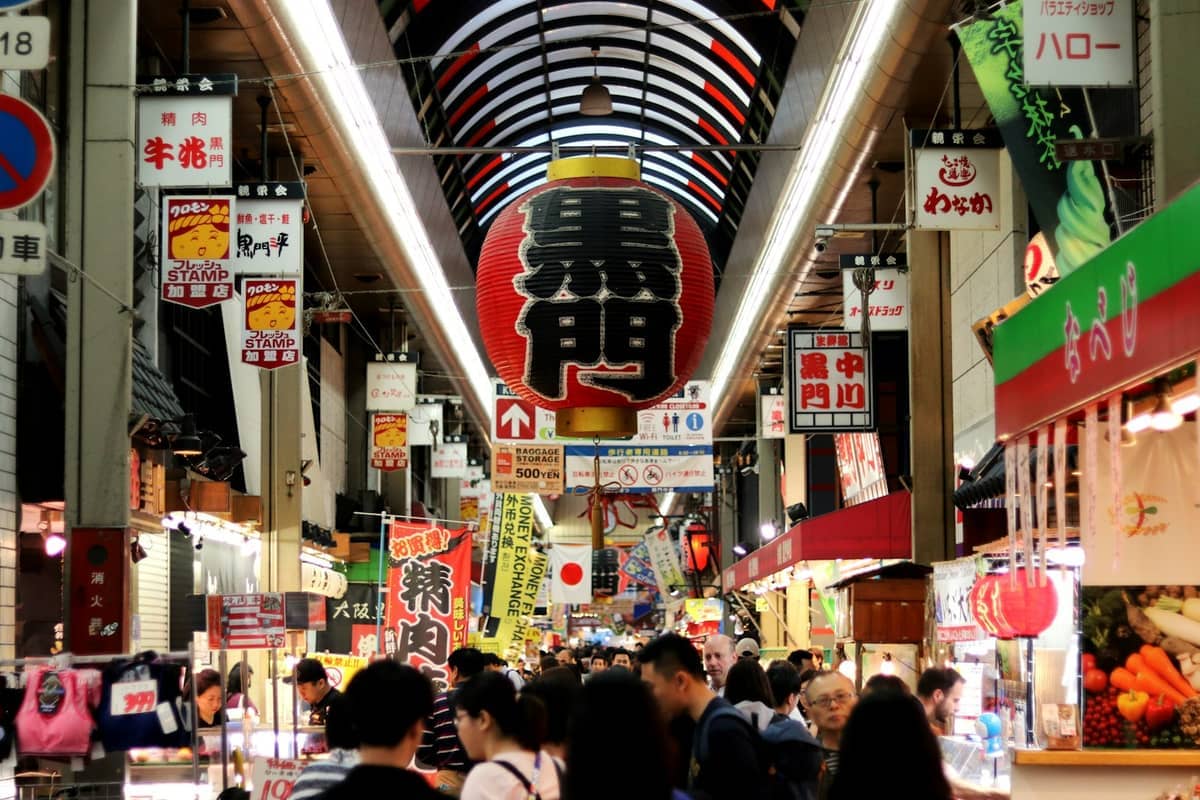
Kuromon Ichiba Market (黒門市場) is a covered shopping arcade stretching about 580 meters through the Nipponbashi area, just east of Namba's main commercial strip. For generations, it served as a wholesale and retail food market supplying restaurants and home kitchens across the city, earning the nickname 'Osaka's Kitchen' in official tourism literature. Today it operates somewhere between those two identities: a functioning food market in the mornings, and a more tourist-oriented eating arcade by midday.
The stalls sell an unusually wide range of goods: whole tuna and king crab legs on ice, live sea urchin cracked open to order, wagyu beef skewers grilled over charcoal, pickled vegetables in ceramic crocks, fresh tofu, seasonal fruit arranged in careful pyramids, and dried goods like katsuobushi and dried shrimp in bulk bags. It is not a single-category market. Walking the full length, you encounter almost every major ingredient used in Osaka cooking within a few hundred meters.
💡 Local tip
Most stalls post prices clearly. If something is unlabeled, ask before you assume. Many vendors speak enough English to handle basic transactions, and pointing works reliably here.
How the Market Changes Through the Day
Arriving between 8:00 and 10:00 puts you in the market at its most functional. This is when local restaurant buyers and home cooks make their rounds. The stalls are fully stocked, the fish counters are at their freshest, and the arcade has a purposeful, working-market feel rather than a performance of one. The smell in the early morning is clean and briny, not overwhelming, and the foot traffic is light enough that you can actually browse without being nudged along.
By late morning, the character shifts. Food-to-eat stalls fire up their grills, and the smell changes to charcoal smoke and grilled shellfish. Tourists begin to outnumber local shoppers, and the narrow corridor fills up. The midday atmosphere (roughly 11:00 to 14:00) is the loudest and most congested part of the day, with vendors calling out to passersby and the sound of sizzling mixing with recorded music from a few stalls. This is when Kuromon feels most like a destination rather than a market.
After 15:00, stalls begin to thin out. Some vendors close early once their stock sells through, particularly fish and seafood sellers. By 17:00 to 18:00, a significant portion of the arcade is shuttered. If you arrive after 16:00 expecting a full market experience, you will likely be disappointed. Plan around the morning window for the most complete visit.
⚠️ What to skip
Individual shop hours vary and are not standardized. A typical range is 8:00–18:00, but specific stalls may open later or close well before that. The market does not operate as a single unified entity with uniform hours.
Tickets & tours
Hand-picked options from our booking partner. Prices are indicative; availability and final rates are confirmed when you complete your booking.
Kuromon Market food walking tour in Osaka
From 31 €Instant confirmationFree cancellationKobe: Mt. Rokko Night View, Kitano Ijinkan, Arima Onsen Full Day Tour
From 47 €Instant confirmationFree cancellationOsaka local food tour in Dotonbori and Shinsekai
From 51 €Instant confirmationFree cancellationGuided day tour from Osaka to Nara Park, Arashiyama and Fushimi Inari
From 59 €Instant confirmationFree cancellation
What to Eat and How to Eat It
The most photogenic and frequently eaten items at Kuromon fall into a few reliable categories. Grilled scallops on the half shell, basted with soy and butter, are a recurring presence across multiple stalls. Tamagoyaki (thick rolled omelette) is sold in small slices, warm, with a faintly sweet-savory flavor that differs noticeably from the convenience store version. Freshly shucked oysters, king crab legs cracked and ready to eat, and sea urchin served directly in the shell with a small spoon are the high-ticket items, with prices that reflect their quality.
Eating while walking is accepted practice in Kuromon in a way it is not in all Japanese public spaces. Stalls that sell food to eat immediately provide small standing counters or plastic stools out front. This is not a sit-down experience: it is a series of small stops, each one adding to a cumulative meal that feels more satisfying than any individual item suggests it will be.
For a broader picture of Osaka's eating culture beyond the market itself, the guide to what to eat in Osaka covers the city's most important dishes and where to find them across multiple neighborhoods.
Historical and Cultural Context
Kuromon Ichiba sits within the Nipponbashi neighborhood, which historically formed part of Osaka's merchant city. The market's name, which translates roughly as 'Black Gate Market', is believed to derive from a gate belonging to a nearby temple, Enmyoji, that once stood in this area. The temple gate was black, and the name transferred to the surrounding marketplace over time.
Osaka has long defined itself by commerce and food. The city's cultural identity is often summarized by the phrase 'kuidaore', meaning to eat until you drop or to ruin yourself by eating. Kuromon sits at the practical center of that identity: it is where the raw materials of Osaka cuisine have historically moved from supplier to chef to table. Even as the customer base has shifted in recent decades to include more tourists, the underlying logic of the market, fresh ingredients, direct transactions, and no-frills presentation, remains consistent.
If you want to understand the neighborhood context better, the Namba district guide covers the broader area surrounding the market, including its entertainment, shopping, and transit connections.
Getting There and Moving Around
The most direct access is via Osaka Metro to Nippombashi Station, which is about a 2 to 3 minute walk from the market's main entrance. Namba Station, served by multiple metro lines and the Nankai Railway, is approximately a 10-minute walk. Both approaches involve flat, paved streets with no significant elevation changes.
The arcade itself is fully covered, which makes it a reasonable choice even on rainy days. The floor is flat and level throughout, and the main entrances are at street level with no steps. Wheelchair access is listed as available in travel database records, though the narrower sections of the arcade can become difficult to navigate during peak crowd hours. Strollers face similar constraints at busy times: the corridor width is fixed, and a congested midday visit can be physically uncomfortable with a large pram.
For broader navigation across Osaka, the getting around Osaka guide explains the metro system, IC cards, and day pass options that make the city easy to cover without renting a car.
Photography and Practical Notes
Kuromon photographs best in the morning, when natural light enters from both ends of the arcade and the stalls are fully stocked. The colors at a well-supplied fish counter or fresh produce stand, silver mackerel, orange salmon roe, deep red tuna, bright green shiso, are worth lingering over with a camera. By midday, the arcade is darker in feel due to crowd density, and spontaneous shots of the market in action become harder to compose cleanly.
Most vendors are accustomed to being photographed and do not object, particularly if you are buying from their stall. Photographing food you have just purchased is universally fine. Pointing a camera directly at a vendor's face without acknowledgment is not recommended: a small nod or gesture asking permission is usually met with an agreeable response and sometimes a pose.
Cash remains the dominant payment method at many individual stalls, though IC cards and card terminals are increasingly accepted. Bring cash as a backup, especially for smaller purchases at produce or dried goods stalls where card acceptance is inconsistent.
ℹ️ Good to know
Tipping is not customary in Japan. Do not tip vendors after a purchase; it can cause confusion and is generally refused. A sincere 'arigato gozaimasu' after a transaction is the appropriate acknowledgment.
Is Kuromon Worth It? An Honest Assessment
Kuromon Ichiba is genuinely interesting, but its reputation has somewhat outrun its reality for certain visitors. If you arrive expecting a quiet, authentic local food market untouched by tourism, you will find the midday version disappointing. Prices on some ready-to-eat items, particularly crab and sea urchin, are higher than at less-visited markets or restaurant equivalents. A few stalls lean heavily into tourist-facing presentation with prices to match.
That said, as an experience of Osaka's food culture, it delivers. The variety is genuine, the quality at reputable stalls is high, and the combination of sensory inputs, smoke, salt air, ceramic bowls of pickles, whole fish on ice, charcoal smoke from a grill two stalls down, adds up to something specific and memorable. Visitors who approach it as a place to eat rather than a place to photograph will leave more satisfied.
Those on a tighter budget may prefer to use Kuromon for browsing and context, then eat at stalls along Osaka's broader street food circuit, where portions are often cheaper and the tourist premium is lower.
Travelers with very limited mobility, a strong aversion to crowds, or no interest in food as an activity will find little reason to visit. The market has no displays, no historical exhibits, no performance component: it is entirely about buying and eating food. Those motivations need to be present for the visit to feel worthwhile.
Insider Tips
- Go on a weekday morning, ideally between 8:30 and 10:00, to see the market at its most functional and least crowded. Weekend middays are significantly more congested and the ready-to-eat stalls can develop queues.
- Walk the full length before buying anything. The arcade is roughly 580 meters end to end. Stall quality and pricing varies, and some of the better-value prepared food vendors are further in, past the first cluster near the main entrance.
- If you want to buy whole fish, shellfish, or produce to cook later, bring a small cooler bag or ask vendors about packaging. Several stalls are set up to package items for transport, including for same-day flights if you are departing from Kansai International.
- The stalls selling tamagoyaki and fresh tofu near the market's interior tend to draw less attention than seafood counters despite being among the higher-quality products available. They are also considerably cheaper.
- Nippombashi Station (not Namba Station) is the closest metro stop.
Who Is Kuromon Ichiba Market For?
- Food-focused travelers who want to understand Osaka's ingredient culture beyond restaurants
- Early risers: the morning window gives access to the market at its most complete and least crowded
- Visitors combining the market with nearby Dotonbori or Shinsaibashi for a half-day Namba food and shopping circuit
- Photographers interested in food and market life, particularly in the first two hours of the day
- Families with older children who can navigate a narrow, busy covered arcade and have some interest in food
Nearby Attractions
Other things to see while in Namba:
- Den Den Town (Nipponbashi)
Den Den Town, officially known as Nipponbashi Denden Town, is Osaka's answer to Tokyo's Akihabara: a dense stretch of electronics retailers, anime merchandise shops, retro game stores, and maid cafes running along Sakaisuji Avenue in Naniwa-ku. Entry is free, the district rewards slow exploration, and it reads completely differently depending on what time of day you arrive.
- Namba Yasaka Shrine
Namba Yasaka Shrine is a traditional Shinto shrine in central Osaka, instantly recognizable for its colossal lion-head stage structure standing 12 meters tall. Admission is free, the grounds are open from early morning, and the shrine sits just a short walk from the chaos of Dotonbori, making it one of the most rewarding and unexpected stops in the Namba area.
- National Bunraku Theatre
The National Bunraku Theatre in Osaka's Namba district is the dedicated home of bunraku, Japan's 400-year-old puppet theatre tradition and a UNESCO Intangible Cultural Heritage. Whether you come for a full performance or a free visit to the exhibition room, this is one of Osaka's most culturally significant and underappreciated attractions.
- Sennichimae Doguyasuji Shopping Street
Sennichimae Doguyasuji is a covered shopping arcade in Namba lined with hundreds of shops selling professional cookware, tableware, and restaurant supplies. Free to enter and a short walk from Namba Station, it offers a rare look at the trade infrastructure behind Osaka's celebrated food culture.