Sennichimae Doguyasuji Shopping Street: Osaka's Kitchen Street in Namba
Sennichimae Doguyasuji is a covered shopping arcade in Namba lined with hundreds of shops selling professional cookware, tableware, and restaurant supplies. Free to enter and a short walk from Namba Station, it offers a rare look at the trade infrastructure behind Osaka's celebrated food culture.
Quick Facts
- Location
- Namba Sennichimae, Chuo-ku, Osaka-shi, Osaka 542-0075
- Getting There
- Namba Station (Osaka Metro Midosuji Line or Nankai Railway), approx. 3–5 min walk; Nippombashi Station approx. 5 min walk
- Time Needed
- 45 minutes to 2 hours depending on interest
- Cost
- Free entry; purchases priced in JPY at individual shops
- Best for
- Food lovers, home cooks, professional chefs, culinary souvenir hunters
- Official website
- www.doguyasuji.or.jp/en
What Is Sennichimae Doguyasuji?
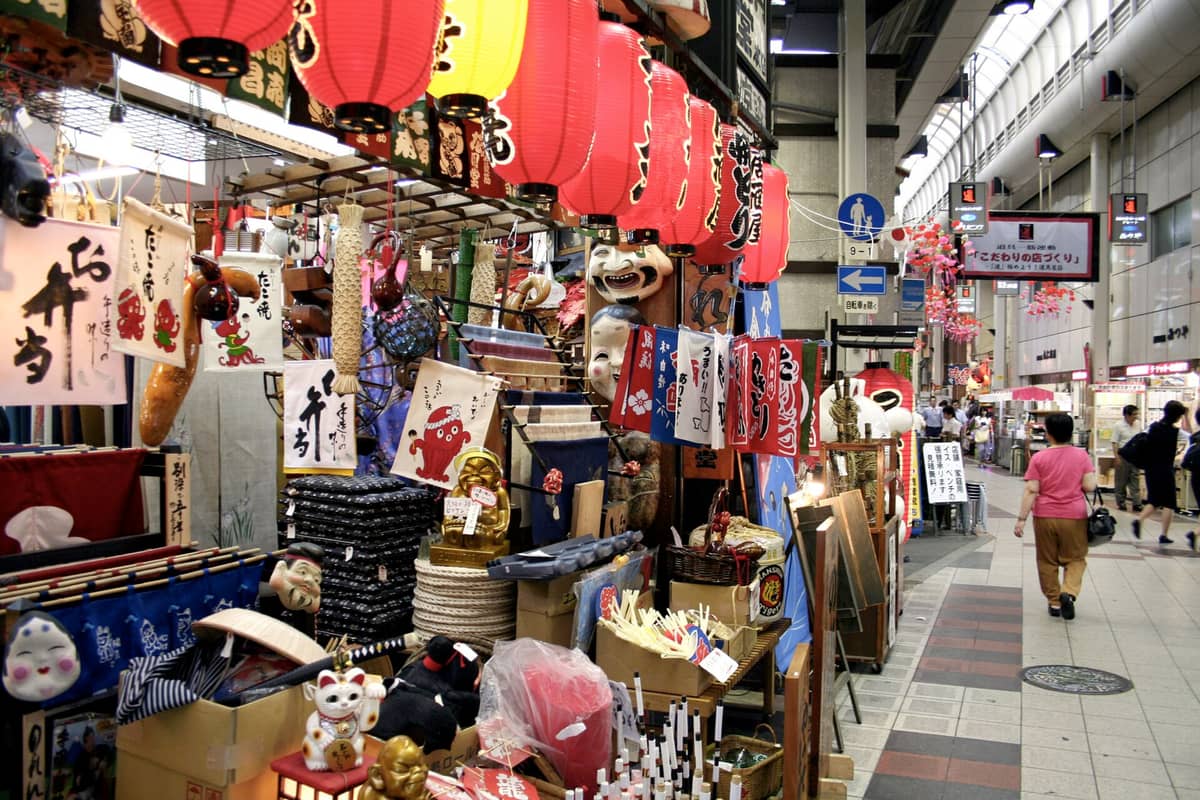
Sennichimae Doguyasuji Shopping Street (千日前道具屋筋商店街) is a roofed pedestrian arcade in the Namba district of Osaka, concentrated almost entirely on one trade: the tools of cooking. Walk its length and you pass shop after shop stacked floor to ceiling with carbon-steel knives, cast-iron pots, lacquerware bowls, bamboo steamers, ramen ladles, commercial-grade takoyaki griddles, and plastic food display models so realistic they border on sculpture. The street is free to enter, flat underfoot, and takes roughly 45 minutes to walk through at a browsing pace, though serious buyers routinely spend a full two hours examining inventory and talking to shop staff.
Namba is already one of Osaka's most dense commercial districts, but Doguyasuji stands apart from the surrounding retail noise. Where Namba's other shopping streets aim at fashion, electronics, or street food, Doguyasuji is almost exclusively professional in character. Its customers range from restaurant owners restocking their supply chain to tourists hunting a handcrafted knife to take home. That dual audience gives the street an unusually serious atmosphere for a tourist attraction, with none of the artificial theatrics found in many Osaka shopping arcades.
ℹ️ Good to know
The shopping arcade itself functions as a public street, but individual shops typically operate 10:00–18:00, with closing days set independently by each store. Plan your visit for a weekday morning to find the widest selection and staff with time to assist.
The History Behind the Street
The 'dogu' in Doguyasuji means 'tools' or 'utensils,' and the street's identity as a cookware district is deeply rooted in the surrounding area's history. The Sennichimae area historically developed around a theater district and marketplace, and the concentration of kitchen equipment suppliers grew to serve the restaurants, food stalls, and entertainment venues that clustered in this part of Namba. Osaka's identity as a city shaped around food commerce, sometimes described in Japanese as 'kuidaore' (eating oneself into ruin), is not just a tourism slogan. The city developed a supply chain for the restaurant industry over centuries, and Doguyasuji represents the visible, retail end of that infrastructure.
Unlike markets that were purpose-built or government-designated, Doguyasuji evolved organically as specialist suppliers clustered together for mutual benefit, creating the critical mass that made it worth the trip for professional buyers. The covered arcade format, common across Japan's older commercial streets, protects shoppers and merchandise from Osaka's summer rains and typhoon-season downpours, which is practically relevant: the street is usable year-round without rain gear.
Tickets & tours
Hand-picked options from our booking partner. Prices are indicative; availability and final rates are confirmed when you complete your booking.
Kobe: Mt. Rokko Night View, Kitano Ijinkan, Arima Onsen Full Day Tour
From 47 €Instant confirmationFree cancellationOsaka local food tour in Dotonbori and Shinsekai
From 51 €Instant confirmationFree cancellationGuided day tour from Osaka to Nara Park, Arashiyama and Fushimi Inari
From 59 €Instant confirmationFree cancellationShiga Day Trip with Miho Museum, Lake Biwa and Waterbird Shrine
From 70 €Instant confirmationFree cancellation
What You'll Actually Find Inside
The range of goods sold along the arcade's roughly 150-metre length is broader than 'cookware' suggests. Knives receive their own dedicated shops, often with glass cases displaying blades by steel type, blade geometry, and handle material. A salesperson at a quality knife shop will typically take time to explain the difference between a single-bevel yanagiba blade for sashimi and a double-bevel gyuto for general use, even if your Japanese is limited. Many of these shops stock professional-grade Japanese knives at prices that compare favourably to what the same pieces cost in specialty stores abroad.
Elsewhere you'll find shops focused entirely on lacquerware, others on commercial refrigeration signage, and a notable cluster selling the hyper-realistic plastic food samples (called 'shokuhin sampuru') used in Japanese restaurant window displays. These samples, ranging from a glistening bowl of ramen to a perfectly rendered parfait, make for unusual and genuinely memorable souvenirs. Budget collectors can find small keychains and magnets; serious buyers can commission custom pieces. The texture underfoot changes as you move between different shop entrances: smooth arcade tile, then worn wooden thresholds, then the occasional faint smell of machine oil from metalware stores.
Tableware covers a wide price spectrum. You can find machine-pressed ceramic bowls for a few hundred yen, or hand-thrown artisan pieces for several thousand. Bamboo and wooden kitchenware, including cutting boards and bento accessories, occupies multiple shops. Wholesale customers and individual buyers shop side by side, and most shops are set up to accommodate both.
Doguyasuji makes a logical pairing with the nearby Kuromon Ichiba Market, Osaka's famous fresh food market, which is a short walk northeast. The two complement each other well: one shows where professional chefs buy their ingredients, the other where they buy their tools.
How the Street Feels at Different Times of Day
Arriving shortly after 10:00 on a weekday morning is when the street most closely resembles a working trade district rather than a tourist site. Shop owners are arranging displays, delivery boxes are being broken down on the pavement outside, and the first customers are often restaurant staff on restocking runs. The smells at this hour are mild: a faint metallic note from cutlery displays, the occasional cedar scent from wooden goods.
By early afternoon, the tourist proportion of visitors increases noticeably. The narrow arcade can feel close during peak times in high season, particularly in spring and autumn when overall visitor numbers in Namba are highest. Even then, Doguyasuji rarely reaches the shoulder-to-shoulder density of the nearby Dotonbori strip because its specialist character naturally filters foot traffic.
Late afternoon, between 15:00 and 17:00, tends to be the window where shop staff are most willing to demonstrate products or spend time answering questions, before the closing rush of restocking. By 18:00, most shops are shuttered. The arcade itself stays accessible, but an empty Doguyasuji after dark is quiet to the point of being eerie, the shuttered gratings and unit displays offering nothing without the shops open.
💡 Local tip
Weekday mornings offer the most authentic experience and the best chance of finding staff with time to answer questions. Weekend afternoons bring more tourists and occasional stock depletion in popular items.
Getting There and Navigating the Arcade
The most straightforward approach is from Namba Station on the Osaka Metro Midosuji Line or Nankai Railway Namba Station, both about three minutes on foot. From Namba Station Exit 4, the walk takes closer to five minutes. Coming from the north, the entrance is marked by large signage adjacent to Namba Grand Kagetsu Theater. The southern entrance opens onto Nansan Dori Avenue.
Nippombashi Station (Osaka Metro Sakaisuji Line or Kintetsu Nippombashi) is an alternative entry point, roughly five minutes on foot from Exit 5. This approach puts you closer to Den Den Town, Osaka's electronics and anime retail corridor, if you want to combine visits. The street itself is a single covered arcade, flat throughout, with no significant steps or barriers along the main walkway. Specific barrier-free facilities such as accessible restrooms along the route are not detailed in official materials, so visitors with particular mobility requirements should check with individual shops or contact Osaka's tourism information centres directly.
Doguyasuji sits within a broader network of walkable Namba attractions. The Dotonbori Canal is under ten minutes on foot, and Hozenji Yokocho is similarly close, making the street a natural part of a half-day walk through central Namba.
Photography and What to Photograph
The plastic food displays are, visually, the street's most photogenic subject. The combination of extreme realism and deliberate artificiality makes them interesting at any camera skill level, and shop owners are generally tolerant of photography in common areas, though asking before photographing inside smaller shops is standard courtesy. The knife shops offer strong visual material too: rows of blades catching the overhead arcade lighting, handles arranged by material and colour.
Wide-angle shots of the full arcade length work best in the first and last hour of business, when the foot traffic thins and the perspective down the corridor is unobstructed. Overcast days produce more even lighting inside the covered arcade than direct sun, which can create harsh contrasts at the open ends of the street. A phone camera handles the ambient light well; dedicated camera gear is not necessary.
⚠️ What to skip
Always ask before photographing inside individual shops, especially smaller family-run stores. Most will say yes, but the courtesy of asking is expected.
Is Doguyasuji Worth Your Time?
If you have any serious interest in cooking, professional kitchenware, Japanese food culture, or distinctive souvenirs beyond the standard tourist fare, Doguyasuji is a clear yes. The concentration of specialist knowledge and quality goods in a single walkable corridor is genuinely unusual. For travellers on their first visit to Osaka whose priorities are iconic experiences and street food, Doguyasuji might sit lower on the priority list compared to the major sights. It is not a spectacle in the theatrical sense.
Travellers who are entirely indifferent to cooking and who find shopping streets uninteresting regardless of their content will find little to hold their attention here. But if a visit to Osaka touches its identity as a food city, exploring how the city's restaurants actually equip themselves is illuminating context. For a broader picture of the food scene, the Osaka food guide provides useful framing before or after your visit.
Insider Tips
- Knife shops on Doguyasuji often stock the same professional-grade blades used in Osaka's top restaurants. If you're buying a knife to take home, staff can advise on blade style for your cooking habits and discuss export-friendly handle materials. Ask about the difference between hagane (high-carbon steel) and stainless blends before deciding.
- The plastic food sample shops will make custom pieces, not just sell off-the-shelf items. If you want a personalised version of a specific dish, some shops accept orders. Lead times and minimum orders vary, so ask early in your Osaka trip if this interests you.
- Cross-reference prices on lacquerware and ceramics before buying. Doguyasuji's trade-oriented pricing can be very competitive, but the same applies in reverse for decorative items where specialty ceramics shops elsewhere in Osaka may offer a better selection.
- If your Japanese is limited, pointing and a phone translation app will get you surprisingly far. Many shop owners in the kitchenware trade have dealt with international restaurant buyers for years and are practised at communicating across language barriers.
- The Namba Grand Kagetsu Theater at the north entrance hosts regular comedy performances in the Osaka manzai tradition. If you are visiting in the evening after the shops close, a show there pairs naturally with the daytime Doguyasuji visit.
Who Is Sennichimae Doguyasuji Shopping Street For?
- Home cooks and professional chefs looking for quality Japanese knives, cookware, or tableware at trade-adjacent prices
- Travellers who want souvenirs with genuine cultural depth rather than standard tourist merchandise
- Food-focused visitors who want to understand the supply side of Osaka's restaurant culture
- Photographers interested in the visual contrast of hyper-realistic food replicas and traditional metalware
- Anyone combining a half-day walk through central Namba with stops at Dotonbori and Hozenji Yokocho
Nearby Attractions
Other things to see while in Namba:
- Den Den Town (Nipponbashi)
Den Den Town, officially known as Nipponbashi Denden Town, is Osaka's answer to Tokyo's Akihabara: a dense stretch of electronics retailers, anime merchandise shops, retro game stores, and maid cafes running along Sakaisuji Avenue in Naniwa-ku. Entry is free, the district rewards slow exploration, and it reads completely differently depending on what time of day you arrive.
- Kuromon Ichiba Market
Kuromon Ichiba Market is a long-running covered food arcade in Osaka's Namba district, packed with fresh seafood, grilled skewers, and produce stalls. Free to enter and open from morning, it draws both professional chefs and curious travelers looking to eat their way through one of Japan's great food cities.
- Namba Yasaka Shrine
Namba Yasaka Shrine is a traditional Shinto shrine in central Osaka, instantly recognizable for its colossal lion-head stage structure standing 12 meters tall. Admission is free, the grounds are open from early morning, and the shrine sits just a short walk from the chaos of Dotonbori, making it one of the most rewarding and unexpected stops in the Namba area.
- National Bunraku Theatre
The National Bunraku Theatre in Osaka's Namba district is the dedicated home of bunraku, Japan's 400-year-old puppet theatre tradition and a UNESCO Intangible Cultural Heritage. Whether you come for a full performance or a free visit to the exhibition room, this is one of Osaka's most culturally significant and underappreciated attractions.