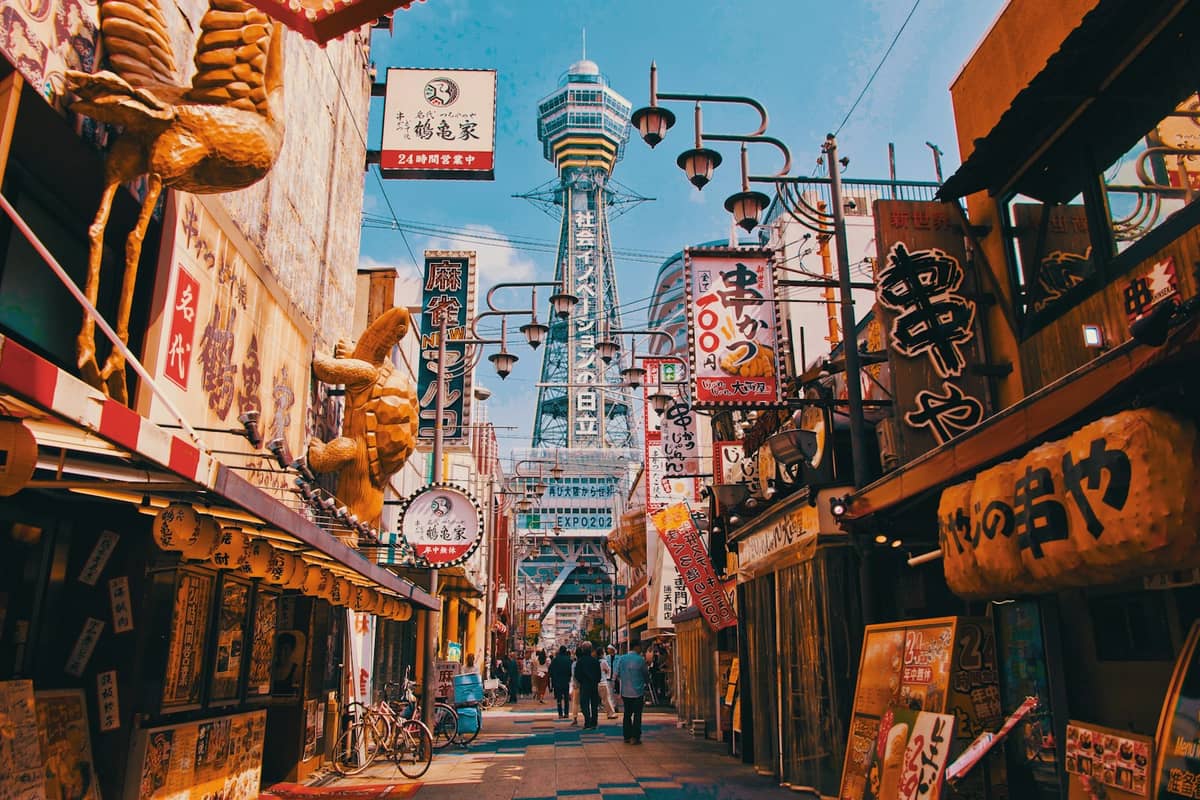
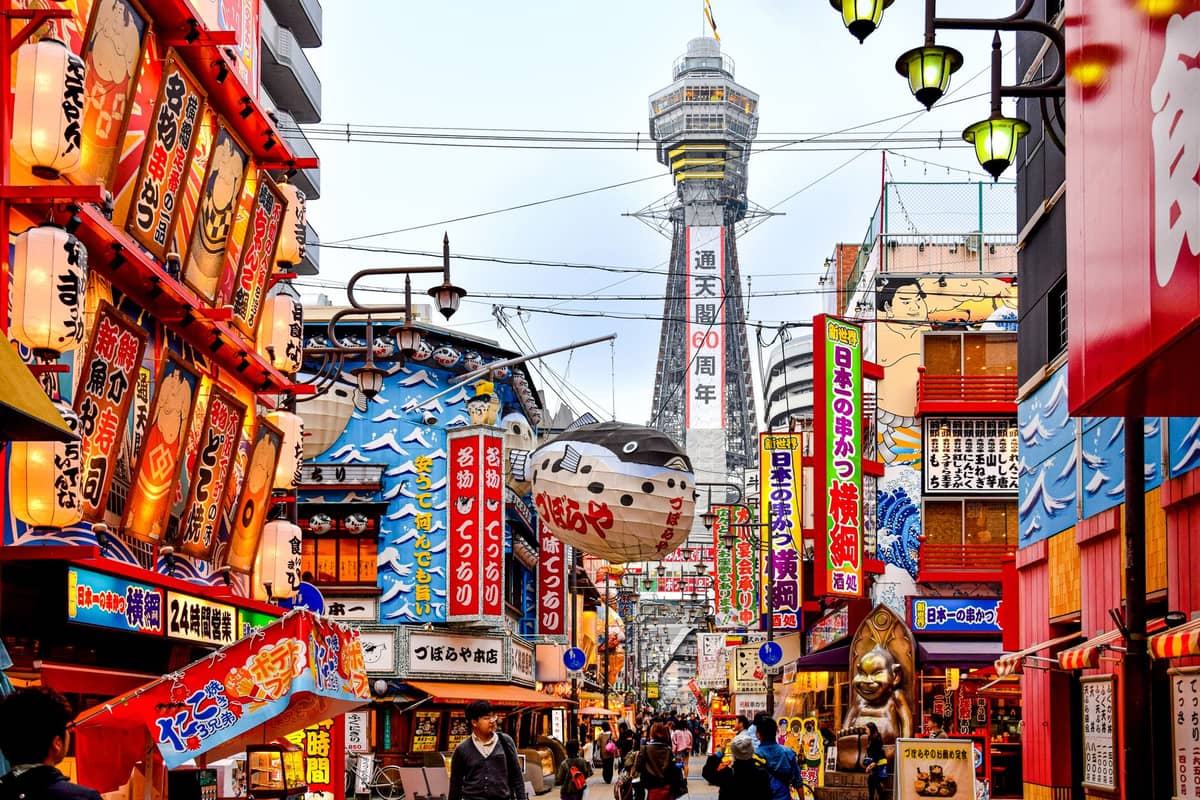
Shinsekai is Osaka's most unapologetically old-school neighborhood, a Showa-era entertainment district in Naniwa Ward where neon towers over kushikatsu joints, pachinko parlors, and narrow covered arcades. It sits just north of Tennoji, feels a world away from the polished shopping streets of Shinsaibashi, and rewards visitors who come ready to eat, drink, and absorb a version of Osaka that hasn't been gentrified into a theme park.
Shinsekai, which translates literally as 'New World,' is one of Osaka's most distinctive districts: a 20th-century entertainment quarter that never fully shed its rough edges, and is all the more interesting for it. Built in the early 1900s to evoke the grandeur of Paris in the north and New York's Coney Island in the south, it now exists as a time capsule of Showa-era Japan, ruled by the Tsutenkaku Tower and the smell of deep-fried kushikatsu skewers.
Orientation
Shinsekai occupies a compact area in Naniwa Ward in southern Osaka, centered on Ebisuhigashi 1 to 3-chome. It is not a large neighborhood in physical terms: you can walk its main streets end to end in about fifteen minutes. But its density is remarkable. Almost every storefront is occupied, almost every sign is backlit, and almost every alley leads somewhere worth poking into.
To build a mental map: Shinsekai sits just north of the Tennoji and Abeno district, one of Osaka's major transport and commercial hubs. The boundary between the two is roughly the line of Dobutsuen-mae Station on the Osaka Metro. To the northwest, the neighborhood blurs into the Nishinari district around Shin-Imamiya Station. To the east, Tennoji Park and the Tennoji Zoo form a natural edge. The area's spine is the Shinsekai Hondori Shopping Street, which runs north from the base of Tsutenkaku Tower, and the covered Janjan Yokocho arcade, which branches off to the south.
Shinsekai is easy to reach from almost anywhere in central Osaka in under 20 minutes by rail or metro. This accessibility, combined with its compact size, makes it well-suited as a half-day excursion or an evening destination rather than a base for a multi-day stay, though there are accommodation options nearby.
Character & Atmosphere
Shinsekai was designed in 1912 as a bold civic entertainment project, split conceptually into two halves: the northern section modeled on the Champs-Elysees in Paris, centered on a wide boulevard leading to a tower, and the southern section inspired by New York's Coney Island, built for working-class amusement. The original tower was dismantled during World War II for scrap metal. The current Tsutenkaku Tower is the second iteration, rebuilt in 1956, and it is this postwar, Showa-era identity that the neighborhood now wears most visibly.
In the morning, Shinsekai is quieter than you might expect. The arcades are swept clean, shopkeepers arrange their displays, and a few early-rising locals sit with coffee at plastic tables outside small diners. The Tsutenkaku Tower catches the morning light well, especially in the low-angle hours before 9am, and the streets around it are genuinely photogenic without crowds. This is the best time to notice the architectural texture: the layering of hand-painted signs, retro logos for beer brands, figurines of Billiken (the district's luck deity), and the corrugated awnings that have barely changed since the 1960s.
By midday, the energy shifts. Tour groups arrive, restaurants open their full menus, and the kushikatsu shops start filling with a mix of domestic tourists, office workers on lunch breaks, and curious international visitors. The covered arcades get warmer and noisier. Janjan Yokocho in particular feels like it's operating at full volume: mahjong parlors, small bars, and fry shops all running simultaneously in a narrow corridor barely four meters wide.
After dark, Shinsekai reveals a different register. The neon signs fully assert themselves, the pachinko parlors spill noise onto the street, and the bars begin filling with locals who live in the surrounding residential blocks rather than tourists passing through. The atmosphere is louder, looser, and decidedly more adult than the daytime version. It is not threatening on the main streets, but it is noticeably less curated than neighborhoods like Shinsaibashi or Namba.
ℹ️ Good to know
Shinsekai sits adjacent to the Nishinari district, particularly the area historically known as Kamagasaki or Airin, which has a higher concentration of day-labor workers and single-occupancy hotels. The main tourist streets of Shinsekai are well-trafficked and safe, but wandering south of Shin-Imamiya Station or Dobutsuen-mae Station into unfamiliar back streets late at night is not recommended. Apply normal city-level awareness: stay on lit streets, keep an eye on belongings, and trust your read of the immediate environment.
What to See & Do
The neighborhood's defining landmark is the Tsutenkaku Tower, a 103-meter steel structure that functions as both observation deck and neighborhood symbol. Its silhouette, usually lit in rotating colors after dark, is visible from considerable distances across southern Osaka. The tower has observation floors at multiple levels, and the views north toward Umeda and south toward Abeno Harukas are useful for orienting yourself to the city's geography. The Billiken shrine inside the tower, a good-luck figure associated with the district since the early 20th century, is worth seeking out.
Janjan Yokocho, the narrow covered arcade running south from near the tower, is the neighborhood's most atmospheric street. Roughly 180 meters long, it is lined with small restaurants, shogi (Japanese chess) parlors, mahjong clubs, and old-school bars. It feels genuinely lived-in rather than staged for tourists, which is increasingly unusual in Osaka's more visited neighborhoods. Walk its full length, resist the urge to photograph everything, and stop somewhere that looks local.
Adjacent to Shinsekai is Spa World, a large multi-floor onsen theme complex that draws visitors looking for a full soaking experience. It divides its bathing areas by geographic theme (European and Asian zones) and rotates them between floors by gender each month. It is not a quiet or particularly serene experience, but it is a practical option for an onsen visit without leaving the city. For more context on onsen options across Osaka, the Osaka onsen and spa guide covers the wider range of choices.
Within easy walking distance, the Shitennoji Temple is one of Japan's oldest Buddhist temple complexes, founded in 593 AD. It is a short walk east through the Tennoji neighborhood and represents a significant historical counterpoint to Shinsekai's modern carnival atmosphere. Combining both in a single day makes sense geographically and thematically.
Tsutenkaku Tower: observation deck, Billiken shrine, and tower exterior photography
Janjan Yokocho arcade: atmosphere, shogi parlors, local bars and eateries
Spa World: large onsen complex with multiple themed bathing zones
Tennoji Zoo and Tennoji Park (walking distance to the east)
Shitennoji Temple (10-15 minute walk east)
Eating & Drinking
Shinsekai is the birthplace of kushikatsu, and this fact is impossible to miss. Kushikatsu are deep-fried skewers, typically breaded in panko and fried in oil: the proteins and vegetables vary (pork, shrimp, lotus root, quail egg, cheese, and on and on), but the format is always the same: dip once in the communal sauce, and never double-dip. This is the one rule enforced at every kushikatsu restaurant in the district, usually announced by signs at every table. For a wider look at what Osaka does with street food and fried dishes, the Osaka street food guide puts kushikatsu in broader context alongside takoyaki, okonomiyaki, and other local specialties.
The price point is one of Shinsekai's strongest appeals. Most kushikatsu restaurants operate on a per-skewer pricing model, with individual skewers typically ranging from around 100 to 250 yen depending on the ingredient. A full, satisfying meal of 10 to 15 skewers with beer costs significantly less than comparable food in more upscale parts of the city. The atmosphere at these spots leans casual: counter seating, shared sauce pots, and often a television showing baseball or sumo.
Beyond kushikatsu, the neighborhood offers a range of old-school Osaka staples. Several shops sell doteyaki, beef sinew simmered in miso and sweet sake, which locals eat at the counter with a glass of beer. There are ramen shops tucked into the arcades, small izakayas serving grilled skewers and cold draft, and a few places specializing in fugu (puffer fish), which is a regional specialty served year-round in the south Osaka area. Do not expect refined presentation: this is food built around flavor and value.
Drinking in Shinsekai follows a similar logic. The bars are small, the prices are reasonable, and the clientele skews local. Janjan Yokocho has a concentration of standing bars and narrow counter seats where you can have a beer and watch the arcade foot traffic. A few spots cater specifically to tourists, but most are serving the same neighborhood regulars they have been serving for decades. If you want a louder, more organized bar experience, the streets immediately around the tower have establishments that are accustomed to non-Japanese visitors.
💡 Local tip
Arriving at kushikatsu restaurants before noon or after 2pm on weekdays avoids the peak lunch rush. On weekends, popular spots along Shinsekai Hondori can have queues from late morning onward. Some restaurants post English menus; many use picture menus, which is enough to navigate. The no-double-dipping rule is universal and non-negotiable.
Getting There & Around
Shinsekai is served by several transit options that make it easy to reach from most of central Osaka. The closest metro station to Tsutenkaku Tower is Ebisucho Station on the Osaka Metro Sakaisuji Line, approximately a three-minute walk to the tower's base. Dobutsuen-mae Station, served by both the Midosuji Line and the Sakaisuji Line, is about a six-minute walk to the tower and provides direct access from Namba (three minutes north) and Tennoji (one stop south). JR Shin-Imamiya Station on the Osaka Loop Line and the Yamatoji Line is also about a six-minute walk from the heart of Shinsekai.
From Namba, the most direct route is the Osaka Metro Midosuji Line to Dobutsuen-mae, two stops taking about four minutes. From Umeda, take the Midosuji Line south to Dobutsuen-mae (approximately 15 minutes). From Tennoji, either walk north through the park (about 15 minutes on foot) or take the Midosuji Line one stop north. For those arriving from Kansai International Airport, the Nankai Rapi:t or Airport Express train to Namba and then a Metro connection is the most straightforward route. The getting around Osaka guide covers the full metro network and IC card options in detail.
Within Shinsekai itself, everything is walkable. The neighborhood is compact enough that you do not need any transit once you arrive. The main streets are flat, the covered arcades are navigable in all weather, and the key attractions are no more than ten minutes apart on foot. Bicycles are also common in the area, and cycle parking is available near the main stations.
💡 Local tip
If you are combining Shinsekai with Tennoji in a single day, consider entering via Dobutsuen-mae Station (for Shinsekai first) and exiting via Tennoji Station after visiting Shitennoji and the Tennoji area. This creates a natural east-west walking route without backtracking.
Where to Stay
Shinsekai itself has limited upscale accommodation, but there are budget hotels, guesthouses, and capsule hotels in the immediate area, particularly around Shin-Imamiya Station. The area appeals most to budget-conscious travelers, backpackers, and those who want a local, non-sanitized version of Osaka as their base. If you prefer more central access to the city's main districts, staying in Namba or Shinsaibashi and visiting Shinsekai as a day or evening trip is a reasonable alternative.
Tennoji, directly adjacent to the southeast, offers a broader range of hotels including several mid-range and business hotel chains clustered around Tennoji and Abenobashi stations. Tennoji has its own strong identity and excellent transit connections, and it works well as a base for exploring both Shinsekai and the broader southern Osaka area. The where to stay in Osaka guide compares neighborhoods across the city and helps match accommodation areas to traveler priorities.
One thing worth noting: the proximity to the Nishinari/Airin district means that some of the cheapest hotels in the area are in buildings that primarily serve long-term or day-labor residents rather than tourists. These are safe in the sense that they are licensed establishments, but the environment around them may be unfamiliar or uncomfortable for first-time visitors. Reading recent reviews and choosing accommodation that is clearly oriented toward tourists is advisable if you are staying in this immediate vicinity.
⚠️ What to skip
Staying in Shinsekai or the Shin-Imamiya area is not recommended for travelers who are sensitive to urban grit, street-level poverty, or noisy late-night environments. If you are traveling with young children or prefer quieter surroundings, basing yourself in Tennoji or Namba and visiting Shinsekai for a few hours is a better fit.
Shinsekai vs. the Rest of Osaka
Shinsekai occupies a specific niche in Osaka's neighborhood landscape. It is not trying to compete with the shopping energy of Shinsaibashi-suji or the canal spectacle of Dotonbori. Its appeal is different: it offers a street-level view of an Osaka that predates the city's current commercial polish, a place where the Showa era is not a design aesthetic but a lived reality.
Travelers who approach Osaka primarily through its food culture will find Shinsekai essential. The combination of low prices, high quality kushikatsu, and authentic local atmosphere is difficult to find in the more tourist-saturated central districts. Those interested in the city's urban history and social character will also find it rewarding. It pairs particularly well with a morning at Osaka Castle or a visit to the Osaka Museum of Housing and Living in Tenjinbashisuji, both of which illuminate different periods of the city's past.
For visitors who want maximum photogenic impact with minimum friction, Shinsekai may feel rough compared to Namba or Dotonbori. The payoff for leaning into its character rather than comparing it to elsewhere is a neighborhood experience that feels genuinely Osaka rather than a version of Osaka packaged for export.
TL;DR
Shinsekai is a compact, walkable Showa-era entertainment district in Naniwa Ward, dominated by Tsutenkaku Tower and deep-fried kushikatsu restaurants.
Best experienced as a half-day visit or evening outing combined with nearby Tennoji rather than as a standalone base, unless you prefer budget accommodation and local, unpolished surroundings.
The main tourist streets are safe and well-trafficked; exercise normal city caution at night and avoid the back streets south of Shin-Imamiya Station after dark.
Kushikatsu here is cheaper and more authentic than anywhere else in the city: budget roughly 1,500 to 2,500 yen per person for a full skewer meal with drinks.
Ideal for food-focused travelers, urban history enthusiasts, and anyone who wants a less curated, more local counterpoint to Osaka's polished commercial districts.
Three days is enough time to cover Osaka's essential neighbourhoods, eat your way through its famous food scene, and still avoid the rookie mistakes that waste half a day. This itinerary is built around the city's subway network, logical geographic clusters, and the real trade-offs between tourist staples and worthwhile alternatives.
Osaka is a dense urban city, but it hides some genuinely excellent green spaces. From the riverside sakura corridors of Kema Sakuranomiya to the sweeping grounds of Expo '70 Commemorative Park, here are the best gardens and parks the city has to offer, organized by type and neighborhood.
Osaka holds its own against much larger museum cities as a museum city. Whether you're drawn to ancient Japanese history, world-class contemporary art, or interactive science, these are the museums worth building your itinerary around.
Osaka is better known for neon signs and street food than spiritual sites, but its temples and shrines are among the most rewarding in western Japan. This guide covers the best sacred places to visit, from ancient foundations to architecturally daring modern complexes, with practical tips on when to go and what to expect.
Osaka rewards visitors year-round, but the experience changes dramatically depending on when you go. This guide breaks down each season's weather, crowd levels, price patterns, and standout events so you can choose the timing that suits your priorities.
Osaka rewards those who look up, look out, and look down from its rooftops, towers, and waterways. This guide covers the best viewpoints in Osaka, from 300-meter observatories to lantern-lit alleys that frame the city in a completely different way.
Osaka sits at the heart of the Kansai rail network, putting some of Japan's greatest destinations within an hour's reach. This guide covers the best day trips from Osaka with precise travel times, fare comparisons, rail pass breakdowns, and a clear take on what each destination is actually worth.
Osaka rewards travelers who explore on foot. From the neon-lit canal at Dotonbori to ancient shrines, riverside parks, and covered shopping streets that double as social spaces, the city is packed with free experiences. This guide covers the best of them, organized by type.
Osaka has one of the most efficient urban transport networks in Japan, with nine color-coded metro lines, overlapping JR and private railways, and a tap-and-go IC card system that connects virtually every corner of the city. This guide covers everything from airport transfers to day passes, so you spend less time figuring out tickets and more time exploring.
Osaka is Japan's third-largest city and one of Asia's most compelling urban destinations. But is it worth your limited travel time? This guide cuts through the noise with a clear look at what Osaka delivers — and where it falls short.
Osaka is served by two airports with very different purposes. Kansai International (KIX) handles almost all international flights, while Itami (ITM) is a domestic-only hub. This guide breaks down every transport option, current fare ranges, journey times, and which airport actually makes sense for your trip.
The Osaka Amazing Pass bundles unlimited transit with free attraction entry across the city. This guide breaks down current prices, what the pass actually covers, how to buy the new e-ticket version, and whether the math works out for your itinerary.
Osaka's anime scene is anchored by Den Den Town in Nipponbashi, a compact district packed with over 150 specialist shops covering manga, figures, retro games, doujinshi, and cosplay. This guide covers every key spot, the best stores, practical logistics, and where to find anime culture outside the main district.
Osaka's cherry blossom season typically peaks in early April, but the full picture is more nuanced than most guides admit. From riverside parks with 5,000 trees to a rare late-blooming tunnel at the Mint Bureau, this guide covers exactly when to go, where to stand, and how to avoid the most crowded mistakes.
Osaka rewards couples who look beyond the neon and crowds. This guide covers the most romantic experiences in the city, from panoramic observatory dates and evening bay cruises to quiet temple lanes and seasonal illumination events, with a clear take on what's worth it and what to skip.
Osaka rewards those who look beyond Dotonbori and Osaka Castle. This guide uncovers the city's overlooked shrines, nostalgic neighborhoods, market streets, and natural escapes that locals actually love.
Autumn is one of Osaka's strongest seasons, with koyo (fall foliage) peaking from mid-November into early December across parks, castle grounds, and riverside paths. This guide covers the best viewing spots, seasonal weather, crowd patterns, and practical logistics so you can plan with confidence.
Thinking about visiting Osaka between December and February? This guide covers the real winter weather, what's open, the best seasonal events, crowd patterns, and a clear take on whether a winter trip makes sense for you.
Osaka after dark is a different city entirely. From the neon-lit canal banks of Dotonbori to the whisky bars of Kitashinchi and the club floors of Shinsaibashi, this guide covers every tier of Osaka nightlife with practical logistics, practical recommendations, and the local knowledge to do it right.
Osaka rewards budget travelers more than almost any other major Japanese city. Between free parks, cheap street food, and the right transit pass, you can cover the highlights without spending a fortune. This guide breaks down exactly where to spend, where to save, and what the tourist traps actually cost.
Osaka has a surprisingly strong onsen scene for a major urban center, ranging from the enormous themed Spa World to sleek modern complexes and neighborhood sento. This guide covers the top facilities, realistic pricing, tattoo policies, seasonal timing, and everything else you need before you strip down and soak.
Osaka and Kyoto sit just 30 minutes apart by train, but they offer very different experiences as a home base. This guide breaks down transport links, accommodation costs, crowd dynamics, and the kind of traveler each city suits best, so you can make the right call before you book.
Osaka is one of Japan's great shopping cities, with distinct districts for every budget and interest. This guide breaks down the best areas, what to buy in each, how tax-free shopping works, and the traps to avoid — so you spend time buying, not wandering.
Osaka has one of the most serious street food cultures in Japan, built around the local philosophy of kuidaore: eat until you drop. This guide covers the essential dishes, the best areas to find them, practical logistics, and a clear take on what lives up to the hype.
The Sanyo Shinkansen makes Osaka to Hiroshima one of Japan's most rewarding day trips, covering roughly 342 km in around 80 minutes. This guide breaks down every transport option, real fare ranges, booking strategy, and what to prioritize once you arrive in Hiroshima.
Kyoto is just 24 minutes from central Osaka by train, but choosing the wrong route can cost you time and money. This guide covers every transport option, from the cheapest private railways to the shinkansen, plus practical advice on where to go in Kyoto once you arrive.
Nara is one of the most rewarding day trips from Osaka, with ancient temples, free-roaming deer, and journey times under an hour. This guide breaks down every transport option, compares costs, and gives you the practical detail to make the day run smoothly.
Osaka rewards walkers more than almost any city in Japan. This guide breaks down the best self-guided walking routes by neighborhood, covers the transit passes that make hopping between areas affordable, and gives you the practical detail you need to plan a full day on foot without second-guessing yourself.
From the whale sharks of Kaiyukan to the Mushroom Kingdom at Universal Studios Japan, Osaka delivers serious family fun across every age group. This guide covers the best kid-friendly attractions, current admission prices, crowd patterns, and practical logistics to make your family trip run smoothly.
Tenjin Matsuri is one of Japan's three great festivals, held every July at Osaka Tenmangu Shrine. This guide covers the 2026 dates, the land and boat processions, fireworks timings, viewing options, and everything you need to plan your visit without the usual tourist pitfalls.
Osaka rewards visitors with a rare combination of serious history, world-class food, and nightlife that runs until dawn. This guide covers the top things to do in Osaka Japan, from feudal castles and temple districts to canal-side street food and sweeping city views, with up-to-date prices, the best times to visit each attraction, and a clear take on what is worth your time.
Universal Studios Japan is one of the most-visited theme parks in Asia, and also one of the most misunderstood. This guide covers everything first-timers get wrong: dynamic ticket pricing, Super Nintendo World timed entry, Express Pass strategy, and the fastest routes from central Osaka.
Osaka has earned its reputation as Japan's kitchen over centuries, and the city's food culture runs far deeper than the few dishes that dominate travel blogs. This guide covers the essential Osaka foods every visitor should try, with real prices, the best areas to eat them, and practical advice on what to skip.
Choosing where to stay in Osaka shapes your entire trip. This guide breaks down every major neighborhood by vibe, price, and practicality — so you can book the right area, not just the cheapest room.