Shitennoji Temple: Osaka's Oldest Buddhist Complex
Founded in 593 by Prince Shotoku, Shitennoji Temple is considered Japan's first officially established Buddhist temple. Spanning a full city block in Tennoji, it offers a rare straight-axis temple layout, a serene pond garden, and a modest treasure house — all within easy reach of central Osaka.
Quick Facts
- Location
- 1-11-18 Shitennoji, Tennoji-ku, Osaka 543-0051
- Getting There
- Shitennoji-mae Yuhigaoka Station (Osaka Metro Tanimachi Line, South Exit); also walkable from JR Tennoji Station
- Time Needed
- 1–2 hours for the full complex; 30–45 minutes for outer grounds only
- Cost
- Outer grounds: free. Central Precinct: ¥300 adults. Garden: ¥300 adults. Treasure House: ¥500 adults. Verify current prices before visiting.
- Best for
- History and architecture enthusiasts, Buddhist culture, quiet morning walks, solo travelers
- Official website
- http://www.shitennoji.or.jp
Why Shitennoji Matters
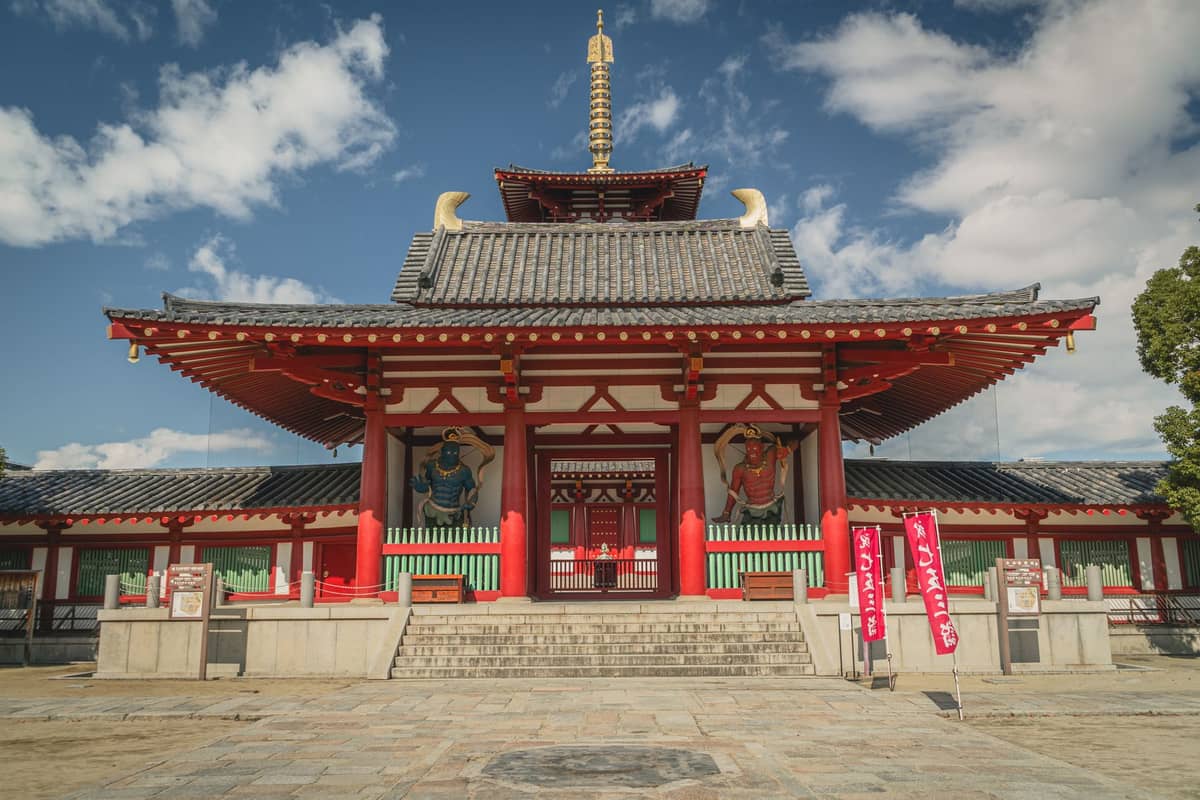
Shitennoji Temple is not simply one of Osaka's older landmarks — it is among the oldest Buddhist institutions in the entire country. Founded in 593 by Prince Shotoku, a regent credited with promoting Buddhism as a state religion, the temple predates many of Japan's most famous religious sites. The present buildings are reconstructions (the originals were destroyed by fire multiple times over the centuries), but the layout they follow is original: a straight south-to-north axis aligning the main gate, a five-story pagoda, the main hall (kondo), and the lecture hall (kodo), enclosed within a rectangular cloister. This garandō configuration is considered one of the earliest formal temple plans in Japanese Buddhist architecture and is preserved almost nowhere else in Japan at this scale.
That historical weight gives Shitennoji a different register than many temples that rely on scenic setting or atmospheric decay. This is a living, working religious complex in the middle of a dense urban ward. Monks conduct ceremonies here. Local worshippers come on weekdays not for tourism but for prayer. On the 21st of each month, a large flea market spreads across the outer grounds, drawing antique dealers, secondhand clothing sellers, and curious locals from across the city. The temple operates on its own internal calendar, and visitors who pay attention to that rhythm will have a much richer experience than those who simply walk through.
The Outer Grounds: Free and Open Around the Clock
The outer precincts of Shitennoji are accessible 24 hours a day, and this matters more than it might seem. Early mornings — before 8:30, when the inner buildings open — the grounds have a particular stillness. The stone lanterns that line the paths catch the low light. Elderly residents from the Tennoji neighborhood do slow circuits of the outer walkways. Pigeons gather near the south gate (Nandaimon), the main stone torii that marks the ceremonial entrance from the south. The torii is itself unusual: a stone archway at the entrance to a Buddhist temple is a feature rooted in the historical fusion of Shinto and Buddhist practice, and Shitennoji is one of the most prominent surviving examples of that syncretism.
The outer grounds contain subsidiary shrines, memorial stones, and several smaller halls that never close. If you visit at dusk, the stone paving takes on a grey-blue tone and the crowds thin considerably. Summer evenings can be warm and humid, but the open space inside the compound provides some air movement that the surrounding streets do not. In winter, the grounds are quieter than almost any temple in Kyoto and far less photogenic — but also entirely uncrowded, which has its own value.
💡 Local tip
The 21st of each month is Shitennoji's monthly market day (Daishi-san). Hundreds of stalls fill the outer grounds from early morning until afternoon, selling ceramics, lacquerware, vintage kimono, and antique tools. Arrive by 9:00 for the best selection before the crowds thicken.
Tickets & tours
Hand-picked options from our booking partner. Prices are indicative; availability and final rates are confirmed when you complete your booking.
Kobe: Mt. Rokko Night View, Kitano Ijinkan, Arima Onsen Full Day Tour
From 47 €Instant confirmationFree cancellationOsaka local food tour in Dotonbori and Shinsekai
From 51 €Instant confirmationFree cancellationGuided day tour from Osaka to Nara Park, Arashiyama and Fushimi Inari
From 59 €Instant confirmationFree cancellationShiga Day Trip with Miho Museum, Lake Biwa and Waterbird Shrine
From 70 €Instant confirmationFree cancellation
The Central Precinct: Architecture and Atmosphere
Admission to the Central Precinct (Garan) costs ¥300 for adults and covers the walled inner compound with the pagoda, the kondo (main hall), the kodo (lecture hall), and the enclosed corridor that links them. The scale is not overwhelming — this is not a sprawling mountain temple — but the geometry is precise and intentional. Walking through the south cloister gate into the inner compound, the pagoda appears directly ahead, and beyond it the roofline of the kondo. Everything is aligned on a single axis. The effect is one of clarity rather than grandeur.
The five-story pagoda can be climbed for an additional view of the compound from above and, on clear days, a partial view of the Tennoji skyline including Abeno Harukas, the tallest building in western Japan. The climb is steep and involves narrow interior stairs, so it is worth knowing in advance if mobility is a concern. The kondo houses the principal Buddhist images and is a place of active worship; visitors are expected to be respectful of ceremonies in progress, which can happen at any time.
The reconstructed buildings are painted in deep ochre-red and white, which can look vivid in afternoon sunlight and slightly flat on overcast days. Photography inside the halls is typically restricted, but the outer compound and pagoda exterior are freely photographable. The best light for the pagoda is in the morning, when the sun hits the structure from the east and the surrounding stone is still cool.
ℹ️ Good to know
Central Precinct hours: April–September 8:30–16:30; October–March 8:30–16:00. On the 21st of each month and certain special days, hours may extend from 8:00. Verify the current schedule at shitennoji.or.jp before visiting.
The Gokuraku-jodo Garden
The Gokuraku-jodo Garden occupies the northeast section of the complex and represents a different kind of experience from the stone-and-pagoda formality of the central precinct. Modeled on the Buddhist concept of the Pure Land, it centers on a pond with a small island connected by stone bridges. Koi move slowly through the water. Maples and other deciduous trees surround the pond, making autumn (mid-November in particular) the season when this garden is at its most photogenic, with reflected color on the water's surface.
Admission is ¥300 for adults, purchased separately from the Central Precinct ticket. The garden is small enough to walk through in fifteen minutes, but benches face the water and it is a reasonable place to sit quietly for longer. On weekday mornings outside of school holidays, the garden sees few visitors. On weekends in spring and autumn, especially during cherry blossom season, it can become crowded enough that the benches are occupied and the bridges congested.
If the garden is your primary reason for visiting, the Nishinomaru Garden at Osaka Castle is a larger and arguably more impressive alternative for spring blossoms. Shitennoji's garden is better understood as a complement to the wider temple visit rather than a standalone destination.
The Treasure House
The temple's Treasure House (Homotsukan) holds a rotating collection of Buddhist sculptures, ritual objects, paintings, and documents connected to the temple's long history. The quality of the artifacts is genuine and some pieces are designated important cultural properties. The museum-style display is modest in presentation — low lighting, minimal English signage — but rewarding for anyone with an interest in early Japanese Buddhist art. Admission is ¥500 for adults, separate from other tickets. Opening periods are limited and should be confirmed in advance, as the Treasure House does not always operate on the same schedule as the rest of the complex.
Getting There and Practical Logistics
The most direct approach is from Shitennoji-mae Yuhigaoka Station on the Osaka Metro Tanimachi Line, using the South Exit. The walk to the temple's south gate takes about five minutes. Shitennoji is also within comfortable walking distance from JR Tennoji Station and Osaka Metro Tennoji Station, approximately ten to fifteen minutes on foot depending on which entrance you approach.
Tennoji is a well-connected ward. The area also contains Tennoji Zoo, Isshinji Temple (a striking contemporary Buddhist structure just a few minutes' walk from Shitennoji), and the Shinsekai district, making the area a logical half-day or full-day itinerary without needing to travel across the city.
The temple grounds are largely flat with paved paths, suitable for most visitors. However, the pagoda interior involves steep stairs, and some inner halls and raised platform areas also require steps. Wheelchair access to the upper levels of the central precinct buildings is limited. The outer grounds and garden paths are generally accessible without stairs.
⚠️ What to skip
Shitennoji draws large crowds on the 21st of each month (flea market day) and during major Buddhist observances. If you want a quieter visit focused on the architecture and inner halls, avoid these dates. Early weekday mornings are consistently the least congested times.
Who Might Not Enjoy This
Visitors expecting a postcard-perfect ancient temple with original wooden structures and moss-covered stone may be disappointed. The main buildings are 20th-century concrete reconstructions that replicate historical forms but lack the patina of age. The surrounding Tennoji neighborhood is urban and commercial in character — there is nothing rural or secluded about arriving here. Travelers already planning a trip to Nara or Kyoto, where original temple structures and more dramatic settings are common, may find Shitennoji redundant unless Japanese Buddhist history is a specific interest. Children without an interest in history or architecture are likely to find the complex too sedate, though the garden pond with koi can hold attention briefly.
For families looking for more interactive options in the area, Kids Plaza Osaka offers a very different kind of day. For a broader look at how to plan time in the city, the guide to Osaka's best temples and shrines helps put Shitennoji in context relative to other religious sites.
Insider Tips
- The monthly flea market on the 21st (called Daishi-san) is worth planning around specifically. It draws genuine antique dealers as well as general secondhand sellers. Prices are negotiable and cash-only transactions are the norm. Arrive before 9:00 for the best items.
- The pagoda interior can be skipped without missing the essence of the site — the architectural experience of the straight-axis compound is fully available from ground level. Save the pagoda climb for clear days when the elevated view is worthwhile.
- The stone torii at the south gate (Nandaimon) is one of Shitennoji's most photographed and historically significant features. Frame it from a few meters back on the approach path for a composition that includes the full arch against the pagoda behind it.
- If you arrive before the Central Precinct opens at 8:30, the outer grounds are already accessible and the atmosphere is noticeably calmer than it will be an hour later. Use this window to walk the perimeter and visit the subsidiary shrines at your own pace.
- The garden (Gokuraku-jodo) and the Central Precinct are sold as separate tickets. If your budget is limited and you need to choose, the Central Precinct gives you the pagoda and main halls. The garden adds the most value in mid-November during autumn color season.
Who Is Shitennoji Temple For?
- Travelers with a genuine interest in early Japanese Buddhist history and architecture
- Visitors building a half-day Tennoji itinerary combining the temple with Shinsekai and Isshinji
- Early risers who want a calm morning walk through a large open temple compound before the city wakes up
- Antique and vintage market enthusiasts visiting on the 21st of any month
- Photographers interested in formal architectural symmetry rather than natural scenery
Nearby Attractions
Other things to see while in Tennoji:
- Abeno Harukas
Abeno Harukas is Osaka's tallest building, rising 300 metres above Tennoji in southern Osaka. The Harukas 300 observatory spans floors 58 to 60 and delivers sweeping views across the city, Osaka Bay, and on clear days, the mountains of Nara and beyond. It is also a major transit hub, shopping complex, and art museum rolled into one vertical neighbourhood.
- Isshin-ji Temple
Isshin-ji Temple in Tennoji is one of Osaka's most singular religious sites, where modern concrete architecture meets a centuries-old Buddhist tradition of incorporating the cremated remains of the deceased into sacred statues. Free to enter and open daily, it rewards thoughtful visitors with a genuinely unusual encounter with Japanese memorial culture.
- Tennoji Zoo
Osaka Tennoji Zoo has been open since 1915, making it one of Japan's oldest and most accessible city zoos. Here's everything you need to plan a smart visit.