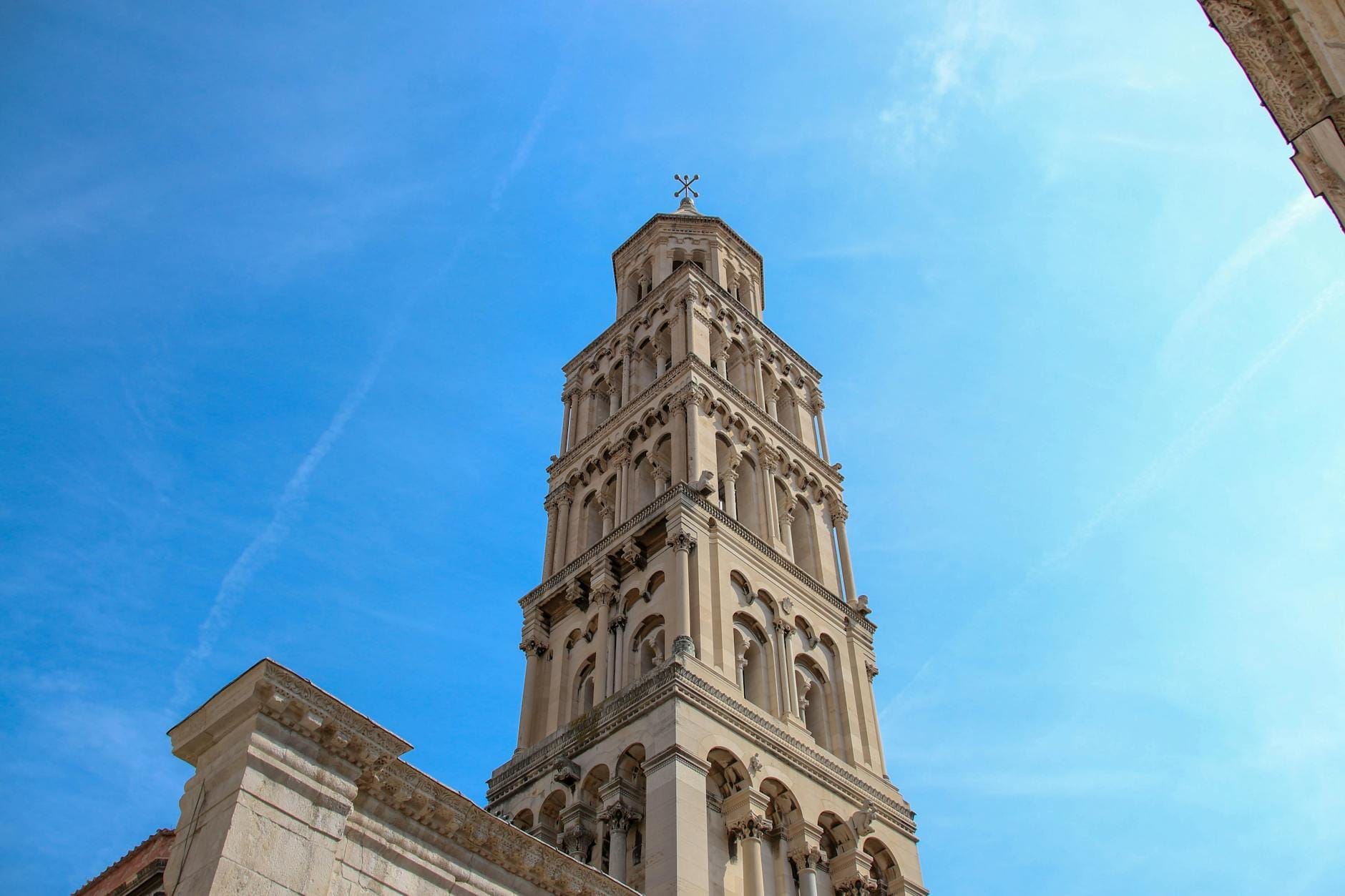
Diocletian's Palace is the historic and geographic heart of Split, a UNESCO World Heritage Site where Roman walls, medieval lanes, and contemporary city life occupy the same limestone blocks. The broader Old Town extends west of the Palace into the medieval Grad quarter, together forming the most layered urban neighborhood on the Dalmatian coast.
Diocletian's Palace is not a ruin you visit and leave. It is a functioning neighborhood where approximately three thousand people live inside walls built at the end of the 3rd and the beginning of the 4th century AD, and where the line between archaeological site and daily life has long since dissolved. For first-time visitors to Split, this is where the city makes its first and most lasting impression.
Orientation
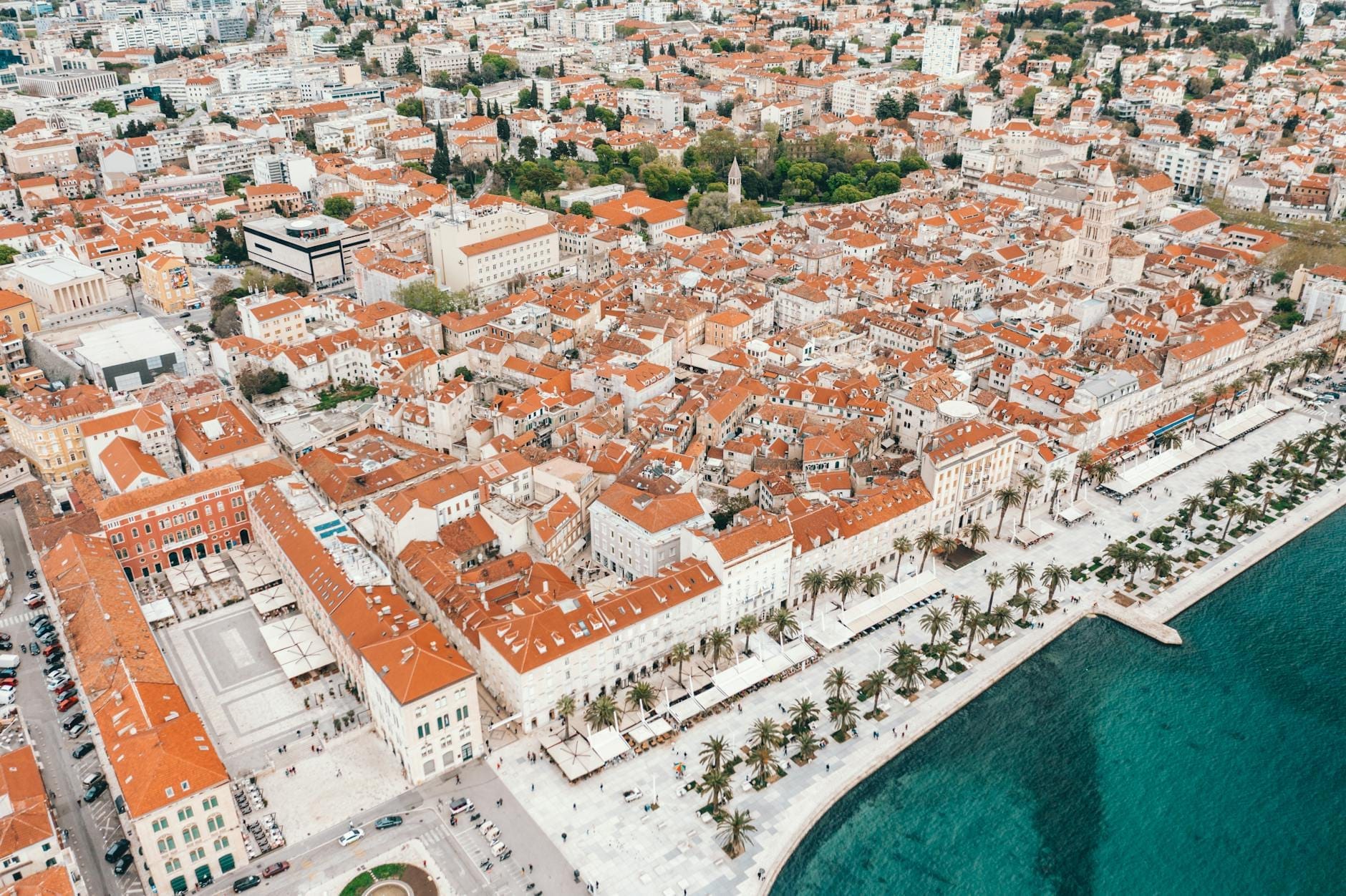
Diocletian's Palace occupies the eastern half of Split's Old Town, pressing directly against the waterfront on the city's central peninsula. The Palace itself is a near-perfect rectangle: approximately 215 metres east-to-west and 180 metres north-to-south, covering around 30,000 square metres. The broader Old Town extends west of the Palace walls into the area historically known as Grad, a medieval quarter that developed organically beyond the original Roman footprint and flows naturally from the Palace without a hard visual break.
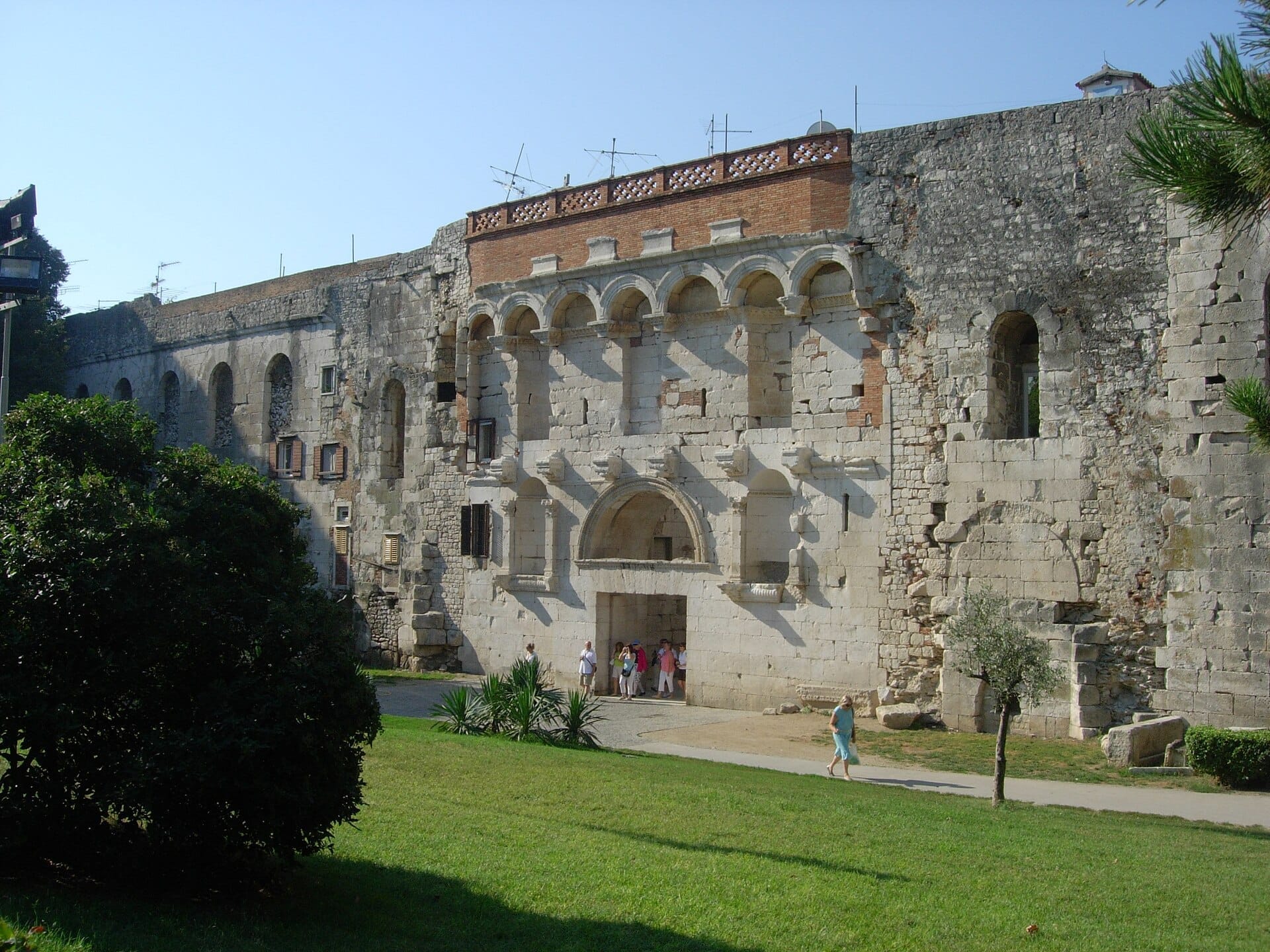
Four gates define the Palace perimeter and serve as the main navigation anchors. The Golden Gate (Zlatna Vrata) faces north and was the original main land entrance toward the Roman city of Salona, whose ruins lie roughly 6 kilometres inland. The Silver Gate (Srebrna Vrata) opens east toward the Pazar market. The Iron Gate (Željezna Vrata) sits on the western wall, facing Narodni trg, known in English as People's Square, which marks the transition into the medieval Grad. The Brass Gate (Porta Aenea) on the southern wall was the original sea gate, and today opens directly onto the Riva promenade and the harbour beyond.
Two Roman streets still govern movement inside the Palace. The Cardo runs north-south, connecting the Golden Gate down to Peristyle Square. The Decumanus runs east-west between the Silver and Iron Gates. Picture a cross overlaid on a rectangle facing the sea and you have the basic mental map. Peristyle Square sits roughly at the intersection of these two axes and functions as the informal center of gravity for the entire neighborhood. Most visitors, whether they know it or not, navigate back to the Peristyle repeatedly throughout a day.
To the west, Republic Square marks the outer edge of the Old Town before the streets open toward Marjan Hill. To the south, the Riva runs the full length of the waterfront, separating the Palace's southern wall from the harbour. To the east, the neighborhood transitions quickly through the Silver Gate into the Pazar market area and then toward Bačvice. To the north, the Golden Gate leads out into a more contemporary urban grid of wider streets and apartment buildings. The Palace is compact by any measure, but its internal complexity makes it feel considerably larger than its dimensions suggest.
Character & Atmosphere
The Palace's character is inseparable from its contradictions. It is simultaneously one of the best-preserved Roman sites in the world and a place where someone's laundry dries above a 1,700-year-old archway. Diocletian commissioned the complex as a retirement villa-fortress, a hybrid of military camp and imperial residence, positioned on a scenic bay between the Marjan peninsula to the west and the Gripe hill to the east. After the Western Roman Empire's collapse, 7th-century refugees fleeing Slavic invasions of nearby Salona moved into the Palace and began adapting its spaces for habitation. The settlement never left. What grew from that occupation eventually became Split itself.
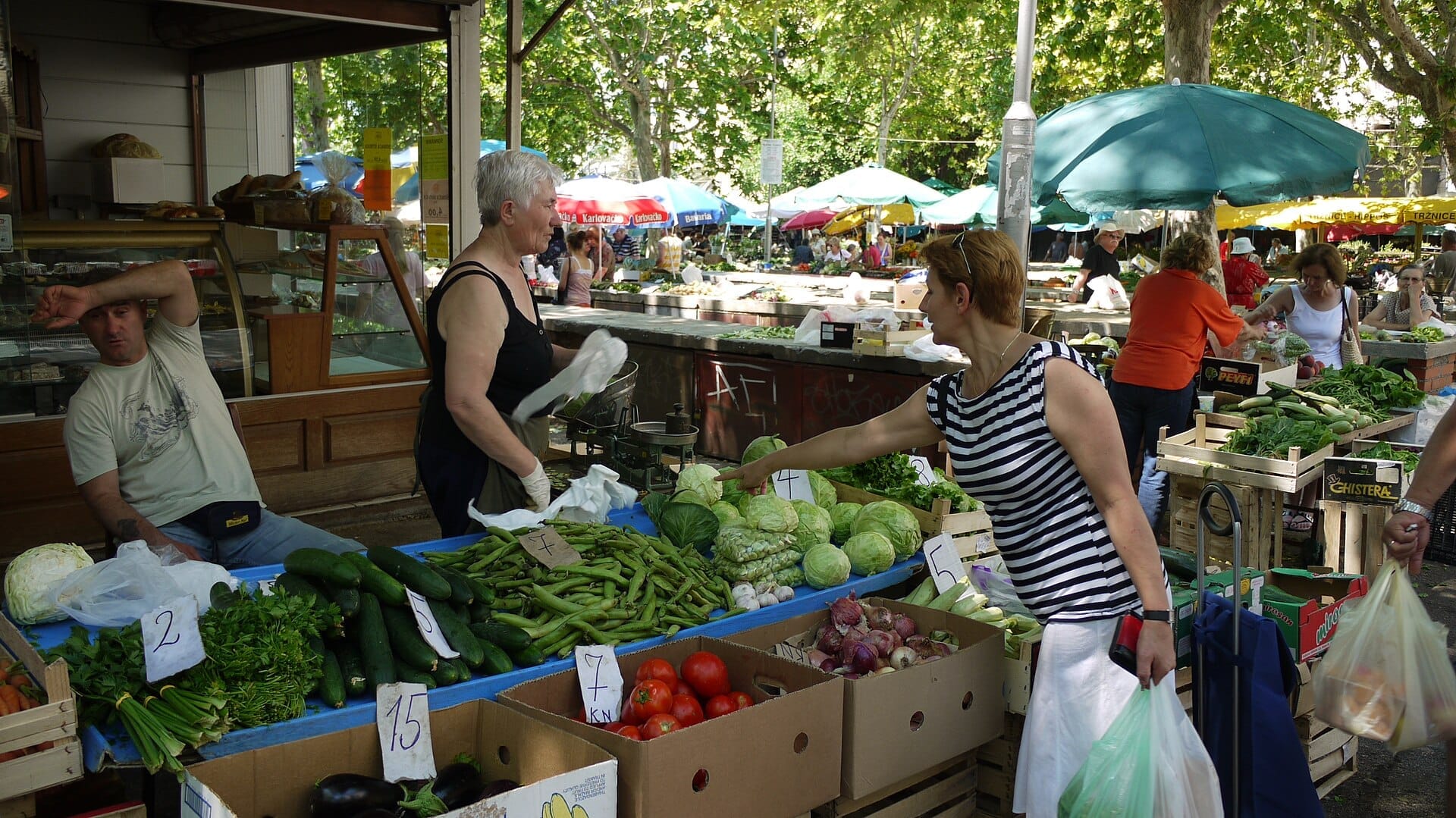
Early mornings inside the Palace belong to locals. By 7am, the Pazar market just outside the Silver Gate is already loud with vendors selling vegetables, fruit, and budget clothing. Inside the walls, delivery scooters navigate narrow alleys with practiced indifference to the columns they pass. Café chairs are being unstacked along the Peristyle. The light at this hour is low and golden, angling through gaps in the medieval rooflines and catching the pale Brač limestone that the Palace is largely built from. The smell of fresh espresso drifts out of small coffee bars along the Decumanus where the clientele is almost entirely local.
By mid-morning the dynamic shifts. Tour groups begin filtering through the Golden Gate and down the Cardo, and the passages around the cathedral can feel congested by 10am in summer. The Peristyle becomes genuinely crowded from roughly June through August. Afternoon heat radiates off the stone, and the spatial compression of the alleys concentrates it. This is when the Palace can feel less like a neighborhood and more like a ticketed attraction, though stepping even one or two streets off the main tourist axis usually recovers a sense of the lived-in city underneath.
After dark, the Palace reclaims its atmosphere. Bars and restaurants around the Peristyle fill with a mix of visitors and locals. Sound carries strangely through the old stone corridors: music from one bar bleeds into the next square over, and voices carry farther than expected. The Cardo and Decumanus lose their daytime foot traffic and become something closer to outdoor corridors in a very old house. By midnight the streets are lit by warm lamps and the glow from open bar windows, and the Palace takes on a theatrical quality that no amount of daytime sightseeing quite prepares you for.
⚠️ What to skip
Noise is a genuine issue for light sleepers inside the Palace walls. Bars operate until late and sound bounces unpredictably through limestone alleys. Streets closest to the Peristyle and the Cardo are loudest between 10pm and 2am in peak season. If sleep quality matters to you, look for accommodation near the Golden Gate in the northern section, or consider staying just outside the walls.
What to See & Do
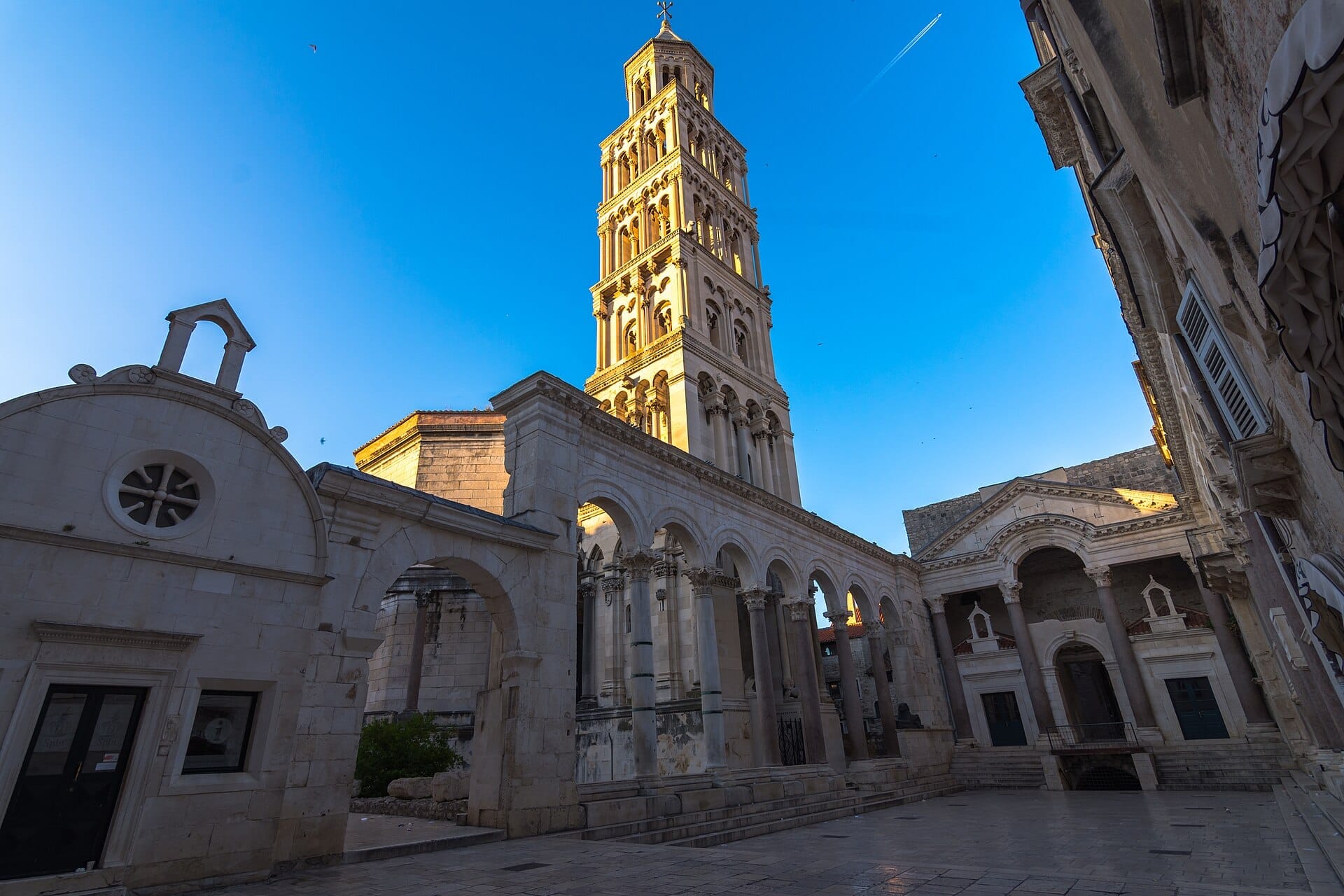
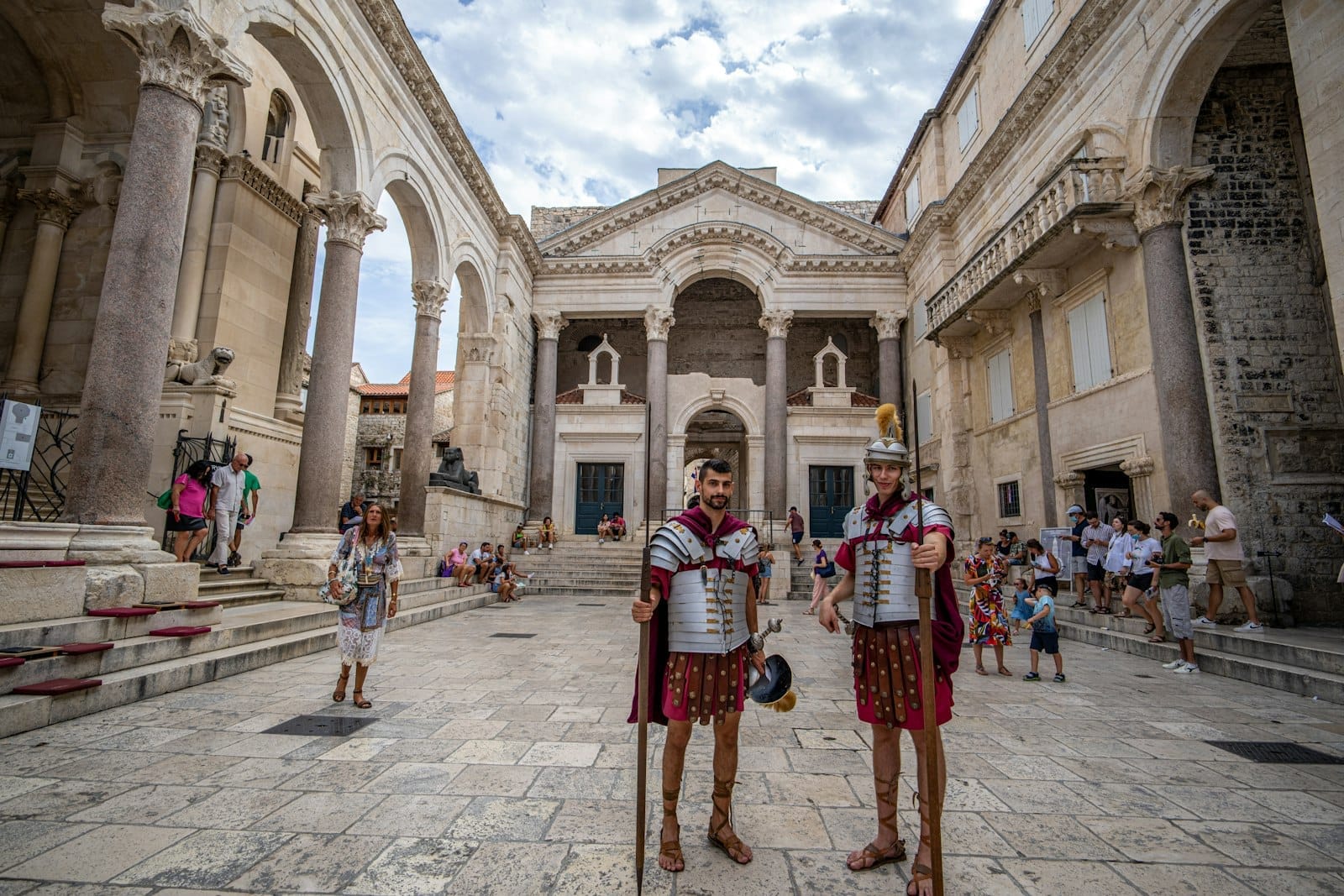
Peristyle Square is the starting point for almost everything. This colonnaded courtyard formed the ceremonial heart of Diocletian's residence and remains the most visually intact Roman space in the Palace. It connects directly south to the vestibule of the imperial apartments and north toward the main streets of the complex. The Peristyle is free to enter at any hour, and its proportions are most clearly appreciated early in the morning or after 6pm, when the tour group density drops.
From the Peristyle, the octagonal Cathedral of Saint Domnius occupies the mausoleum that Diocletian built for himself. The conversion of a Roman emperor's tomb into a Christian cathedral by the very people his edicts persecuted is one of history's better ironies, and the building retains remarkable original Roman decorative stonework inside. An approximately 3,500-year-old Egyptian granite sphinx stands near the entrance, one of a handful brought to Dalmatia during Roman rule. Tickets for the Cathedral, the treasury, and the bell tower are sold separately; verify current prices and opening hours before visiting.
The Cathedral's bell tower is a separate structure begun in the 13th century and offers the best elevated view of the Palace and the Adriatic. The climb is steep and the staircase narrow, but the perspective from the top clarifies the Palace's geometry in a way that no street-level map quite manages. It is worth the effort even if heights are not your preference.
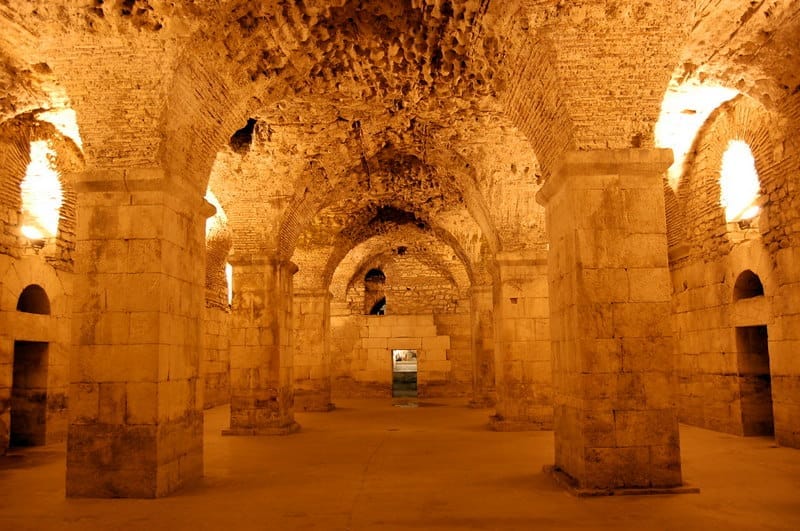
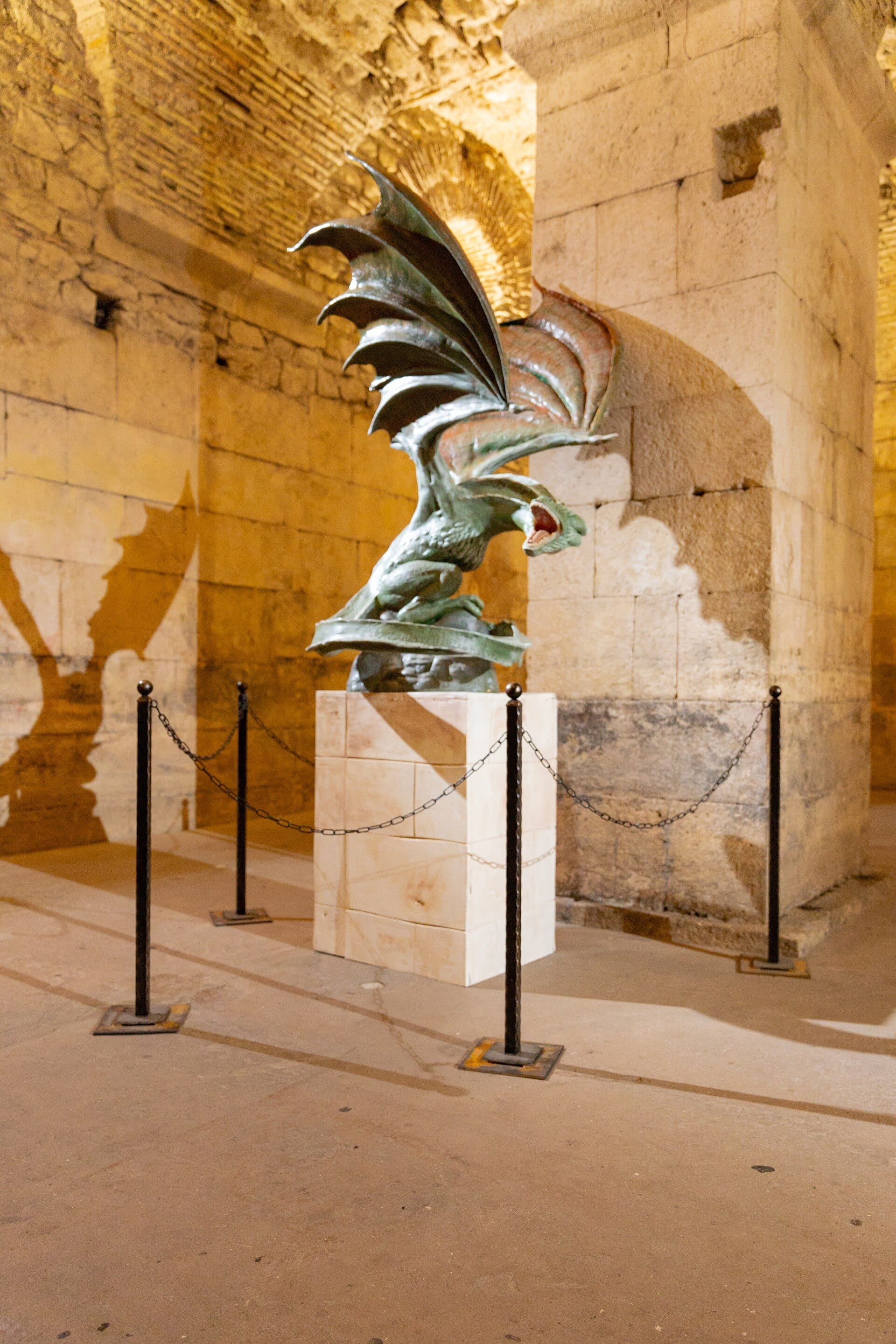
Beneath the southern half of the Palace, the subterranean halls that supported the imperial apartments above have survived in remarkable condition. Diocletian's Cellars are effectively a mirror image of the rooms above, preserved in part because they were used for storage and later infilled with debris rather than heavily rebuilt after the Roman period. Walking through them gives an unusually clear sense of the original Palace scale. The cellars also function as an event and market space; the quality of goods sold there varies considerably, so browse with appropriate skepticism.
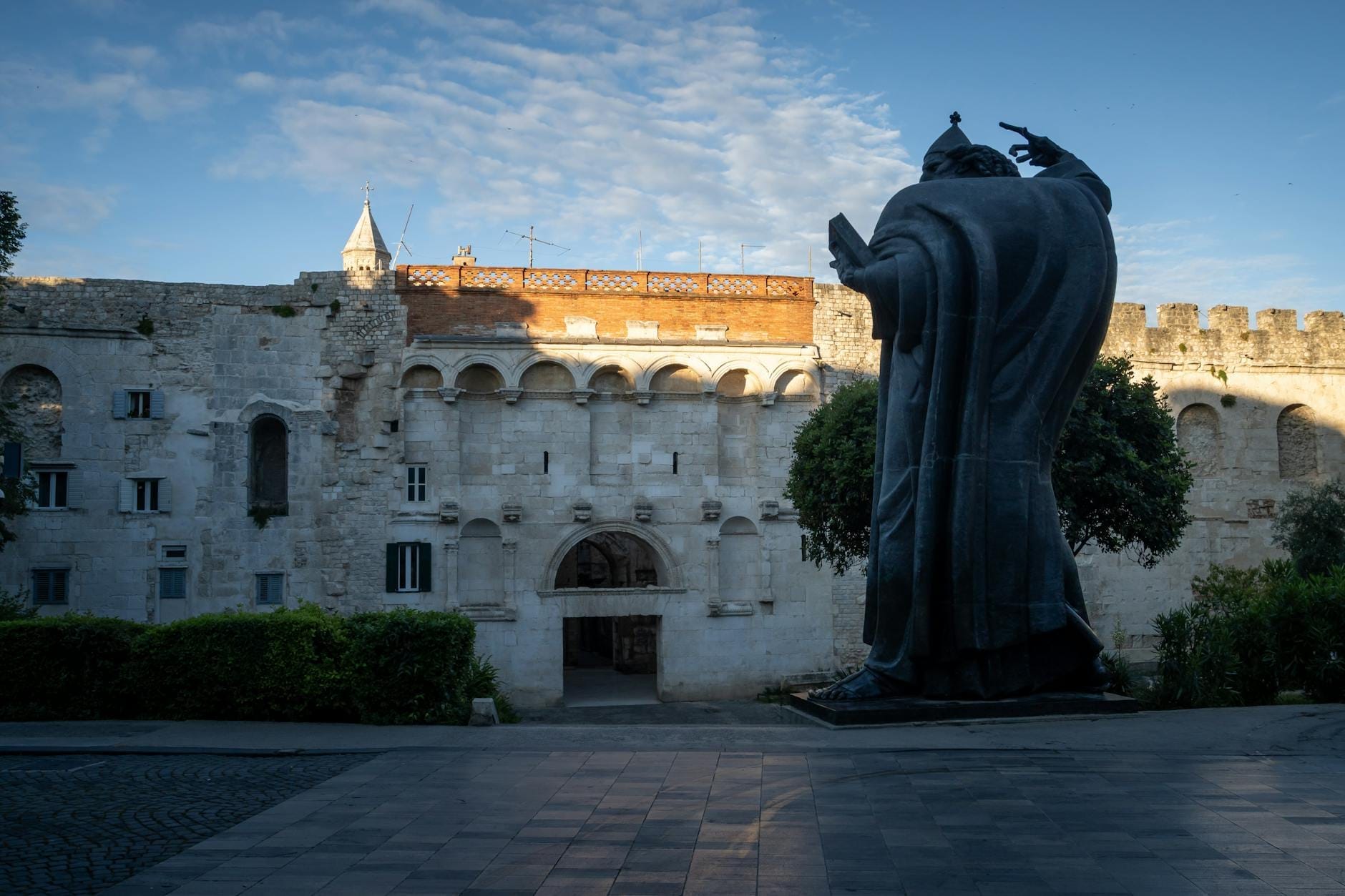
The Golden Gate on the northern wall is the most monumental of the four entrances, flanked by octagonal towers. Just outside it stands the Gregorius of Nin Statue, Ivan Meštrović's 1929 bronze of the medieval Croatian bishop who fought for the use of Croatian rather than Latin in church services. Rubbing the statue's left toe is a local tradition, and the bronze is worn smooth at that spot. The habit has become as much tourist ritual as local custom at this point, but the statue itself is genuinely worth stopping for.
Peristyle Square: the Roman ceremonial courtyard at the Palace's heart, free and always accessible
Cathedral of Saint Domnius and bell tower: a Roman mausoleum converted to a cathedral, with panoramic views from the tower
Diocletian's Cellars: the subterranean mirror of the imperial apartments above
Golden Gate and Gregorius of Nin Statue: the northern entrance and Ivan Meštrović's famous bronze
Narodni trg (People's Square): the medieval civic square at the western edge of the Old Town
Iron Gate clock tower: the western gate, notable for featuring one of the oldest public clock faces in Europe
Fans of the HBO series will recognize several Palace locations from the show, particularly the cellars, which served as the dragon pit of Meereen. A dedicated Game of Thrones filming locations guide for Split covers the specific spots in detail for anyone who wants to trace the scenes.
💡 Local tip
The Peristyle is at its best just after sunrise, when the columns catch the early light and the square is almost empty. If you are staying inside the Palace walls, set an alarm once just to experience it before the first tour groups arrive around 9am.
Eating & Drinking
The eating and drinking scene inside the Palace covers a wide range of quality and pricing, and the two do not always correlate with location in the way you might expect. Restaurants directly on and around the Peristyle tend to charge more for the setting than for the food. This is not a universal rule, but it is worth being aware of before sitting down anywhere with a prime view of Roman columns. A menu that catches your eye on the Cardo may serve significantly better food for less money than its equivalent on the main square.
The Palace and immediately surrounding Old Town have a strong café culture that operates on its own schedule, mostly indifferent to tourism. Mornings bring locals to small coffee bars along the Decumanus and its side streets for espresso and conversation before the tourist wave arrives. These places typically open early, charge reasonable prices, and have no interest in selling you a breakfast platter. If you want something to eat before 9am, the stalls at the Pazar market just outside the Silver Gate are the most practical option: fresh produce, local cheese, and bread at prices that have nothing to do with the tourist economy inside the walls.
For a proper sit-down meal, the streets immediately north of the Peristyle and the alleys branching off the western section of the Decumanus tend to offer better value than the main squares. Look for grilled fish, peka (slow-cooked meat or fish under a bell-shaped lid placed over open coals), and pašticada, a Dalmatian braised beef dish served with homemade gnocchi, as indicators of a kitchen engaged with local tradition rather than a menu designed for rapid tourist turnover. The Split food guide covers Dalmatian specialties and what to order in more depth.
After dark, the Palace shifts decisively toward bar culture. Cocktail bars occupy Roman-era stone rooms along narrow alleys, and the density of options between the Peristyle and the Silver Gate is high enough that choosing becomes a matter of whichever doorway draws you first. Wine bars serving Dalmatian varieties like Plavac Mali and Pošip have become more visible in recent years, alongside the inevitable craft beer offerings. The overall atmosphere is more relaxed than dedicated nightlife districts: people move between places, linger in doorways, and treat the streets as much as the interiors as social space. For late-night clubs and harder partying, the area around Bačvice, east of the Palace, is the more appropriate destination.
💡 Local tip
For coffee and a cheap bite without tourist pricing, walk through the Silver Gate to Pazar market on any weekday morning. The covered section has basic café-bar counters where espresso costs what it costs everywhere else in Croatia, not the Peristyle premium. The market is liveliest from around 7am to noon.
Getting There & Around
Split has no metro system. The city's main bus terminal (Autobusni kolodvor Split) sits just southeast of the Palace, immediately east of the train station and adjacent to the ferry port. From there, it is a straightforward 5 to 10 minute walk northwest along the waterfront and then up into the Old Town via the southern Brass Gate or north from the Riva to the Silver Gate entrance. This cluster of transport infrastructure makes the Palace the most convenient neighborhood in the entire city for arrivals by any mode.
Ferry and catamaran services dock at the main ferry terminal a short walk southeast of the Palace's southern wall. Ferries from Hvar, Brač, Vis, and the overnight service from Ancona all arrive here. Walking from the ferry gangway to accommodation inside the Palace walls can take under five minutes. Local buses operated by Promet Split serve stops along the Riva and near Trg Republike on the western edge of the Old Town, which is the most useful stop for connections from the western suburbs or from Trogir.
Once inside the Palace, movement is almost entirely on foot. The alleys are too narrow and irregular for vehicles, and most are pedestrianized. The Palace is compact enough that no point inside it is more than a few minutes' walk from any other. For reaching areas outside the Old Town, such as Marjan Hill to the west (roughly a 15 to 20 minute walk from the Iron Gate) or Bačvice beach to the east (about 10 minutes from the Silver Gate), walking handles most distances. Local buses cover longer cross-city trips. A full overview of navigating all of Split is in the getting around Split guide.
ℹ️ Good to know
Split Airport (SPU) is located near Kaštela, approximately 24 kilometres northwest of the city centre. Airport buses run regularly to the main bus terminal, from where the Palace is a short walk along the waterfront. Taxis and ride-hailing apps are available but significantly more expensive than the bus. Verify current timetables before travel.
Where to Stay
Staying inside Diocletian's Palace is genuinely unlike any other accommodation experience in Croatia. Apartments and small guesthouses occupy converted Roman and medieval rooms, some with original stone vaulting overhead and walls thick enough to muffle summer heat. The experience suits travelers who prioritize location and atmosphere over hotel amenities and consistent service standards. For a broader comparison of all Split neighborhoods before booking, the where to stay in Split guide covers all the main options with honest trade-offs.
Within the Palace, the northern section near the Golden Gate and the quieter alleys branching off the western Decumanus offer more sleep-friendly conditions than the streets near the Peristyle or the Cardo, which are effectively outdoor bars until 1am or later in peak summer. The difference between a room one alley removed from the main route and a room directly on it can be the difference between a decent night and a miserable one. If you need to carry heavy luggage to your accommodation, check access before booking: some addresses require navigating steep staircases through alleys that are impassable with wheeled bags, and there are no elevators in Roman architecture.
The Old Town immediately west of the Palace walls, around the medieval Grad neighborhood and toward Narodni trg, offers similar historic atmosphere with marginally more hotel-standard options and somewhat less concentrated night noise. It is still within a two-minute walk of the Peristyle. This zone suits couples and travelers who want the historic center without the most intense foot traffic directly outside their door.
Families with young children, travelers who need reliable parking, or anyone who values undisturbed sleep above a central address are generally better served by neighborhoods a short bus ride away: the residential streets north of the Old Town, or the Bačvice area to the east. The Palace works well as a base for light sleepers only if they choose their specific accommodation with care and check reviews that explicitly mention noise.
Day Trips from the Old Town
The Palace's position immediately adjacent to Split's ferry terminal makes it the natural staging point for island and coastal day trips. HvarHvar is roughly an hour away by fast catamaran from the terminal right outside the Brass Gate, making a morning departure and late-afternoon return a straightforward one-day itinerary. The Roman ruins at Salona, the very city whose 7th-century refugees first settled inside the Palace walls, sit just 6 kilometres north and are easily reached by local bus for a half-day excursion. There is something satisfying about visiting the ruins of the city that made the Palace what it is.
For anyone interested in the fortress that controlled the strategic land route above Split for centuries, Klis Fortress sits about 12 kilometres inland and is reachable by bus from the city center. National parks and the wider Dalmatian island chain are all accessible from the ferry terminal, making the Old Town a logistically efficient base for building an itinerary around day excursions. The day trips from Split guide covers schedules, logistics, and honest assessments of the most popular routes.
TL;DR
Diocletian's Palace and the surrounding Old Town form the historic core of Split and the most concentrated area for sightseeing, dining, and nightlife in the city. Almost everything a first-time visitor wants to see is within a 10-minute walk.
The neighborhood rewards early mornings and late evenings most. Midday in summer, particularly around the Peristyle and Cardo, is crowded and hot. Stepping off the main tourist axis by even one street recovers a more genuine sense of the place.
Staying inside the walls is an atmospheric experience unlike anything else in Croatia, but noise from bars is a real issue near the Peristyle. Choose accommodation in the northern section near the Golden Gate for quieter nights.
The adjacent ferry terminal makes this the best-positioned neighborhood in Split for island day trips to Hvar, Brač, and Vis, and for connections to national parks further afield.
Best suited for: history-focused travelers, first-time visitors to Split, couples, and anyone who wants to be within walking distance of the city's best restaurants and bars. Less suited for: families with young children needing early bedtimes, light sleepers who have not carefully vetted their accommodation, and anyone arriving with large wheeled luggage.
Three days in Split is enough to cover the Roman palace that doubles as a living neighborhood, hike the forested hill above the city, and reach one of Croatia's best day trip destinations. This guide gives you a realistic, sequenced plan with specific timings, honest cost breakdowns, and clear advice on when to go and what to avoid.
Split sits on one of the most beach-rich stretches of the Adriatic, with options ranging from sandy city bays to remote island coves. This guide covers the best beaches in Split itself, plus the top island and coastal spots reachable on a day trip.
Split rewards travelers differently depending on when they arrive. This guide breaks down every season, from the shoulder-season sweet spots of June and September to the realities of peak summer and the quiet appeal of winter, so you can choose the right time for your trip.
Split sits at the centre of some of the most spectacular island waters in the Mediterranean. Whether you want to float inside a glowing sea cave, swim at a legendary beach, or explore a remote island with excellent local wine, this guide covers every boat tour worth booking from Split's piers.
Split is one of the best-positioned cities in the Mediterranean for day trips. Within two hours you can reach cascading national park waterfalls, medieval island towns, ancient Roman ruins, and secluded Adriatic beaches. This guide covers the top destinations worth leaving the city for, with practical advice on getting there.
Krka National Park is the most practical major day trip from Split: under 90 minutes away, no ferry schedules, and waterfalls that justify the early alarm. This guide covers every transport option, the Lozovac vs. Skradin entrance debate, current swimming restrictions, and how to time your visit to avoid the worst of the summer crowds.
Plitvice Lakes is one of the most dramatic natural landscapes in Europe, and it's doable as a day trip from Split if you plan correctly. This guide covers every transport option, the true cost breakdown, seasonal timing, and what separates a good tour from a rushed one.
Split rewards the budget-conscious traveller generously. Most of the city's greatest attractions cost nothing at all, from wandering a 1,700-year-old Roman palace to hiking a forested hill above the Adriatic. Here are 12 genuinely free things to do in Split.
Split and Klis stood in for the slave city of Meereen in seasons 4 and 5 of Game of Thrones. This guide breaks down every filming location, what each site looks like in real life versus on screen, and how to plan an efficient half-day covering both.
Everything you need to know about getting around Split, Croatia — from Split Airport (SPU) to the city center, navigating the Old Town on foot, catching ferries to the islands, and reaching national parks by bus. Practical costs, seasonal warnings, and zero fluff.
Hajduk Split is more than a football club — it is the heartbeat of Dalmatia. This guide covers everything you need to attend a match at Poljud: ticket prices, booking platforms, stand selection, matchday logistics, and how to fit a fixture into your Split itinerary.
Split rewards those who wander past Diocletian's Palace. From a cliff-edge sunset terrace to Roman ruins swallowed by meadows, these are the places locals love and guidebooks overlook.
Split is Croatia's second-largest city and one of the Mediterranean's most compelling destinations. But is it worth visiting, and for how long? This guide cuts through the hype with specific advice on timing, realistic expectations, and what the city does better than anywhere else in the Adriatic.
Split is the undisputed hub for island hopping in Croatia, with direct ferry connections to Brač, Hvar, Vis, Korčula, Mljet, and beyond. This guide covers every practical detail: which islands are actually worth your time, how to book ferries before they sell out, the best seasonal windows, and how to build a realistic multi-island itinerary without wasting half your trip at port.
Split, Croatia rewards couples who look past the ferry crowds and party reputation. A 1,700-year-old Roman palace you can wander at dusk, a pine-forested hill with island views, and ferry access to Hvar within an hour — this guide covers how to experience the best of Split as a couple, including when to go, where to eat, and which day trips are actually worth your time.
July and August are the most intense months to visit Split, Croatia. Scorching heat, Adriatic waters at their warmest, packed beaches, major festivals, and ferry connections firing on all cylinders. This guide breaks down exactly what to expect and how to make the most of it.
Split, Croatia in winter is a genuinely different destination from its summer self. Fewer crowds, lower prices, and the same UNESCO-listed palace walls — but with real trade-offs around island access, restaurant closures, and unpredictable rain. This guide gives you the full picture.
Split, Croatia runs on a late-night schedule that catches most visitors off guard. This guide breaks down how the evening actually works, from afternoon beach clubs to Old Town bars, rooftop cocktails, and the boat parties that define summer nights on the Adriatic.
Split, Croatia is one of the Mediterranean's most rewarding cities for budget-conscious travelers. This guide breaks down real daily costs, the best free attractions, where to eat without the tourist markup, and exactly when to visit to cut accommodation costs by up to 50%.
Split, Croatia is genuinely safe for most travelers, but that doesn't mean risk-free. This guide covers the real threats, from pickpockets in Diocletian's Palace to overcharging scams, so you can visit confidently and without unnecessary worry.
Three realistic ways to travel from Split to Dubrovnik, each with different trade-offs. This guide breaks down ferry schedules, bus operators, driving logistics, and seasonal factors so you can book the right option for your trip.
Everything you need to know about the Split to Hvar ferry crossing: which operators run the route, how long it takes, what tickets cost, and how schedules shift dramatically between summer and winter. Includes booking tips and common mistakes to avoid.
Split's old town is one of Europe's most remarkable urban spaces, where a 4th-century Roman emperor's retirement palace became a living city. This self-guided walking tour covers the full route, key landmarks, practical timing, and honest advice on what's worth your time.
Split, Croatia is one of the Adriatic's most rewarding family destinations, blending a UNESCO Roman palace, sandy-bottom beaches, and easy island day trips into a trip that works for all ages. This guide covers the best family attractions, seasonal planning, day trip logistics, and honest tips on what to skip.
Split is one of the Mediterranean's most layered cities: a Roman palace you can sleep inside, a hill park above a working harbor, and ferry connections to some of Croatia's finest islands. This guide covers the best things to do in Split, from UNESCO-listed history to practical day-trip logistics, with honest advice on what to skip.
Ultra Europe is one of Europe's biggest electronic music festivals, held every July in Split, Croatia. This guide covers dates, tickets, the venue, what to expect from Destination Ultra island events, and practical tips for first-timers.
Dalmatian cuisine is one of the most distinct regional food cultures in Croatia — built on olive oil, fresh seafood, and slow-cooked meat dishes with roots going back centuries. This guide breaks down exactly what to eat in Split, dish by dish, with context on ingredients, seasonality, and where to find the real thing.
Not all of Split's neighborhoods are created equal. This guide breaks down the four main areas where visitors stay, who each one suits, what to expect on price, and what nobody warns you about before you book.