Salona Roman Ruins: Dalmatia's Forgotten Roman Capital
Once the largest Roman city on the eastern Adriatic coast, Salona (modern Solin) held up to 60,000 inhabitants before its abandonment in the 7th century. The sprawling archaeological site contains an amphitheatre, city walls, a forum, early Christian basilicas, and a haunting necropolis — all within 15 minutes of central Split.
Quick Facts
- Location
- Solin, near Split, Croatia
- Getting There
- ~10-15 min drive north of Split city centre; local buses run toward Solin
- Time Needed
- 2-3 hours for a thorough visit
- Cost
- Admission fee applies; verify current prices before visiting (+385 21 212 900)
- Best for
- History enthusiasts, archaeology lovers, travellers wanting Roman context beyond Diocletian's Palace
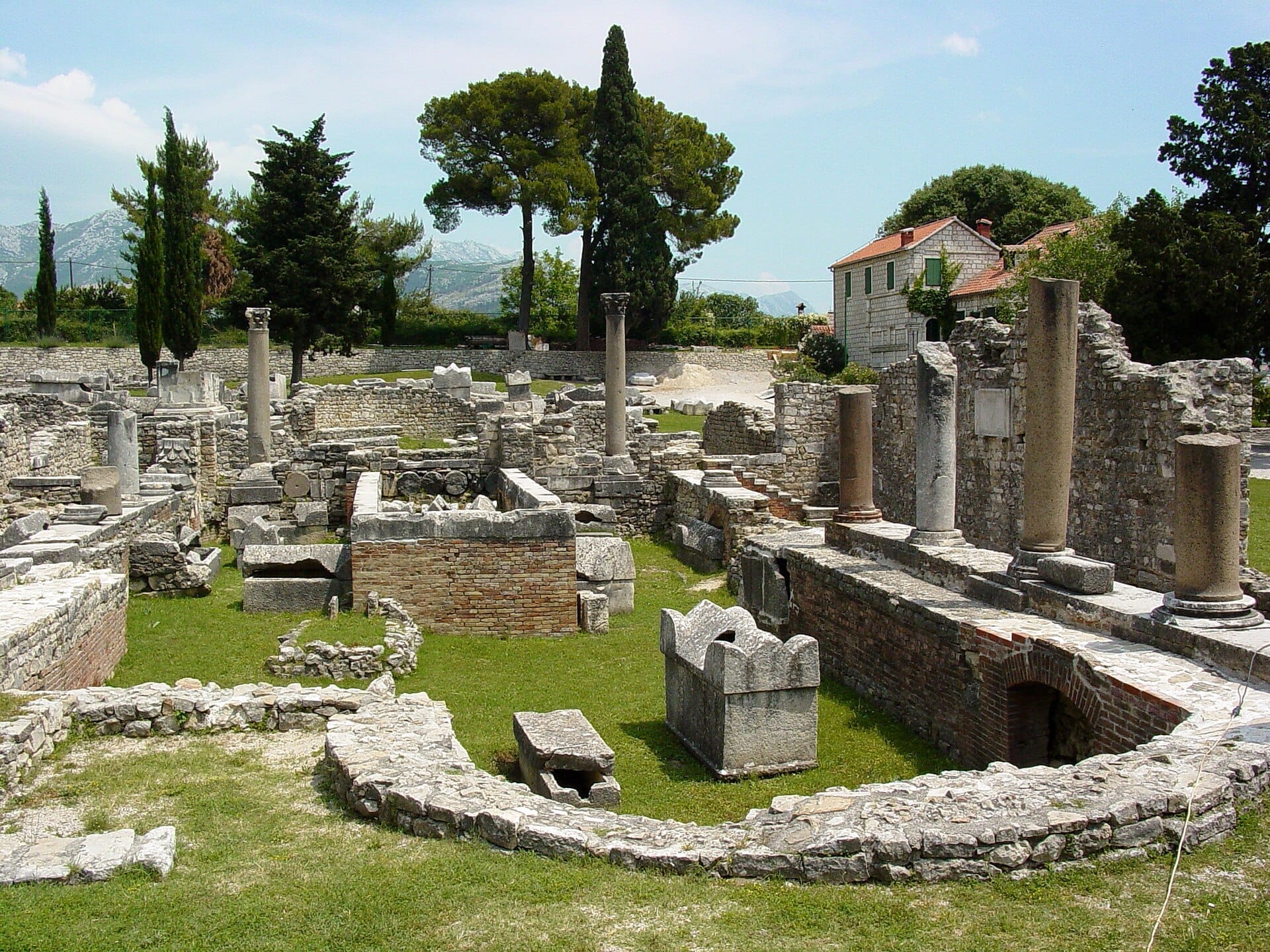
What Salona Actually Is
The Salona Roman Ruins are the remains of Colonia Martia Iulia Salona, once the capital of the Roman province of Dalmatia and one of the most significant cities in the entire Roman Empire's Adriatic sphere. At its peak, Salona housed up to 60,000 inhabitants, dwarfing most other settlements on the eastern Adriatic coast. Founded as an Illyrian settlement in the 3rd century BC, it became a Roman colony under Julius Caesar in the 40s BC and grew steadily for centuries before being sacked and abandoned around 640 AD following Avar and Slav invasions.
The site sits in the modern town of Solin, just north of Split, and it is visible from the main road heading toward the airport. That visibility is slightly misleading: what you see from the road gives almost no sense of the site's actual scale. The ruins spread across a wide area, encompassing defensive walls you can walk along, a partially excavated amphitheatre, a forum, public baths, an aqueduct, multiple early Christian basilicas, and Manastirine — an early Christian necropolis where early martyrs, including the Bishop Domnius (whose sarcophagus now sits in Split's cathedral), were buried.
ℹ️ Good to know
Opening hours at Salona are seasonal and change throughout the year. Always verify current hours before visiting by calling the on-site museum at +385 21 212 900 or checking the Archaeological Museum of Split's official website.
The Scale and Layout of the Site
Salona is not a compact, curated ruin. It is a large, partially excavated landscape that rewards slow exploration. The main entrance brings you into a site where Roman-era stone, overgrown scrub, and paved paths exist side by side. In summer, the dry Dalmatian heat amplifies the sense of age — you are walking through ground that absorbed centuries of urban life.
The defensive walls are among the most accessible and impressive elements. You can climb sections of them for a panoramic view across the whole site and toward the mountains beyond Solin. From up there, the sheer footprint of the ancient city becomes legible in a way it cannot be at ground level. The amphitheatre, which once seated approximately 18,000 spectators, sits at the western edge of the site. Much of it remains underground or partially excavated, but the curved earthworks and stone foundations communicate the scale without requiring complete reconstruction.
Manastirine, the early Christian necropolis, is one of the more emotionally resonant sections. It is here that the site connects directly to Split itself: Domnius, the first Bishop of Salona and a Christian martyr executed under Diocletian, was buried in this cemetery. His remains were later moved to what became the Cathedral of Saint Domnius in Split's old town — the very mausoleum Diocletian had built for himself. That arc, from persecution to appropriation, is one of history's more striking ironies, and it begins here in this quiet corner of Solin.
Understanding Manastirine adds considerable depth to any visit to the Cathedral of Saint Domnius back in Split's old town. The two sites speak to each other across fifteen centuries.
Tickets & tours
Hand-picked options from our booking partner. Prices are indicative; availability and final rates are confirmed when you complete your booking.
Blue Cave and Hvar 5 islands tour from Split
From 145 €Instant confirmationFree cancellationKrka national park tour from Split
From 27 €Instant confirmationFree cancellationAll-inclusive Blue Lagoon tour from Split with three islands visit
From 68 €Instant confirmationFree cancellationGuided kayaking tour with snorkeling stops from Split
From 50 €Instant confirmationFree cancellation
How the Experience Changes by Time of Day
Morning visits, particularly in the first hour after opening, offer the quietest conditions. The light at that hour falls low across the stone, sharpening the texture of column bases and masonry courses in a way that midday glare completely flattens. The air still carries some coolness, which matters considerably if you are visiting between June and September, when afternoon temperatures regularly exceed 30°C (86°F).
By midday in peak summer, the site can feel exposed and exhausting. There is limited shade across much of the open ground. Bring water, a hat, and sun protection regardless of season. The site is not heavily commercialized, meaning there is no guarantee of refreshment stands inside. A late afternoon visit in shoulder season — May, early June, September, October — combines bearable temperatures with warm directional light that is particularly good for photography of the wall sections and amphitheatre.
💡 Local tip
Bring at least 1.5 litres of water per person in summer. Shade is minimal across most of the open site, and the walk along the walls covers significant ground in direct sun.
Historical Context: Why This Site Matters
Most visitors arrive in Split having read about Diocletian's Palace, and rightly so. But Salona is the older and, in Roman terms, the more important city. Diocletian himself was almost certainly born near Salona — in what is now the village of Podstrana or nearby Klis — and when he retired in 305 AD, he built his palace not in Rome or Constantinople but within reach of his home province's capital. The palace at Split was, in a sense, Salona's suburbs.
The relationship between Salona and Diocletian's Palace is a thread worth following. When Salona fell to invaders around 640 AD, its surviving population fled south and took refuge inside the walls of the abandoned palace. That refugee settlement became the nucleus of modern Split. So the city you are walking through today exists partly because Salona ceased to exist. For more on the palace itself, the Diocletian's Palace page covers the architecture and history in detail.
The excavations at Salona began in earnest in the 19th century under the archaeologist Frane Bulić, whose painstaking work over decades uncovered much of what is visible today. The small on-site museum — modest by international standards — displays finds from those excavations and provides stratigraphic context that helps the exposed ruins make more sense. It is worth spending twenty minutes inside before heading out to the wider site.
Practical Walkthrough: Getting There and Navigating the Site
Salona is approximately 10 to 15 minutes north of central Split by car or taxi, following the road toward the airport and Solin. Local buses also connect Split to Solin, though the walk from the bus stop to the archaeological site entrance requires some navigation. Driving or taking a taxi is the most straightforward option, and the site's visibility from the main road makes it easy to locate.
Many visitors choose to pair Salona with the nearby Klis Fortress, which sits on the ridge above Solin and is visible from parts of the site. The combination makes for a full half-day from Split: Salona in the morning, Klis in the late morning or early afternoon, then back into the city.
Footwear with grip is worth wearing. Parts of the site involve uneven stone surfaces, earthen paths, and the occasional stretch over loose rubble. Sandals are workable but less than ideal. The site is signed, and the main structures are labeled, though the signage is not uniformly comprehensive across all sections.
Accessibility across the full site is limited for visitors with reduced mobility. The defensive walls require climbing stairs, and much of the open ground is uneven. The central path and museum area are more manageable, but a complete circuit of the ruins is difficult without stable footing.
Photography and What to Prioritize
The defensive walls in early morning or late afternoon light photograph extremely well, with long shadows defining the coursed stonework. The amphitheatre is better captured with a wide lens given its horizontal spread. Manastirine rewards closer work: the carved sarcophagi and inscribed stones have detail worth capturing, and the cypress trees framing the necropolis give the shots a quality that distinguishes them from generic ruin photography.
If you are building a broader historical itinerary around Split, the Archaeological Museum Split holds a significant collection of artifacts from Salona that complement what you see at the site itself. The museum is in Split proper and can be visited before or after your trip to Solin.
⚠️ What to skip
Salona is not a polished tourist site with clean pathways throughout. Some areas are raw and unstructured. Visitors expecting the presentation quality of, say, a major Italian ruin may find the experience rough around the edges — which is part of its authenticity, but worth knowing in advance.
Honest Assessment: Is It Worth the Trip?
For travellers with a genuine interest in Roman history, Salona is quietly extraordinary. The site's scale — even partially excavated — communicates the reality of a major Roman provincial capital in a way that a museum case cannot. Standing inside the amphitheatre footprint, or on the defensive walls with the Mosor mountains in the background, produces a sense of the city's former mass that is difficult to replicate.
For travellers who found Diocletian's Cellars moderately interesting but not gripping, Salona may not hold their attention for long. The site requires active engagement and some prior reading to yield its rewards. It does not perform its history for you.
Families with young children may find the open, rough terrain workable as an adventure space, but the historical content requires an adult to animate it. For ideas on structuring a broader trip with kids, the Split with kids guide has practical suggestions.
Insider Tips
- Read about Frane Bulić before you visit. Understanding that a single archaeologist spent decades uncovering the site changes how you look at what is exposed and what is still underground.
- The on-site museum is small but contains inscribed stones and sculptural finds that would be major centerpieces in a lesser museum. Do not skip it in a rush to reach the open ruins.
- Combine with Klis Fortress on the same half-day. Both sites are north of Split, the drive between them takes under ten minutes, and the two together tell a much longer story — from Roman Dalmatia to medieval Croatian defense.
- The Manastirine necropolis section is the quietest and most atmospheric part of the site, but visitors often spend all their time at the amphitheatre and walls and barely pause here. Allow time for it.
- Verify opening hours before every visit, not just before your trip. Hours shift between high season and low season, and the site occasionally closes for conservation work or administrative reasons.
Who Is Salona Roman Ruins For?
- Travellers who want Roman-era context that goes deeper than Diocletian's Palace
- Archaeology and ancient history enthusiasts who appreciate partially excavated, unpolished sites
- Photographers looking for dramatic stone ruins with mountain backdrops and minimal crowds
- Day-trippers combining the site with Klis Fortress for a full historical half-day
- Visitors on a second trip to Split who have already covered the main old town sites