Klis Fortress: The Mountain Stronghold Above Split
Klis Fortress rises on a rocky ridge roughly 360 meters above sea level, commanding the mountain pass that once determined who controlled the Adriatic hinterland. With origins dating to Illyrian tribes, a brutal Ottoman siege lasting over two decades, and a starring role as Meereen in Game of Thrones, few sites in Croatia pack this much history into a single hilltop.
Quick Facts
- Location
- Trg Mejdan 10, 21231 Klis, Croatia — approximately 12 km (7.5 mi) from Split
- Getting There
- Bus from Split (e.g., Promet Split lines 22, 35, and 36 toward Klis/Sinj); by car 15-20 min from Split center; parking on site
- Time Needed
- 1.5 to 2.5 hours for a thorough visit
- Cost
- Approx. €10 admission (verify current price before visiting)
- Best for
- History enthusiasts, photography, day-trippers from Split, Game of Thrones fans
- Official website
- www.tvrdavaklis.com
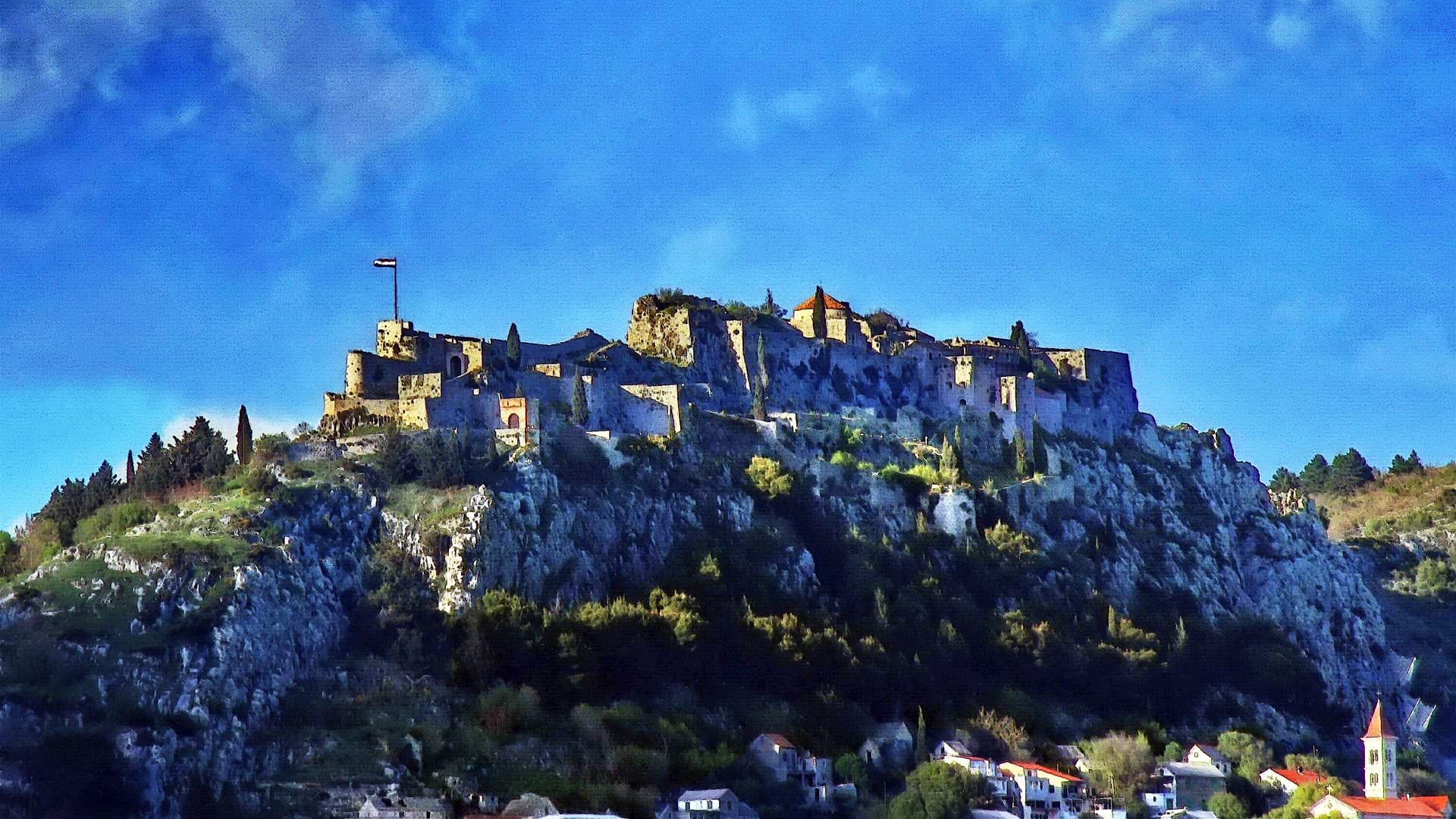
What Klis Fortress Actually Is
Klis Fortress, known in Croatian as Tvrđava Klis, sits on a narrow limestone ridge at roughly 360 meters above sea level, wedged between the Mosor and Kozjak mountain ranges. The pass it guards was the only practical overland route between the Dalmatian coast and the Balkan interior for centuries, which explains why so many different powers fought so hard to hold it. What you visit today is a layered accumulation of Illyrian, medieval Croatian, Ottoman, and Venetian construction, compressed into one jagged silhouette above the plain.
The site functions as an open-air museum managed in part by the Kliški uskoci association, which maintains exhibits of period arms, armor, and artifacts inside the fortress rooms. This is not a ruin in the purely archaeological sense. Parts of the structure are well-preserved, some rooms are accessible and interpreted, and the three defensive wall systems are still legible on the ground. Visitors walk through real history rather than peer at it from behind a fence.
💡 Local tip
Opening hours are often listed as roughly 9:00–17:00, but these can shift seasonally and may extend later in peak summer. Check the official website at tvrdavaklis.com before making the trip, especially in winter months.
The History That Makes This Place Worth the Climb
The fortress has been continuously used as a defensive position since at least the 2nd or 3rd century BC, when Illyrian tribes recognized the ridge's strategic value. By the medieval period it had become the seat of Croatian royalty and nobility, developing its characteristic three-tier wall system across the elongated summit.
The most consequential chapter in the fortress's history unfolded between 1513 and 1537. Petar Kružić, captain of the Croatian defenders known as the Uskoks, held the fortress against repeated Ottoman assaults for nearly a quarter century. The siege was one of the longest in the region's history. When Kružić was finally killed in battle in 1537 and the Ottomans took control, it marked a turning point in Ottoman expansion along the Adriatic. The story of the Uskoks, fierce anti-Ottoman fighters who later relocated to Senj on the northern coast, remains a significant thread in Croatian national identity.
The Ottoman conversion of the fortress chapel into a mosque is one of the most visible layers of that history. After Venice wrested control from the Ottomans in 1648, the mosque was reconverted into the Church of Saint Vitus, and the building still stands inside the compound today. Looking at its architecture carefully, you can read multiple centuries of religious and military history in the same walls.
For context on how the broader Split region developed alongside this kind of fortified inland architecture, the Roman ruins at Salona — the former provincial capital located in the valley below — are worth pairing with a Klis visit.
Tickets & tours
Hand-picked options from our booking partner. Prices are indicative; availability and final rates are confirmed when you complete your booking.
Private tour of National Park Krka Waterfalls and Klis Fortress
From 1.500 €Instant confirmationFree cancellationBlue Cave and Hvar 5 islands tour from Split
From 145 €Instant confirmationFree cancellationKrka national park tour from Split
From 27 €Instant confirmationFree cancellationAll-inclusive Blue Lagoon tour from Split with three islands visit
From 68 €Instant confirmationFree cancellation
What the Visit Actually Feels Like
Arriving by car, you park at the base and walk up a short but steep stone path to the entrance gate. The approach already rewards you with improving views over the Kaštela valley and the distant glimmer of the Adriatic. The air is noticeably cooler and windier than on the coast, even in midsummer — bring a layer if you run cold.
Once inside, the layout requires navigating uneven stone paths, staircases of varying height, and narrow passages between walls. Comfortable shoes with grip are not optional here. The terrain is genuinely rocky and some sections can be slippery after rain. This is not an attraction suited for pushchairs, and visitors with limited mobility will find access significantly restricted due to stairs and uneven surfaces throughout.
The interior rooms contain the museum exhibits: swords, crossbows, period dress, explanatory panels in Croatian and English. The quality of interpretation is solid without being exhaustive. Most visitors spend 20-30 minutes with the exhibits and the rest of their time on the walls and terraces, which is where the fortress earns its reputation.
⚠️ What to skip
Wear proper footwear. Sandals and flat-soled shoes are a genuine safety risk on the rocky, uneven paths inside the fortress. The terrain is steep in places and can be wet or dusty depending on the season.
The Views: Why Photographers and Strategists Both Understood This Place
The panoramic view from the top ramparts is the single most arresting thing about Klis Fortress. On a clear day, you can see Split spread across its peninsula below, the islands of Brač and Šolta sitting in the Adriatic, and the mountain ridgeline of Mosor rising sharply to the southeast. The spatial logic of the pass becomes immediately obvious: whoever held this ridge controlled every road between the coast and the interior.
For photography, the best light falls on the fortress itself in the morning hours, when the sun illuminates the pale limestone walls from the east. The views toward the sea photograph best in late afternoon, with the Adriatic catching the low light. Midday in summer is the harshest time to visit, both photographically and in terms of heat exposure on the exposed ramparts.
If the view from Klis interests you primarily for its Split panorama, note that Marjan Hill offers a different coastal perspective that rewards comparison — greener, closer to the sea, and accessible entirely on foot from the city center.
The Game of Thrones Connection: Real or Tourist Inflation?
Klis Fortress served as the filming location for Meereen in Seasons 4 and 5 of Game of Thrones. For fans of the series, the visual match between the fortress's stone towers and the fictional slave city is immediately recognizable. The production team used the real architecture with minimal modification, so standing on the upper walls gives a genuine spatial echo of scenes many viewers watched closely.
That said, the Game of Thrones connection is supplementary, not central. The fortress's historical and architectural substance stands independently. Visitors who have no interest in the series lose nothing by skipping that framing entirely. The site would warrant a serious visit purely on its medieval and Ottoman military history.
Travelers specifically organizing itineraries around filming locations might find the dedicated Game of Thrones filming locations guide for Split useful for combining Klis with other relevant sites in the region.
Getting to Klis from Split
By car, Klis is a 15-20 minute drive northeast of Split via the road toward Sinj. Parking is available directly at the fortress and is the most convenient option if you have a vehicle. The drive itself is scenic, climbing through the gorge below the fortress before the ridge comes fully into view.
By bus, public lines connecting Split to Klis and the inland towns pass through regularly. The journey takes roughly 30-40 minutes depending on traffic and route. Buses depart from the main Split bus station area. The stop for the fortress is in the village of Klis, from which the entrance is a short uphill walk. It is worth checking current bus timetables locally, as schedules vary by season.
For broader guidance on navigating the Split area using public transport, the getting around Split guide covers bus, taxi, and car options in detail.
ℹ️ Good to know
Klis pairs naturally with a visit to Solin (ancient Salona), which sits in the valley between the fortress and Split. A half-day itinerary combining both sites is manageable by car and gives a rare opportunity to read 2,000 years of regional history in sequence.
Who This Attraction Suits, and Who Should Reconsider
Klis Fortress rewards travelers who are genuinely interested in military history, medieval architecture, or the layered story of Ottoman-European conflict on the Adriatic. It also works well for anyone willing to invest a half-day to earn an extraordinary view. The experience is active and physical, which is part of its appeal for the right visitor.
Families with older children who can manage the terrain will find it engaging, particularly with the arms and armor exhibits. Those traveling with very young children, strollers, or anyone with mobility considerations should weigh the access limitations seriously before making the journey. If you are looking for a broader picture of what Split offers families, the Split with kids guide covers more accessible alternatives.
Visitors primarily interested in beach time, urban café culture, or comfortable walking tours will likely find Klis less relevant to their trip. It is also worth skipping if rain is forecast — wet stone on steep slopes makes the experience genuinely unpleasant and increases the risk of slipping. The fortress sits fully exposed to wind in all seasons, which can be refreshing in July but punishing in November.
Insider Tips
- Arrive right when the fortress opens (typically around 9:00). The light is better for photography, tour groups from Split haven't arrived yet, and you'll have the top ramparts largely to yourself for the first 30-40 minutes.
- The Church of Saint Vitus inside the compound is easy to walk past without realizing its full significance. Look at the building carefully: the arched prayer niche (mihrab) from its Ottoman mosque phase is still partially visible inside, preserved alongside Catholic additions. It's one of the most tangible examples of layered religious history in the entire region.
- Bring water. There are no reliably operating refreshment facilities inside the fortress walls, and the exposed terrain in summer means you will want more hydration than you expect.
- If you are driving back to Split, the road through the gorge just below the fortress offers a pull-off point with an excellent angle for photographing the fortress against the mountain backdrop — more dramatic than the view from the visitor entrance.
- The medieval re-enactment events organized by the Kliški uskoci association, held at the fortress several times a year, are worth checking the official website for. Watching costumed fighters demonstrate period combat on the actual battlements is significantly more evocative than the standard visit.
Who Is Klis Fortress For?
- History enthusiasts interested in medieval Croatian, Ottoman, and Venetian military history
- Photographers seeking panoramic Adriatic and Split cityscapes from elevation
- Game of Thrones fans who want to see Meereen filming locations in context
- Day-trippers from Split wanting a half-day itinerary beyond the old town
- Hikers and active travelers comfortable with steep, uneven terrain