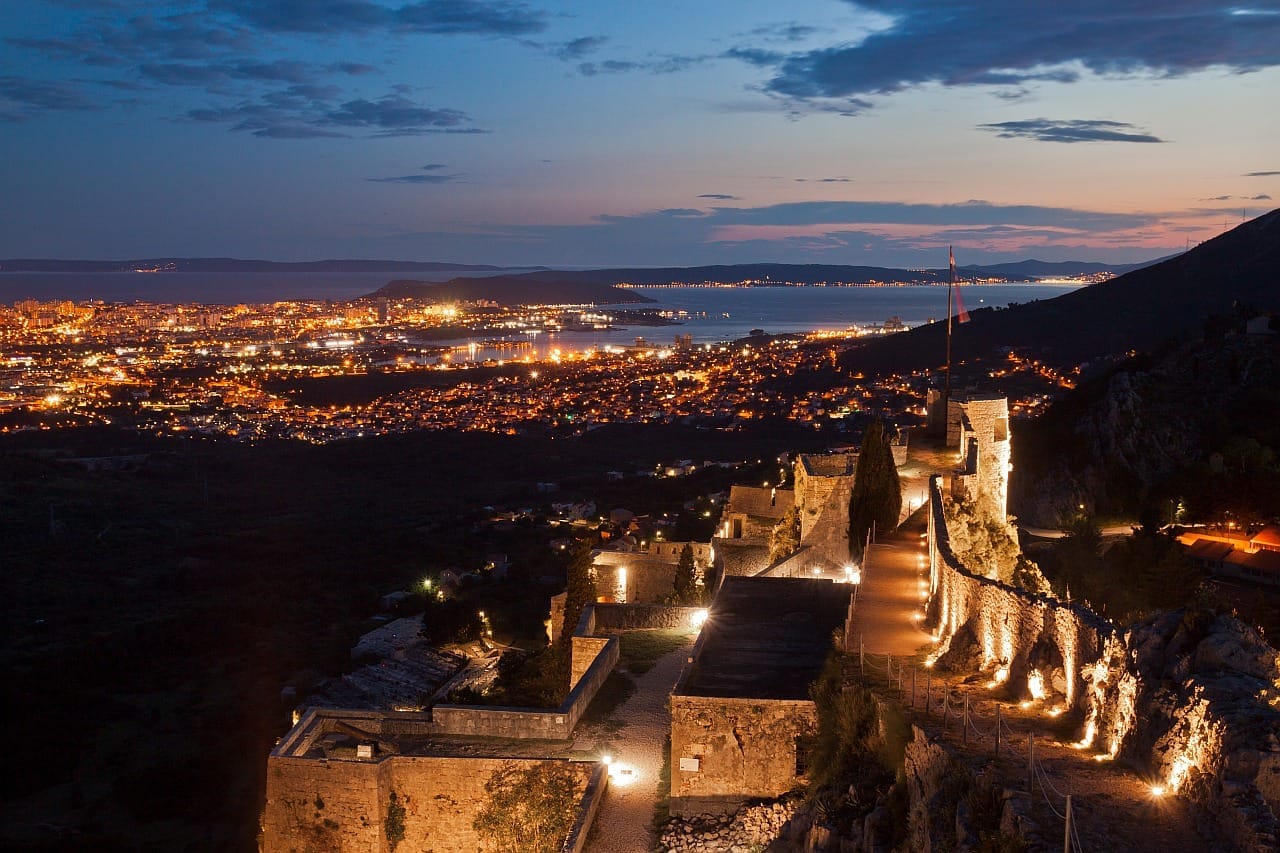
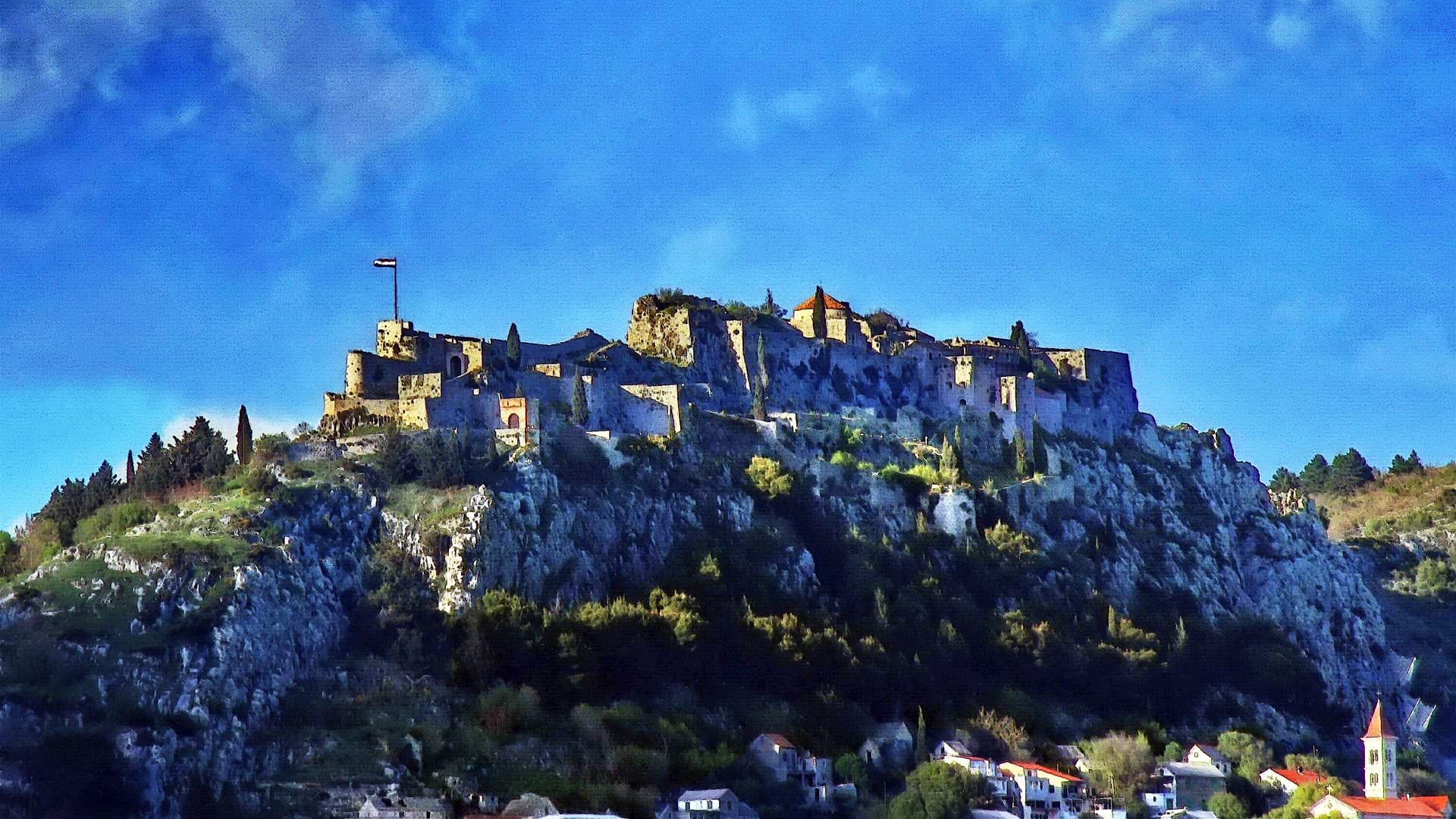
Klis is a small mountain village northeast of Split, built around a dramatic fortress that has guarded the only natural pass between the Dalmatian coast and the Balkan interior for over two thousand years. A half-day trip from Split, it offers serious history, spectacular views, and traditional inland cooking that stands apart from anything you will find on the waterfront.
Klis is not a coastal resort or a city neighborhood. It is a mountain pass village with a fortress ridge that rises sharply above the road and a history that explains why Split exists at all. Come here for one of the most strategically important fortifications in the Adriatic, a panorama that stretches from the islands to the mountains, and a plate of slow-roasted lamb that has nothing in common with tourist-strip seafood.
Orientation
Klis sits roughly 11 to 13 kilometers northeast of Split, at approximately 43°34′N, 16°31′E, and an elevation of around 290 meters at the village core. The fortress itself crowns a limestone ridge at about 360 meters, wedged between the Mosor and Kozjak mountain ranges. This is not a neighborhood within Split in any administrative sense. Klis is a separate municipality in Split-Dalmatia County, with a population of just over 5,800 across several small settlements including Brštanovo and Prugovo. But it belongs firmly in any Split travel itinerary because the pass it guards is the reason the entire coastal settlement below it survived long enough to become a city.
The village clusters along the main pass road that connects the Dalmatian coast to the Bosnian interior. This road, still heavily used by freight traffic on weekday mornings, threads directly beneath the fortress hill and continues north through the mountains. Arriving by car from Split, you pass through Solin and begin climbing into the pass, and the fortress wall becomes visible above the road well before you reach the village. The visual drama is immediate and considerable.
The nearest town of scale is Solin, just a few kilometers south, where the ancient Roman city of Salona once stood. Combining Klis and Solin in a single half-day trip is entirely logical and gives the visit a coherent historical arc. For a broader sense of how Klis fits into the region's excursion options, the day trips from Split guide covers both sites alongside longer excursions to Krka, Trogir, and the islands.
Character & Atmosphere
On a weekday morning outside peak summer, Klis is a quiet working village. The main road carries trucks and local traffic. The air is noticeably cooler than the coast below, carrying traces of pine and stone dust. A few local residents walk between the handful of shops and cafes along the road, and the sounds are mostly wind, distant engines, and occasionally bells from livestock on the hillside. There is no tourist promenade, no souvenir strip of any substance, and none of the summer-resort energy that defines coastal Dalmatia.
What Klis has, in full, is physical drama. The fortress walls cascade down the limestone ridge in uneven layers, each course of stone representing a different era of construction. In the early morning, before tour groups arrive from Split, the site is practically deserted. The eastern light strikes the pale stone walls directly and throws long shadows across the ramparts. The view south from the highest point takes in the entire coastal plain, the rooftops of Solin and Split, and the Adriatic islands arranged on the horizon in a line that seems improbably clear on a good morning.
By late morning in summer, organized day-trippers arrive. The peak congestion window runs roughly from 10am to 2pm, when tour buses from Split and cruise ships unload visitors at the fortress entrance. The village itself never feels overwhelmed because there is genuinely little to detain casual visitors beyond the fortress and the konobas beneath it. By mid-afternoon the crowds thin significantly. The light turns golden across the mountain faces, the road noise drops, and the place reverts to something close to its everyday character.
💡 Local tip
Arriving before 9am or after 3pm significantly reduces crowds at the fortress, especially in July and August. Morning light also makes for sharper photographs of the walls and the panorama south toward the coast.
One thing worth noting for visitors accustomed to the coastal heat: Klis runs cooler, and wind through the pass can be strong. Even in midsummer, a light layer is worth carrying for the exposed upper ramparts. In winter, the pass road occasionally sees frost and the fortress itself takes on a stark, stripped-back quality that some travelers find even more impressive than the summer version.
History in Brief
Klis owes its entire existence and its entire character to geography. The narrow pass between the Mosor and Kozjak ranges is the most direct natural route between the Dalmatian coast and the Balkan interior. Whoever controls the heights above it controls trade, communication, and military access across the entire region. Illyrian tribes recognized this in the 2nd century BC and established the earliest fortifications here. Roman forces used the pass as a supply and communication corridor linking Salona, the provincial capital, with the interior. Medieval Croatian kings made Klis a royal seat precisely because the pass was worth defending at almost any cost.
The most celebrated chapter in Klis history belongs to Captain Petar Kružić, who held the fortress against repeated Ottoman siege attempts through the early decades of the 16th century. The Ottomans finally broke through in 1537 and held Klis for over a century. Venice recaptured it in 1648, and the strategic threat from the east gradually subsided over the following generations. Napoleonic French forces controlled the site briefly in the early 19th century before it passed eventually into the historical monument it is today.
Understanding Klis sharpens the entire Split experience. The Roman emperor Diocletian, who built the palace that now forms the heart of Split's old town, was born in this same region. The ancient city of Salona, just south of Klis, was the Roman provincial capital that the fortress defended. The thread running from Illyrian Klis through Roman Salona to the medieval fortress and finally to Diocletian's coastal palace is one of the clearest continuities in Mediterranean urban history. Visiting Diocletian's Palace in Split before or after Klis gives that thread a concrete physical form.
What to See & Do
The Klis Fortress is the sole reason almost everyone visits, and it is entirely sufficient. Walking through the complex means moving through layers of two thousand years of construction. The lower sections show Venetian-era defensive engineering: thick angled walls designed to deflect artillery fire. The upper citadel retains structural elements from much earlier medieval and possibly Roman phases. Signage inside explains the chronology reasonably well, but the physical experience of the ramparts and the views they command does most of the interpretive work.
The panorama from the highest accessible point is genuinely outstanding on a clear day. South, the coastal plain stretches flat and wide to the Adriatic, with Split visible and the islands of Brač, Hvar, and Šolta arranged along the horizon. North and east, the limestone ranges climb toward Bosnia. The sense of why this specific ridge was worth fighting over for two millennia is immediate and physical, not just intellectual.
Fans of the television series Game of Thrones will recognize Klis Fortress as the filming location for Meereen, the slave city ruled by Daenerys Targaryen in seasons four and five. The production used the outer walls and entrance areas extensively, and some visitors come specifically for this reason. For a full picture of the show's Croatian locations, the Game of Thrones filming locations guide covers all the major spots across the Split region.
Pairing Klis with a visit to the Salona Roman ruins just south in Solin makes for a coherent half-day circuit. Salona was the capital of the Roman province of Dalmatia and the city from which Diocletian originated. The site includes a large amphitheater, early Christian basilicas, and several kilometers of defensive walls spread across a low-lying field that is easy to walk and rarely crowded. The contrast between Salona's sprawling low ruins and Klis's vertical drama above makes the combination more satisfying than either site alone.
Klis Fortress: the main event, allow 1.5 to 2 hours including the climb to the upper citadel
Salona Roman ruins: 30 to 45 minutes south, best combined in the same half-day
Views from the ramparts: bring a camera with a wide lens and go in morning or late afternoon light
Game of Thrones filming spots: the outer gate area and walls are the most recognizable on-screen locations
⚠️ What to skip
The stone surfaces inside the fortress are uneven and can be extremely slippery when wet. Closed-toe shoes with grip are essential. Sandals and flip-flops are genuinely problematic in the upper sections.
Eating & Drinking
The food situation in Klis is limited in variety but high in quality within its narrow lane. A small cluster of traditional konobas, the Croatian term for family-run taverns, sits along the main road beneath the fortress. These places cook inland Dalmatian food, which is a different world from the seafood-heavy menus of Split's waterfront. The focus is on lamb and veal roasted under the peka, a heavy bell-shaped iron lid buried under glowing embers and left for several hours until the meat falls apart. Alongside it you get grilled meats, thick bean stews, local sheep's cheese, and bread straight from the wood-fired oven.
If you have spent several days eating grilled fish and pizza along the coast, a meal in Klis resets the palate entirely. Prices are noticeably lower than in Split's center, and portions are sized for people who have been climbing stone walls. Most of these restaurants have outdoor terraces with direct views up to the fortress, which makes lunch here feel like an occasion rather than a refueling stop.
💡 Local tip
Peka dishes take three to four hours to prepare and must be ordered in advance. Call the restaurant the morning of your visit, or the evening before during July and August. Arriving and asking on the spot will almost certainly result in disappointment.
For drinks, the konobas serve local Dalmatian wine, rakija (Croatian fruit brandy), and Croatian beer. There is no specialty coffee culture or cocktail bar scene. If you want espresso before the fortress opens, the small roadside cafes near the parking area serve basic but functional coffee. Do not arrive expecting anything resembling a Split city cafe.
For context on what to eat more broadly across the Split region, the what to eat in Split guide covers both coastal and inland Dalmatian food traditions, and explains where peka fits in the wider culinary picture.
Getting There & Around
By car, Klis is a 20 to 25 minute drive from central Split, following the road northeast through Solin and up into the pass. Parking at the fortress is free and generally sufficient except on the busiest summer weekends, when the small lot near the entrance fills and visitors park along the approach road. Klis sits adjacent to the A1 motorway interchange, which makes it a logical first or last stop if you are driving between Split and inland Croatia. The fortress is clearly visible from the highway approach, which gives a useful sense of its scale before you arrive.
By public bus, the journey from Split takes approximately 30 minutes. Several services run daily from Split's main bus station, with more frequent departures in summer. Klis is typically the final stop on the route. The bus drops passengers near the base of the fortress hill, from which it is a short but steep uphill walk to the entrance. Verify current timetables and fares at the Split bus station or through the operator's website before your visit, as schedules change seasonally.
Organized tours from Split also serve Klis, sometimes combining it with Solin or the Salona Roman ruins in a single guided excursion. These are a practical option if you prefer not to manage logistics independently. The getting around Split guide covers all transport options from the city, including how to reach hinterland destinations.
⚠️ What to skip
The pass road through Klis carries significant freight traffic on weekday mornings. If you are walking sections of the approach road rather than driving, stay alert and use designated pedestrian areas where available. The road is not designed with pedestrians as a priority.
Within Klis, everything relevant to visitors is walkable from the main road parking area. The fortress is the only real destination, and once you have climbed the entrance path, the entire site is explored on foot. Budget around 20 to 30 minutes for the walk from the bus stop or parking area to the fortress entrance, factoring in some uphill gradient. The overall visit, including the fortress and lunch at one of the konobas, fits comfortably into half a day.
Where to Stay
Almost nobody stays overnight in Klis, and there is no compelling reason to. The village has virtually no accommodation infrastructure, and there is little to do after the fortress closes for the evening. Split is 20 to 25 minutes away by car and offers a full range of hotels, apartments, restaurants, and onward transport. For the vast majority of visitors, Klis is a half-day excursion from a Split base, and that is the right way to approach it.
The Solin area just below Klis has a slightly wider range of guesthouses and apartments for travelers who specifically want to avoid the coastal crowds and access the fortress early before tour groups arrive. That said, staying in Split itself remains the more practical choice for anyone using the city as a base for wider Dalmatian exploration. The where to stay in Split guide breaks down the city's neighborhoods and accommodation options in detail.
Practical Tips
The fortress is open year-round, though opening hours and entry fees vary by season. Verify current times and prices before visiting, as these change and are not always updated in real time on third-party sites. In summer, the site stays open into the early evening, making a late afternoon arrival genuinely appealing: the light is better, the crowds are thinner, and the temperature is more manageable than at midday. In winter, shorter hours apply, but the site rarely closes entirely.
Bring water. There are no vendors inside the fortress walls, and the visit involves considerable uphill walking on exposed stone. Sun protection is equally important in summer, as the ramparts offer almost no shade. The combination of altitude, reflective limestone, and full sun exposure makes this site hotter than it looks from below.
For travelers building a broader itinerary around Split's historical sites, Klis pairs naturally with a morning visit to Diocletian's Palace in Split followed by an afternoon at Klis and Solin. The things to do in Split guide helps sequence these sites into a coherent multi-day plan.
TL;DR
Klis is a mountain pass village 13 to 15 kilometers northeast of Split, built entirely around a fortress that has defended the Dalmatian coast since Illyrian times. It is a half-day excursion, not an overnight base.
The fortress is the main and arguably the only reason to visit, but it is fully worth the trip: two thousand years of layered history, sweeping views from the Adriatic to the Bosnian mountains, and a tangible sense of why this ridge mattered so profoundly for so long.
Pairing Klis with the nearby Salona Roman ruins in Solin creates a coherent historical circuit covering Illyrian, Roman, medieval, and Ottoman eras in a single half-day.
The konobas beneath the fortress serve some of the best inland Dalmatian cooking accessible from Split. Peka must be ordered in advance; without it, a simple grilled meat lunch still beats most coastal tourist menus.
Best suited to history enthusiasts, Game of Thrones fans, architecture travelers, and anyone wanting a break from the coast. Not suitable for travelers seeking beaches, nightlife, or urban exploration.
Three days in Split is enough to cover the Roman palace that doubles as a living neighborhood, hike the forested hill above the city, and reach one of Croatia's best day trip destinations. This guide gives you a realistic, sequenced plan with specific timings, honest cost breakdowns, and clear advice on when to go and what to avoid.
Split sits on one of the most beach-rich stretches of the Adriatic, with options ranging from sandy city bays to remote island coves. This guide covers the best beaches in Split itself, plus the top island and coastal spots reachable on a day trip.
Split rewards travelers differently depending on when they arrive. This guide breaks down every season, from the shoulder-season sweet spots of June and September to the realities of peak summer and the quiet appeal of winter, so you can choose the right time for your trip.
Split sits at the centre of some of the most spectacular island waters in the Mediterranean. Whether you want to float inside a glowing sea cave, swim at a legendary beach, or explore a remote island with excellent local wine, this guide covers every boat tour worth booking from Split's piers.
Split is one of the best-positioned cities in the Mediterranean for day trips. Within two hours you can reach cascading national park waterfalls, medieval island towns, ancient Roman ruins, and secluded Adriatic beaches. This guide covers the top destinations worth leaving the city for, with practical advice on getting there.
Krka National Park is the most practical major day trip from Split: under 90 minutes away, no ferry schedules, and waterfalls that justify the early alarm. This guide covers every transport option, the Lozovac vs. Skradin entrance debate, current swimming restrictions, and how to time your visit to avoid the worst of the summer crowds.
Plitvice Lakes is one of the most dramatic natural landscapes in Europe, and it's doable as a day trip from Split if you plan correctly. This guide covers every transport option, the true cost breakdown, seasonal timing, and what separates a good tour from a rushed one.
Split rewards the budget-conscious traveller generously. Most of the city's greatest attractions cost nothing at all, from wandering a 1,700-year-old Roman palace to hiking a forested hill above the Adriatic. Here are 12 genuinely free things to do in Split.
Split and Klis stood in for the slave city of Meereen in seasons 4 and 5 of Game of Thrones. This guide breaks down every filming location, what each site looks like in real life versus on screen, and how to plan an efficient half-day covering both.
Everything you need to know about getting around Split, Croatia — from Split Airport (SPU) to the city center, navigating the Old Town on foot, catching ferries to the islands, and reaching national parks by bus. Practical costs, seasonal warnings, and zero fluff.
Hajduk Split is more than a football club — it is the heartbeat of Dalmatia. This guide covers everything you need to attend a match at Poljud: ticket prices, booking platforms, stand selection, matchday logistics, and how to fit a fixture into your Split itinerary.
Split rewards those who wander past Diocletian's Palace. From a cliff-edge sunset terrace to Roman ruins swallowed by meadows, these are the places locals love and guidebooks overlook.
Split is Croatia's second-largest city and one of the Mediterranean's most compelling destinations. But is it worth visiting, and for how long? This guide cuts through the hype with specific advice on timing, realistic expectations, and what the city does better than anywhere else in the Adriatic.
Split is the undisputed hub for island hopping in Croatia, with direct ferry connections to Brač, Hvar, Vis, Korčula, Mljet, and beyond. This guide covers every practical detail: which islands are actually worth your time, how to book ferries before they sell out, the best seasonal windows, and how to build a realistic multi-island itinerary without wasting half your trip at port.
Split, Croatia rewards couples who look past the ferry crowds and party reputation. A 1,700-year-old Roman palace you can wander at dusk, a pine-forested hill with island views, and ferry access to Hvar within an hour — this guide covers how to experience the best of Split as a couple, including when to go, where to eat, and which day trips are actually worth your time.
July and August are the most intense months to visit Split, Croatia. Scorching heat, Adriatic waters at their warmest, packed beaches, major festivals, and ferry connections firing on all cylinders. This guide breaks down exactly what to expect and how to make the most of it.
Split, Croatia in winter is a genuinely different destination from its summer self. Fewer crowds, lower prices, and the same UNESCO-listed palace walls — but with real trade-offs around island access, restaurant closures, and unpredictable rain. This guide gives you the full picture.
Split, Croatia runs on a late-night schedule that catches most visitors off guard. This guide breaks down how the evening actually works, from afternoon beach clubs to Old Town bars, rooftop cocktails, and the boat parties that define summer nights on the Adriatic.
Split, Croatia is one of the Mediterranean's most rewarding cities for budget-conscious travelers. This guide breaks down real daily costs, the best free attractions, where to eat without the tourist markup, and exactly when to visit to cut accommodation costs by up to 50%.
Split, Croatia is genuinely safe for most travelers, but that doesn't mean risk-free. This guide covers the real threats, from pickpockets in Diocletian's Palace to overcharging scams, so you can visit confidently and without unnecessary worry.
Three realistic ways to travel from Split to Dubrovnik, each with different trade-offs. This guide breaks down ferry schedules, bus operators, driving logistics, and seasonal factors so you can book the right option for your trip.
Everything you need to know about the Split to Hvar ferry crossing: which operators run the route, how long it takes, what tickets cost, and how schedules shift dramatically between summer and winter. Includes booking tips and common mistakes to avoid.
Split's old town is one of Europe's most remarkable urban spaces, where a 4th-century Roman emperor's retirement palace became a living city. This self-guided walking tour covers the full route, key landmarks, practical timing, and honest advice on what's worth your time.
Split, Croatia is one of the Adriatic's most rewarding family destinations, blending a UNESCO Roman palace, sandy-bottom beaches, and easy island day trips into a trip that works for all ages. This guide covers the best family attractions, seasonal planning, day trip logistics, and honest tips on what to skip.
Split is one of the Mediterranean's most layered cities: a Roman palace you can sleep inside, a hill park above a working harbor, and ferry connections to some of Croatia's finest islands. This guide covers the best things to do in Split, from UNESCO-listed history to practical day-trip logistics, with honest advice on what to skip.
Ultra Europe is one of Europe's biggest electronic music festivals, held every July in Split, Croatia. This guide covers dates, tickets, the venue, what to expect from Destination Ultra island events, and practical tips for first-timers.
Dalmatian cuisine is one of the most distinct regional food cultures in Croatia — built on olive oil, fresh seafood, and slow-cooked meat dishes with roots going back centuries. This guide breaks down exactly what to eat in Split, dish by dish, with context on ingredients, seasonality, and where to find the real thing.
Not all of Split's neighborhoods are created equal. This guide breaks down the four main areas where visitors stay, who each one suits, what to expect on price, and what nobody warns you about before you book.