Self-Guided Walk Through Split Old Town: The Complete Route
Split's old town is one of Europe's most remarkable urban spaces, where a 4th-century Roman emperor's retirement palace became a living city. This self-guided walking tour covers the full route, key landmarks, practical timing, and honest advice on what's worth your time.
Plan and book this trip
Tools from our partner Travelpayouts help you compare flights and hotels. If you book through them, we may earn a commission at no extra cost to you.
Flights
Hotels map
TL;DR
- The core old town walking route covers around 1-1.2 km and takes roughly 1 hour at a relaxed pace, longer if you enter paid attractions.
- Start at the Riva promenade near the Brass Gate and work inward through the palace, ending at People's Square.
- Walking the exterior and public spaces is completely free. Budget an extra €10-20 if you want to enter the cathedral, bell tower, or cellars.
- Peak summer crowds (June to August) make mornings before 9am the only comfortable time to walk the narrow lanes without battling tour groups.
- Diocletian's Palace is not a museum. It's a functioning neighborhood with around 3,000 residents. Understanding this changes how you experience the entire old town district.
What Makes This Walk Different From Any Other City
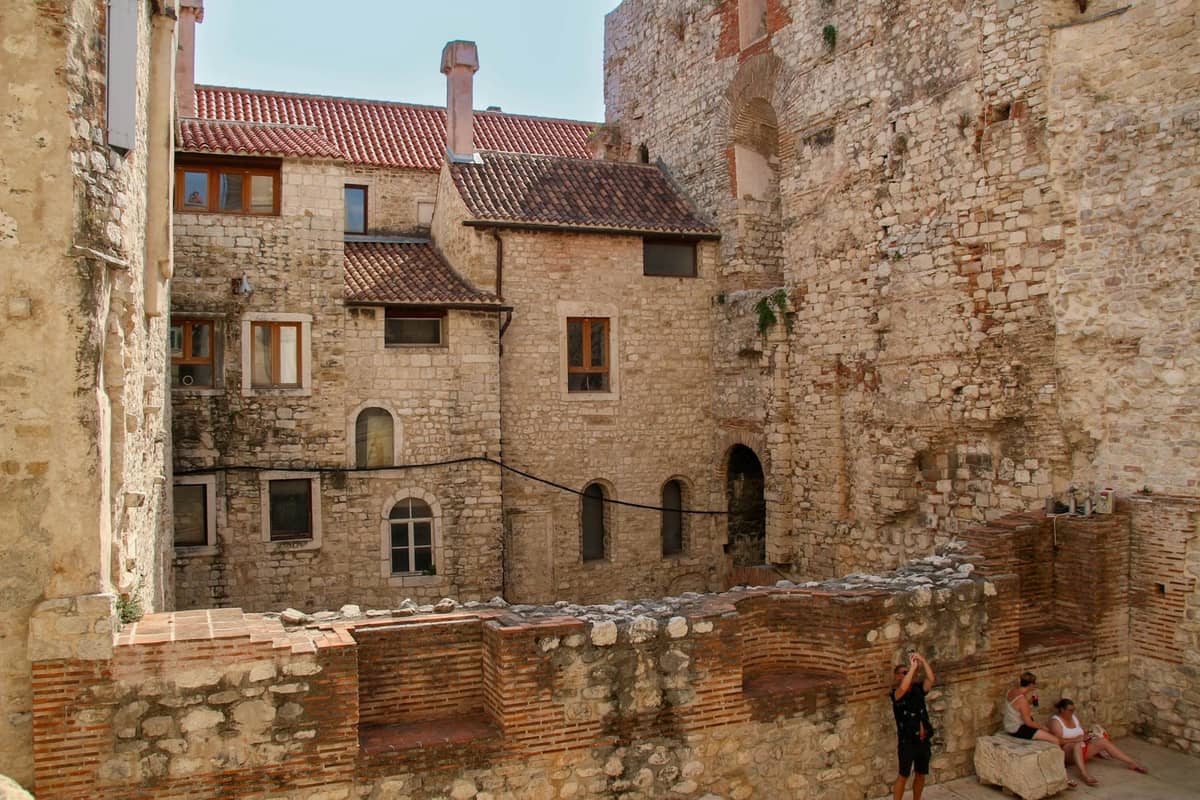
Most historic city centers are preserved as showpieces. Split went a different direction. When Diocletian built his palace between roughly 295 and 305 AD, he intended it as a fortified retirement complex on the Adriatic coast. After the fall of Rome, refugees from the nearby city of Salona moved in, converted the mausoleum into a cathedral, turned the temple into a baptistery, and started building homes inside the walls. They never left. Today, the palace walls contain apartments, bars, restaurants, a working cathedral, and narrow alleys where locals hang laundry above tourist foot traffic.
The UNESCO World Heritage designation came in 1979, recognizing the Historic Complex of Split with Diocletian's Palace as an exceptional example of continuity between late antiquity and medieval urban development. For walkers, this means you're not moving through a reconstruction or a ruin. You're walking through a place that has been continuously inhabited for 1,700 years. That context matters more than any single landmark on the route. If you want more background before you visit, the Diocletian's Palace overview covers the full architectural and historical story.
ℹ️ Good to know
The palace walls enclose roughly 38,000 square meters. The complex has four gates named after precious materials: Golden (north), Silver (east), Iron (west), and Brass or Bronze (south, facing the sea). Each gate anchors one of the four main streets that cross the palace interior.
The Route: Landmark by Landmark
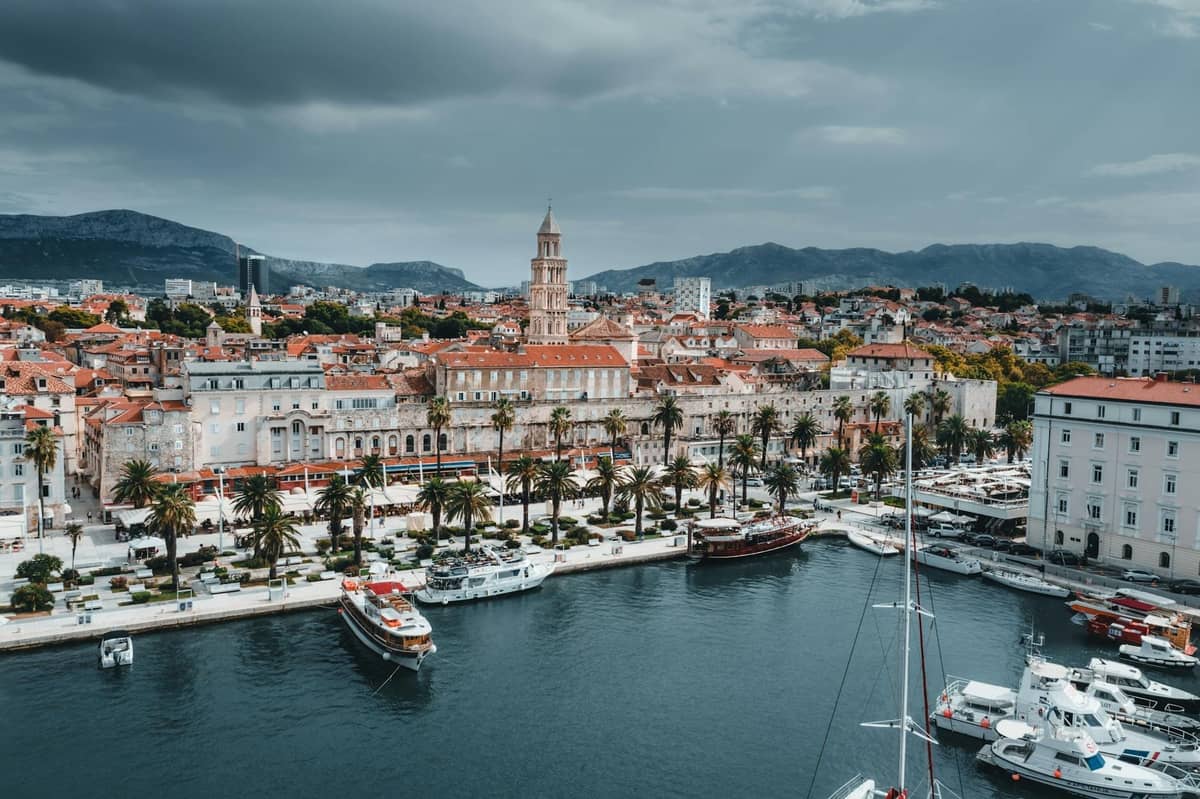
Start at the Riva, Split's seaside promenade. Before entering the palace, find the bronze scale model of the old town near the Brass Gate. It gives you a three-dimensional orientation that no map quite replicates, showing how the palace walls relate to the surrounding city. The Brass Gate itself is the southern entrance, directly off the Riva, and it leads straight into the palace substructures.
The palace substructures (cellars) run beneath the entire southern half of the palace and are the best-preserved Roman basement halls in existence. Their survival has nothing to do with flooding or deliberate conservation. The ground level above stayed consistently occupied, which meant the cellars were used as dump sites for centuries. Paradoxically, the accumulated debris protected the vaulted ceilings from collapse. The lower halls served as filming locations for Game of Thrones (the dragon pits), but that shouldn't be the main reason you go in. Entry costs around €8–10. The scale of the space, especially the central hall, is genuinely impressive.
From the cellars exit, climb through the Peristyle, the main ceremonial courtyard of the palace. This open square is framed by columns on three sides and leads directly to the Cathedral of Saint Domnius. The cathedral was built inside Diocletian's mausoleum, meaning the emperor built his own tomb and Christians converted it into a church dedicated to one of his martyred victims. The irony is not lost on historians, and local guides enjoy pointing it out.
The Cathedral of Saint Domnius is worth the entrance fee (around €5-7) if you're interested in early Christian architecture. The bell tower offers one of the best elevated views of the palace interior and the Riva below. The climb involves narrow medieval stairs with rope handrails. Not ideal if you're uncomfortable with heights or confined spaces, but the views are worth it for those who make it up. Verify current opening hours at the cathedral entrance, as they change seasonally.
Just west of the Peristyle is the Vestibule, a domed circular room that was the formal entrance to Diocletian's private apartments. The dome is open to the sky, which was probably not the original design but creates an unusual acoustic chamber. Musicians sometimes perform here, and the reverb is striking. Continue north toward the Golden Gate, the most intact of the four gates and the most impressive architecturally. The double-walled entrance passage gives a clear sense of the military seriousness of the original design.
Outside the Golden Gate stands the statue of Gregorius of Nin, a medieval Croatian bishop cast by sculptor Ivan Meštrović. The statue's big toe is polished bright from decades of tourists rubbing it for luck. This is one of Split's most photographed moments, though the custom has no ancient roots. From here, circle back through the Silver Gate (east) and explore the Pazar market area just outside the walls, where locals shop for fruit, vegetables, and flowers every morning. The market is a genuinely local space, not a tourist set piece.
- Riva Promenade (Start) Find the bronze model near the Brass Gate for orientation before entering. Free.
- Palace Cellars (Substructures) Enter from the Brass Gate passage. Best-preserved Roman basement halls in existence. Entry around €10.
- Peristyle Square Ceremonial courtyard, free to enter. Heart of the palace. Can get crowded midday in summer.
- Cathedral of Saint Domnius Built inside Diocletian's mausoleum. Bell tower climb recommended for views. Entry around €5-7, verify locally.
- Jupiter's Temple / Vestibule Two adjacent ancient structures west of the Peristyle. Free to view exterior; Jupiter's Temple accessible with a small fee.
- Golden Gate (Porta Aurea) Best-preserved gate, northern exit. Gregorius of Nin statue immediately outside.
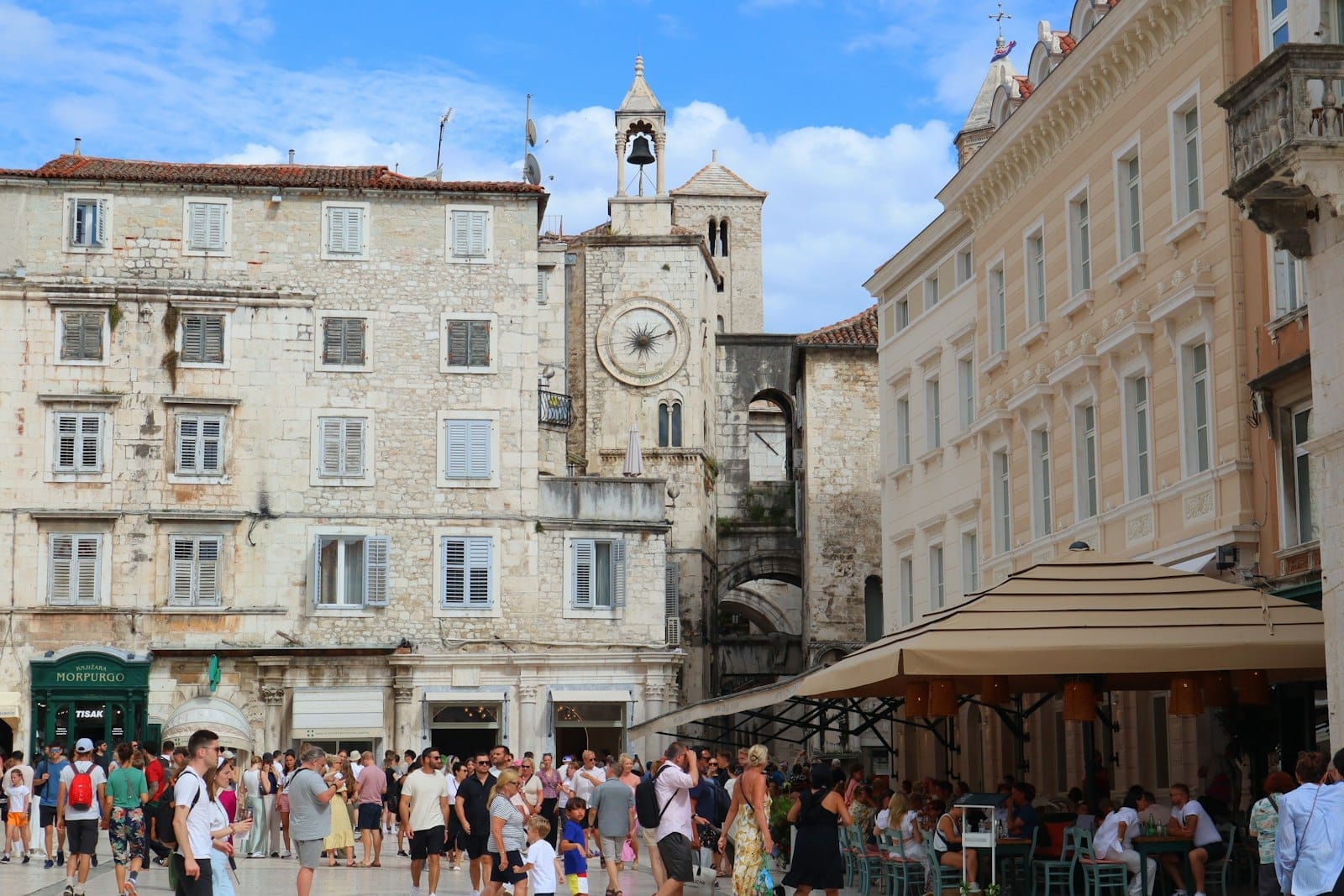
- People's Square (Pjaca) The main square of the medieval town just outside the palace walls. Good coffee stop.
- Pazar Market Daily open-air market outside the Silver Gate. Local produce, flowers, souvenirs. Free to browse.
Timing, Crowds, and the Best Hours to Walk
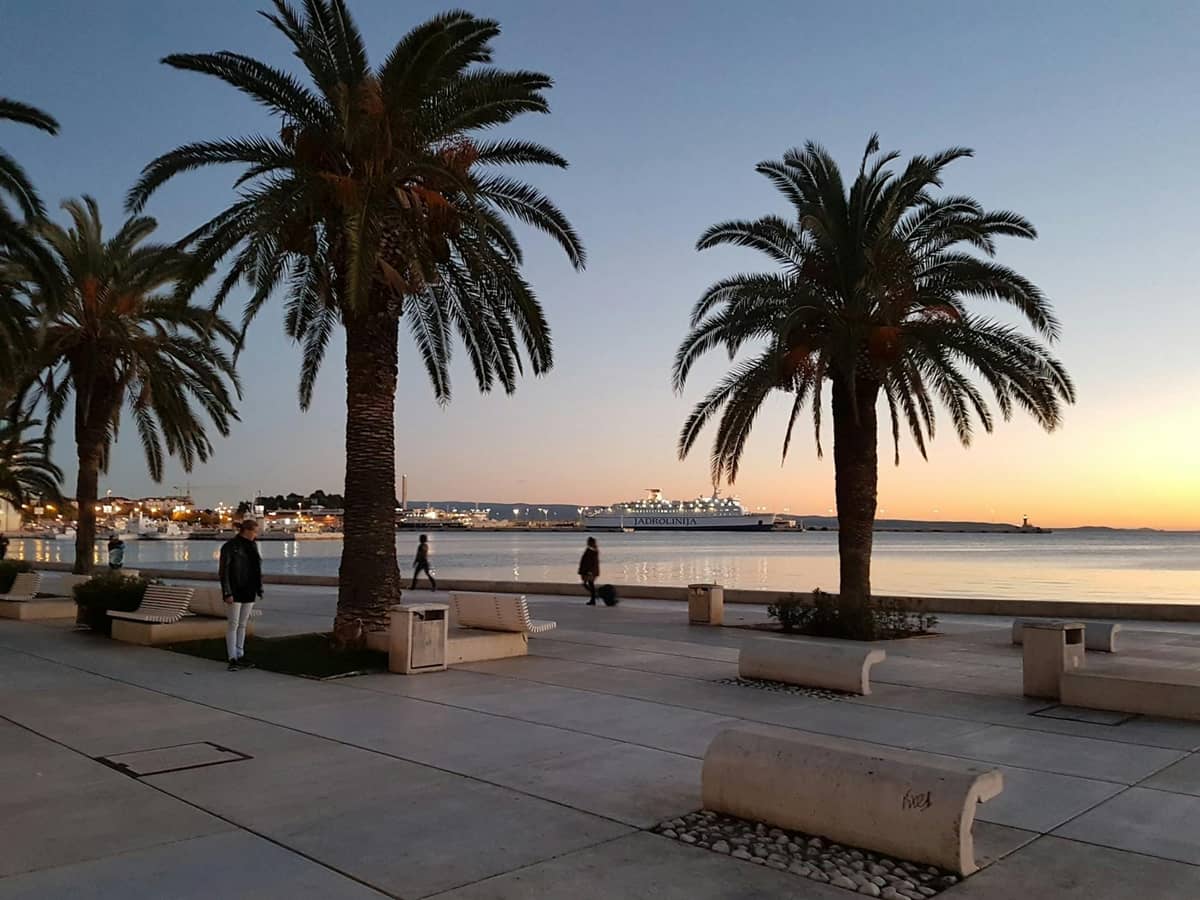
Split receives over a million visitors annually, and a large portion of them arrive on cruise ships that dock in the harbor and funnel directly into the old town between 10am and 4pm. The Peristyle and the Riva become extremely congested during these windows from June through August. If you're visiting in summer, starting your walk at 7:30 or 8am gives you an almost entirely different experience. The light is better for photographs, the air is cooler, and the palace lanes feel appropriately ancient rather than theme-park busy.
Spring (April to May) and autumn (September to October) are significantly more comfortable for walking. Temperatures sit in the mid-teens to mid-twenties Celsius, crowds are manageable, and most attractions are open. Winter is genuinely uncrowded and the palace takes on a different character when locals reclaim it. Some restaurants and smaller shops close, but the cathedral, cellars, and main landmarks remain accessible.
⚠️ What to skip
The cobblestones inside the palace are uneven, worn smooth, and become slippery after rain. This is not a walk for hard-soled shoes or sandals with no grip. Trainers or walking shoes with rubber soles are the practical choice regardless of how hot it is.
Free Walk vs. Guided Tour vs. Audio Tour
The self-guided walk described here is entirely free for public spaces. You can wander every alley, cross through all four gates, and spend an hour absorbing the atmosphere without paying anything. For most visitors, this is the right approach on a first pass. Get the spatial sense of the place first, then decide what to go deeper on.
If you want structured context without the cost or scheduling constraints of a live guide, the VoiceMap audio tour covers the old town and extends to Marjan Hill and runs around €5-12 through their app. The quality is solid and the geo-triggered commentary means you hear information at the right moment rather than needing to read while walking. For first-time visitors who want more than the surface layer, it's reasonable value.
Live guided walking tours average €15-25 per person and typically run 1.5 to 2 hours. The advantage is the ability to ask questions, which makes a real difference in a place as layered as Diocletian's Palace. Group free tours (tip-based) also operate daily from the Peristyle, though quality varies significantly by guide. Check the broader Split activity guide for vetted tour operators.
✨ Pro tip
The GPSmyCity app offers a downloadable offline walking map for Split's old town, useful if you're navigating without mobile data. It's not as narratively rich as VoiceMap but works well as a route guide when you just need to know where you are inside the palace maze.
Extending the Walk: Beyond the Palace Walls
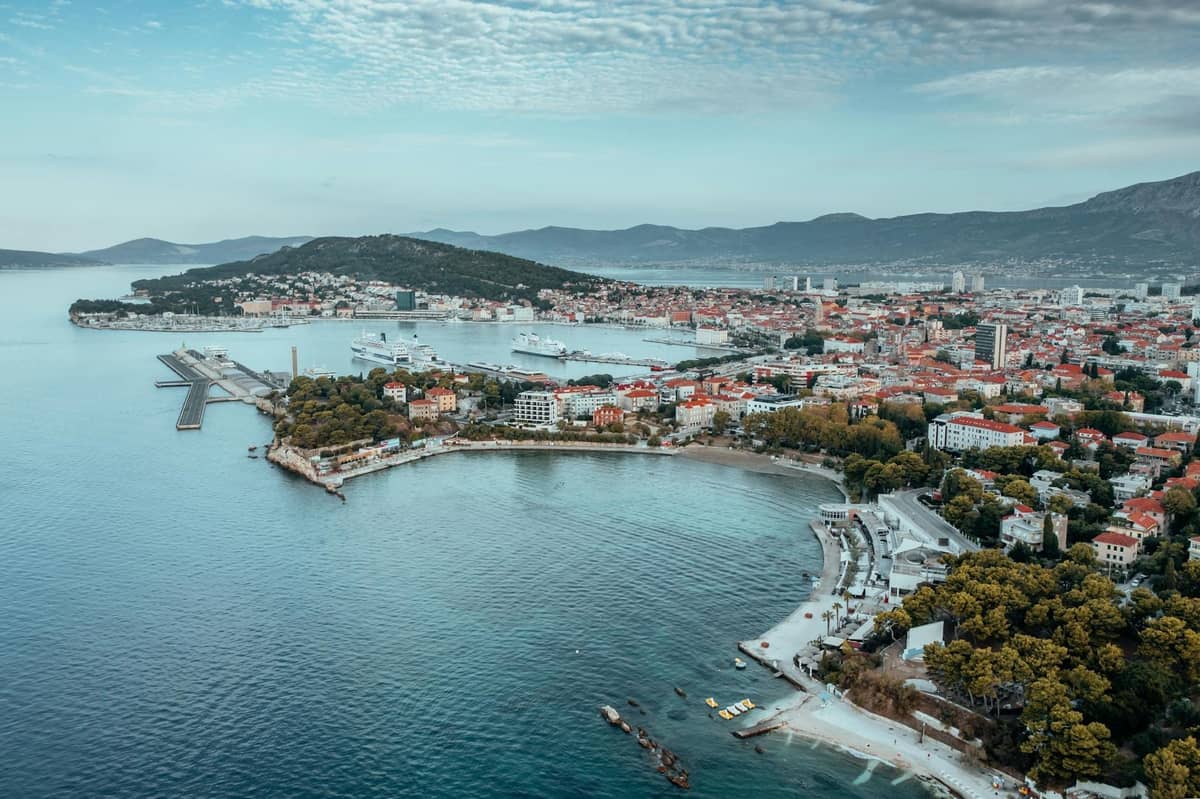
The palace and old town can reasonably be combined with a walk up Marjan Hill, the forested peninsula west of the old town. The ascent from the Varoš neighborhood takes around 20-30 minutes and the trails are shaded, which matters considerably in summer. The hilltop viewpoints look back over the old town, the Riva, and the islands beyond. Add 1.5 to 2 hours for a Marjan extension.
East of the palace, Bačvice beach is a 10-minute walk along the coast. The shallow sandy bay is where locals play picigin, a traditional Dalmatian ball game played in ankle-deep water. It's worth watching even if you're not swimming. For a full day structure combining the old town walk, Marjan, and Bačvice, the 3 days in Split itinerary provides a well-tested sequence.
- Add Marjan Hill for elevated views and shade: allow an extra 1.5-2 hours from the Golden Gate
- People's Square and the Fruit Square (Voćni trg) extend the old town area just west of the palace walls: 20-30 minutes
- The Meštrović Gallery is a 15-minute walk west along the coast and houses one of the most significant collections of 20th-century Croatian sculpture
- Bačvice beach is about 10-15 minutes east along the waterfront for a post-walk swim
- Salona, the Roman city Diocletian's palace refugees fled from, is about 6 km inland and accessible by bus for a half-day extension
💡 Local tip
If you're combining the old town walk with a day trip, Split makes an excellent base. Trogir is 30 minutes west by bus, Krka National Park is around 60–90 minutes, and ferries to Hvar depart regularly from the harbor directly below the Riva. Plan the walk for the morning and the day trip for the afternoon, or vice versa.
Practical Logistics Before You Go
The old town is entirely walkable from any central accommodation. If you're staying outside the immediate center, the guide to getting around Split covers bus routes and transport options. Parking near the old town is limited and can be expensive in summer. Most visitors are better served by public transport or arriving on foot from nearby neighborhoods.
There are no bag storage lockers inside the palace. If you're arriving with luggage before check-in, several luggage storage services operate near the ferry terminal and bus station, typically charging around €3-5 per bag. The old town lanes are narrow and bags with wheels are difficult to manage on the cobblestones.
Food and coffee options inside the palace walls range from excellent to overpriced tourist traps. The general rule: the closer to the Peristyle, the higher the markup. Wander one street back from the main tourist corridors for better value. For a fuller picture of where to eat and what to order, the guide to eating in Split covers local dishes and reliable spots across price ranges.
FAQ
How long does a self-guided walk through Split old town take?
The core route covering the Riva, palace cellars, Peristyle, cathedral area, and four gates takes around 1 hour at a comfortable pace without entering paid attractions. Add 30-60 minutes if you go inside the cellars and cathedral. A full walk including People's Square, the Gregorius of Nin statue, and Pazar market takes 1.5 to 2 hours.
Is the walking tour of Split old town free?
Walking through the old town and exploring public spaces, gates, and exterior landmarks is completely free. Individual attractions have entrance fees: the palace cellars cost around €10, the Cathedral of Saint Domnius and bell tower around €5-10 each. Verify current prices locally as they change seasonally.
What is the best time of day to walk through Split old town?
Early morning, between 7:30 and 9am, gives you the best experience in summer. Cruise ship passengers tend to arrive from around 10am and the Peristyle gets crowded quickly. In spring or autumn, timing is more flexible, though midday is always more comfortable earlier or later.
Do I need a guided tour or can I walk Split old town independently?
You can absolutely walk independently and most visitors do. A guided tour or audio guide adds historical context that significantly deepens the experience, especially for Diocletian's Palace, which has over 1,700 years of layered history. If budget allows, even a basic audio tour (around €5-12) is worthwhile for first-time visitors.
Is Split old town suitable for wheelchair users or people with limited mobility?
The cobblestones inside the palace are uneven and some alleyways have steps with no ramps. The Riva and areas immediately outside the palace walls are accessible. Parts of the palace interior have been improved, but the medieval street structure means full wheelchair access throughout the old town is not possible.