Gregorius of Nin Statue: Split's Most Touched Monument
Standing over seven meters tall outside Diocletian's Palace's Golden Gate, Ivan Meštrović's bronze statue of Bishop Gregory of Nin is one of Split's most recognizable landmarks. Free to visit at any hour, it carries both historical weight and a well-worn good-luck ritual that draws visitors from across the world.
Quick Facts
- Location
- Kralja Tomislava 10A, beside the Golden Gate (Zlatna vrata), north entrance to Diocletian's Palace, Split
- Getting There
- Walk north through Diocletian's Palace from the Peristyle, or approach along Ulica Kralja Tomislava from the city center bus stops
- Time Needed
- 15–30 minutes at the statue; combine with a broader Old Town walk
- Cost
- Free, open 24/7 year-round
- Best for
- History enthusiasts, first-time visitors, photography, cultural context on Croatian identity
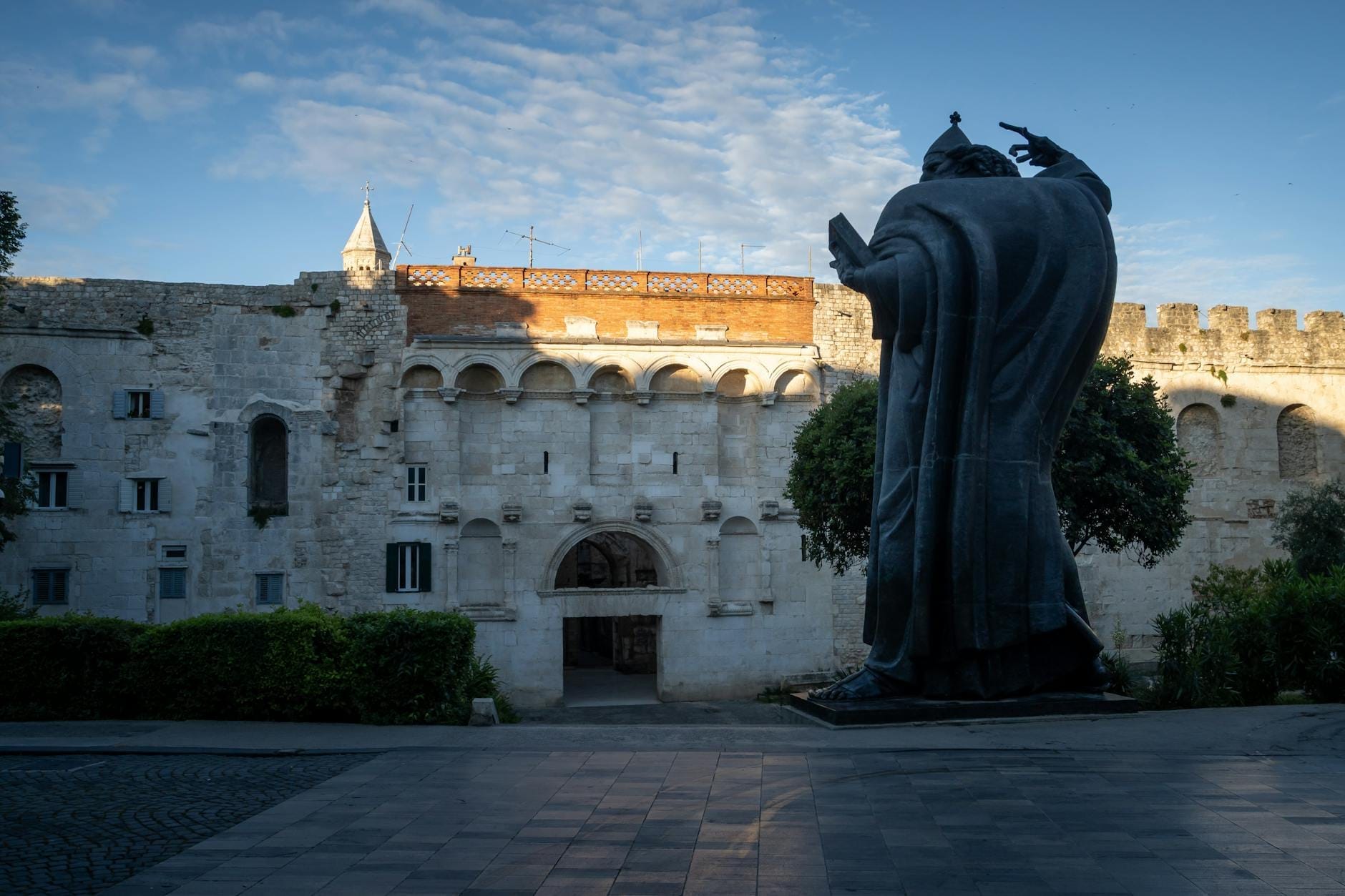
What You're Looking At
The Gregorius of Nin statue, known locally as Grgur Ninski, dominates the open square just outside the Golden Gate on the north face of Diocletian's Palace. Cast in dark bronze and rising approximately 7.58 meters from base to crown, it is the largest bronze statue in Croatia. The figure depicted is Bishop Gregory of Nin, a 10th-century Croatian ecclesiastical leader who fought to have the liturgy conducted in the Croatian vernacular rather than Latin. In a country that spent centuries under foreign rule, that act of cultural resistance carries serious weight.
The statue is the work of Ivan Meštrović, widely considered Croatia's most celebrated sculptor of the 20th century. His interpretation of Gregory is monumental in every sense: the bishop is shown mid-stride, robes bunched with motion, right arm raised with a bishop's staff, the whole composition radiating determined authority rather than saintly passivity. Meštrović made Gregory look like someone who had just won an argument, which is essentially historically accurate.
ℹ️ Good to know
The statue's left big toe is noticeably lighter in color than the rest of the bronze. That's decades of visitors rubbing it for good luck. You'll spot the patch of bright metal immediately.
A Layered History: From Peristyle to Golden Gate
The statue was first erected in 1929, but not where you see it today. It originally stood on the Peristyle, the central courtyard inside Diocletian's Palace, where it created an immediate controversy. Positioning a towering monument in one of the most architecturally sensitive Roman spaces in the world was contentious from the start, and in 1941, during the Italian occupation of Split in World War II, it was removed and relocated to storage.
It was re-erected in 1954 at its current position outside the Golden Gate, a placement that works far better spatially. The statue now anchors the northern approach to the old town, acting as a threshold marker between the modern city and the ancient palace. The bronze underwent a significant restoration between 2013 and 2015, addressing surface oxidation and structural concerns, which is why it looks more crisply detailed up close than you might expect from a 1929 work.
Gregory himself lived around 900 AD and served as Bishop of Nin, a town north of Split. His advocacy for the Glagolitic script and the use of Old Church Slavonic in Croatian liturgy put him in direct conflict with the Pope and the broader Latin Church hierarchy. He lost that particular battle at the Synod of Split in 925 AD, but his role as a defender of Croatian cultural and linguistic identity made him a lasting national symbol. For more on how Split's layered history shapes the city you walk through today, see our guide to Diocletian's Palace and the Old Town.
Tickets & tours
Hand-picked options from our booking partner. Prices are indicative; availability and final rates are confirmed when you complete your booking.
Cetina River basic canyoning adventure
From 50 €Instant confirmationFree cancellationExtreme canyoning on the river Cetina
From 67 €Instant confirmationFree cancellationCetina River extreme canyoning adventure
From 70 €Free cancellationSplit old city and Diocletian's Palace private morning tour
From 96 €Instant confirmationFree cancellation
The Experience at Different Times of Day
Morning, roughly between 7am and 9am, is when the statue reads best. The square in front of the Golden Gate is calm, the light comes in at a low angle from the east, and the bronze takes on a warm amber tone that photographs don't quite replicate. You can actually circle the statue fully, read the inscriptions at the base, and absorb the scale of the work without being jostled.
By mid-morning, tour groups begin arriving and the queue to touch the toe forms organically. This is not an organized line, just a loose cluster of people waiting their turn. It moves quickly. By early afternoon in summer, the square can hold 50 to 100 people at once, which makes thoughtful contemplation difficult but makes for interesting people-watching.
Evening visits have a different character. The Golden Gate itself is lit from below, and the statue takes on a heavier, more austere presence under artificial light. The surrounding café terraces fill up, there's ambient conversation and the smell of grilled fish drifting from nearby restaurants. It's a pleasant atmosphere but the statue becomes background to social life rather than the focus. Night photography here, with the warm gate lighting and deep bronze shadows, can produce striking results if you have a tripod.
💡 Local tip
For the cleanest photographs, arrive before 8:30am. You'll have the statue largely to yourself and the morning light is significantly more interesting than the flat midday glare.
Ivan Meštrović and Why the Sculptor Matters
Understanding this statue means understanding something about Ivan Meštrović. Born in 1883 in a village near Drniš, north of Split, Meštrović trained in Vienna and became internationally recognized during his lifetime, exhibiting at the Metropolitan Museum of Art in New York before the end of World War II. His work frequently drew on Croatian national mythology and religious themes, and his technical command of large-scale bronze and stone was exceptional.
The Grgur Ninski statue is among his most recognized public works, but it represents only one dimension of his output. His studio in Split, now operating as the Meštrović Gallery, holds an extensive permanent collection of his sculptures, reliefs, and drawings. If the statue outside the Golden Gate interests you, the gallery is worth at least two hours of your time.
Practical Walkthrough: Getting There and Getting Around
The statue is free to visit and accessible at any hour. There are no tickets, no queues to enter, and no staff on site. It sits on a public pedestrian square directly adjacent to the Golden Gate, which is the most intact of the four original Roman gates of Diocletian's Palace.
From the Riva promenade on the south side of the palace, the most straightforward route is to enter through the Brass Gate (Mjedena vrata), follow the main internal street north through the palace, pass through the Peristyle, and exit through the Golden Gate. The walk takes about 8 to 10 minutes and passes several significant interior sites. Alternatively, from the wider city center, Ulica Kralja Tomislava runs directly to the statue along a flat, wide pedestrian walkway that is fully accessible for wheelchairs and strollers.
If you're planning a fuller exploration of the old town, consider pairing this stop with the Golden Gate itself and the Cathedral of Saint Domnius further south inside the palace walls. Together, these three stops cover the architectural and historical backbone of Split's ancient core in under two hours.
⚠️ What to skip
The area directly around the statue gets congested during peak summer afternoons, particularly when cruise ship groups arrive. If large crowds bother you, plan your visit for early morning or after 7pm.
Is It Worth Your Time?
Bluntly: yes, but keep expectations proportionate. This is a public sculpture on a city square, not a museum experience. You can absorb everything the statue has to offer in 15 to 20 minutes, assuming you read about its context beforehand or on-site. What makes it genuinely worthwhile is the combination of factors: the craftsmanship is serious, the historical figure depicted is legitimately interesting, and the location adjacent to a Roman gateway that is nearly 1,700 years old creates a peculiar compression of Croatian history in a single visual frame.
Visitors who arrive expecting a grand plaza experience may find the square a little underwhelming in terms of size, particularly in summer when it's crowded. Those who approach it as one chapter in a longer walk through the old town will get the most from it.
Travelers looking to understand Split more deeply before or after their visit can use our Split walking tour guide to build an itinerary that connects the Gregorius of Nin statue with other key sites across the old town and beyond.
Insider Tips
- The polished toe is an obvious target for photos, but the real photographic interest is the upper body of the statue shot from low angle at ground level: the raised staff against the sky is far more dramatic than any toe close-up.
- The Golden Gate immediately behind the statue is often overlooked by visitors focused on the bronze. Step through it into the palace and look back at the medieval tower built into the ancient Roman structure. It's one of the more striking architectural collisions in the whole city.
- If you visit in the evening, the bar terraces on Ulica Kralja Tomislava are well-positioned for sitting with a drink while looking at the lit statue. It's a quieter and more local scene than the cafés on the Riva.
- The restoration of 2013 to 2015 left the statue in better condition than many outdoor bronzes you'll see in Mediterranean cities. Look closely at the robe folds and the facial detail — Meštrović's technical precision is easier to appreciate now than it was before the restoration.
- Context before you arrive makes a significant difference. A five-minute read on Bishop Gregory's role in Croatian history and the Synod of Split in 925 AD will make the statue mean considerably more than it would to someone who simply stumbles across it.
Who Is Gregorius of Nin Statue For?
- First-time visitors to Split building familiarity with Croatian history
- Architecture and public art enthusiasts interested in 20th-century European sculpture
- Photographers who want a visually strong subject outside the palace walls
- Travelers combining the statue with a full walking route through the old town
- Anyone with an interest in the Meštrović Gallery and his broader body of work
Nearby Attractions
Other things to see while in Diocletian's Palace & Old Town:
- Cathedral of Saint Domnius
The Cathedral of Saint Domnius began its life as the mausoleum of Emperor Diocletian around AD 305 and was converted into a Christian cathedral in the 7th century, making it the oldest Catholic cathedral in continuous use within its original structure. Rising above the Peristyle at the heart of Diocletian's Palace, it remains an active place of worship, a climb-worthy bell tower, and one of the most layered architectural sites in Europe.
- Diocletian's Cellars (Peristyle Substructure)
Beneath the streets of Split's old town, the Cellars of Diocletian's Palace preserve one of the most complete Roman substructures anywhere in the world. Built around the turn of the 4th century AD to support the emperor's private apartments, these vast underground halls cover over one hectare and feel unlike any museum. This is the actual Roman foundation, open to walk through.
- Diocletian's Palace
Diocletian's Palace is not a museum. It is a functioning neighborhood built inside a Roman emperor's retirement complex, where cafes, apartments, and a cathedral occupy spaces once designed for imperial ceremony. This guide covers what to see, when to go, and how to make sense of one of Europe's most extraordinary living monuments.
- Game of Thrones Museum Split
Tucked into the Old Town at Bosanska ulica 9, the Game of Thrones Museum Split offers five themed rooms filled with props, costumes, and life-size character statues. It's a compact, fan-focused stop that makes most sense when paired with a walk through the very palace walls that stood in for Meereen on screen.