Golden Gate (Porta Aurea): Split's Most Impressive Roman Entrance
The Golden Gate, known in Croatian as Zlatna Vrata and originally called Porta Aurea, is the northern entrance to Diocletian's Palace and the grandest of its four gates. Free to visit at any hour, it connects the ancient palace to the road that once led to the Roman city of Salona, and stands today as a remarkably well-preserved late Roman fortified gateway.
Quick Facts
- Location
- North wall of Diocletian's Palace, Split Old Town (Stari Grad)
- Getting There
- 15-20 min walk from the main bus/train station via the Riva and through the palace streets; no transit stop directly at gate
- Time Needed
- 20-40 minutes at the gate itself; pair with nearby Grgur Ninski statue
- Cost
- Free, open 24/7 as part of the UNESCO Diocletian's Palace site
- Best for
- History enthusiasts, architecture lovers, photographers, and early-morning walkers
- Official website
- visitsplit.com/en/521/the-golden-gate
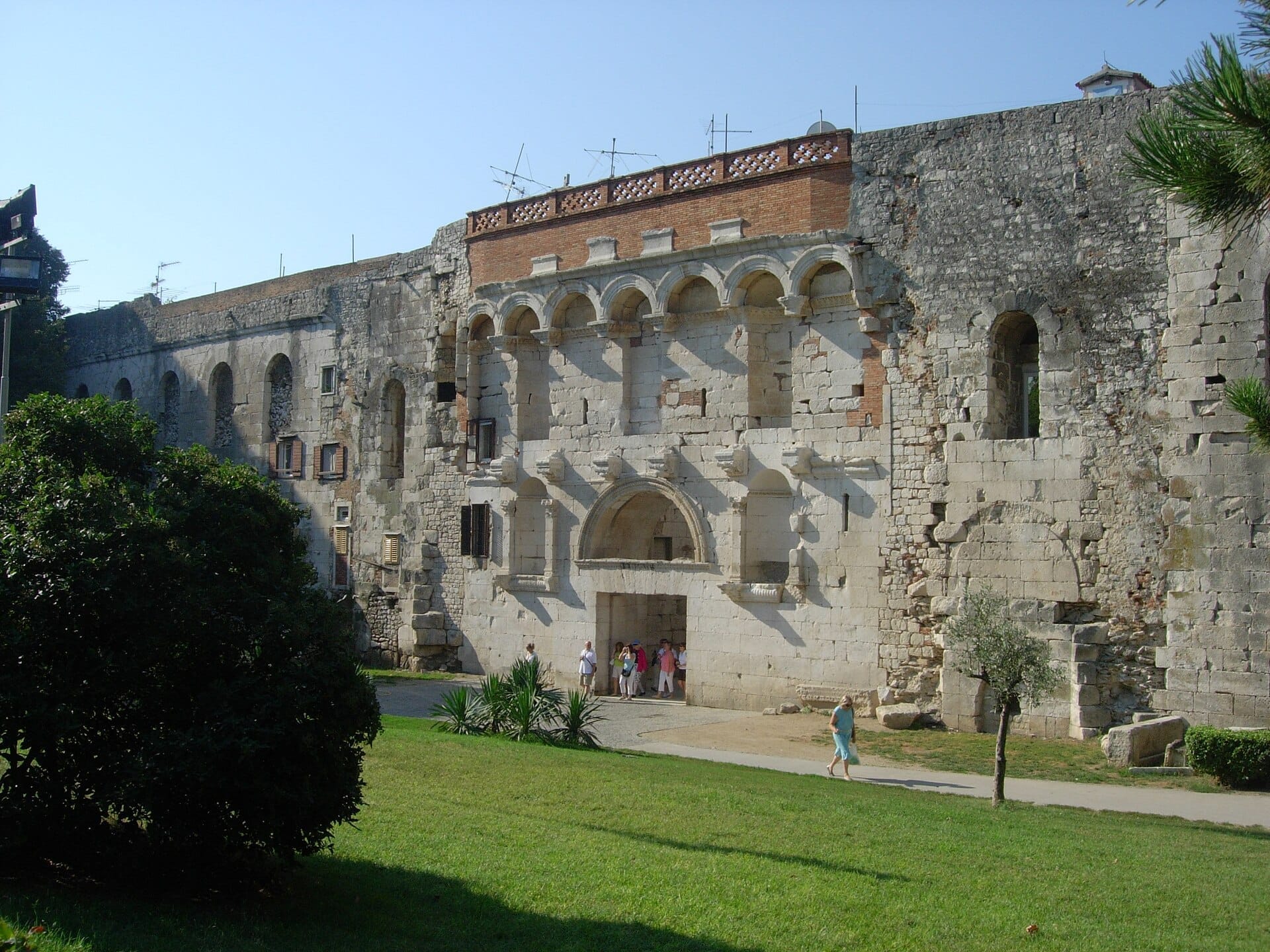
What the Golden Gate Actually Is
The Golden Gate, or Porta Aurea, was built in the early 4th century AD as the principal ceremonial entrance to Emperor Diocletian's retirement palace. Of the four gates in the palace walls, each corresponding to a cardinal direction, this northern one was the largest, the most elaborately decorated, and the most strategically important. It faced the road to ancient Salona, the Roman provincial capital where Diocletian had governed before abdicating in 305 AD.
Its original Latin name was Porta Septemtrionalis, meaning the northern gate. The name 'Golden Gate' emerged around the 16th century, likely under Venetian influence, and refers to its prestige rather than any literal use of gold. It is the grandest of the four palace entrances, which were also named Silver (east), Iron (west), and Brass (south).
For context on how all four gates fit into the palace layout, the guide to Diocletian's Palace covers the full structure, its history, and how to navigate it today.
ℹ️ Good to know
The Golden Gate is completely free to visit and open at all hours. There is no ticket booth, no queue, and no reservation needed. You walk through it as people have done for over 1,700 years.
The Architecture: What You're Looking At
Approaching from the north, outside the palace walls, the gate reveals its defensive logic immediately. The structure uses a propugnaculum design: a rectangular forecourt with two gates in sequence, creating a trap corridor where any attacker who breached the outer gate would find themselves enclosed, exposed to defenders above. The stonework is limestone, quarried locally from the nearby island of Brač, a pale stone famously used in many Dalmatian buildings and exported abroad, though not in the construction of the White House in Washington DC.
The facade once featured decorative niches framed by pilasters and small columns, many of which remain visible in varying states of preservation. The upper register shows blind arcading above the main archway, a decorative motif typical of late Roman palatial architecture. Some of the surface ornamentation has weathered significantly over the centuries, but the scale and structural integrity of the gate are remarkably intact.
Look upward when passing through the gate passage: the vaulted ceiling of the corridor still retains its original Roman masonry. The gate was sealed at some point during the medieval period when the palace was converted into a city, and parts of the interior walls were built into surrounding structures. A small 6th-century chapel dedicated to St. Martin was incorporated into the guard corridor on the upper level, accessible at certain times, where you can see how successive centuries layered their own additions onto Roman foundations.
Tickets & tours
Hand-picked options from our booking partner. Prices are indicative; availability and final rates are confirmed when you complete your booking.
Golden Horn and Brac Island private boat tour
From 1.850 €Instant confirmationFree cancellationBlue Cave and Hvar 5 islands tour from Split
From 145 €Instant confirmationFree cancellationKrka national park tour from Split
From 27 €Instant confirmationFree cancellationAll-inclusive Blue Lagoon tour from Split with three islands visit
From 68 €Instant confirmationFree cancellation
How the Experience Changes Through the Day
Early morning is the most rewarding time to visit. Between 7am and 9am, the area outside the north wall is quiet enough that you can stand directly in front of the gate without negotiating around tour groups. The pale limestone catches the morning light at a low angle, sharpening every carved detail. The sound environment is almost entirely ambient at that hour: pigeons, a distant delivery truck, the faint echo of footsteps inside the passage.
By mid-morning, tour groups begin arriving from the direction of the Riva and the Peristyle. The main Cardo street, which runs south from the Golden Gate through the palace toward the sea, becomes a corridor of foot traffic. The gate itself turns into a bottleneck, with visitors stopping mid-arch for photographs while others try to pass. It is still entirely manageable, but the contemplative quality disappears.
Evening brings another shift. After 8pm in summer, the area outside the gate has a noticeably different character: locals walking dogs or cutting through on foot, the nearby bars along the palace perimeter generating a low hum of conversation, the gate itself lit against a darkening sky. The stone takes on a warmer tone under artificial lighting, and the absence of crowds makes it easy to stop and look up at the facade without any social pressure to keep moving.
💡 Local tip
For the best photographs of the gate facade, position yourself directly north of the entrance before 9am. The sun rises to the east and catches the carved detailing on the upper section clearly in the morning hours. By noon, the light is flat and the stone looks washed out.
The Grgur Ninski Statue: The Real Reason Most People Stop Here
Standing just outside the Golden Gate, slightly to the left as you face the palace, is an 8-meter bronze statue that commands the space entirely. This is Ivan Meštrović's statue of Grgur Ninski, or Gregory of Nin, a 10th-century Croatian bishop who famously advocated for the use of the Croatian language in church liturgy at a time when Latin was the only permissible option. Meštrović completed the statue in 1929, and it was moved to its current position outside the Golden Gate in 1954.
The statue is one of Split's most recognized landmarks and a powerful piece of public sculpture in its own right. The Gregorius of Nin statue has its own dedicated page with more detail on Meštrović's technique and the cultural significance of the bishop's story.
The left big toe of the statue is conspicuously bright gold, worn smooth by decades of visitors rubbing it for good luck. The tradition has no ancient origin but it is thoroughly embedded at this point: the toe gets polished by hundreds of hands daily. Whether or not you participate, it is worth noting how the statue and the Roman gate behind it form an unlikely compositional pair, one ancient, one early 20th century, both making statements about power and identity.
Historical Context: From Imperial Gate to Living Neighborhood
Diocletian entered his palace for the first time on 1 June 305 AD, shortly after his abdication, which was itself an extraordinary act in Roman imperial history. No emperor had voluntarily stepped down before him. The Golden Gate was his ceremonial entry point into a retirement that lasted until his death in 311 or 312 AD. Within two centuries, the palace had begun its transformation from private imperial residence to urban settlement, as refugees from the sacked city of Salona moved inside the walls in the 7th century.
The ruins of Salona, the Roman city to which the road through the Golden Gate once led, are still visible today about 5 kilometers northeast of Split. The Salona Roman ruins offer a compelling counterpoint to the palace: while the palace survived because people moved in and kept it alive, Salona was abandoned and slowly reclaimed by earth and vegetation.
The gate was sealed at some point during the medieval period, converting a functional entrance into a wall section. It was reopened and restored over time, eventually becoming the pedestrian passage it is today. The street that runs south from it, the ancient Cardo Maximus, is now one of the main arteries of the old town, lined with cafes, souvenir shops, and the occasional archaeological display behind glass set into the pavement.
Practical Notes for Your Visit
The Golden Gate is free to pass through and requires no planning beyond showing up. From the main bus and ferry terminal at the Riva, walk north along Marmontova street for about 15 to 20 minutes until you reach the northern edge of the palace walls. The gate is unmistakable. Alternatively, if you are already inside the palace, follow the Cardo (the main north-south street) from the Peristyle directly to the gate.
If you are planning a structured walk through the old town, the Split walking tour guide routes through the Golden Gate and connects it to the other major palace landmarks in a logical sequence.
The ground outside the gate is paved with large, slightly uneven stone slabs. Comfortable shoes with grip are advisable, particularly after rain when the surface becomes slippery. The area is not wheelchair accessible in any meaningful sense: there are no ramps, curb cuts are absent in several places, and the passage itself has a slightly raised threshold. People with limited mobility can view the gate facade clearly from outside without navigating the passage.
⚠️ What to skip
The space immediately outside the Golden Gate is one of the more congested pedestrian areas in Split during peak summer months (July and August). If you are visiting between 10am and 6pm in high season, expect to share the space with multiple tour groups simultaneously. The gate does not close, but the experience is significantly more pleasant outside these hours.
If you have a full day in the palace area, consider pairing the Golden Gate with the Cathedral of Saint Domnius and the Diocletian's cellars, which together give a comprehensive picture of how the palace has evolved from Roman times to the present.
Who Will Get the Most From This Attraction
Travelers with an interest in Roman history, late antique architecture, or urban archaeology will find the Golden Gate genuinely rewarding. The gate is one of the few places in Split where you can stand inside a Roman defensive structure, look at the original masonry overhead, and understand the spatial logic of how a 4th-century military architect thought about security and ceremony simultaneously.
For travelers who are primarily interested in beaches, nightlife, or Croatian food culture, the Golden Gate is easy to walk past in five minutes without feeling shortchanged. It is not an experience that requires extended engagement. Those who want to linger, to read the layers of stone and history, will find the time passes quickly. Those who are simply checking a box will check it and move on, and that is entirely fine too.
Insider Tips
- The small Chapel of St. Martin, built into the upper level of the gate's guard corridor in the 6th century, is one of the oldest continuously used Christian spaces in Split. Check locally whether it is open during your visit; it is easy to walk past without noticing it exists.
- Stand inside the gate passage and look up: the original Roman barrel vaulting is directly above you. Most visitors walk through staring forward or at their phones and miss the ceiling entirely.
- The Grgur Ninski statue photographs best from a low angle, crouching near the base and shooting upward. From standing height, the surrounding context crowds the composition.
- If you walk north through the Golden Gate and continue for about 5 minutes, you reach a quieter residential street on the edge of the old town with a clear view back toward the palace's north wall. This vantage point, rarely mentioned in guidebooks, gives you a sense of the full defensive scale of the structure.
- Visit after 9pm in summer. The gate is lit, the crowds have thinned considerably, and the atmosphere outside the north wall shifts from tourist attraction to neighborhood landmark in a way that is more authentic to daily life in Split.
Who Is Golden Gate (Porta Aurea) For?
- Roman history and archaeology enthusiasts who want to stand inside a functioning 4th-century gateway
- Architecture-focused travelers interested in late antique military design and how successive centuries modified it
- Photographers looking for strong compositional subjects in the early morning or evening light
- Visitors combining a walking tour of the palace with a stop at the Grgur Ninski statue
- Anyone doing a self-guided tour of Diocletian's Palace who wants to understand the original entry sequence
Nearby Attractions
Other things to see while in Diocletian's Palace & Old Town:
- Cathedral of Saint Domnius
The Cathedral of Saint Domnius began its life as the mausoleum of Emperor Diocletian around AD 305 and was converted into a Christian cathedral in the 7th century, making it the oldest Catholic cathedral in continuous use within its original structure. Rising above the Peristyle at the heart of Diocletian's Palace, it remains an active place of worship, a climb-worthy bell tower, and one of the most layered architectural sites in Europe.
- Diocletian's Cellars (Peristyle Substructure)
Beneath the streets of Split's old town, the Cellars of Diocletian's Palace preserve one of the most complete Roman substructures anywhere in the world. Built around the turn of the 4th century AD to support the emperor's private apartments, these vast underground halls cover over one hectare and feel unlike any museum. This is the actual Roman foundation, open to walk through.
- Diocletian's Palace
Diocletian's Palace is not a museum. It is a functioning neighborhood built inside a Roman emperor's retirement complex, where cafes, apartments, and a cathedral occupy spaces once designed for imperial ceremony. This guide covers what to see, when to go, and how to make sense of one of Europe's most extraordinary living monuments.
- Game of Thrones Museum Split
Tucked into the Old Town at Bosanska ulica 9, the Game of Thrones Museum Split offers five themed rooms filled with props, costumes, and life-size character statues. It's a compact, fan-focused stop that makes most sense when paired with a walk through the very palace walls that stood in for Meereen on screen.