Diocletian's Cellars: Inside the Ancient Substructures of Split's Roman Palace
Beneath the streets of Split's old town, the Cellars of Diocletian's Palace preserve one of the most complete Roman substructures anywhere in the world. Built around the turn of the 4th century AD to support the emperor's private apartments, these vast underground halls cover over one hectare and feel unlike any museum. This is the actual Roman foundation, open to walk through.
Quick Facts
- Location
- Ul. Iza Vestibula 3, Diocletian's Palace Old Town, Split
- Getting There
- Pedestrian zone; enter near the Peristyle and Palace Vestibule in the heart of the old town
- Time Needed
- 45 to 90 minutes
- Cost
- Admission charged; verify current prices on-site or at visitsplit.com before visiting
- Best for
- History enthusiasts, architecture lovers, travelers seeking shade on hot days
- Official website
- visitsplit.com/en/529/the-substructures
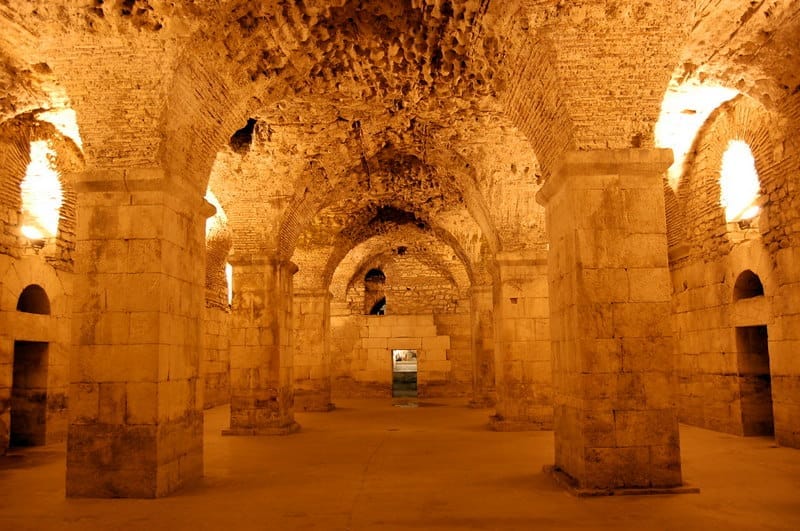
What the Cellars Actually Are
The Cellars of Diocletian's Palace, known in Croatian as Podrumi Dioklecijanove palače, are not a cellar in any ordinary sense. They are the full substructure of the southern half of Emperor Diocletian's imperial residence, constructed around the turn of the 4th century AD. The Roman engineers built this underground level first, essentially creating an elevated platform of vaulted stone rooms that would support the imperial apartments above. The layout of the cellars mirrors the floor plan of those apartments almost exactly, which is part of what makes them so valuable to archaeologists: the underground spaces preserved the geometry of rooms that no longer exist at ground level.
The complex covers a little over one hectare. That scale surprises most visitors, who expect a single atmospheric corridor and instead find a sequence of interconnected halls, barrel-vaulted passages, and open chambers stretching deep beneath the city. Walking the full route from the main entrance near the Peristyle to the far reaches of the eastern halls takes genuine effort, and the spatial variety keeps the experience from feeling monotonous.
ℹ️ Good to know
The cellars are part of the UNESCO World Heritage-listed Split Historic Complex, inscribed in 1979. They are widely considered one of the best-preserved Roman substructures in the world.
A Brief History Worth Knowing Before You Enter
Diocletian, Roman Emperor from 284 to 305 AD, commissioned this palace as his retirement residence on the Dalmatian coast near his birthplace of Salona. The cellars were built primarily as structural substructures, though they were also used as storage areas for the palace and later by residents in subsequent centuries. After Diocletian's death and the eventual collapse of centralized Roman authority in the region, the palace itself became the nucleus of what is now Split. People moved into its walls, converted temples into churches, and gradually filled the cellars with debris over centuries.
Systematic excavation began in the mid-19th century under Croatian architect and conservator Vicko Andrić. The western halls were opened to the public in 1959; the eastern section was not accessible until 1996. What visitors see today is the product of those long excavation efforts, which removed accumulated sediment and revealed the original Roman masonry largely intact. The stone used is limestone quarried from the nearby island of Brač, the same material used throughout the palace.
The proximity to other ancient sites deepens the context considerably. The ruins of Salona, the Roman city where Diocletian was born, lie just a few kilometers northeast of Split and give a sense of how significant this region was in late imperial Roman history. Visiting both in the same day is feasible and genuinely rewarding for anyone serious about Roman history.
Tickets & tours
Hand-picked options from our booking partner. Prices are indicative; availability and final rates are confirmed when you complete your booking.
Split old city and Diocletian's Palace private walking tour
From 96 €Instant confirmationFree cancellationSplit old city and Diocletian's Palace early bird walking tour
From 18 €Instant confirmationFree cancellationSplit old city and Diocletian's Palace private morning tour
From 96 €Instant confirmationFree cancellationSplit old city and Diocletian's Palace guided walking tour
From 18 €Instant confirmationFree cancellation
What You See Inside
The entrance from near the Peristyle leads you immediately into the main hall, a long central corridor with a high vaulted ceiling and stone walls that carry visible layers of history: Roman masonry at the base, medieval modifications higher up, and modern lighting rigs anchored to both. The air is noticeably cooler than outside, which in July and August makes the cellars genuinely pleasant to spend time in.
Moving deeper, the spaces branch. Some rooms are empty and atmospheric, lit just enough to read the stonework. Others are occupied by souvenir stalls and craft vendors, which divides opinion among visitors. The commercial presence in the central passages is real and fairly constant during tourist season; it lends the space a lively, market-like character that feels either charming or distracting depending on what you came for. Serious architecture explorers will want to move quickly through these sections toward the quieter eastern halls, where the Roman fabric is more legible and the crowds thinner.
The vaulting technique is worth close attention. Roman builders used a series of barrel vaults intersecting at right angles to create a load-bearing structure capable of supporting the heavy marble and stone floors of the imperial apartments above. You can trace the logic of the construction by looking at how the vaults align and where supporting piers were placed. No interpretive panels explain this in detail, so arriving with some background knowledge or a good audio guide improves the experience significantly.
💡 Local tip
Bring a light layer. The cellars stay cool year-round, which feels wonderful in summer heat but can be unexpectedly cold if you've been in the sun all morning. A compact audio guide or guidebook is more useful here than at most Split attractions, since on-site interpretation is limited.
How the Experience Changes by Time of Day
The cellars open to tourists daily, and the single biggest variable in your visit is crowd density. Between roughly 10am and 2pm in peak summer months, the central corridors near the entrance fill with tour groups moving in sequence, which can make the main hall feel congested. The acoustics amplify group noise considerably, and the echoing stone carries sound far.
Arriving early, close to opening time, or in the early evening gives a very different experience. The light is the same (artificial throughout), but fewer people means you can actually stand still in the center of a vaulted room and absorb the scale. Off-season, from October through April, the cellars are noticeably quieter throughout the day and feel closer to what a thoughtful Roman history visit should feel like.
The cellars also serve as a venue for exhibitions, performances, and events throughout the year. During Split Summer, the annual festival running from mid-July to mid-August, the spaces host theatrical productions and concerts. If you're visiting during this period, check the program in advance: a performance in these halls is a genuinely unusual experience that the tourist-season daytime visit doesn't replicate.
Getting There and Navigating the Area
The cellars are located in the heart of the old town, which is entirely pedestrianized. The main entrance is on Ul. Iza Vestibula, just south of the Peristyle, the grand colonnaded courtyard at the center of the palace. If you're arriving by ferry or bus, the Riva promenade runs directly along the palace's southern wall, and the cellar entrance is approximately a three-minute walk from any point along it. There is no vehicle access to the immediate area; the walk from any central bus stop or the ferry port takes under ten minutes.
Most visitors to the cellars are already spending time in the Diocletian's Palace old town district and encounter the entrance almost by accident while exploring. This is a reasonable way to approach it: the palace complex rewards wandering, and the cellars are best understood as one layer of a much larger site rather than a standalone destination. Budget for the Cathedral of Saint Domnius and the Peristyle courtyard in the same visit.
⚠️ What to skip
The cellars involve stone stairs and uneven surfaces throughout. They are not fully wheelchair accessible. There is no elevator or ramp access to the main halls. Visitors with significant mobility limitations should check current accessibility arrangements with the site before visiting.
Photography and What to Expect Visually
The cellars photograph well but require patience. The artificial lighting is warm and directional, which creates strong shadows in the vaulted ceilings and works well for moody architectural shots. A wide-angle lens, or the wide setting on a phone camera, captures the vault geometries best. The main corridor offers a natural leading-line composition toward the far end, but you'll need to time it around passing groups to get a clean shot.
Flash photography adds little and tends to flatten the texture of the stone. The ambient lighting, while dim, is sufficient for most modern phone cameras at slightly slower shutter speeds. The most photogenic areas are typically in the less-trafficked eastern halls, where the vaulting is intact and the vendor stalls are absent.
Connecting the Cellars to the Broader Palace
The cellars make most sense when understood in the context of the full palace complex above ground. The Diocletian's Palace is one of the most remarkable examples of late Roman imperial architecture anywhere in the Mediterranean, and the substructures are the physical foundation of everything visible at street level. Standing in the vaulted halls and imagining the weight of 1,700 years of continuous habitation directly above you is the kind of conceptual shift that makes this more than an ordinary ancient site.
Equally worth your time immediately after exiting the cellars: the Cathedral of Saint Domnius, which occupies what was originally Diocletian's mausoleum, and the Saint Domnius bell tower, which offers a view down into the Peristyle and across the old town rooftops. These three elements together, the underground substructures, the converted mausoleum, and the bell tower, represent the full vertical range of the palace's transformation from Roman residence to living city.
Insider Tips
- The eastern halls, accessed by continuing past the main vendor section, are less crowded and give a clearer read of the original Roman stonework. Most visitors turn back before reaching them.
- Check the Split Summer festival program if you're visiting between mid-July and mid-August. Performances held inside the cellars are a distinct experience from a daytime visit and tickets are often available on short notice.
- The cellars stay pleasantly cool year-round regardless of outside temperature. In August when the city bakes, this makes a midday visit here genuinely comfortable rather than a sacrifice.
- Skip the souvenir stalls in the main corridor unless you're specifically shopping. The vendors are persistent during peak hours and the central passage is much more rewarding to experience at your own pace when it's less crowded.
- Combine the cellars with a visit to the Pazar market just outside the eastern palace walls for a useful contrast: the Roman underground, then the chaotic open-air market that has occupied the same spot for centuries.
Who Is Diocletian's Cellars (Peristyle Substructure) For?
- Roman history enthusiasts who want to engage with original imperial architecture rather than reconstructions
- Travelers visiting in summer who need a genuine respite from midday heat without sacrificing cultural value
- Architecture students and anyone interested in Roman engineering and vaulted construction techniques
- Visitors combining the cellars with the Cathedral of Saint Domnius and Peristyle for a comprehensive palace circuit
- Festival-goers during Split Summer who want to see the venue in its most dramatic use
Nearby Attractions
Other things to see while in Diocletian's Palace & Old Town:
- Cathedral of Saint Domnius
The Cathedral of Saint Domnius began its life as the mausoleum of Emperor Diocletian around AD 305 and was converted into a Christian cathedral in the 7th century, making it the oldest Catholic cathedral in continuous use within its original structure. Rising above the Peristyle at the heart of Diocletian's Palace, it remains an active place of worship, a climb-worthy bell tower, and one of the most layered architectural sites in Europe.
- Diocletian's Palace
Diocletian's Palace is not a museum. It is a functioning neighborhood built inside a Roman emperor's retirement complex, where cafes, apartments, and a cathedral occupy spaces once designed for imperial ceremony. This guide covers what to see, when to go, and how to make sense of one of Europe's most extraordinary living monuments.
- Game of Thrones Museum Split
Tucked into the Old Town at Bosanska ulica 9, the Game of Thrones Museum Split offers five themed rooms filled with props, costumes, and life-size character statues. It's a compact, fan-focused stop that makes most sense when paired with a walk through the very palace walls that stood in for Meereen on screen.
- Golden Gate (Porta Aurea)
The Golden Gate, known in Croatian as Zlatna Vrata and originally called Porta Aurea, is the northern entrance to Diocletian's Palace and the grandest of its four gates. Free to visit at any hour, it connects the ancient palace to the road that once led to the Roman city of Salona, and stands today as a remarkably well-preserved late Roman fortified gateway.