Riva Promenade: Split's Waterfront Living Room
The Riva Promenade is a 250-meter white-stone walkway running along the southern face of Diocletian's Palace, overlooking the Adriatic. Free and open around the clock, it functions as Split's central gathering space, from morning espresso rituals to late-night socialising under the palms.
Quick Facts
- Location
- Waterfront promenade, southern façade of Diocletian's Palace, Split city centre
- Getting There
- 5-minute walk from the Ferry Terminal (east end); accessible from Marmontova street (west end)
- Time Needed
- 30–60 minutes to stroll and sit; longer if combining with palace exploration
- Cost
- Free (cafés and restaurants along the promenade charge standard prices)
- Best for
- People-watching, sunset drinks, morning coffee culture, first impressions of Split
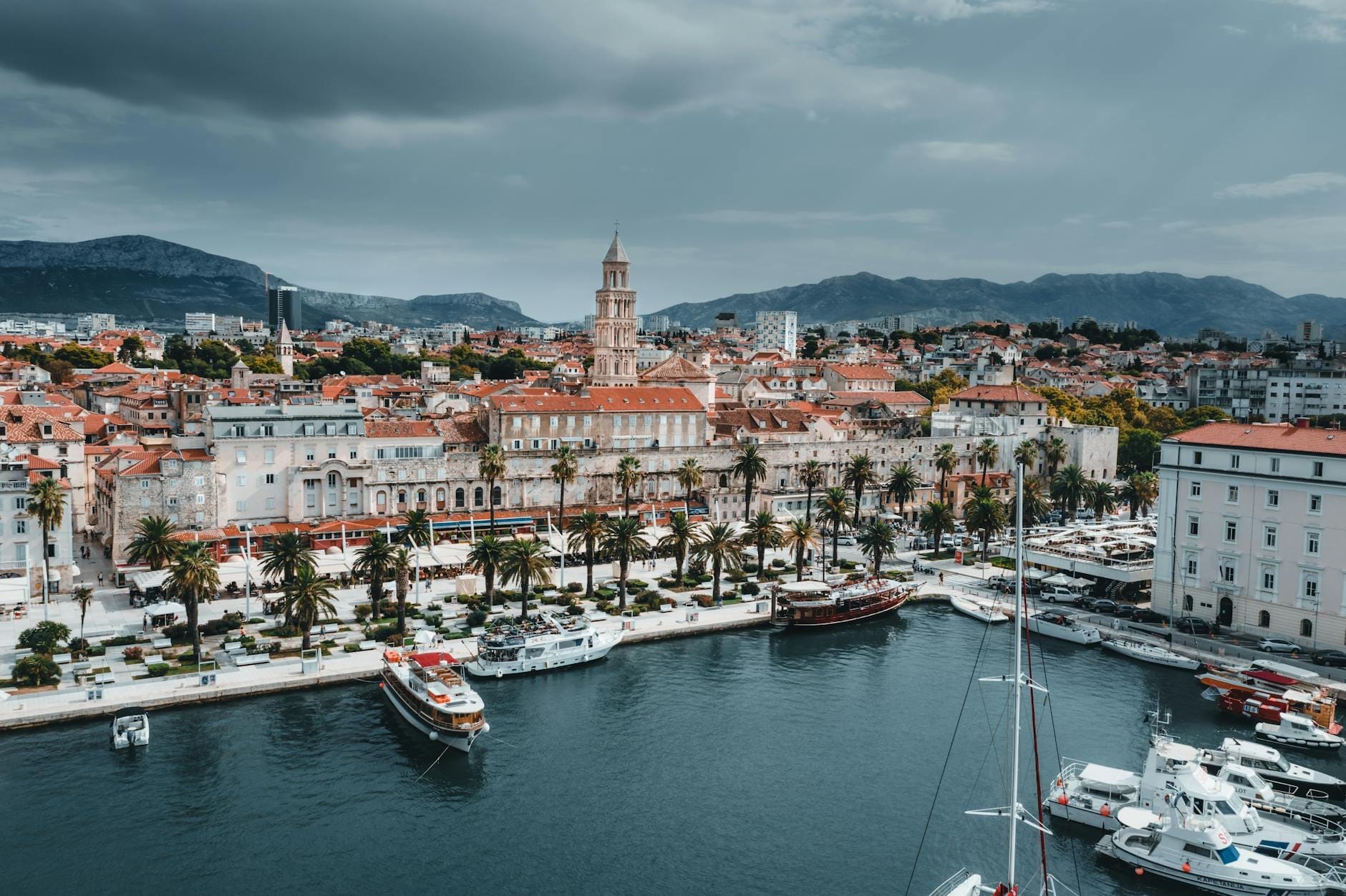
What the Riva Actually Is
The Riva Promenade, officially named Obala hrvatskog narodnog preporoda (Quay of the Revival of the Croatian Nation) in Croatian, is a 250-metre stretch of pale marble running along the southern waterfront of Split's old town. Locals have always simply called it 'the Riva.' It faces the open sea, with the ancient southern wall of Diocletian's Palace rising behind it and the Adriatic in front. That contrast — a Roman imperial complex on one side, open water on the other — makes this promenade unlike almost any other seaside walkway in Europe.
It is free to walk, open 24 hours, and requires no planning whatsoever. For most visitors arriving in Split, the Riva is the first thing they see. For residents, it is where daily life plays out: morning coffee before work, afternoon gossip on shaded benches, evening strolls with children. Understanding this dual function as both tourist landmark and genuine neighbourhood square is key to appreciating what you are looking at.
💡 Local tip
The Riva stretches from the split ferry terminal at its east end to the shopping street Marmontova Street at its west end. Both ends are well-marked and easy to find from Split's old town.
A Brief History: From Napoleonic Shore to Modern Marble
The promenade began taking its current shape roughly two centuries ago, during the period of French rule under Marshal Marmont in the early 19th century. Before that, the southern side of Diocletian's Palace was essentially the edge of the palace itself, with the sea coming much closer to the ancient walls. The French administration reshaped the waterfront and created a proper public promenade, a concept in keeping with Napoleonic urban planning ideas of the era.
The name 'Revival of the Croatian Nation' is a reference to the Croatian National Revival (Narodni Preporod), a 19th-century cultural and political movement that sought to assert Croatian language and identity under Habsburg rule. The promenade's formal name carries political weight that the word 'Riva' entirely sidesteps in everyday use.
The most recent significant transformation came in 2005, when the promenade was redesigned and modernised. The renovation introduced the smooth white marble surface underfoot, the uniform rows of palm trees, and the low-profile street furniture that gives the Riva its clean, contemporary look. If you're interested in the broader context of what stands behind this promenade, the Diocletian's Palace complex covers the full history of the Roman structure whose southern wall you walk alongside.
Tickets & tours
Hand-picked options from our booking partner. Prices are indicative; availability and final rates are confirmed when you complete your booking.
Split old city and Diocletian's Palace private walking tour
From 96 €Instant confirmationFree cancellationPrivate Day Trip to Krka Waterfalls from Split
From 295 €Instant confirmationFree cancellationPrivate Day Trip to Plitvice Lakes from Split
From 485 €Instant confirmationFree cancellationSplit old city and Diocletian's Palace private morning tour
From 96 €Instant confirmationFree cancellation
The Riva Hour by Hour: How the Space Changes
Early morning, roughly 7–9 AM, the Riva belongs to locals. The light comes in low from the east, catching the polished marble and the water at the same angle. The cafés put out their chairs around this time, and you'll see Split residents drinking their first coffee standing at the bar or on stools facing the sea. There's barely a tourist to be seen. The sea air is noticeably cooler, the smell of salt and faint diesel from the overnight ferries still present. This is arguably the most authentic version of the Riva.
By mid-morning, tour groups begin to arrive, especially during summer. Guided walking tours typically begin at the Ferry Terminal end and move westward, pausing to explain the palace facade. By noon in July and August, the promenade is at full capacity: cruise passengers, backpackers, families with strollers, and day-trippers from the islands all converge here. The marble reflects heat intensely at this point, and the lack of shade in the centre of the walkway becomes noticeable. The palm trees provide some relief, but the shaded benches fill up fast.
Late afternoon and early evening is when the Riva becomes something different again. As the temperature drops and the western light turns orange, the promenade enters what Dalmatians call fjaka, a loose term for the comfortable, unhurried state of simply being. Locals return. Tables at the seafront cafés fill. People sit and watch other people walk past. Sunset over the water is genuinely good from here, with unobstructed views to the west. This is the Riva at its most photogenic and most social.
⚠️ What to skip
In midsummer, avoid the Riva between 11 AM and 3 PM if you're sensitive to heat. The marble surface radiates considerable warmth and there is limited shade in the central walkway. Bring water and wear sun protection.
After 10 PM, the Riva takes on a nightlife energy. The cafés and bars stay open late, music drifts out from some venues, and groups of younger visitors linger on the marble steps leading down toward the water. It rarely feels rowdy; the scale of the space absorbs the crowd. For a fuller picture of what happens after dark across the city, the Split nightlife guide covers the options beyond the promenade itself.
What to Look At: The Details Worth Noticing
Most visitors look outward toward the sea, which makes sense. But the wall behind you deserves equal attention. The southern facade of Diocletian's Palace, built in the early 4th century AD for the Roman Emperor Diocletian, is one of the longest stretches of late Roman imperial architecture anywhere in the world. The arched gallery running along the upper level once served as the Emperor's loggia, a private walkway where he could survey the sea. You can make out the rhythmic arcade of blind arches and the heavier protruding towers at intervals. Looking up at this wall from the Riva gives a cleaner view of its overall scale than you can get from inside the palace.
The Bronze Gate, set into the middle of the southern wall, is the entrance point into the CellarsDiocletian's Cellars, the substructure vaults that run beneath the old town. The gate itself is understated and easy to miss if you're not looking for it specifically. It's flanked by stone pilasters and opens into a vaulted passage that leads up into the palace interior.
Along the promenade, the rows of date palms were planted as part of the 2005 renovation. They're not native to Dalmatia but have become a recognisable part of the Riva's visual identity. The marble paving is Brač limestone, the same white stone used in construction throughout the Dalmatian coast and famously exported to Washington D.C. for the White House. Underfoot, it's smooth and slightly slippery when wet.
Events and Cultural Role
The Riva functions as Split's primary outdoor venue for public gatherings. The Split Carnival, held before Lent each year, uses the promenade as its main stage for processions and performances. New Year's Eve celebrations centre here, with crowds gathering along the waterfront for midnight countdowns. Throughout summer, the Riva hosts open-air concerts, food events, and performances connected to the Split Summer festival.
For visitors planning a trip around specific events, the Split in summer guide outlines the main festival calendar and what the city looks and feels like at peak season.
On an ordinary afternoon without any scheduled event, the Riva still delivers a reliable cross-section of Split's social life. It's where youth football is celebrated after a win (Hajduk Split supporters have been known to fill this space after significant matches), where families promenade on Sunday evenings, and where older residents read newspapers on benches that have been in the same spot for decades.
Practical Notes for Visitors
The Riva is fully accessible via its flat marble surface, though the marble can be uneven in places and wet marble is genuinely slippery. The promenade has no steps along its main length, making it manageable for pushchairs and wheelchairs. Seating is available along the cafés and on public benches, though benches fill quickly in the afternoon and evening.
Coffee prices at Riva cafés are slightly higher than elsewhere in Split because of the location, but not dramatically so. A standard espresso typically costs slightly more than at a side-street café. If budget is a concern, order at the bar rather than requesting table service, which usually carries an extra charge at some venues.
The Riva sits at the centre of a compact area that is easy to explore on foot. A walking tour of SplitOld Town sightseeing typically begins or ends here, making it a natural anchor point for a day exploring the old town and its surroundings.
ℹ️ Good to know
Photography tip: The best light for shooting the Riva against the palace wall is in the late afternoon from the western end, looking east. The warm light catches the stone facade and the water simultaneously. For sunrise shots, position yourself at the Ferry Terminal end and face west along the promenade.
Who might not enjoy the Riva: visitors seeking solitude or untouched historical atmosphere will find the summer crowds frustrating. The promenade was modernised in 2005 and has a deliberately clean, contemporary design rather than a period-accurate historical feel. If what you want is the raw texture of the Roman city, you'll find more of that inside the palace walls than out here on the waterfront.
Insider Tips
- Visit on a weekday morning in May, June, or September for the best balance of good weather and manageable crowd levels. July and August are significantly more congested, especially mid-morning when cruise ships disembark.
- The benches at the far western end of the Riva, nearest Marmontova, tend to stay emptier than those in the middle. If you want to sit and watch the promenade without being in the thick of it, that stretch is your best option.
- The Bronze Gate in the palace wall leads directly into the Cellars (Diocletian's Substructure). Most visitors walk past it without going in. It's one of the most direct transitions anywhere in Split between the modern promenade and the ancient city beneath.
- Riva café prices vary. Venues at the eastern end closest to the Ferry Terminal tend to have slightly more competitive pricing than those positioned in the centre of the promenade, where foot traffic is highest.
- In winter, the Riva empties significantly and takes on a different character entirely: quieter, windier, and dominated by local life. Cafés still operate, and the view across the Adriatic on a clear January day can be remarkable. If you're visiting off-season, don't skip it.
Who Is Riva Promenade For?
- First-time visitors wanting an immediate sense of Split's scale and energy
- Couples looking for a relaxed evening walk with sea views and easy access to bars
- Families with young children, given the flat surface, open space, and accessible facilities
- Architecture enthusiasts who want to view the exterior of Diocletian's Palace from the south
- Anyone in Split for a short layover who wants to cover the city's signature experience efficiently
Nearby Attractions
Other things to see while in Riva & City Center:
- Croatian National Theatre Split
Built in 1893 and rebuilt after a devastating fire, the Croatian National Theatre Split is the city's cultural anchor, staging around 300 performances a year in a horseshoe-shaped Rococo auditorium. Whether you catch an opera during the Split Summer Festival or simply admire the facade on an evening walk, this is one of the few places in the city where the past and present share a stage.
- Republic Square (Prokurative)
Trg Republike, known locally as Prokurative, is a sweeping neo-Renaissance square just west of Diocletian's Palace. Free to enter at any hour, it transforms from a quiet morning gathering spot into an open-air concert venue by summer evenings. This guide covers what to see, when to go, and why locals treat it as a second living room.