Croatian National Theatre Split: What to Expect Before You Go
Built in 1893 and rebuilt after a devastating fire, the Croatian National Theatre Split is the city's cultural anchor, staging around 300 performances a year in a horseshoe-shaped Rococo auditorium. Whether you catch an opera during the Split Summer Festival or simply admire the facade on an evening walk, this is one of the few places in the city where the past and present share a stage.
Quick Facts
- Location
- Trg G. Bulata 1, Split 21000 — just northwest of the Old Town, about a 10-minute walk from the Riva
- Getting There
- Easily walkable from Diocletian's Palace; city buses stop near Trg G. Bulata
- Time Needed
- 30–45 min to see the exterior and foyer; 2–3 hours for a full performance
- Cost
- Ticket prices vary by performance; verify current prices at hnk.hr
- Best for
- Culture lovers, architecture enthusiasts, couples, evening entertainment
- Official website
- www.hnk-split.hr/en
What the Croatian National Theatre Split Actually Is
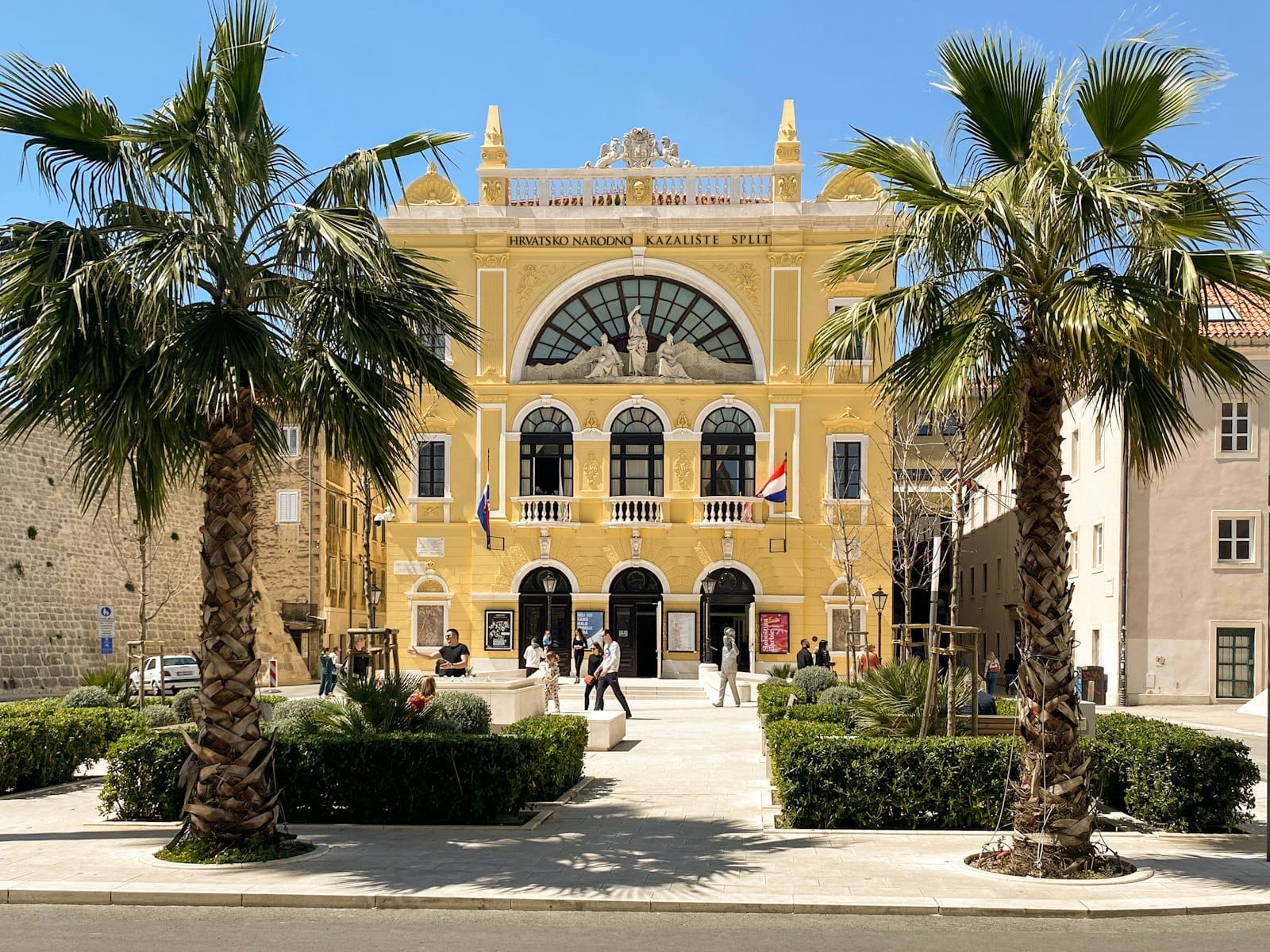
The Croatian National Theatre Split, known locally as Hrvatsko Narodno Kazalište Split or simply HNK Split, is the city's principal performing arts institution. Opened in 1893 on Trg G. Bulata, a compact square just north of the Old Town walls, it stages around 300 performances per year across opera, ballet, drama, and music. It is owned and operated by the City of Split, and its three resident ensembles, drama, opera, and ballet, have been active since 1940.
This is not a museum piece or a heritage attraction you observe from a distance. The theatre runs an active season and draws an audience that includes locals in genuine finery alongside tourists in summer casual. For anyone spending more than a day or two in Split, an evening here provides a completely different angle on the city than the beach or the palace interior.
ℹ️ Good to know
Ticket prices and seasonal schedules change each year. Always check the official programme at hnk.hr before planning your visit, as popular performances sell out weeks in advance during summer.
The Building: Rococo Formality in a Mediterranean City
The theatre was designed by architects Emilio Vecchietti and Ante Bezić and completed in 1893, originally under the name Split Municipal Theatre, championed by Mayor Gajo Bulat. The exterior belongs to the late-19th-century Austro-Hungarian civic tradition: a symmetrical, cream-coloured facade with arched windows, pilasters, and decorative cornice work. It looks slightly formal against Split's typically relaxed stone streetscape, which is precisely the point. The building was meant to signal cultural ambition.
Inside, the auditorium follows a horseshoe plan with a capacity of around 1,000 seats, decorated in Rococo style. Tiered balconies curve around a central stage, and the proportions create remarkably good sightlines from most seats. What you notice immediately is the warmth of the space: the gilding is not excessive, and the acoustics work without artificial amplification for chamber and orchestral performances.
The building you see today is partly a reconstruction. In February 1970, a fire nearly destroyed the theatre entirely. The rebuilding process took a full decade, and the theatre reopened in May 1980. Knowing this history makes the interior feel less preserved and more earned.
Tickets & tours
Hand-picked options from our booking partner. Prices are indicative; availability and final rates are confirmed when you complete your booking.
Full-day tour to Krka National Park in Croatia from Split
From 35 €Instant confirmationFree cancellationBlue Cave and Hvar 5 islands tour from Split
From 145 €Instant confirmationFree cancellationKrka national park tour from Split
From 27 €Instant confirmationFree cancellationAll-inclusive Blue Lagoon tour from Split with three islands visit
From 68 €Instant confirmationFree cancellation
The Experience at Different Times of Day
During daylight hours, Trg G. Bulata is a functional square used mainly by people passing between the Old Town and the broader city centre. The theatre facade is visible and photogenic, especially in morning light when the stone takes on a golden cast and foot traffic is light. There are no tours of the interior listed for general visitors during the day, so this is primarily an exterior experience outside of performance hours.
The transformation happens in the early evening. From around 7 pm on performance nights, the square in front of the theatre fills with a different crowd: couples dressed deliberately, older locals who treat the theatre as a regular ritual, visitors who have planned the evening in advance. The foyer opens before curtain, and even the act of collecting tickets and finding your seat carries a ceremony that feels markedly different from any other evening activity in Split.
After a performance, the crowd tends to spill out toward the Riva or into the streets around the Old Town. The contrast between the formal atmosphere inside and the casual Dalmatian street life outside is striking and, for most visitors, an enjoyable part of the experience.
For context on how the theatre fits into the wider city evening, the Split nightlife guide covers the full spectrum from waterfront bars to late-night clubs.
The Split Summer Festival: The Best Time to Attend
The theatre's highest-profile period is the Splitsko ljete, or Split Summer Festival, which typically runs for roughly a month in July and August. Established in 1954, it is the second-oldest performing arts festival in Croatia. Performances span opera, drama, ballet, and music, using not only the theatre's main stage but also outdoor venues including the peristyle and cellars of Diocletian's Palace.
Attending a performance inside Diocletian's Palace during the festival is a specific experience worth planning around. The Diocletian's Cellars and the palace courtyard become temporary stages, and the overlap of Roman stonework and live performance is hard to replicate anywhere else.
Tickets for festival performances sell faster than regular-season shows. If your travel dates fall during July or August, checking the festival programme before you finalise accommodation is practical advice, not just a suggestion.
💡 Local tip
Festival and regular-season schedules are published separately on hnk.hr. The summer programme is usually announced by late spring. If you are visiting in peak season, bookmark the site and check it a month or two before your trip.
Practical Details: Getting There and Planning Around a Performance
The theatre sits on Trg G. Bulata, roughly five minutes on foot from the northern edge of Diocletian's Palace and about ten minutes from the Riva promenade. The walk from most central accommodation is straightforward with no significant navigation required. City buses serve the wider Trg G. Bulata area, but in practice, most visitors walk from the Old Town.
If you are combining a theatre evening with earlier sightseeing, the Split walking tour routes all pass within a few minutes of the theatre, making it easy to plan an evening performance as the final act of a full day in the city centre.
Dress code at Croatian national theatres is generally smart casual for regular performances and more formal for opening nights and opera premieres. You will not be turned away for wearing neat trousers and a clean shirt, but the local audience tends to dress up noticeably more than is common at equivalent venues in Western Europe. For ballet and opera, leaning slightly formal is comfortable and respectful.
⚠️ What to skip
Accessibility information for the building is not confirmed in publicly available sources. If you have mobility requirements, contact the theatre directly via hnk.hr before purchasing tickets.
Photography and Exterior Visits
The facade photographs best in the late afternoon or early evening when the square is less shadowed. The building faces roughly northwest, so the front gets good light from mid-afternoon onward on clear days. Morning visits offer quieter surroundings but the facade sits more in shadow.
Interior photography during performances is not permitted, which is standard practice. If you are visiting purely for the architecture rather than a performance, the foyer on performance nights offers a brief window to see the interior before the house opens, though access without a ticket is limited.
Who This Is For, and Who Might Pass
The theatre is genuinely rewarding for anyone with even a passing interest in opera, ballet, or theatre. The programme quality at HNK Split is considered strong for a regional theatre of this size, and the Rococo auditorium makes the experience enjoyable even when the production is not exceptional. Couples looking for a distinctive evening that goes beyond the standard beach-and-dinner pattern will find this satisfying.
Travellers focused on beaches, outdoor activities, or day trips will likely find little reason to visit unless a festival performance specifically interests them. If your priority is outdoor time, the best beaches near Split or a day trip from Split will probably serve you better than an evening at the theatre.
Families with young children should check the specific programme before committing. Ballet performances can work well for older children who have some patience for the format, but a three-hour opera in Croatian or Italian is a difficult experience for most young kids.
Insider Tips
- The Split Summer Festival programme is announced by late spring each year. If your trip falls in July or August, check hnk.hr at least six weeks before you travel — popular opera and ballet nights sell out well before the festival opens.
- For the best auditorium sightlines, aim for the central stalls or the first balcony tier. The horseshoe design means extreme side seats on upper balconies lose some of the stage picture.
- On performance nights, the square outside the theatre is the best place in this part of the city to observe local Split life at its most put-together. Arrive 20 minutes before the doors open and watch the crowd gather.
- If you cannot get tickets for a main-stage production, check whether festival performances are running at Diocletian's Palace simultaneously — they are programmed under the same Splitsko ljete umbrella and offer a completely different setting.
- The theatre bar opens before curtain and during intervals. Ordering a drink during the interval rather than before the show means shorter queues and more time to see the foyer at its liveliest.
Who Is Croatian National Theatre Split For?
- Culture and performing arts travellers who want a genuine local evening, not a tourist set piece
- Couples looking for a memorable evening that breaks from the standard Dalmatian itinerary
- Architecture enthusiasts interested in late-19th-century Austro-Hungarian civic buildings
- Visitors whose dates overlap with the Split Summer Festival in July and August
- Travellers who want to understand Split as a city with cultural depth beyond its Roman ruins
Nearby Attractions
Other things to see while in Riva & City Center:
- Republic Square (Prokurative)
Trg Republike, known locally as Prokurative, is a sweeping neo-Renaissance square just west of Diocletian's Palace. Free to enter at any hour, it transforms from a quiet morning gathering spot into an open-air concert venue by summer evenings. This guide covers what to see, when to go, and why locals treat it as a second living room.
- Riva Promenade
The Riva Promenade is a 250-meter white-stone walkway running along the southern face of Diocletian's Palace, overlooking the Adriatic. Free and open around the clock, it functions as Split's central gathering space, from morning espresso rituals to late-night socialising under the palms.