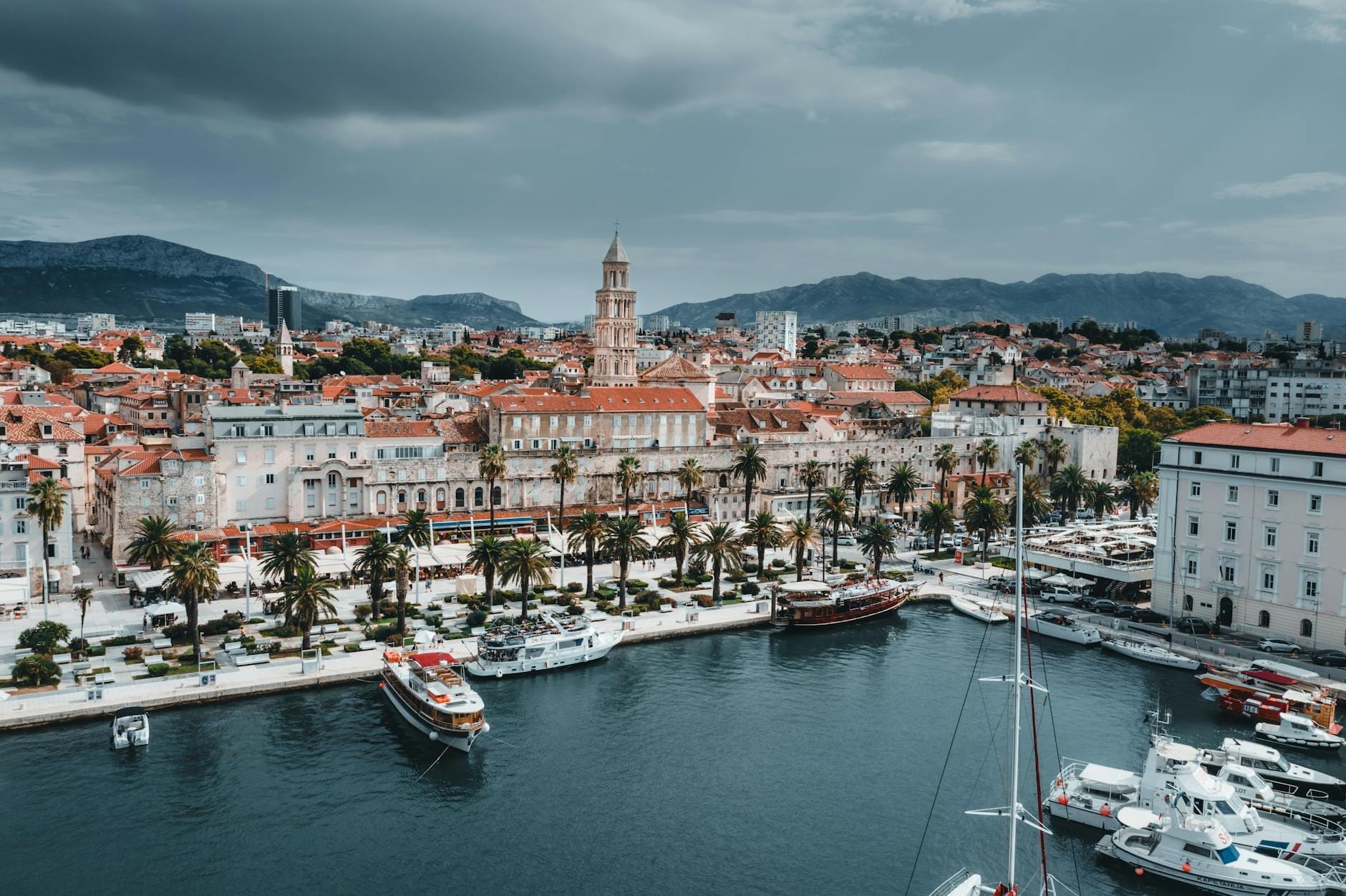
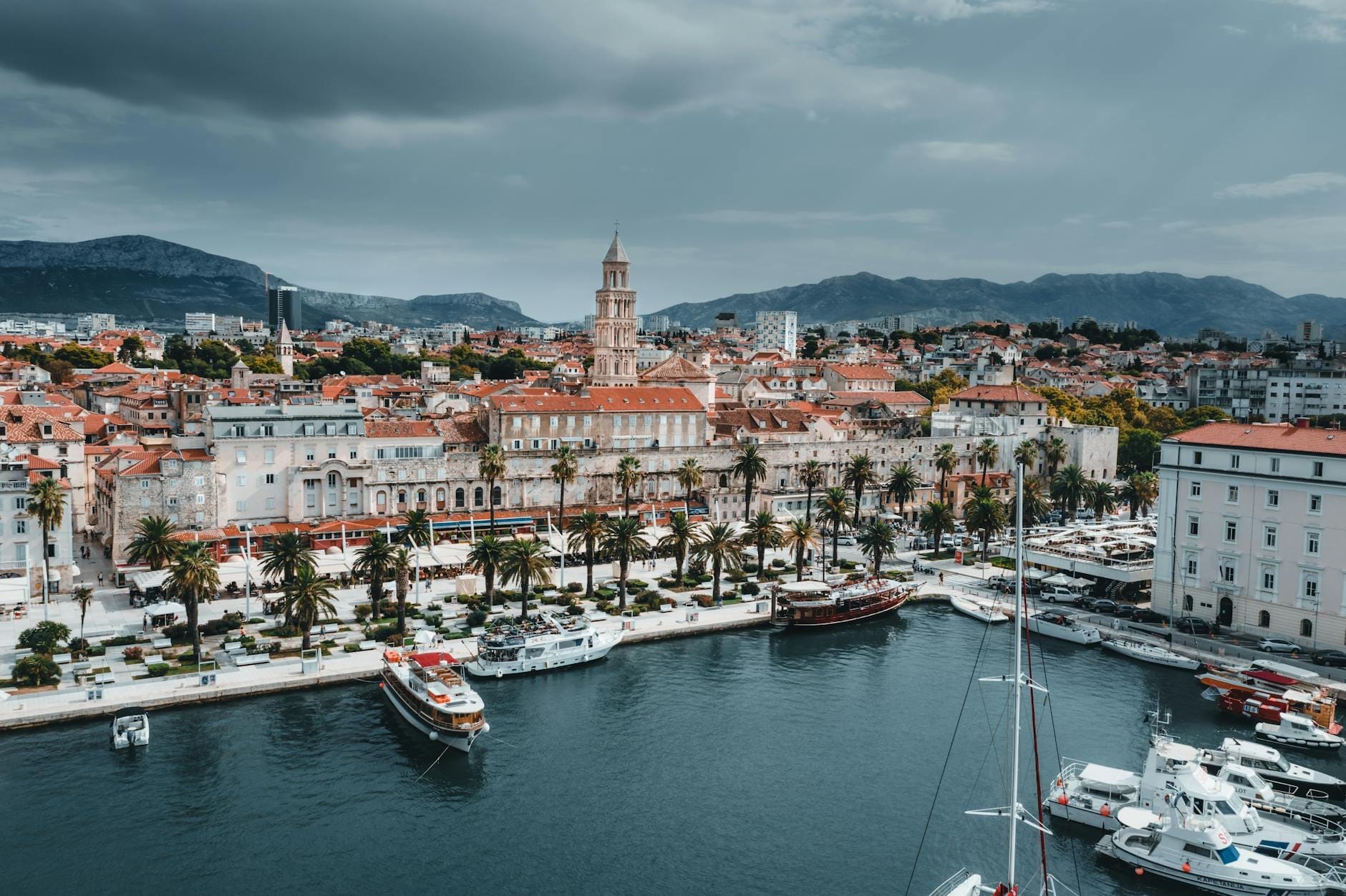
The Riva is Split's waterfront nerve center, a 250-meter promenade that doubles as the city's living room, running along the southern wall of Diocletian's Palace. Behind it, the City Center layers Roman ruins, medieval squares, and everyday Dalmatian life into one of the most compelling urban cores in the Mediterranean. This is where every visit to Split begins and ends.
Split's Riva and City Center is the kind of place where you can eat breakfast in a Roman cellar, watch a ferry depart for a Greek-era island, and be back on your terrace for sunset wine — all without moving more than ten minutes in any direction. It is the densest concentration of history, atmosphere, and logistical convenience in Croatia, and it demands at least a full day even for travelers who think they are just passing through.
Orientation
The Riva, formally named Obala Hrvatskog narodnog preporoda, runs east to west along Split's southern seafront for approximately 250 meters. At its eastern end stands the Port Authority Building, adjacent to the main ferry terminal on Obala Kneza Domagoja. At the western end, the promenade terminates near the Franciscan Monastery and St. Francis Church. What distinguishes it from most Croatian waterfront promenades is its width, about 55 meters, which gives it the proportions of a public square laid on its side rather than a simple coastal path.
Immediately behind the Riva to the north sits the southern wall of Diocletian's Palace, the 4th-century Roman imperial complex that forms the structural skeleton of Split's entire Old Town. Four gates punctuate the palace perimeter: the Bronze Gate opens from the Riva directly into the palace cellars below; the Iron Gate faces west toward Narodni trg; the Golden Gate faces north toward the Gregory of Nin statue; and the Silver Gate opens east toward the Stari Pazar market. Each gate marks a cardinal point of the Roman cardo-decumanus grid that still organizes movement through the Old Town today.
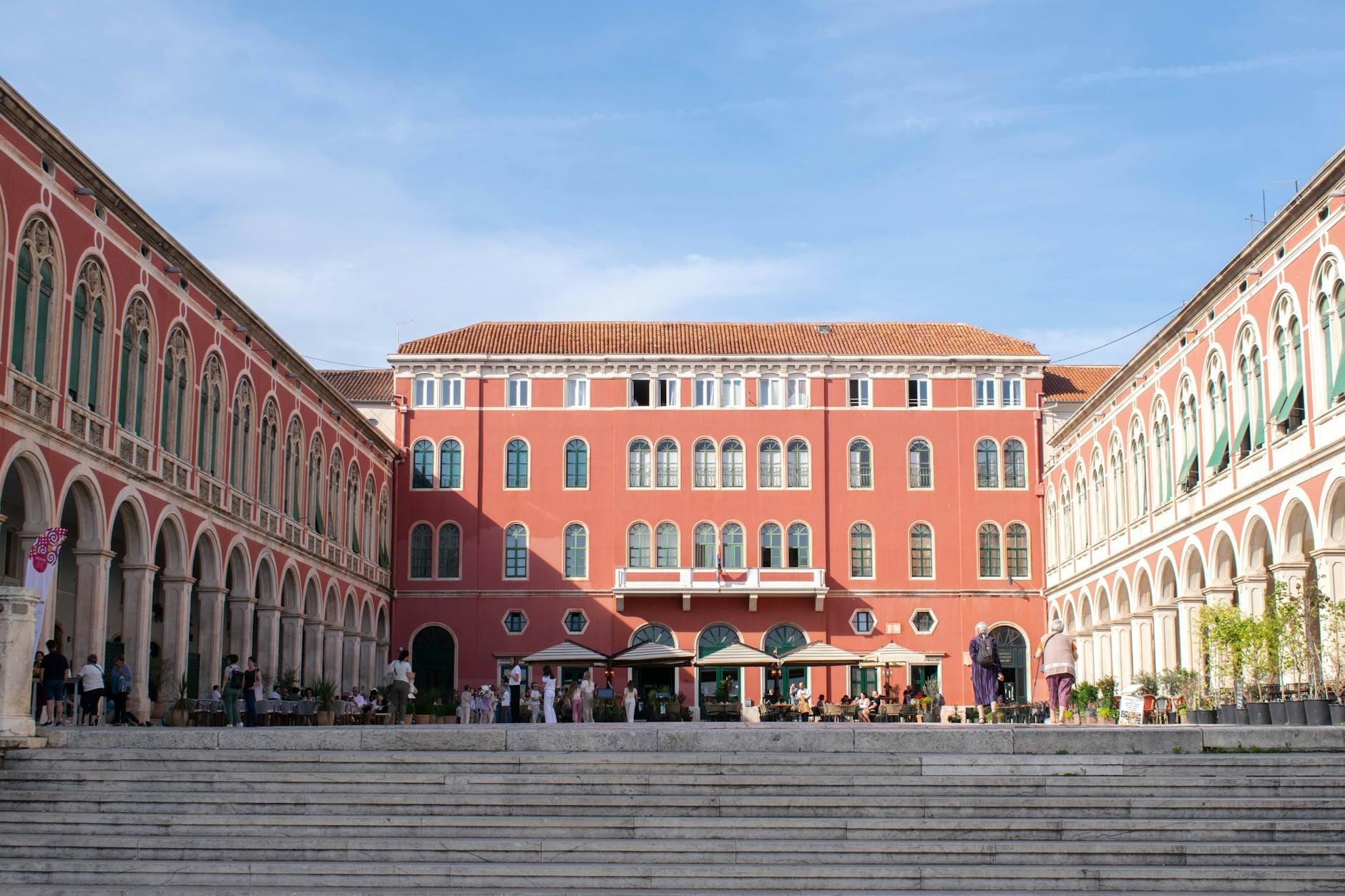
The City Center extends slightly west of the palace walls into the area locals call Grad, where Narodni trg (People's Square) and Republic Square, known locally as Prokurativa, anchor civic and cultural life. The shopping street Marmontova runs north-south just west of the palace, connecting the Riva to the market area and onward to the bus and train stations about ten minutes' walk to the east. Split has no metro system. The entire central zone is compact enough that most points of interest are reachable on foot within fifteen minutes of the waterfront.
ℹ️ Good to know
The Riva was redesigned in 2007 by Zagreb architecture firm 3LHD, winning an open competition in 2005. The project covered 14,053 square meters at a cost of approximately nine million euros. The mosaic paving references traditional Dalmatian textile motifs. A bronze scale model of the Old Town sits near the promenade's western section and gives an excellent spatial overview before you enter the palace alleys.
Character & Atmosphere
The Riva operates on a rhythm that shifts dramatically through the day. Early mornings belong to locals: older men nursing espressos at cafe terraces before the chairs have fully warmed up, women cutting through toward the Stari Pazar market on the palace's eastern side, delivery workers stacking produce crates near the ferry terminal. The white mosaic paving, part of the 3LHD redesign, reflects morning light back at you in a way that makes the whole promenade seem to glow. The scent of lavender and rosemary from the planted borders, both plants historically associated with the Dalmatian coast, mixes with salt air and fresh coffee. The Adriatic sits perfectly still at this hour, and the islands on the horizon look close enough to touch.
By mid-morning in summer, the character shifts completely. Tour groups have arrived, cafe terraces fill three rows deep, and the stone paving absorbs and radiates heat. The Riva is genuinely dense from June through August, with ferry passengers, cruise ship day-trippers, and beach tourists converging on the same 250-meter strip. Afternoons in July and early August can feel claustrophobic if you are not accustomed to high crowd density. The narrow alleys inside the palace walls offer shade but not escape: the streets around the Cathedral and Peristyle carry their own concentrated foot traffic. If you want to see the palace interior with room to breathe, aim for the first hour after opening or the late afternoon when day-trippers have retreated.
After 7pm, the area transforms into something closer to the Dalmatian tradition of the korzo, the evening promenade where people walk without particular destination, stop to talk, circle back, and repeat. The light over the Adriatic turns amber then deep orange. Cafe terraces fill again with a slower, more local crowd. On summer evenings, the Peristyle becomes an open-air concert venue for the Split Summer festival, and you can hear classical music or opera drifting out through the Bronze Gate onto the Riva. This is when the neighborhood earns its reputation as Split's living room.
Off the Riva, the streets inside and around the palace walls carry a more layered, less performative energy. Locals use the palace as a genuine urban neighborhood: laundry hangs from medieval windows, scooters park against Roman column bases, small grocery shops operate in spaces that were once imperial guardrooms. The palace is not a preserved museum district in any sterile sense. It is a city that simply never left its oldest core, and that continuity of habitation is what makes it unlike any other Roman site in Europe.
⚠️ What to skip
Noise is a genuine issue if you are staying inside the palace walls or on the Riva during peak season. Stone buildings and narrow alleys amplify sound significantly, and bar activity continues past midnight. This is not the neighborhood for light sleepers in July and August unless your accommodation faces a courtyard rather than a street.
What to See & Do
The logical starting point for understanding Diocletian's Palace is Diocletian's Cellars, the vaulted substructures beneath the palace floor that were cleared of centuries of accumulated debris during the 20th century. These spaces give a clear sense of the building's original Roman scale and provide interpretive context that the alleys above, layered with medieval and later construction, cannot. The cellars also function as a venue for markets, art installations, and occasional events. Entry is affordable and the ticketing is organized, making it a rare controlled point in an otherwise free-roaming site.
The Cathedral of Saint Domnius occupies what was originally Diocletian's mausoleum, making it one of the oldest cathedral buildings in the world in continuous religious use. The conversion from imperial tomb to Christian cathedral took place in the 7th century, repurposing the octagonal structure that Diocletian had built for his own burial. The interior retains Roman-era carved reliefs depicting Diocletian's military campaigns, creating an odd juxtaposition with the Christian iconography added in subsequent centuries.
Climbing the adjacent Saint Domnius Bell Tower is the single most useful spatial exercise you can do in this neighborhood. The staircase is narrow and steep, but the view from the top gives you the clearest possible orientation: the palace grid laid out below, the Riva stretching along the southern waterfront, Marjan Hill rising to the west, and the islands of Brač and Šolta visible on clear days. Everything you will walk through at street level suddenly makes sense from up here.
Peristyle courtyard: the ceremonial heart of the palace, framed by granite columns brought from Egypt. Free to enter, best visited early morning or after 6pm.
Golden Gate and Gregory of Nin statue: on the north side, a 5-minute walk through the palace interior from the Riva. The Mestrovic bronze statue outside the gate is one of the largest in Croatia.
Narodni trg (People's Square): the medieval center of civic life west of the palace, still surrounded by Gothic and Renaissance architecture.
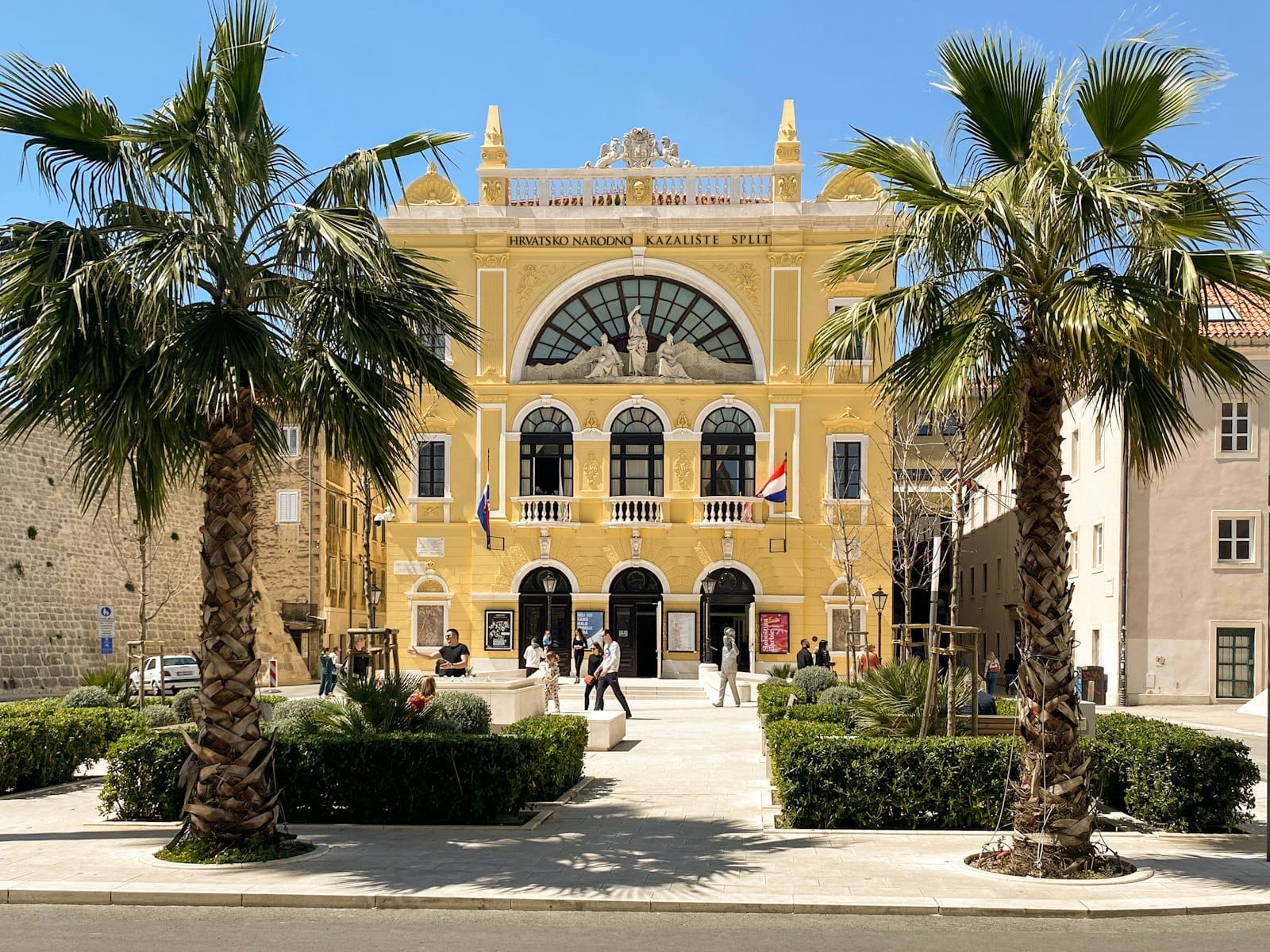
Republic Square (Prokurativa): a 19th-century neo-Renaissance square used for open-air concerts and cultural events during summer festivals.
Stari Pazar market: the open-air market outside the Silver Gate, selling produce, olives, and local crafts to residents and visitors alike.
For a broader historical context beyond the Roman period, the Archaeological Museum Split is a short walk north of the palace and covers prehistoric, Greek, Roman, and early medieval finds from across the region. Founded in 1820, it is one of the oldest museums in Croatia and consistently undervisited relative to its collection quality. If you have any interest in the Roman city of Salona, which preceded Split and supplied much of the stone used in the palace's construction, this is the essential reference point.
Eating & Drinking
The Riva cafe terraces are priced for the view, not for value. Expect to pay significantly more for coffee here than anywhere else in Split, sometimes double what you would pay two streets back inside the palace. The quality is consistent but unremarkable. The honest assessment is this: sitting on the Riva with an espresso while watching a ferry load for Hvar is a genuine Dalmatian pleasure, and the premium is real. Treat it as an experience cost, have one, then move on to eat and drink elsewhere.
For actual eating, the streets inside the palace walls and just north of the Riva offer significantly better value and quality. The area around Narodni trg has a concentration of konobas, traditional Dalmatian restaurants serving grilled fish, octopus salad, peka dishes (meat or seafood slow-cooked under a bell-shaped iron lid called a peka, requiring advance order), and local wines from the Dingač and Pošip regions of Dalmatia. For a comprehensive overview of what to order and what to avoid, the guide to Split's food scene covers local specialties in practical detail.
The Stari Pazar market on the palace's eastern side is the best place in the City Center to shop at local prices. Stalls sell seasonal produce, olives, olive oil, dried figs, local cheeses, and lavender products. The market is most active from early morning through midday. Nearby, small bakeries and sandwich shops cater to the morning market crowd and offer the cheapest breakfast options in the area: pastries, burek (flaky pastry filled with cheese or meat), and sandwiches are available for a fraction of cafe prices.
Bar and nightlife options cluster around the Peristyle and the alleys immediately behind the Riva. Cocktail bars, wine bars, and club-adjacent venues occupy former Roman and medieval structures. The contrast between the architecture and the activity creates an atmosphere that is genuinely unusual. By 11pm in summer, the Peristyle area in particular becomes very loud. The Split nightlife guide maps out where the action is concentrated by night and what to expect at different types of venues.
💡 Local tip
Restaurants and cafes with tables directly on the Riva waterfront typically charge 20-40% more than equivalent places two streets back. The view is genuine but if budget matters, walk one block north into the palace alleys before sitting down. You will still be inside a Roman structure, which is its own compensation.
Getting There & Around
The Riva sits at the geographic center of Split's transport network. The main ferry terminal, Trajektna luka Split, is at the eastern end of the promenade on Obala Kneza Domagoja. From here, regular ferries and catamarans depart throughout the day for Hvar, Brač, Vis, and international routes including Ancona in Italy. The bus and train stations are approximately ten minutes on foot east along the waterfront, past the ferry terminal. This concentration of departure points makes the Riva the natural logistics hub for anyone planning day trips or island visits.
The City Center itself is pedestrianized and best navigated on foot. City buses serve the broader Split area: lines 12 and 21 connect the city center to Marjan Hill and the Meštrović Gallery to the west. Taxis congregate near the Riva and along the main approach roads. Split Airport (IATA: SPU) is located approximately 25 kilometers north near Kaštela. Transfers to the Riva area typically cost 30-40 euros by taxi. A cheaper option uses the shuttle bus service to the main bus station, from which the Riva is ten minutes on foot. Verify current shuttle schedules before travel, as they change seasonally.
Walking distances from the Riva as a reference point: the Bronze Gate into the palace cellars is directly adjacent; Narodni trg is 3 minutes northwest; Republic Square is 5 minutes; the Stari Pazar market is 5 minutes east through the Silver Gate; the bus and train stations are 10 minutes east along the waterfront; Bačvice Beach is about 15 minutes southeast along the coastal path. For anyone planning to explore beyond the city, the day trips from Split guide covers the most practical excursions, including timing and transport logistics from the ferry terminal.
For island-focused travel, the Riva terminal is your primary departure point. The guide to island hopping from Split maps out ferry routes, journey times, and which islands are realistic as day trips versus overnight stays. Most catamarans to Hvar town run multiple times daily in summer and the crossing takes under an hour.
Where to Stay
Accommodation inside the palace walls and on the Riva puts you at the center of everything: ferry access, sightseeing, evening atmosphere, and the morning market are all within a five-minute walk. Waking up inside a 4th-century building, with Roman stone visible through your window and the sound of the Adriatic a few meters south, is a legitimately unusual experience and one of the things that distinguishes this neighborhood from anywhere else in Europe. Prices reflect the demand: this is consistently the most expensive accommodation zone in Split, with boutique hotels and apartment rentals occupying former Roman and medieval structures throughout the palace interior.
The practical downside is noise. The palace alleys amplify sound considerably, and bar activity runs late. If you are a light sleeper or traveling in high season, look carefully at specific room positions. Accommodations facing interior courtyards are significantly quieter than those on the main alleys. The streets just west of the palace, around Narodni trg and along Marmontova toward Prokurativa, offer a quieter alternative that keeps you within five minutes of the Riva without full exposure to the late-night noise corridor. For a complete overview of accommodation options across different neighborhoods, the Split accommodation guide breaks down price ranges and character by area.
Families and travelers who prioritize quieter evenings might find the Riva and City Center better as a daytime base than an overnight one. Staying just slightly further out, in the Veli Varoš district to the west or near Bačvice to the east, keeps you within easy walking distance of the Riva while giving you quieter streets after dark and generally lower accommodation costs.
Practical Tips
The City Center is safe by the standards of any major European city. Petty theft in crowded tourist areas is the primary risk, particularly in the Peristyle area and on the Riva at peak hours when crowds are densest. Keep bags zipped and phones in front pockets. The Split safety guide covers city-wide precautions and what to be aware of in different contexts.
Dress codes apply if you intend to enter the Cathedral of Saint Domnius: shoulders and knees must be covered. The cathedral is an active place of worship, not purely a tourist attraction, and photography restrictions apply in the interior. Carry a light layer or a scarf if you are arriving from the beach. The same applies to the smaller churches within the palace perimeter.
Orientation inside the palace alleys takes about 20 minutes to calibrate on first visit. The cardo (main north-south street) runs from the Bronze Gate on the Riva to the Golden Gate on the north side. The decumanus (main east-west street) crosses it at the Peristyle. If you get turned around, find either of these two main arteries and use them to reorient. The Split walking tour guide traces a logical route through the City Center that covers the major landmarks in sequence without backtracking. If time is limited, the cellars, the bell tower climb, and the Peristyle are the three non-negotiable experiences in this neighborhood.
💡 Local tip
The bronze scale model of the Old Town on the western section of the Riva is a genuinely useful orientation tool. Spend two minutes studying it before entering the palace, and the layout of gates, main streets, and the cathedral's position will immediately make sense. Most visitors walk past it without stopping.
TL;DR
The Riva and City Center is Split's most concentrated and logistically central neighborhood, combining a UNESCO-listed Roman palace, the main ferry terminal, and the city's primary waterfront promenade within a fifteen-minute walking radius.
Best for: first-time visitors to Split, history travelers, anyone using Split as a ferry hub for island or day-trip access, couples after the korzo atmosphere at dusk.
Not ideal for: light sleepers in peak season (June-August), travelers on tight budgets who want to eat and drink well without paying tourist-location premiums, families seeking calm evenings.
Peak season crowds are significant and unavoidable. July and early August are the most intense months. Shoulder season, particularly May and September, gives you nearly identical sights with dramatically lower visitor numbers.
Key sites to prioritize: Diocletian's Cellars, the Cathedral of Saint Domnius bell tower for orientation, the Peristyle in the evening, Stari Pazar market in the morning, and a single slow coffee on the Riva at sunset.
Three days in Split is enough to cover the Roman palace that doubles as a living neighborhood, hike the forested hill above the city, and reach one of Croatia's best day trip destinations. This guide gives you a realistic, sequenced plan with specific timings, honest cost breakdowns, and clear advice on when to go and what to avoid.
Split sits on one of the most beach-rich stretches of the Adriatic, with options ranging from sandy city bays to remote island coves. This guide covers the best beaches in Split itself, plus the top island and coastal spots reachable on a day trip.
Split rewards travelers differently depending on when they arrive. This guide breaks down every season, from the shoulder-season sweet spots of June and September to the realities of peak summer and the quiet appeal of winter, so you can choose the right time for your trip.
Split sits at the centre of some of the most spectacular island waters in the Mediterranean. Whether you want to float inside a glowing sea cave, swim at a legendary beach, or explore a remote island with excellent local wine, this guide covers every boat tour worth booking from Split's piers.
Split is one of the best-positioned cities in the Mediterranean for day trips. Within two hours you can reach cascading national park waterfalls, medieval island towns, ancient Roman ruins, and secluded Adriatic beaches. This guide covers the top destinations worth leaving the city for, with practical advice on getting there.
Krka National Park is the most practical major day trip from Split: under 90 minutes away, no ferry schedules, and waterfalls that justify the early alarm. This guide covers every transport option, the Lozovac vs. Skradin entrance debate, current swimming restrictions, and how to time your visit to avoid the worst of the summer crowds.
Plitvice Lakes is one of the most dramatic natural landscapes in Europe, and it's doable as a day trip from Split if you plan correctly. This guide covers every transport option, the true cost breakdown, seasonal timing, and what separates a good tour from a rushed one.
Split rewards the budget-conscious traveller generously. Most of the city's greatest attractions cost nothing at all, from wandering a 1,700-year-old Roman palace to hiking a forested hill above the Adriatic. Here are 12 genuinely free things to do in Split.
Split and Klis stood in for the slave city of Meereen in seasons 4 and 5 of Game of Thrones. This guide breaks down every filming location, what each site looks like in real life versus on screen, and how to plan an efficient half-day covering both.
Everything you need to know about getting around Split, Croatia — from Split Airport (SPU) to the city center, navigating the Old Town on foot, catching ferries to the islands, and reaching national parks by bus. Practical costs, seasonal warnings, and zero fluff.
Hajduk Split is more than a football club — it is the heartbeat of Dalmatia. This guide covers everything you need to attend a match at Poljud: ticket prices, booking platforms, stand selection, matchday logistics, and how to fit a fixture into your Split itinerary.
Split rewards those who wander past Diocletian's Palace. From a cliff-edge sunset terrace to Roman ruins swallowed by meadows, these are the places locals love and guidebooks overlook.
Split is Croatia's second-largest city and one of the Mediterranean's most compelling destinations. But is it worth visiting, and for how long? This guide cuts through the hype with specific advice on timing, realistic expectations, and what the city does better than anywhere else in the Adriatic.
Split is the undisputed hub for island hopping in Croatia, with direct ferry connections to Brač, Hvar, Vis, Korčula, Mljet, and beyond. This guide covers every practical detail: which islands are actually worth your time, how to book ferries before they sell out, the best seasonal windows, and how to build a realistic multi-island itinerary without wasting half your trip at port.
Split, Croatia rewards couples who look past the ferry crowds and party reputation. A 1,700-year-old Roman palace you can wander at dusk, a pine-forested hill with island views, and ferry access to Hvar within an hour — this guide covers how to experience the best of Split as a couple, including when to go, where to eat, and which day trips are actually worth your time.
July and August are the most intense months to visit Split, Croatia. Scorching heat, Adriatic waters at their warmest, packed beaches, major festivals, and ferry connections firing on all cylinders. This guide breaks down exactly what to expect and how to make the most of it.
Split, Croatia in winter is a genuinely different destination from its summer self. Fewer crowds, lower prices, and the same UNESCO-listed palace walls — but with real trade-offs around island access, restaurant closures, and unpredictable rain. This guide gives you the full picture.
Split, Croatia runs on a late-night schedule that catches most visitors off guard. This guide breaks down how the evening actually works, from afternoon beach clubs to Old Town bars, rooftop cocktails, and the boat parties that define summer nights on the Adriatic.
Split, Croatia is one of the Mediterranean's most rewarding cities for budget-conscious travelers. This guide breaks down real daily costs, the best free attractions, where to eat without the tourist markup, and exactly when to visit to cut accommodation costs by up to 50%.
Split, Croatia is genuinely safe for most travelers, but that doesn't mean risk-free. This guide covers the real threats, from pickpockets in Diocletian's Palace to overcharging scams, so you can visit confidently and without unnecessary worry.
Three realistic ways to travel from Split to Dubrovnik, each with different trade-offs. This guide breaks down ferry schedules, bus operators, driving logistics, and seasonal factors so you can book the right option for your trip.
Everything you need to know about the Split to Hvar ferry crossing: which operators run the route, how long it takes, what tickets cost, and how schedules shift dramatically between summer and winter. Includes booking tips and common mistakes to avoid.
Split's old town is one of Europe's most remarkable urban spaces, where a 4th-century Roman emperor's retirement palace became a living city. This self-guided walking tour covers the full route, key landmarks, practical timing, and honest advice on what's worth your time.
Split, Croatia is one of the Adriatic's most rewarding family destinations, blending a UNESCO Roman palace, sandy-bottom beaches, and easy island day trips into a trip that works for all ages. This guide covers the best family attractions, seasonal planning, day trip logistics, and honest tips on what to skip.
Split is one of the Mediterranean's most layered cities: a Roman palace you can sleep inside, a hill park above a working harbor, and ferry connections to some of Croatia's finest islands. This guide covers the best things to do in Split, from UNESCO-listed history to practical day-trip logistics, with honest advice on what to skip.
Ultra Europe is one of Europe's biggest electronic music festivals, held every July in Split, Croatia. This guide covers dates, tickets, the venue, what to expect from Destination Ultra island events, and practical tips for first-timers.
Dalmatian cuisine is one of the most distinct regional food cultures in Croatia — built on olive oil, fresh seafood, and slow-cooked meat dishes with roots going back centuries. This guide breaks down exactly what to eat in Split, dish by dish, with context on ingredients, seasonality, and where to find the real thing.
Not all of Split's neighborhoods are created equal. This guide breaks down the four main areas where visitors stay, who each one suits, what to expect on price, and what nobody warns you about before you book.