Saint Domnius Bell Tower: Split's Highest Vantage Point
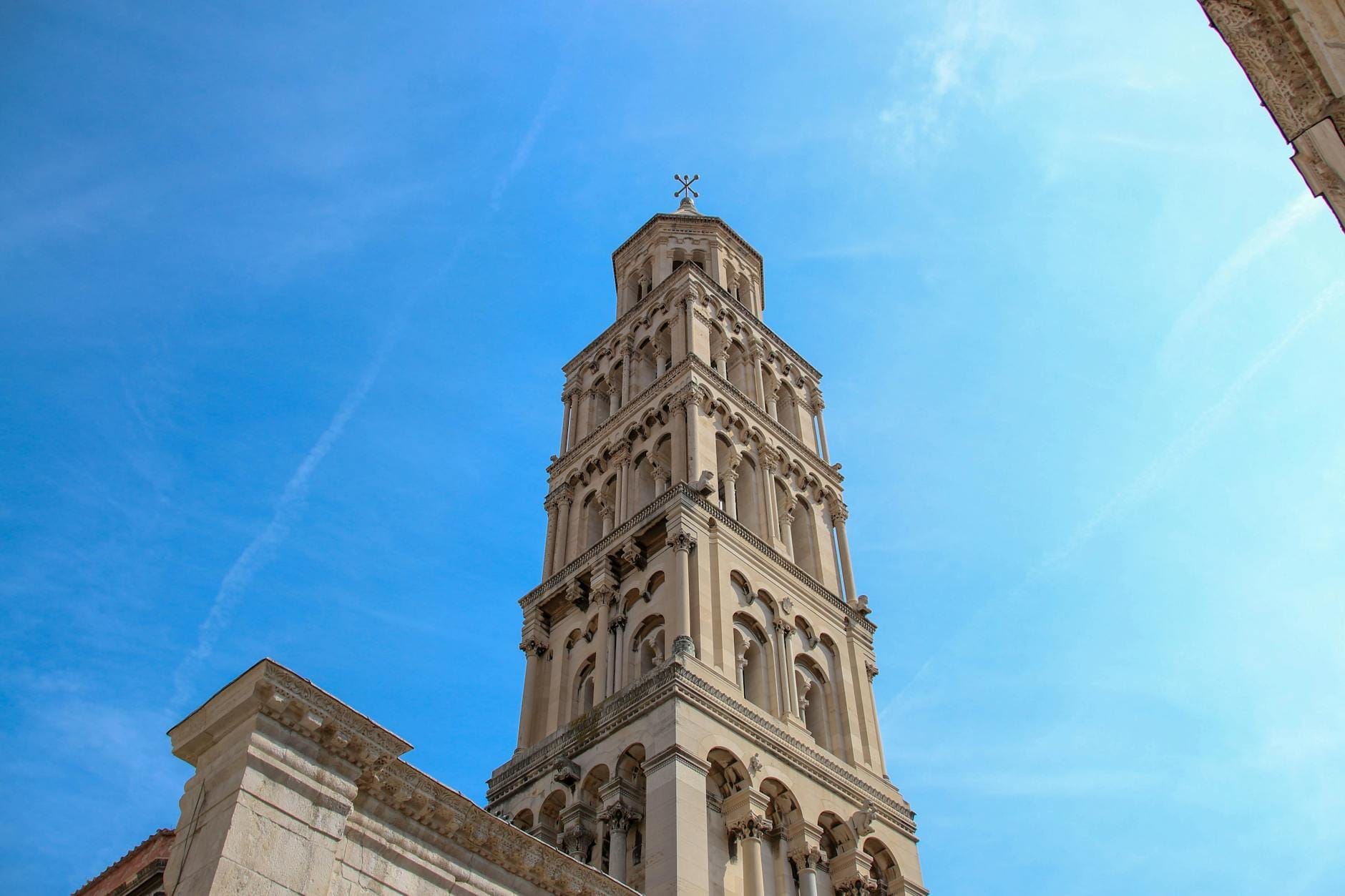
Standing 57 metres above the rooftops of Diocletian's Palace, the Bell Tower of Saint Domnius is the tallest structure in Split and the highest bell tower in Dalmatia. The 314-step climb rewards visitors with a sweeping panorama that no street-level photograph can replicate.
Quick Facts
- Location
- Ul. Kraj Svetog Duje 3, Peristil Square, Diocletian's Palace, Split 21000
- Getting There
- Walk from the Riva promenade (5 min) through the Bronze Gate or Iron Gate into the Palace
- Time Needed
- 45–90 minutes including the Cathedral complex combo ticket
- Cost
- ~€15 combo ticket (Cathedral, Crypt, Baptistery, Treasury, Bell Tower) — verify current price on-site
- Best for
- Panoramic views, architectural history, photography
- Official website
- visitsplit.com/en/527/cathedral-of-saint-domnius
What the Bell Tower Is — and Why It Matters
The Bell Tower of Saint Domnius, known locally as Zvonik katedrale svetog Duje, rises 57 metres from the heart of Diocletian's Palace. It is the tallest structure in Split and the highest bell tower in Dalmatia, a physical exclamation mark over a city that has been continuously inhabited for more than 1,700 years. You can see it from the ferry as you approach Split's waterfront, from the hills of Marjan, and from half the rooftops in the old town. Climbing it gives you the reverse view: the entire city laid out at your feet.
The tower stands directly beside the Cathedral of Saint Domnius, itself one of the oldest continuously used Christian churches in the world, converted from Diocletian's imperial mausoleum sometime in the 7th century. The bell tower is inseparable from this history. It is not a stand-alone attraction but part of an ensemble that includes the cathedral, its crypt, the baptistery, and the treasury. All are covered by the same combo ticket.
ℹ️ Good to know
Ticket prices and opening hours are set seasonally and can change year to year. Always verify current hours at the ticket booth on Peristil Square or at visitsplit.com before visiting.
The Architecture: Romanesque Foundation, Later Additions
Construction of the bell tower began in the 13th century, though some sources trace the earliest phases to the 12th century, with completion stretching into the early 14th century. The result is a layered structure: the lower storeys read as Romanesque, solid and slightly austere, while the upper sections show the softer tracery of Gothic influence, with Renaissance touches appearing in later modifications. Each level has a slightly different character, which you notice most clearly as you ascend — the stone detailing around the window openings changes from broad rounded arches to pointed Gothic forms.
Between 1890 and 1908, the tower underwent a significant restoration that rebuilt and regularised much of its upper section. The restorers removed original spolia, meaning fragments of older Roman and early medieval stonework that had been incorporated into the medieval construction. This is a point of some historical controversy among architectural historians: the restored tower is more uniform and legible than it was before, but a layer of physical evidence from the early centuries of Christian Split was lost in the process. What you see today is a 19th-century interpretation of a medieval tower, built over a genuinely ancient core.
The tower is attached to the Diocletian's Palace complex, which itself is a UNESCO World Heritage Site. The Peristil, the monumental colonnaded courtyard at the base of the tower, was the formal ceremonial space of the palace and remains one of the most intact Roman urban spaces in the world. The bell tower grew out of this context, which is part of what makes standing at its summit so affecting: you are looking down at Roman column capitals with the Adriatic behind them.
Tickets & tours
Hand-picked options from our booking partner. Prices are indicative; availability and final rates are confirmed when you complete your booking.
Blue Cave and Hvar 5 islands tour from Split
From 145 €Instant confirmationFree cancellationKrka national park tour from Split
From 27 €Instant confirmationFree cancellationAll-inclusive Blue Lagoon tour from Split with three islands visit
From 68 €Instant confirmationFree cancellationGuided kayaking tour with snorkeling stops from Split
From 50 €Instant confirmationFree cancellation
The Climb: What to Expect on the Way Up
The ascent involves 314 steps. That number appears consistently across visitor reports and should be taken seriously. The stairs are stone, worn smooth in places, and in the lower sections are genuinely steep and narrow. The handrail helps but is not continuous throughout. Visitors carrying backpacks or camera bags should be aware that some of the passages are tight enough to require turning sideways.
The climb is divided across multiple levels rather than a single unbroken staircase. At certain points the stairway opens into small landings with window openings, giving you partial views over the Peristil and the old town below before you reach the top. These intermediate pauses are worth taking slowly: the views grow incrementally, and you can track the way the Roman street grid of the palace gives way to the organic medieval lanes beyond its walls.
⚠️ What to skip
The Bell Tower has no elevator and is not accessible to wheelchair users or visitors with significant mobility limitations. The steps are uneven and can be slippery in wet weather. Wear shoes with grip, not sandals or smooth-soled footwear.
At the top, the bells are still in place and the openings in the belfry are unglazed, meaning you get unobstructed views in all directions but also direct exposure to wind. On a bora wind day, the platform can be cold and gusty even in summer. Bring a layer if you are visiting outside peak summer months.
The View From the Top
The panorama from the summit of the Bell Tower of Saint Domnius is arguably the clearest orientation tool in Split. To the south, the Riva waterfront and the open Adriatic spread out, with the islands of Brač and Šolta visible on clear days. To the west, the wooded ridge of Marjan Hill frames the city. To the north and east, the dense medieval fabric of the old town and the modern city beyond it fill the frame.
Looking directly down, you can trace the entire footprint of Diocletian's Palace from above: the rectangular Roman plan, the four gates, the Peristil at the centre, and the dense residential fabric that has grown inside the walls over fourteen centuries. This bird's-eye clarity is something the Diocletian's Cellars at ground level cannot give you. The two attractions are complementary: the cellars show you the bones of the palace from below; the bell tower shows you the whole from above.
The quality of light matters significantly here. In the hour before sunset, the warm light catches the pale Dalmatian limestone of the rooftops and turns the whole scene amber. Midday in summer produces harsh flat light and crowded conditions on the platform, making photography harder. Early morning, when the Peristil is largely empty and the light is cool and horizontal, is the most photographically rewarding time, though you should confirm that the tower is already open at that hour before planning around it.
When to Visit and How to Time Your Climb
The platform at the top of the tower accommodates only a small number of visitors at once. In July and August, queues form at the ticket booth and the summit can feel crowded, with wait times at the top while other visitors descend. The narrowness of the staircase means that ascending and descending visitors occasionally have to negotiate passage. Visiting before 9am or after 5pm in summer months reduces both the queue and the summit crowd significantly.
Outside of peak summer, the experience changes considerably. In spring and autumn, the Peristil below is quieter, the climb is cooler, and you may have the top largely to yourself. Split in spring and early autumn offers some of the best conditions for exploring the palace complex without the dense crowds that July and August bring. For more on seasonal timing, see the guide to the best time to visit Split.
💡 Local tip
Buy the combo ticket rather than a tower-only ticket if one is offered. The Baptistery alone, converted from the Temple of Jupiter, is one of the most intact Roman interiors in Dalmatia and adds very little extra time to your visit.
Getting There and Practical Logistics
The tower is located on Peristil Square inside Diocletian's Palace, accessible through any of the palace's four gates. From the Riva waterfront, the Bronze Gate (southern entrance) leads directly into the cellars and up to the Peristil in under five minutes on foot. The Iron Gate on the western side deposits you into the Narodni Trg area, from which the Peristil is a two-minute walk through the palace lanes. There is no dedicated parking near the tower; the palace is a pedestrian zone.
If you are combining the bell tower with a broader exploration of the area, the Split walking tour covers the major landmarks of the palace in a logical sequence. The bell tower fits naturally into a morning or late-afternoon circuit that includes the cathedral, the Peristil, the Golden Gate, and the Riva.
Photography note: a wide-angle lens or the wide-angle mode on a smartphone is useful at the top, where the unglazed belfry openings frame the view. Polarising filters help cut glare off the sea on bright days. The combination of vertical stonework in the foreground and the horizontal expanse of the Adriatic makes for a strong compositional structure without much effort.
Who Should Skip the Climb
The bell tower is not the right choice for visitors with a fear of heights, restricted mobility, or knee problems. The descent on steep, worn stone stairs is harder on the joints than the ascent, which surprises some visitors. If the primary goal is architectural history rather than the view, the cathedral and the baptistery at ground level offer more substantive content per minute. The view from the bell tower is genuinely excellent, but visitors who find stairs difficult should not feel they are missing the essential experience of the palace complex by staying at ground level.
Families with young children should assess carefully. Small children can and do make the climb, but the tight staircase and unguarded openings at the top require constant attention. It is not a relaxed experience with toddlers in tow.
Insider Tips
- The ticket booth for the combo package is at the base of the tower on the Peristil. Arrive when it opens rather than mid-morning: queues build quickly after tour groups arrive, typically from 9:30am onward in summer.
- The bells ring on the hour. If you time your ascent to arrive at the top shortly before the hour, the sound at close range is remarkable, but be prepared: it is genuinely loud. Anyone sensitive to sudden loud noise should factor this in.
- The intermediate landings on the way up have narrow window openings that are often overlooked by visitors rushing to the top. The view of the Peristil through a Roman-Romanesque window frame is one of the better photographs you can take in the palace, and it requires no queue.
- The combo ticket also covers the Treasury, which holds medieval liturgical objects including a reliquary of Saint Domnius. It is small and takes ten minutes, but it is rarely crowded and the silverwork is genuinely fine.
- For the best panoramic light without the crowds, aim for the first opening slot on a weekday in May, June, or September. The Adriatic is often at its clearest in morning light, and the islands on the horizon are more distinct before midday haze develops.
Who Is Saint Domnius Bell Tower For?
- Photographers wanting Split's most complete panoramic vantage point
- Architecture and history enthusiasts interested in Romanesque-Gothic construction and Roman urban planning
- First-time visitors to Split who want spatial orientation before exploring the palace on foot
- Travellers with enough time to combine the full cathedral complex visit into a single morning
- Anyone visiting in spring or autumn who wants an unhurried, uncrowded experience of the old town
Nearby Attractions
Other things to see while in Diocletian's Palace & Old Town:
- Cathedral of Saint Domnius
The Cathedral of Saint Domnius began its life as the mausoleum of Emperor Diocletian around AD 305 and was converted into a Christian cathedral in the 7th century, making it the oldest Catholic cathedral in continuous use within its original structure. Rising above the Peristyle at the heart of Diocletian's Palace, it remains an active place of worship, a climb-worthy bell tower, and one of the most layered architectural sites in Europe.
- Diocletian's Cellars (Peristyle Substructure)
Beneath the streets of Split's old town, the Cellars of Diocletian's Palace preserve one of the most complete Roman substructures anywhere in the world. Built around the turn of the 4th century AD to support the emperor's private apartments, these vast underground halls cover over one hectare and feel unlike any museum. This is the actual Roman foundation, open to walk through.
- Diocletian's Palace
Diocletian's Palace is not a museum. It is a functioning neighborhood built inside a Roman emperor's retirement complex, where cafes, apartments, and a cathedral occupy spaces once designed for imperial ceremony. This guide covers what to see, when to go, and how to make sense of one of Europe's most extraordinary living monuments.
- Game of Thrones Museum Split
Tucked into the Old Town at Bosanska ulica 9, the Game of Thrones Museum Split offers five themed rooms filled with props, costumes, and life-size character statues. It's a compact, fan-focused stop that makes most sense when paired with a walk through the very palace walls that stood in for Meereen on screen.