Diocletian's Palace, Split: Inside the Roman Ruin That Became a City
Diocletian's Palace is not a museum. It is a functioning neighborhood built inside a Roman emperor's retirement complex, where cafes, apartments, and a cathedral occupy spaces once designed for imperial ceremony. This guide covers what to see, when to go, and how to make sense of one of Europe's most extraordinary living monuments.
Quick Facts
- Location
- Old Town, Split, Croatia (43°30′29″N 16°26′18″E)
- Getting There
- Walk from the Riva promenade; city buses serve Split city center. All four palace gates are pedestrian entry points.
- Time Needed
- 2–4 hours for the palace core; half a day if visiting the Cathedral, cellars, and bell tower
- Cost
- Free to walk the streets and squares. Individual sites (Cathedral, cellars, bell tower) charge separately — typically €5–10 each. Verify current prices on-site.
- Best for
- History lovers, architecture enthusiasts, first-time visitors to Split, evening walkers
- Official website
- visitsplit.com/en/448/diocletian-palace
What Diocletian's Palace Actually Is
Diocletian's Palace is one of the most unusual places in Europe to spend an afternoon. Built between approximately 295 and 305 CE as the retirement compound of the Roman Emperor Diocletian, the palace covers roughly half of Split's entire old town. It measures approximately 215 by 180 meters, with four corner towers and four ceremonial gates oriented to the cardinal directions. When Diocletian abdicated in 305 CE — the only Roman emperor to do so voluntarily — he withdrew here to grow cabbages, by his own account, and died within these walls around 311 or 312 CE.
What makes the palace remarkable is not just its age but its continuous habitation. After Diocletian's death, the complex was repurposed repeatedly: as a Byzantine fortress, a medieval town, and eventually the urban core of modern Split. Today approximately 3,000 people live within the original walls, alongside around 220 businesses. The ancient Roman grid of streets has been overlaid with medieval, Renaissance, and 20th-century additions, making the palace less an archaeological site and more a layered urban puzzle to unravel on foot.
ℹ️ Good to know
Diocletian's Palace was inscribed as a UNESCO World Heritage Site in 1979 as part of the 'Historical Complex of Split with the Old Town.' There is no single entrance gate or ticket booth — you walk in from the Riva promenade or through any of the four historic gates, and you are immediately inside.
Arriving and Orienting Yourself
Most visitors enter from the south, through the Brass Gate (Porta Aenea), which opens directly onto the Riva promenade. This is the most gradual introduction: you pass through a low vaulted passage and emerge into the cellars, a network of underground halls that mirror the floor plan of the imperial apartments above. The cellars have their own admission fee and are worth the time — they give the best sense of the palace's original Roman engineering before medieval construction obscured it.
The northern entry, the Golden Gate (Porta Aurea), is the grandest of the four gates and was historically reserved for imperial processions. Just outside it stands the statue of Gregorius of Nin, the 10th-century bishop cast in bronze by Ivan Meštrović. Visitors rub the statue's left toe for luck, which has been polished to a bright gold by decades of hands. This gate is a better starting point if you want to walk south through the palace interior toward the Peristil, the central courtyard.
The East Gate (Porta Argentea) and West Gate (Porta Occidentalis) connect the palace to the surrounding old town neighborhood. Both are useful for navigating between the palace and the broader city, though neither has the visual impact of the Golden Gate or the underground atmosphere of the Brass Gate entrance.
💡 Local tip
Pick up a simple printed map from any tourist information point on the Riva before entering. The streets inside the palace look navigable but are genuinely confusing — lanes dead-end, stairs double back, and the medieval overlay makes compass orientation unreliable.
Tickets & tours
Hand-picked options from our booking partner. Prices are indicative; availability and final rates are confirmed when you complete your booking.
Split old city and Diocletian's Palace private walking tour
From 96 €Instant confirmationFree cancellationSplit old city and Diocletian's Palace early bird walking tour
From 18 €Instant confirmationFree cancellationSplit old city and Diocletian's Palace private morning tour
From 96 €Instant confirmationFree cancellationSplit old city and Diocletian's Palace guided walking tour
From 18 €Instant confirmationFree cancellation
The Peristil: The Heart of the Palace
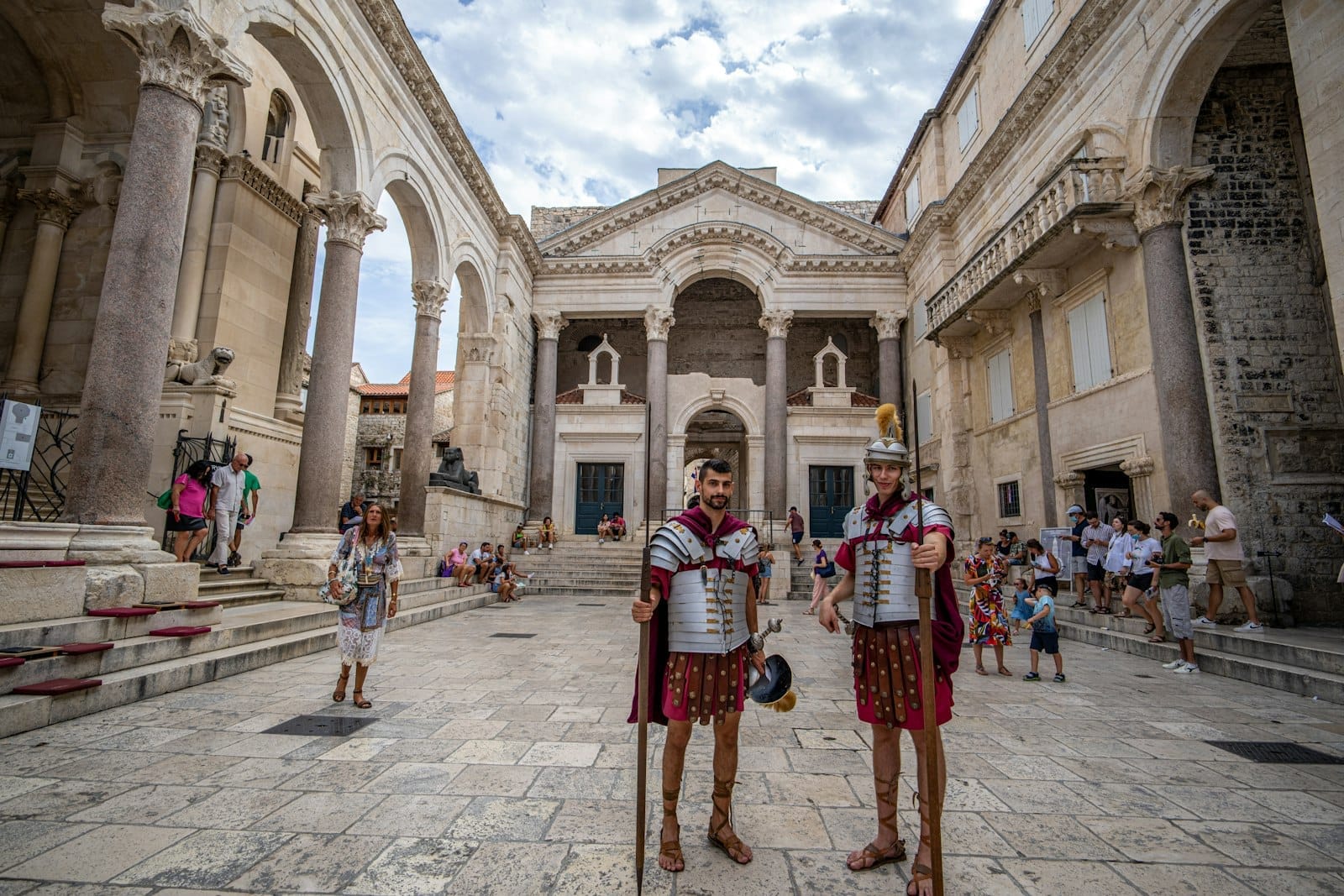
The Peristil is the main ceremonial courtyard of the original palace, and it remains the social and spatial center of the old town. It is a rectangular square framed by granite columns salvaged from Egypt, with a raised vestibule on the south side that once led to Diocletian's private apartments. The scale is smaller than most visitors expect — perhaps 35 meters long — but the compressed proportions make the columns feel more imposing, not less.
In the morning, before the tour groups arrive, the Peristil is one of the quietest places in Split. The stone is cold and pale in early light, and the only sounds are pigeons and the occasional scrape of a cafe chair being set out. By midday in summer it fills with guided tour clusters, and by evening it transforms again: locals sit on the steps, outdoor concerts are held in July and August during the Split Summer festival, and the ambient noise of the surrounding bars creates an unlikely but effective backdrop.
On the east side of the Peristil, steps lead up to the Cathedral of Saint Domnius, one of the oldest cathedrals in the world. It was converted from Diocletian's mausoleum — with considerable irony, since Diocletian was one of the Roman emperors who actively persecuted Christians. The building retains its original octagonal shape. A separate ticket grants access to the cathedral interior and the bell tower, which offers the best elevated view of the palace roofline and surrounding city.
How the Palace Changes Through the Day
The palace does not have operating hours in any conventional sense because it is a neighborhood. The main streets are accessible at all hours. What changes is the character of the experience.
Before 9 AM, the palace belongs to residents doing their morning routines: someone rolling a suitcase over cobblestones, a shopkeeper hosing down a doorstep, a cat sleeping on a warm stone ledge. The smell of bakeries opening drifts through the narrower lanes. This is when the texture of the stone is most visible and the sense of layers — Roman base, medieval walls, contemporary signage — is easiest to read without crowd interference.
From late morning through the afternoon in peak summer months (July and August), the core streets fill substantially. Narrow passages between the Peristil and the Cathedral become shoulder-to-shoulder with tour groups. If large crowds bother you, the solution is to move to the residential zones in the northeast quadrant, where tourists rarely penetrate and the alleys become genuinely medieval in atmosphere.
Evening is when the palace earns its reputation. Bars with outdoor seating fill the narrower courtyards. The stone, which absorbs heat during the day, stays warm underfoot well into the night. Restaurants in old Roman halls serve dinner until midnight or later. The lighting is minimal and largely atmospheric, which makes the ancient walls recede into shadow and the inhabited rooms glow amber by contrast. For visitors with limited time, one evening walk through the palace is worth more than two daytime visits.
The Cellars: What Lies Beneath
The Diocletian's Cellars are the best-preserved part of the original Roman structure and one of the most instructive places to spend 30 to 45 minutes before exploring the streets above. The subterranean halls were used as storage and service areas for the palace above, and because later inhabitants built upward rather than digging through the floors, the cellars survived largely intact. Their barrel-vaulted ceilings and brick construction give a clear picture of Roman engineering at a scale that street-level exploration cannot.
In summer the cellars are significantly cooler than the streets above — a practical advantage. They are also used as a gallery and event space, so the exact layout of accessible areas can vary. Fans of the television series Game of Thrones will recognize sections of the cellars used as sets for the dragon pits of Meereen.
What the Palace Does Not Do Well
Diocletian's Palace is not particularly good at explaining itself to first-time visitors. Information panels are sparse and inconsistently placed. The commercial development of the ground floors — boutique shops, souvenir stalls, restaurants — can make it hard to distinguish Roman fabric from later additions without prior knowledge or a guided tour.
Wheelchair and pushchair access is limited throughout the core. The ancient stone streets are uneven, the steps between levels are steep, and the narrower residential lanes have no flat alternatives. The Peristil and the main street running south to the Brass Gate are the most navigable areas for anyone with mobility constraints.
Visitors seeking beaches, nature, or a relaxed pace may find the palace insufficiently rewarding on its own. It works best as the anchor of a broader day that includes the Riva promenade to the south and a walk up to Marjan Hill for contrast.
⚠️ What to skip
In July and August, the interior lanes of the palace can feel extremely hot and airless between noon and 4 PM. Wear light clothing, carry water, and consider scheduling your detailed exploration for early morning or after 5 PM.
Fitting the Palace Into Your Itinerary
If this is your first visit to Split, the palace should anchor your first day. A practical sequence: enter through the Golden Gate from the north, walk to the Peristil, visit the Cathedral and bell tower, descend to the cellars via the southern arcade, and exit onto the Riva. That route covers the essential architecture in roughly 2 to 3 hours. The Split walking tour covers this route in detail with additional context for each landmark.
The palace also makes a strong base for day trips. Ferries to Hvar Island depart from the harbor a few minutes' walk from the Brass Gate, and bus connections to national parks leave from the main bus terminal nearby. If you are planning several days in the region, the 3 days in Split itinerary shows how to sequence the palace alongside the city's other districts.
Insider Tips
- The northeast quadrant of the palace, roughly bounded by the Silver Gate and the residential streets running north, sees a fraction of the foot traffic of the Peristil area. This is where the palace still functions as a genuine neighborhood: washing lines, potted plants on Roman sills, residents playing cards in doorways.
- Hire a local guide for a 90-minute tour rather than relying on audio guides or panels. The palace layers Roman, early Christian, medieval, and contemporary history in ways that are hard to parse visually without someone who knows where to look. The Tourist Board of Split maintains a list of licensed guides.
- The bell tower of Saint Domnius offers the best overhead view of the palace layout — you can trace the original rectangular Roman footprint clearly from the top, which helps the street-level experience make more sense afterward.
- If you visit during the Split Summer festival (July and August), check whether open-air performances are scheduled in the Peristil. Attending even a short concert in that courtyard, surrounded by Egyptian granite columns, is an experience that no daytime visit can replicate.
- The Pazar open-air market sits just outside the East Gate (Silver Gate) and runs every morning. It is one of the best places in Split to buy local produce and is a sharp contrast to the tourist-facing interior of the palace — worth 20 minutes before or after your main visit.
Who Is Diocletian's Palace For?
- First-time visitors to Split who want to understand the city's historical foundation
- Architecture and history enthusiasts who can spend time reading the layers of Roman, Byzantine, and medieval construction
- Evening walkers looking for atmosphere, outdoor dining, and live music in an ancient setting
- Travelers using Split as a base who want a walkable, central neighborhood with ferry and bus connections nearby
- Families with older children who are engaged by the idea of a Roman fortress that people still live inside
Nearby Attractions
Other things to see while in Diocletian's Palace & Old Town:
- Cathedral of Saint Domnius
The Cathedral of Saint Domnius began its life as the mausoleum of Emperor Diocletian around AD 305 and was converted into a Christian cathedral in the 7th century, making it the oldest Catholic cathedral in continuous use within its original structure. Rising above the Peristyle at the heart of Diocletian's Palace, it remains an active place of worship, a climb-worthy bell tower, and one of the most layered architectural sites in Europe.
- Diocletian's Cellars (Peristyle Substructure)
Beneath the streets of Split's old town, the Cellars of Diocletian's Palace preserve one of the most complete Roman substructures anywhere in the world. Built around the turn of the 4th century AD to support the emperor's private apartments, these vast underground halls cover over one hectare and feel unlike any museum. This is the actual Roman foundation, open to walk through.
- Game of Thrones Museum Split
Tucked into the Old Town at Bosanska ulica 9, the Game of Thrones Museum Split offers five themed rooms filled with props, costumes, and life-size character statues. It's a compact, fan-focused stop that makes most sense when paired with a walk through the very palace walls that stood in for Meereen on screen.
- Golden Gate (Porta Aurea)
The Golden Gate, known in Croatian as Zlatna Vrata and originally called Porta Aurea, is the northern entrance to Diocletian's Palace and the grandest of its four gates. Free to visit at any hour, it connects the ancient palace to the road that once led to the Roman city of Salona, and stands today as a remarkably well-preserved late Roman fortified gateway.