Hvar Island: What to Know Before You Make the Trip from Split
Hvar Island stretches about 68 kilometres along the Dalmatian coast, combining 2,400 years of layered history with some of Croatia's clearest water and a landscape still shaped by ancient Greek land divisions. It is reachable from Split by ferry in roughly two hours, making it a logical day trip or short stay from the city.
Quick Facts
- Location
- Off the Dalmatian coast, Split-Dalmatia County — between Brač, Vis, and Korčula islands
- Getting There
- Car ferry from Split to Stari Grad (~2 hours); catamaran to Hvar Town also available — verify current schedules with Jadrolinija
- Time Needed
- Full day minimum; 2–3 nights recommended to move beyond Hvar Town
- Cost
- No admission fee (public island); ferry ticket required — verify current fares before travel
- Best for
- History, swimming, hiking, island-hopping, slow travel
- Official website
- visithvar.hr/visit-hvar/island-of-hvar
The Island at a Glance
Hvar Island is Croatia's longest Adriatic island at about 68 kilometres, covering approximately 300 square kilometres of limestone terrain, pine forest, and terraced farmland. Its highest point, Mount Sveti Nikola, rises to about 628 metres and is visible from the ferry well before you dock. The island sits between Brač to the north and Vis to the west, with Korčula further southeast. It belongs to Split-Dalmatia County and is part of the European Union.
The island has two distinct personalities that most visitors never fully see both of. Hvar Town, on the western end, is the one that fills the travel magazines: a fortified medieval harbour with a Renaissance theatre, outdoor bars on the main square, and a constant ferry traffic of day-trippers in summer. Stari Grad, at the end of a deep natural bay on the north coast, is quieter, older, and for many people considerably more interesting. Between the two lies the Stari Grad Plain, a UNESCO World Heritage Site since 2008, where Greek colonists from Paros laid out agricultural plots in 384 BC that are still visibly intact in the landscape today.
ℹ️ Good to know
Hvar Island has no admission fee. What costs money is the ferry crossing from Split. Check the current Jadrolinija timetable before you travel, as departure times shift between seasons and sell out on summer weekends.
History That Shows in the Landscape
Few places in the Mediterranean make 2,400 years of continuous use as legible as Hvar. The Greeks who established the colony of Pharos in 384 BC divided the agricultural land of the central plain into geometric plots separated by dry-stone walls. Those walls, and the basic grid of that land division, survive today as field boundaries. The Stari Grad Plain is genuinely one of the best-preserved ancient agricultural landscapes in Europe, not a reconstruction or a museum, but working land.
Rome took the island in 219 BC, and Stari Grad (then still called Pharos) remained the administrative centre through the Byzantine period. The Slavic name Hvar appears in the early medieval record, derived from the older Greek name through a series of phonetic shifts. Venice turned Hvar Town into a naval base from 1279, and the influence of that four-century occupation is everywhere in the architecture: the loggia on the main square, the arsenal with its theatre above it (one of the oldest public theatres in Europe, built in 1612), and the Venetian Gothic facades on the streets behind the harbour.
The island's history under Venice, Austria, and eventually Yugoslavia is covered in more detail in the context of the wider region. If you want background before you arrive, the guide to day trips from Split provides useful framing for how Hvar fits into Dalmatian history.
Tickets & tours
Hand-picked options from our booking partner. Prices are indicative; availability and final rates are confirmed when you complete your booking.
Blue Cave and Hvar 5 islands tour from Split
From 145 €Instant confirmationFree cancellationHvar and the Pakleni Islands private boat tour
From 1.850 €Instant confirmationFree cancellationBlue Cave and Hvar 5 islands tour from Trogir
From 137 €Instant confirmationFree cancellationKrka national park tour from Split
From 27 €Instant confirmationFree cancellation
Arriving: The Ferry Experience and First Impressions
The main car ferry route runs from Split to Stari Grad, crossing in approximately two hours. This is the route you take if you have a car, or if you want to arrive on the quieter, more historical side of the island. A separate catamaran service runs to Hvar Town directly, which is faster and more convenient if you are travelling on foot and aiming straight for the nightlife or the harbour bars.
The approach to Stari Grad by ferry is one of the more quietly dramatic arrivals in Dalmatia. The bay is long and narrow, flanked by limestone hillsides, and the town only reveals itself in the final minutes. In high summer, the first thing you notice onboard is the smell: lavender, rosemary, and pine from the hillsides as the boat enters the bay. Hvar is one of the few Dalmatian islands where lavender is cultivated at scale, and the scent is real, not a tourism embellishment.
⚠️ What to skip
In July and August, car ferries to Stari Grad operate at capacity. Foot passengers board easily, but drivers can face waits of several hours. Book your car ferry slot in advance through Jadrolinija, and arrive at the Split ferry terminal well before the departure time.
From Stari Grad, local buses run to Hvar Town along a route that crosses the plain, giving you a ground-level view of the ancient field system. The drive takes around 20 minutes. Taxis and rental cars are also available, but the bus is cheap and the route itself is worth seeing slowly.
Hvar Town: What You Will Find and What to Expect
Hvar Town (population roughly 3,500) occupies a sheltered harbour on the southwestern coast. The main square, Trg Svetog Stjepana, is large by Dalmatian standards, and at its far end stands the Cathedral of Saint Stephen, a 16th-century structure built over an older Benedictine monastery. The square runs directly to the water, and the line of sight from the cathedral down to the harbour is the defining image of the town.
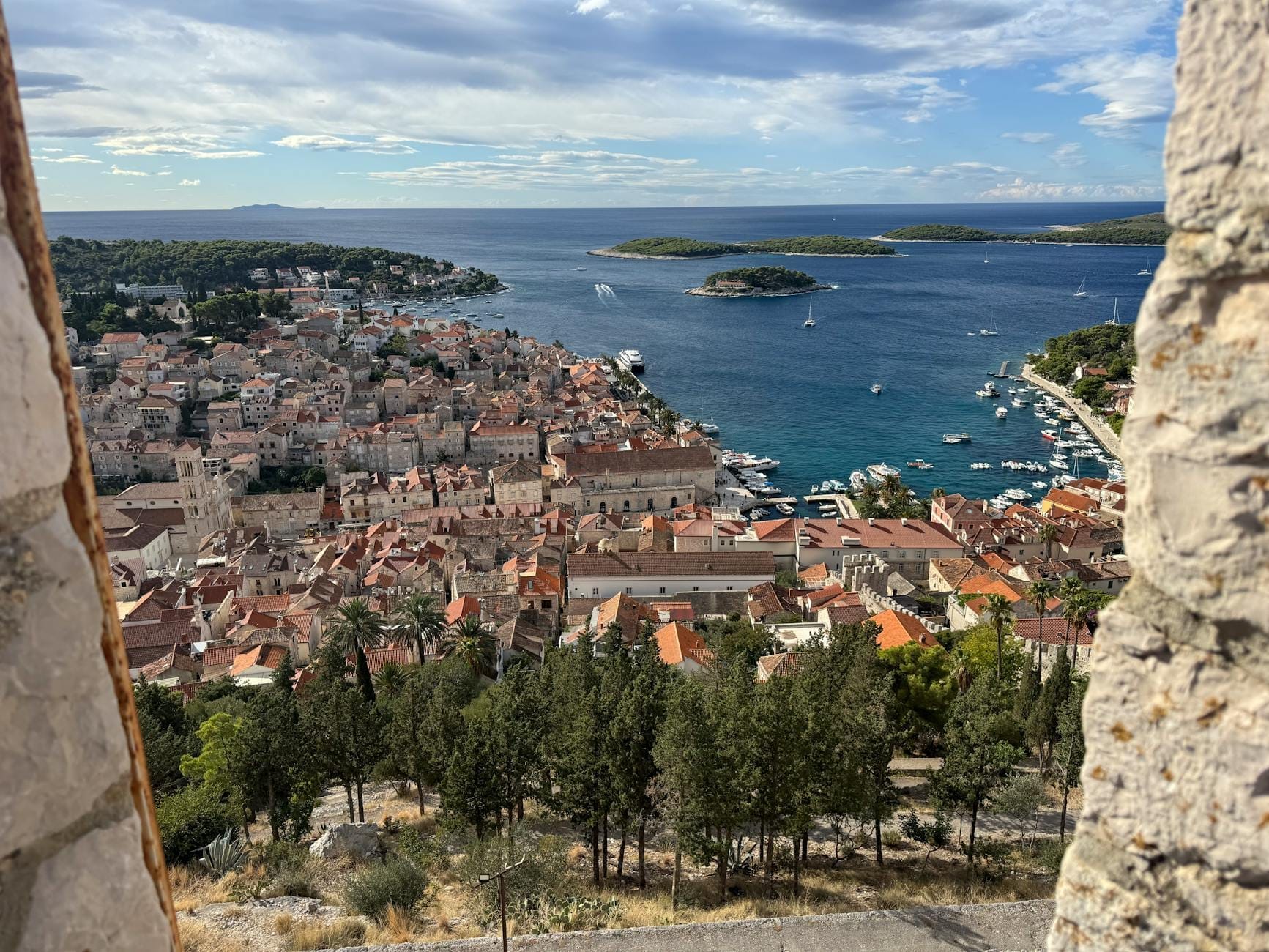
The Venetian Arsenal and theatre above it sit on the harbour's northern edge. The theatre, opened in 1612, was designed to be used by both the Venetian garrison and local citizens, a deliberate social policy that makes it historically unusual. It still functions as a performance space. The Fortica fortress, also called Španjola, sits on the hill above the town and offers the best elevated view of the harbour and the Pakleni Islands. The climb takes 15–20 minutes on foot and is steep in places.
For context on how Hvar Town compares to other Dalmatian destinations worth visiting from Split, the Split to Hvar travel guide covers the crossing options, timing, and what to prioritise once you arrive.
The honest thing to say about Hvar Town in summer is that it is crowded, loudly so by mid-afternoon when the day-tripper ferries have deposited their passengers. The bars on and around the main square are busy from mid-morning onwards. If you respond well to that energy, the town delivers it in full. If you were hoping for the quiet Adriatic village of the imagination, you will not find it here between late June and late August. The shoulder months, May, early June, and September, offer the same architecture and water with a fraction of the crowds.
Beyond the Town: The Rest of the Island
Most day-trippers see Hvar Town and the Pakleni Islands just offshore. That leaves the rest of the island, which is the part that rewards slower travel. The Stari Grad Plain is the obvious priority for anyone with a historical interest. Walking the edges of the ancient field system in the early morning, when the light is low and the path is quiet, is a different experience from the midday heat of the town square. Information boards around the plain explain the Greek land-division system without requiring a guide.
The eastern end of the island, including the small settlement of Sućuraj with its own ferry connection to the mainland, is largely untouched by mass tourism. The road along the southern coast passes through villages where lavender is dried on wooden frames outside stone houses, and where the only sounds on a weekday morning are cicadas and wind. This is the Hvar that photographs do not usually show, and it requires either a rental car or a motorbike to reach comfortably.
Mount Sveti Nikola at about 628 metres is the island's high point and offers a full panoramic view across to the other Dalmatian islands on clear days. The ascent is a serious hike rather than a casual walk, and proper footwear is necessary. The terrain is rocky limestone, which becomes slippery when wet. Start early to avoid the midday heat.
💡 Local tip
If you plan to hike or explore inland, carry more water than you think you need. The limestone terrain reflects heat, shade is intermittent away from pine forests, and roadside shops are sparse outside the main settlements.
Swimming, the Pakleni Islands, and Time on the Water
The Pakleni Islands, a small archipelago of pine-covered islets directly west of Hvar Town, are accessible by water taxi from the harbour in under 15 minutes. The most visited are Jerolim, Stipanska, and Palmižana. The water clarity is exceptional: in calm conditions, visibility can reach several metres, and the bottom is visible at depth over white sand. The island-hopping guide from Split includes the Pakleni chain as part of a wider itinerary if you want to combine multiple islands in one trip.
The beaches on Hvar itself range from small pebble coves on the southern coast to flat rock platforms near Hvar Town. None are sandy in the traditional sense. Stiniva Cove on nearby Vis is often cited in the same breath as Hvar's beaches, but it is a separate island and requires its own crossing. If swimming is your primary objective, a boat tour that moves between several spots tends to be more satisfying than committing to one beach for the day.
Who This Island Suits and Who Might Reconsider
Hvar works well for travellers who are comfortable combining historical sightseeing with outdoor activity and are flexible about pace. It also works well for people who simply want a reliable, beautiful stretch of Adriatic coast with good food and easy water access. The island has a deserved reputation as a summer nightlife destination, and Hvar Town's bar scene is real and lively, so party-focused visitors do find what they are looking for.
Travellers who should think carefully before committing to Hvar Town as their base in July or August: those who are sensitive to crowds and noise, anyone on a tight budget (prices in Hvar Town's harbour restaurants are among the highest in Dalmatia), and families with very young children who need sandy beaches and calm, shallow water. For families, the Split with kids guide may suggest alternatives that are better suited.
Mobility-limited visitors will find Hvar Town's main square and harbour accessible, but the hillside streets leading to the fortress are steep, uneven, and not wheelchair-friendly. The ferry gangway can also present challenges depending on sea conditions and the specific vessel operating the route on a given day.
Insider Tips
- The last catamaran back to Split from Hvar Town is often fully booked by mid-afternoon on peak summer days. Buy your return ticket as soon as you arrive, not when you are ready to leave.
- Stari Grad is a better base than Hvar Town if you are staying multiple nights and want to sleep without street noise. It is 20 minutes by bus from Hvar Town's nightlife, but the price difference in accommodation is significant.
- The Stari Grad Plain is best walked in the first two hours after sunrise. By 10am in July, the limestone reflects enough heat to make it uncomfortable. The light is also better for photography in the early morning.
- Water taxis to the Pakleni Islands do not run to a fixed timetable in the way ferries do. Negotiate a pickup time when you board, or you may find yourself waiting considerably longer than expected for a return boat.
- Hvar Town's main square is surrounded by restaurants that price primarily for tourists. Walk two streets back from the harbour into the residential lanes and the quality-to-price ratio changes noticeably.
Who Is Hvar Island For?
- History-focused travellers who want to see a living ancient landscape in the Stari Grad Plain
- Swimmers and snorkellers looking for clear Adriatic water without a long journey from Split
- Couples combining a beach stay with evening dining in an architecturally interesting town
- Hikers who want to combine coastal views with serious elevation on Mount Sveti Nikola
- Island-hoppers using Hvar as one stop on a multi-island itinerary from Split
Nearby Attractions
Combine your visit with:
- Archaeological Museum Split
Founded in 1820, the Archaeological Museum Split (Arheološki muzej Split) is widely regarded as the oldest museum institution in Croatia. Its collection of some 150,000 artifacts, spanning prehistoric through medieval periods, makes it the most complete record of ancient Dalmatia in existence. The arcaded garden alone, lined with Roman sarcophagi and stone inscriptions, is worth the ticket price.
- Blue Cave (Biševo)
The Blue Cave, or Modra špilja, is a flooded sea cave on Biševo island whose interior glows an otherworldly blue when sunlight enters through a submerged opening. Reachable only by small boat, it sits about 50 km southwest of Split and draws visitors from across the Dalmatian coast. The light effect is real — but timing, weather, and crowds determine whether the experience feels magical or rushed.
- Brač Island
Brač is the largest island in Dalmatia, covering around 395–396 km² and rising to about 778 metres at Vidova Gora, the highest peak among all Adriatic islands. Reachable by ferry from Split in under an hour, it delivers a full day of beach, landscape, and stone-village atmosphere without the crowds that descend on Hvar.
- Cetina River Canyon
The Cetina River Canyon carves through limestone karst southeast of Split, delivering sheer cliff walls, the 49-metre Gubavica Falls, and one of Dalmatia's most rewarding rafting routes. Whether you kayak the emerald water, walk the gorge paths, or simply lunch beside the historic Radmanove Mlinice mills, it is a compelling contrast to Split's coastal crowds.