Brač Island: Croatia's Largest Dalmatian Island, Explained
Brač is the largest island in Dalmatia, covering around 395–396 km² and rising to about 778 metres at Vidova Gora, the highest peak among all Adriatic islands. Reachable by ferry from Split in under an hour, it delivers a full day of beach, landscape, and stone-village atmosphere without the crowds that descend on Hvar.
Quick Facts
- Location
- Adriatic Sea, Split-Dalmatia County, Croatia. Separated from Split mainland by the Brač Channel (5–13 km wide).
- Getting There
- Car/passenger ferry from Split harbour to Supetar (approx. 50 min). Bol also reachable from Split by catamaran in season. Book via Jadrolinija or Ferryhopper.
- Time Needed
- Full day minimum. Overnight stay recommended to see more than one area.
- Cost
- Ferry fare applies (verify current prices with Jadrolinija). The island itself is free to explore. Parking, beaches, and activities vary.
- Best for
- Beach days, hiking, photography, day trips from Split, slow coastal travel
What Brač Actually Is (And Why It's Not Just a Beach Stop)
Brač is the largest island in Dalmatia, and the third largest in the entire Adriatic, stretching roughly 40 kilometres east to west and up to about 13 kilometres across. At around 395 km², it dwarfs most islands in the region, yet its population of around 13,800 people is spread across more than 20 settlements, leaving most of the interior remarkably quiet.
Most visitors arrive for Zlatni Rat, the photogenic spit of pebble beach near Bol that appears on what feels like every piece of Croatian tourism material ever printed. That beach is genuinely worth seeing. But reducing Brač to a single beach would be like visiting Split only to walk the Riva. The island has a functioning stone quarry history that is often claimed to have shaped the White House in Washington, a summit that towers over every other Adriatic island peak, and a string of inland villages where tourism hasn't reshaped daily life.
ℹ️ Good to know
Brač stone (called 'kamen iz Brača') is a fine-grained white limestone quarried on the island for centuries. It was used not only in Diocletian's Palace in Split but is also frequently claimed to have been used in the construction of the White House, though this is not supported by primary architectural records. The quarries near Pučišća remain active.
Brač also makes a logical base for anyone who finds Split's old town too loud in high summer. Ferries run frequently from Split's main harbour, the crossing takes under an hour, and accommodation in Supetar or Bol covers every budget. For context on planning your overall time in the region, the 3-day Split itinerary includes a useful framework for fitting island time alongside city sightseeing.
Getting to Brač: Ferries, Routes, and Timing
The primary crossing is the Jadrolinija car ferry from Split harbour to Supetar, the island's administrative centre on the northern coast. The journey takes approximately 50 minutes and runs multiple times daily year-round, with significantly more frequency in summer. This is the easiest option if you want to bring a vehicle or simply have flexibility on departure times.
A faster catamaran service connects Split to Bol (on the southern coast, near Zlatni Rat) during the summer season. Journey time is shorter but check current schedules, as this service doesn't run year-round and timetables shift between seasons. Brač also has its own airport, located near Bol, which handles seasonal charter and some domestic flights, though most independent travellers arrive by sea.
💡 Local tip
In July and August, book your outbound ferry early or arrive at the Split harbour well before departure. The car-ferry queue fills quickly on summer weekends and public holidays. On foot, boarding is rarely a problem, but cyclists should also allow extra time.
If you're combining Brač with a broader island strategy, island hopping from Split covers how to chain multiple island visits without backtracking through the city repeatedly.
Tickets & tours
Hand-picked options from our booking partner. Prices are indicative; availability and final rates are confirmed when you complete your booking.
Golden Horn and Brac Island private boat tour
From 1.850 €Instant confirmationFree cancellationBlue Cave and Hvar 5 islands tour from Split
From 145 €Instant confirmationFree cancellationKrka national park tour from Split
From 27 €Instant confirmationFree cancellationAll-inclusive Blue Lagoon tour from Split with three islands visit
From 68 €Instant confirmationFree cancellation
Supetar: The Ferry Port That's Worth More Than a Transit Stop
Most people step off the ferry at Supetar and immediately hire a car or grab a bus to Bol. That's understandable, but the town itself deserves at least a short walk. Supetar's waterfront is compact and low-key, with a small harbour, a modest beach on either side, and a cemetery on the western headland that is genuinely one of the more extraordinary in Dalmatia.
The Petrinović Mausoleum in the cemetery was designed by sculptor Ivan Rendić in the late 19th century and is an astonishing piece of neo-Gothic stonework set among cypress trees. It sees a fraction of the foot traffic of anything in Split's old town, which is precisely why it rewards a detour. The stonework is local Brač limestone, visibly different in texture from mainland construction, almost luminous in direct sunlight.
Supetar has a population of just over 3,200, making it one of the larger settlements on the island. In the morning, before the day-trippers move through, the town has the ordinary rhythm of a Dalmatian working community: fishermen sorting nets near the harbour, the smell of bread from a bakery on the main street, older residents at outdoor café tables with coffee and newspapers.
Zlatni Rat: What the Photos Don't Tell You
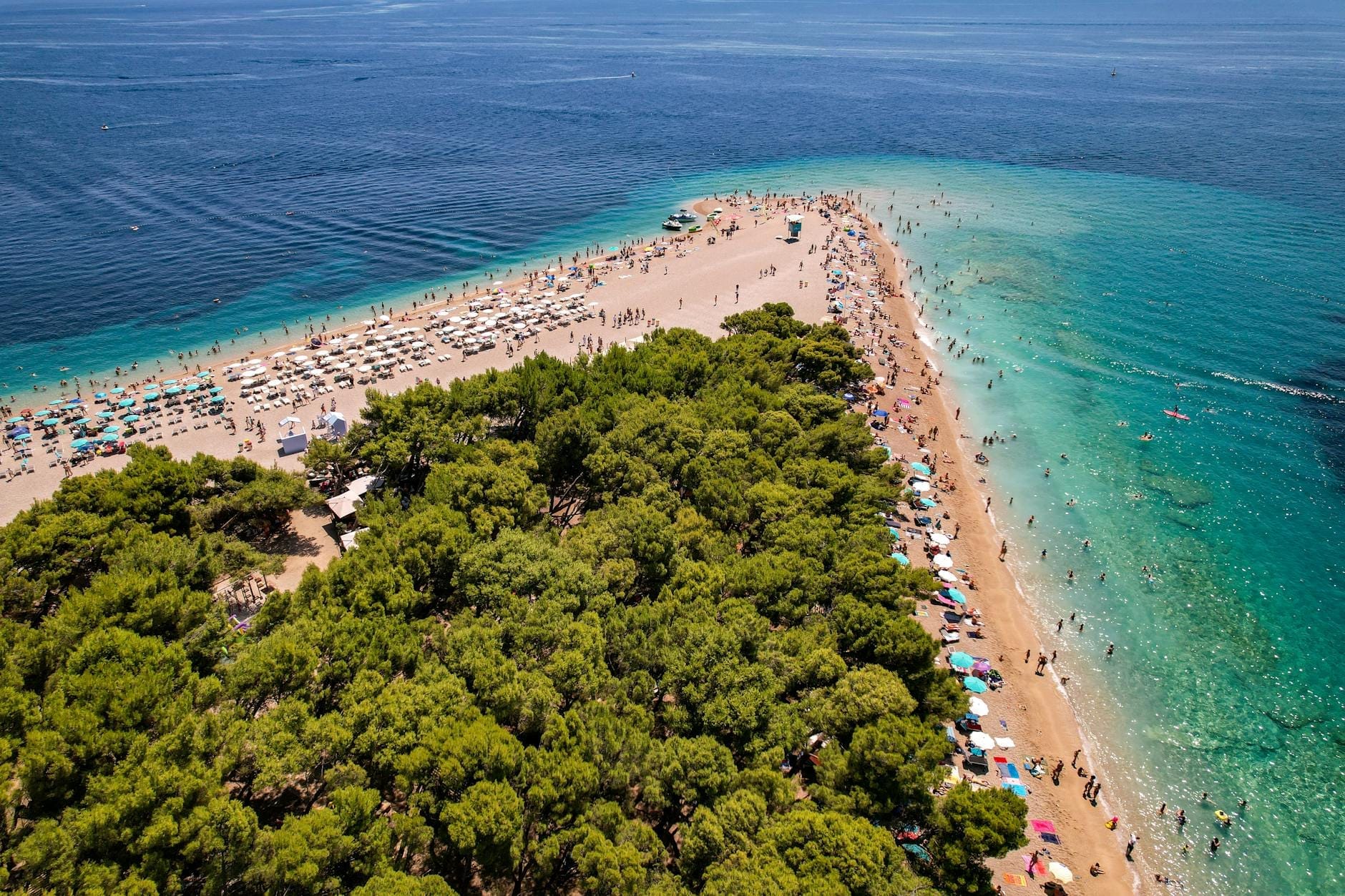
Zlatni Rat (Golden Cape) is a beach near Bol on the island's southern coast. It extends roughly 500 metres into the Adriatic and shifts shape slightly depending on currents and seasonal wind direction, which is what makes aerial photographs of it so striking. On the ground, it's a pebble beach, narrow at the tip, heavily attended in peak season. The best beaches near Split compares it against other options in the region if you're weighing alternatives.
The beach is backed by a pine forest that provides real shade, which is a genuine asset in July and August when the stone and pebble hold heat intensely. The water is clear and shallow enough near the tip for children, though currents around the point can be stronger than they appear. The Maestral wind that blows across the southern shore makes this one of the better windsurfing locations in the Adriatic, and Bol has rental and instruction infrastructure built around that.
⚠️ What to skip
Zlatni Rat in August is heavily crowded. The beach becomes shoulder-to-shoulder by mid-morning on clear days. Arriving before 9am or after 5pm changes the experience significantly. If you're coming purely for photography, the late afternoon light is better anyway, and crowds thin as day-trippers leave.
Bol itself, the nearest town, is one of the more polished tourist destinations on the island. It has good restaurants, a small Dominican monastery with a fine-art collection, and a waterfront that functions as the social centre in the evenings. If Supetar feels like a working Dalmatian town that also has tourism, Bol feels like a tourism destination that also has a town underneath.
Vidova Gora: The Highest Summit in the Adriatic Islands
At about 778 metres, Vidova Gora is the highest peak among all Adriatic islands. That statistic sounds modest until you're standing on the summit and looking south across open sea toward Hvar, east toward the Pelješac peninsula, and west back toward the Split coastline. On a clear day the visibility extends to Vis, roughly 60 kilometres offshore.
The summit is reachable by road (a narrow mountain road from Bol, driveable in a standard vehicle but slow) or on foot via marked hiking trails that ascend from Bol through scrub forest and exposed limestone. The hike from Bol is approximately 12 kilometres round trip with around 700 metres of elevation gain, which takes most people three to four hours. The path is well-marked but rocky and without shade in the upper section, so start early and carry more water than you think you need.
The summit has a small konoba (traditional Croatian restaurant) that serves food and drink, though hours are seasonal and irregular. There's a modest church and a stone terrace that functions as the viewpoint. The light is best in the early morning or late afternoon. For anyone combining this with a broader active itinerary, Marjan Hill in Split offers a lower-key but more accessible hiking option directly from the city.
Inland Villages and the Stone Culture of Brač
The island's interior is largely scrubland, dry-stone walls, and abandoned terracing, with a handful of villages that have existed since medieval times. Škrip is the oldest settlement on the island, with a small museum inside a 16th-century castle tower and Roman-era fortification walls still visible. It sits in a hillside position that makes clear why early inhabitants chose function over coastal access.
Pučišća is architecturally the most significant village on the island. Almost everything here is built from local limestone, and the stonemason school (Klesarska Škola) has been operating continuously since 1909, training students in the traditional techniques used to cut and finish Brač stone. Walking through the village, you pass workshops where you can hear tools on stone and see apprentice work displayed outside.
These villages see far fewer visitors than Bol or Supetar, and outside July and August many restaurants and shops keep limited hours. Bring food and water if you're exploring inland, particularly if you're arriving by bicycle or on foot. The roads are narrow, twisting, and not always well-signed.
Practical Considerations: Seasons, Getting Around, and Who Should Skip This
Brač works best from late May through June and in September. July and August deliver the best swimming weather and the most ferry frequency, but also the highest prices, fullest beaches, and hottest temperatures. The island has almost no shade outside forested areas, and midday in summer at Zlatni Rat in direct sun is genuinely difficult without a hat and sunscreen.
Getting around the island without a car or scooter is possible but slow. Buses connect Supetar to Bol and a few other settlements, but schedules are limited, especially outside peak season. Renting a car or scooter in Supetar or Bol gives you full access to the island and is the most practical option for a day trip where time is limited.
Wheelchair access is limited outside the main town centres. Zlatni Rat beach is pebble throughout and has no flat, paved access to the shoreline. Supetar's waterfront is largely flat and manageable. Vidova Gora and inland villages involve rough, uneven terrain. Anyone whose trip is primarily beach-focused and mobility-dependent will find easier options closer to Split, including Žnjan Beach on the Split mainland.
Brač is not the right choice if you have only a few hours in Split, if you dislike ferries, or if you're travelling with young children who need predictable nap schedules and changing facilities. The ferry timeline commits most of your day, and the island rewards slow movement rather than quick check-offs.
Insider Tips
- The last afternoon ferry back to Split is always the most crowded. If you're on foot, you'll board fine. If you have a car, either leave earlier in the day or book in advance during July and August.
- Pučišća is easier to enjoy outside peak summer weeks. On a quieter morning, the stonemason school sometimes allows visitors to observe classes, and the harbour is calm enough to hear only the water and occasional tool work. Call ahead if that kind of access matters to you.
- Zlatni Rat faces south and catches the Maestral wind from the west in the afternoon. Windsurfers know this, which is why conditions (and crowds) are best understood by checking the wind forecast before you go. The beach is better for swimming in calm morning conditions; better for spectating or windsurfing by early afternoon.
- Vidova Gora road access means you can combine the summit view with a short hike by driving to a midpoint and walking the final section. This is a useful strategy in summer heat when a full ascent from Bol would be uncomfortable by mid-morning.
- If you want to eat well on a budget, look away from the Bol waterfront. The small konobas in villages like Nerežišća and Dol serve traditional food at prices aimed at local residents, not tourists, and the portions reflect that.
Who Is Brač Island For?
- Day-trippers from Split who want more than a city beach
- Hikers and active travellers targeting Vidova Gora or coastal trails
- Photographers focused on landscape and coastal light
- Travellers who want a quieter, less developed alternative to Hvar
- Anyone interested in traditional stone architecture and Dalmatian craft history
Nearby Attractions
Combine your visit with:
- Archaeological Museum Split
Founded in 1820, the Archaeological Museum Split (Arheološki muzej Split) is widely regarded as the oldest museum institution in Croatia. Its collection of some 150,000 artifacts, spanning prehistoric through medieval periods, makes it the most complete record of ancient Dalmatia in existence. The arcaded garden alone, lined with Roman sarcophagi and stone inscriptions, is worth the ticket price.
- Blue Cave (Biševo)
The Blue Cave, or Modra špilja, is a flooded sea cave on Biševo island whose interior glows an otherworldly blue when sunlight enters through a submerged opening. Reachable only by small boat, it sits about 50 km southwest of Split and draws visitors from across the Dalmatian coast. The light effect is real — but timing, weather, and crowds determine whether the experience feels magical or rushed.
- Cetina River Canyon
The Cetina River Canyon carves through limestone karst southeast of Split, delivering sheer cliff walls, the 49-metre Gubavica Falls, and one of Dalmatia's most rewarding rafting routes. Whether you kayak the emerald water, walk the gorge paths, or simply lunch beside the historic Radmanove Mlinice mills, it is a compelling contrast to Split's coastal crowds.
- Hvar Island
Hvar Island stretches about 68 kilometres along the Dalmatian coast, combining 2,400 years of layered history with some of Croatia's clearest water and a landscape still shaped by ancient Greek land divisions. It is reachable from Split by ferry in roughly two hours, making it a logical day trip or short stay from the city.