Blue Cave (Biševo): What the Light Actually Looks Like, and How to Get There
The Blue Cave, or Modra špilja, is a flooded sea cave on Biševo island whose interior glows an otherworldly blue when sunlight enters through a submerged opening. Reachable only by small boat, it sits about 50 km southwest of Split and draws visitors from across the Dalmatian coast. The light effect is real — but timing, weather, and crowds determine whether the experience feels magical or rushed.
Quick Facts
- Location
- Balun Bay, Biševo Island, ~60–70 km southwest of Split
- Getting There
- Organized boat tour from Split, Hvar, or Komiža; no direct land access to the cave itself
- Time Needed
- Full day including travel; ~15 min inside the cave
- Cost
- Tour-dependent; cave entry fee applies (verify before booking)
- Best for
- Nature lovers, photography, island-hopping day trips
- Official website
- bluecave-bisevo.com/en
What You're Actually Going to See
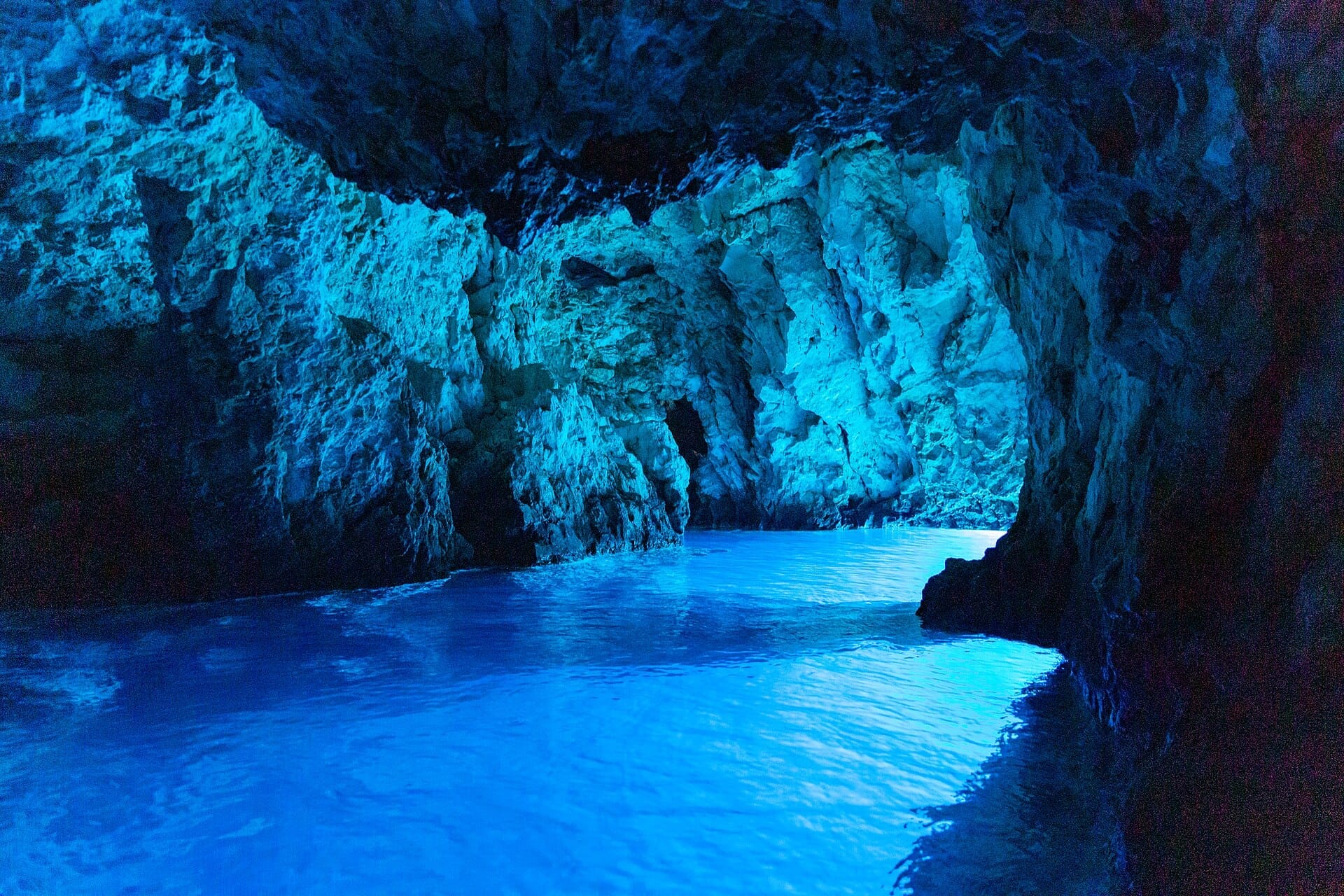
The Blue Cave, known in Croatian as Modra špilja, is a flooded sea cave carved by centuries of wave erosion into the limestone cliffs of Biševo island. The cave is about 24 meters long, around 10–12 meters deep, and rises up to roughly 15 meters in height. Its interior is unremarkable in low light — grey rock, still water, narrow walls. But when the sun is positioned correctly, light enters through a submerged natural opening on the southern wall and scatters upward through the water, casting the entire cave in a cold, vivid blue that seems to illuminate the space from below.
Objects underwater appear silver, not silver-blue — the refraction strips them of their usual color. Skin looks pale, almost luminescent. The effect is brief and specific: it peaks roughly between 11 AM and noon on sunny days when the sea is calm. Overcast skies reduce the glow significantly. A choppy sea can close the cave entirely, since boats must pass through an artificial entrance that is only 1.5 meters high and 2.5 meters wide. If conditions are marginal, operators will turn around.
⚠️ What to skip
The Blue Cave closes when seas are rough. There is no way to know in advance whether it will be accessible on a given day. If your entire itinerary is built around this single stop, build in a flexible return option.
The History Behind the Glow
Komiža fishermen on the nearby island of Vis knew the cave for generations, but it entered wider European consciousness in the 19th century when Baron Eugen von Ransonet, an Austrian naturalist and artist, described and painted its interior. The cave's natural entrance is too small for human access, and in 1884 the artificial entrance was cut into the rock specifically to allow boat passage. That intervention turned a geological curiosity into a visitable site.
The Croatian government designated Modra špilja a geomorphological monument in 1951, giving it protected status. Biševo itself is a small island about 5–6 kilometers southwest of Vis, reached from the port of Komiža. The cave sits in Balun Bay on the island's eastern side, at coordinates roughly 42°57′N, 16°00′E.
Tickets & tours
Hand-picked options from our booking partner. Prices are indicative; availability and final rates are confirmed when you complete your booking.
Blue Cave and Hvar 5 islands tour from Split
From 145 €Instant confirmationFree cancellationSplit small-group tour to Blue Cave and Coastline Caves
From 118 €Instant confirmationFree cancellationBlue Cave and 6 Islands boat tour from Split
From 143 €Instant confirmationFree cancellationBlue Cave and island exploration private boat tour from Split
From 1.850 €Instant confirmationFree cancellation
How to Reach It from Split
Getting to the Blue Cave from Split is a full-day commitment — there is no shortcut. The most common approach is to book an organized boat tour, which typically departs from Split's harbor in the early morning, stops at the cave, and may include additional islands such as Hvar or Vis along the way. These tours are widely available from May through October and usually last the full day.
Alternatively, you can take a ferry to Vis, make your way to Komiža on the island's western coast, and catch a local boat from there to Biševo. This route gives you more control over timing and lets you explore Vis independently, but it requires more planning and at least one overnight if you want to hit the cave near midday without a predawn start from Split.
There is no land access to the cave. All entry is by small motorized boat. If you are considering pairing this with other Dalmatian highlights, it fits naturally into a broader island-hopping itinerary from Split.
💡 Local tip
Tours departing from Komiža have the shortest travel time to the cave and are more likely to arrive during peak light hours. If you are flexible, basing yourself on Vis for a night is the most reliable way to time the visit well.
Inside the Cave: The Visit Itself
Access is by small wooden or fiberglass boat, and passengers must duck low as the vessel slides through the cut entrance. Once inside, the boat drifts slowly in the enclosed space while visitors take in the light. The interior is cool even in summer, and the sound shifts completely — the slap of open water disappears and is replaced by the hollow echo of dripping and soft engine idle.
Time inside is short. In high season, guides keep each boat moving to accommodate the queue building outside. In July and August, waits outside the cave entrance can stretch to an hour or more. The actual time inside is typically around 15 minutes. It is not enough time to feel unhurried, but it is enough to see what the cave actually does. Swimming and diving are no longer permitted inside the Blue Cave itself — if you want to experience similar subaquatic light effects, look for dive tours in nearby areas where it is allowed.
The cave receives well over 10,000 visitors per year. In peak summer, the logistical experience can overshadow the natural one. For the clearest possible light and the shortest queue, aim to arrive at the cave entrance no later than 11 AM. That means boarding your boat by 8 or 9 AM at the latest, depending on your departure point.
Photography Inside the Cave
The cave is genuinely one of the more photogenic natural spaces in the Adriatic, but it also frustrates photographers who are unprepared. The light is blue-dominant and dim by the standards of most cameras. A smartphone will often produce muddy, underexposed images unless you manually override exposure settings. A mirrorless or DSLR camera set to a wide aperture and a high ISO will do significantly better.
Avoid using flash — it kills the ambient blue entirely and produces flat, clinical images. The best shots capture the contrast between the dark rock ceiling and the glowing water surface below the boat. A waterproof camera or a housing for an underwater shot of the submerged entrance arch is worth bringing if you plan to dive. The cave's color is genuinely difficult to replicate in post-processing from a poorly exposed base image.
💡 Local tip
Set your camera to manual or shutter-priority mode before entering. Auto-exposure will often try to compensate for the low light by overexposing the walls, losing the blue cast that makes the shot worth taking.
Practicalities, Accessibility, and Seasonal Notes
The Blue Cave is accessible seasonally, generally from May through October, though peak operations center on July and August. Opening dates vary by year and are weather-dependent, so verify current hours through the official visitor center site before building your itinerary around it.
The cave is not wheelchair accessible. The combination of small boats, low cave entrances, and the requirement to duck while seated makes it physically unsuitable for visitors with significant mobility limitations. It is also not recommended for people with severe claustrophobia: the entrance passage is tight and there is no way to quickly exit once inside.
Many tours combine the Blue Cave with the nearby Green Cave (Zelena špilja) on the island of Ravnik, which has a larger sea-level entrance and a different light quality — bright and emerald-toned rather than deep blue. If you are coming all this way, it is worth including. See also the broader context of day trips from Split to understand how this fits into a multi-day itinerary.
Is It Worth the Trip?
The honest answer depends on what you're measuring. The Blue Cave delivers something real: a natural phenomenon that is visually striking and occurs reliably under the right conditions. If you arrive at midday on a clear, calm day and the queue is short, it will likely rank among the most memorable single experiences of your Dalmatian trip. If you arrive on an overcast morning in a boat with 30 other tourists and wait an hour in the sun for 12 minutes inside, it may feel like an elaborate exercise in organized disappointment.
The best frame for this visit is as part of a wider day on the water rather than as a standalone destination. Pair it with time on Vis — one of the most under-touristed of the larger Dalmatian islands — or with a stop on Hvar Island, and the logistics feel justified. Treat the cave as the centerpiece of an all-day boat excursion, not as a box to tick on a rushed afternoon.
Travelers who prioritize unhurried, solitary encounters with nature may find the peak-season version of the Blue Cave underwhelming. Those with young children should also weigh the long boat ride against how the kids will handle a quick cave stop that lasts less than 20 minutes. The open water journey each way can be rough if wind picks up — motion sickness is a real consideration.
Insider Tips
- Book a tour that departs from Komiža rather than Split if timing the light is your priority. The shorter travel time from Komiža means you can be inside the cave near 11 AM without a 6 AM departure.
- Early May and late September offer substantially shorter queues and calmer tour groups. The light still works if the sky is clear — summer exclusivity on the Blue Cave is mostly a myth.
- If you are a diver or snorkeler, look specifically for operators offering diving experiences in nearby permitted areas rather than inside the Blue Cave itself, as in-cave diving is currently prohibited.
- Check sea conditions the evening before using a local weather service like Meteo Adriatic. A Beaufort 3 or higher will likely mean a closed cave or a very uncomfortable ride.
- The Green Cave on Ravnik island is 45 minutes away and far less crowded. If the Blue Cave is closed or over-queued, it functions as a credible alternative with its own distinct light effect.
Who Is Blue Cave (Biševo) For?
- Nature and geology enthusiasts who appreciate the physics behind the blue light effect
- Photographers comfortable shooting in low, color-dominant ambient light
- Travelers building a multi-day island-hopping route through central Dalmatia
- Adventurous travelers willing to commit a full day on the water for a single natural phenomenon
- Couples or small groups who can book a private boat and control their own timing
Nearby Attractions
Combine your visit with:
- Archaeological Museum Split
Founded in 1820, the Archaeological Museum Split (Arheološki muzej Split) is widely regarded as the oldest museum institution in Croatia. Its collection of some 150,000 artifacts, spanning prehistoric through medieval periods, makes it the most complete record of ancient Dalmatia in existence. The arcaded garden alone, lined with Roman sarcophagi and stone inscriptions, is worth the ticket price.
- Brač Island
Brač is the largest island in Dalmatia, covering around 395–396 km² and rising to about 778 metres at Vidova Gora, the highest peak among all Adriatic islands. Reachable by ferry from Split in under an hour, it delivers a full day of beach, landscape, and stone-village atmosphere without the crowds that descend on Hvar.
- Cetina River Canyon
The Cetina River Canyon carves through limestone karst southeast of Split, delivering sheer cliff walls, the 49-metre Gubavica Falls, and one of Dalmatia's most rewarding rafting routes. Whether you kayak the emerald water, walk the gorge paths, or simply lunch beside the historic Radmanove Mlinice mills, it is a compelling contrast to Split's coastal crowds.
- Hvar Island
Hvar Island stretches about 68 kilometres along the Dalmatian coast, combining 2,400 years of layered history with some of Croatia's clearest water and a landscape still shaped by ancient Greek land divisions. It is reachable from Split by ferry in roughly two hours, making it a logical day trip or short stay from the city.