Vis Island: Croatia's Farthest Inhabited Island — and One of Its Most Rewarding
Vis Island sits farther from the Croatian mainland than any other inhabited island in the Adriatic, and that distance is precisely what has preserved it. Closed to foreign visitors until the late 1980s due to Yugoslav military use, Vis developed on its own terms, leaving behind an island with layered history, unhurried villages, and coastline that still feels genuinely uncrowded by Dalmatian standards.
Quick Facts
- Location
- Adriatic Sea, Split-Dalmatia County, Croatia (farthest inhabited island from the Croatian mainland)
- Getting There
- Ferry from Split port (direct Split–Vis line; separate services run to Stari Grad on Hvar); journey approximately 2 hours 20 minutes by regular ferry, faster by catamaran
- Time Needed
- Minimum 2 days; 3-4 days recommended to see both towns and the coastline properly
- Cost
- Ferry ticket required (verify current fares with Jadrolinija); island itself has no entry fee
- Best for
- History enthusiasts, swimmers, couples, travelers who find Hvar too crowded
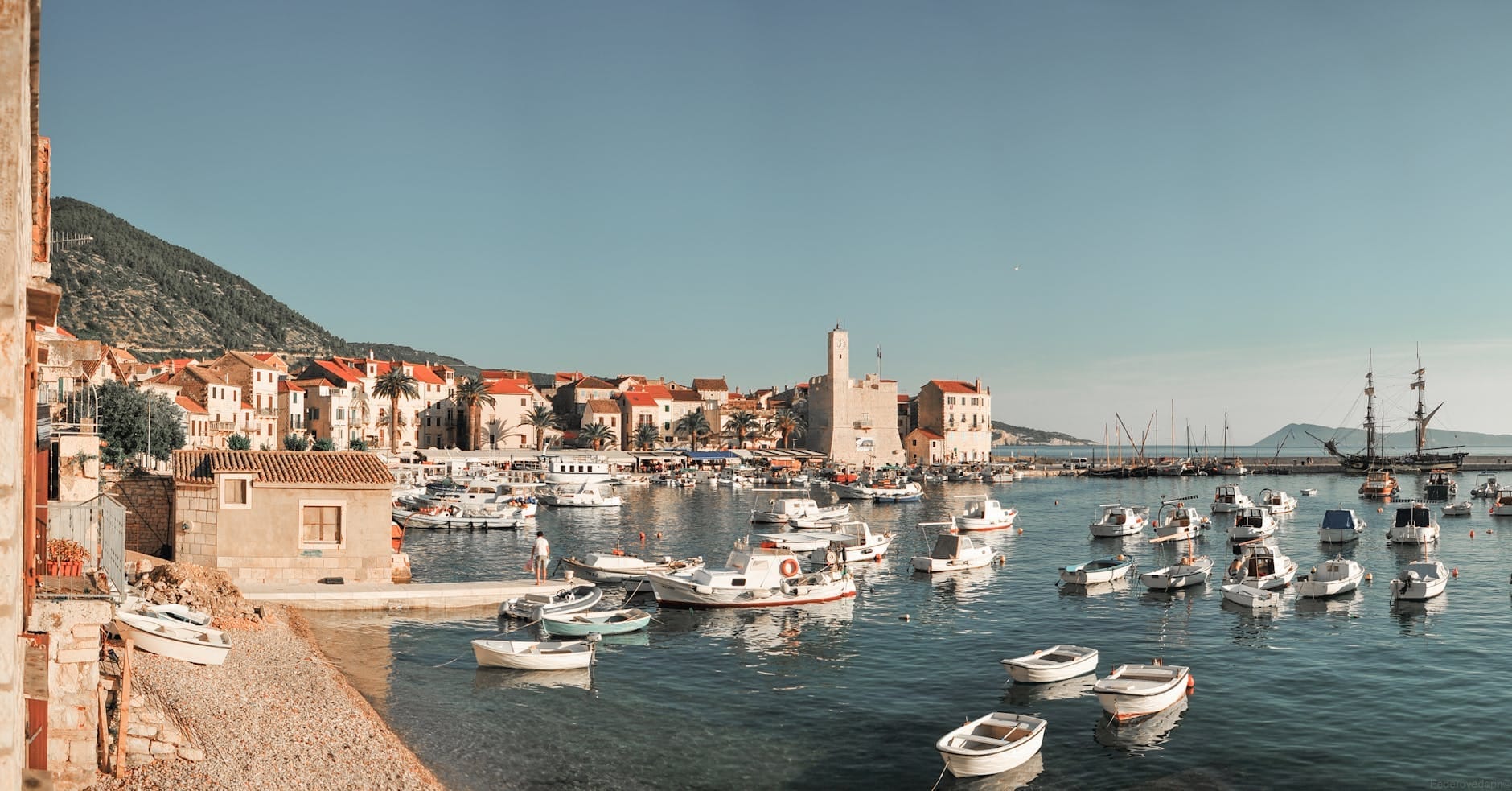
What Vis Island Actually Is
Vis Island covers about 90 square kilometres and rises at its highest point to Hum, a peak of 587 metres above sea level. The island sits at coordinates 43°02'33"N 16°09'09"E, further from the mainland than Hvar, Brač, or any of the other central Dalmatian islands. Its two main settlements are the town of Vis on the eastern coast, sheltered within the Bay of Saint George, and Komiža on the western side, facing open water toward the outer islands. As of the 2021 census, the island's total population was 3,313, a figure that gives some sense of the pace you should expect.
That low population is partly a result of emigration over the decades, but also of the island's unusual 20th-century history. From the end of World War II until 1989, Vis functioned as a restricted military zone operated by the Yugoslav People's Army. Foreign tourists were simply not permitted. When those restrictions lifted, Vis entered the tourism economy roughly 30 to 40 years behind its neighbors. The consequence is a built environment that was not reshaped for mass visitors: the old town fabric of both Vis and Komiža survived largely intact, fishing culture remained central, and the island's underwater ecosystems were left undisturbed for decades.
ℹ️ Good to know
Vis became a member of the UNESCO Global Geopark network in 2019 as part of the GEOPARK Vis Archipelago designation, recognizing the geological, ecological, and cultural significance of the island and its surrounding islets.
A History That Goes Deeper Than Most Dalmatian Islands
The ancient name of Vis was Issa, and it was founded in the 4th century BC as a Greek colony by Dionysius the Elder of Syracuse. That makes it one of the oldest urban settlements on Croatian territory. The Archaeological Museum in the town of Vis holds finds from this Greek period, including pottery, coins, and architectural fragments that illustrate how significant Issa was as a trading outpost in the ancient Adriatic. Remnants of the ancient Greek city walls can still be seen near the modern town.
The island passed through Roman administration, then centuries of Venetian rule until 1797, then into Habsburg and Austrian rule from the early 19th century until 1918. In 1920, the Treaty of Rapallo ceded Vis to the Kingdom of Yugoslavia. During World War II, the island took on a different kind of historical weight: it served as the headquarters of the Yugoslav Partisan movement, and Josip Broz Tito operated from a cave in the hills above the island, now known as Tito's Cave. The military tunnels and bunkers from both the WWII and Cold War periods are still accessible and represent one of the most distinctive visitor experiences on the island. If you want context for the broader region's layered past, the Roman ruins at Salona near Split offer a useful comparison point for understanding how ancient urban life developed along this coastline.
In 2017, Vis received an entirely different kind of attention when it was used as the filming location for the fictional Greek island of Kalokairi in Mamma Mia! Here We Go Again. The film brought a surge of visitors, particularly to the beaches and village of Komiža, which provided much of the on-screen inspiration, but the island's infrastructure and spirit have largely absorbed that interest without fundamentally changing character.
Tickets & tours
Hand-picked options from our booking partner. Prices are indicative; availability and final rates are confirmed when you complete your booking.
All-inclusive Blue Lagoon tour from Split with three islands visit
From 68 €Instant confirmationFree cancellationBlue Cave and Hvar 5 islands tour from Split
From 145 €Instant confirmationFree cancellationKrka national park tour from Split
From 27 €Instant confirmationFree cancellationGuided kayaking tour with snorkeling stops from Split
From 50 €Instant confirmationFree cancellation
The Town of Vis: Morning Light and Ancient Layers
The town of Vis wraps around a wide, protected bay. At dawn, the water in the bay sits almost perfectly still, and the light comes in flat and golden across the Venetian-era waterfront buildings. The smell is salt and faint diesel from fishing boats returning from night runs. By 9am, the first ferry passengers begin arriving and the pace lifts slightly, but Vis town is not a place that ever really rushes.
The archaeological museum here is worth at least an hour, particularly for its collection of Greek-era artifacts excavated from the ancient city of Issa. The town's Habsburg-era architecture blends with older stone structures in a way that feels organic rather than curated. The bay itself divides into two smaller inlets, Kut and Luka, each with a distinct character: Kut is quieter and more residential, with stone houses and overgrown gardens pressing close to the water; Luka is the more active harbor area with boats, a fish market in the morning, and the ferry terminal.
💡 Local tip
The fish market in Luka operates in the early morning. If you are staying overnight on the island, set an alarm and arrive before 8am. The selection and the atmosphere are both sharply different from anything you will find later in the day.
Komiža: Fishing Culture and the Outer Islands
Komiža sits on the western side of the island, about 10 kilometres from the town of Vis by road. The drive over the central ridge passes through vineyards and stone walls and emerges with views of both coasts that are worth stopping for. Komiža is smaller and feels more enclosed, with a 16th-century Venetian tower, the Kaštel, sitting at the edge of the harbor. The town built its identity around fishing, and that identity is still legible in the wooden lajut fishing boats moored along the quay and in the Fishing Museum housed inside the Kaštel.
Komiža is also the main departure point for boat trips to the Blue Cave on the island of Biševo, a short distance offshore. The Blue Cave is a sea cave where sunlight enters through an underwater opening and refracts into intense blue light from around 11am to noon. It is one of the more photographed natural phenomena in the Adriatic and, as a result, can be crowded during peak summer. Trips typically combine the Blue Cave with stops at other islets in the Vis archipelago. For more on the Blue Cave itself, see the dedicated guide to the Blue Cave at Biševo.
Beaches, Swimming, and the Coastline
Vis has no single dominant beach. The coastline is broken into coves, many accessible only by boat or on foot via unmarked paths. Stiniva is among the most recognized: a narrow cove where cliffs close to within a few metres above a pebble shore and clear turquoise water, accessible either by boat or by a steep 20-minute descent on foot. It was voted Europe's best beach in 2016 by the European Best Destinations organization, which brought attention but also queues in high summer. Early morning arrivals on foot will find it quiet.
Srebrna and Zaglav are other pebble coves worth locating on a map before you arrive. The water around Vis, given its long period of restricted access, is exceptionally clear. Snorkeling directly from the shore yields visibility that is noticeably better than at more heavily trafficked islands. Swimmers with their own mask and fins will find this is one of the better places in Dalmatia to use them.
⚠️ What to skip
In peak July and August, the most accessible beaches at Vis fill by midmorning. Renting a small boat for the day from either Vis town or Komiža is the most effective way to reach quieter coves. Rental availability changes seasonally, so inquire on arrival.
Getting There and Getting Around
Vis is reached by sea from Split. Jadrolinija operates the regular ferry service, and the crossing takes approximately 2 hours 20 minutes on the car ferry. Catamaran services run faster but do not carry vehicles. If you plan to explore the island independently, bringing a car or renting a scooter or bicycle on arrival is worth serious consideration, since the two main towns are 10 kilometres apart and many beaches require transport. For broader context on how to approach island travel from Split, the guide to island hopping from Split covers logistics across multiple destinations.
There is no airport on Vis. The island is served exclusively by ferry and catamaran from the Split ferry terminal. Schedules are significantly reduced outside the summer season, so anyone visiting in spring or autumn should confirm departure times carefully. The Split to Hvar route is a useful comparison if you are deciding between nearby island options.
Who Should Visit and Who Should Think Twice
Vis rewards travelers who are comfortable with a slower pace and a certain degree of effort. Getting to the best beaches involves walking, or renting a boat, or arriving early enough to secure access before crowds form. The ferry crossing itself takes longer than the trip to Hvar or Brač, which filters out a portion of the day-trip crowd. Most visitors who stay overnight report that the island feels genuinely different from the more polished tourism infrastructure of its neighbors.
Travelers with mobility limitations should be aware that many of the island's coves involve uneven terrain, steps, and unpaved paths. The town of Vis and the Komiža waterfront are largely flat and navigable, but exploring beyond the settlements requires physical capability. Families with young children will find the island enjoyable with planning, though it is not optimized for that purpose in the way that, say, a resort beach is. For families who are prioritizing accessible organized beaches, the Split with kids guide may point toward better-suited options closer to the mainland.
Travelers who want nightlife, a wide selection of international restaurants, or resort-level amenities will find Vis underwhelming. The island has restaurants, some of them very good and focused on local fish and the distinctive Vis wines from the Plavac Mali and Vugava grape varieties, but the evening scene is quiet. That is not a flaw; it is the nature of the place.
Insider Tips
- Vis produces two wines worth seeking out specifically: Vugava, a white grape variety found almost nowhere else in the world, and Plavac Mali from the island's rocky terraces. Ask at any local konoba for the house wine before defaulting to a bottled label.
- Tito's Cave above the town of Vis is a short hike from the road and can be visited without a guide. The views from the ridge on the way up are among the best on the island, and the historical context of WWII partisan operations makes the site more interesting than it might sound from the outside.
- The local Chakavian dialect is regarded as part of Croatia’s intangible cultural heritage. Older residents particularly in Komiža still use it conversationally. Even a basic attempt at standard Croatian will be warmly received; the island sees enough Italian, German, and English speakers that Croatian speakers of any level are appreciated.
- Bring cash in euros. ATMs exist in both towns, but they run short of cash in peak season, particularly on weekends when ferry traffic increases. Smaller konobas and beach-side vendors often do not accept cards.
- The light at Stiniva cove is most dramatic in the late afternoon when the cliffs shade parts of the water and create contrast. Morning visits are better for beating crowds; afternoon visits are better for photography. Decide which matters more before you plan the trip down.
Who Is Vis Island For?
- Couples looking for a quieter alternative to Hvar with more genuine local character
- History enthusiasts drawn to the ancient Greek, WWII, and Cold War layers all present on one island
- Swimmers and snorkelers who prioritize water clarity over beach amenities
- Travelers who want to eat fresh Adriatic fish at a konoba that has been serving locals for generations, not just tourists
- Anyone who has already done the main Dalmatian islands and wants to understand what they looked like before mass tourism reshaped them
Nearby Attractions
Combine your visit with:
- Archaeological Museum Split
Founded in 1820, the Archaeological Museum Split (Arheološki muzej Split) is widely regarded as the oldest museum institution in Croatia. Its collection of some 150,000 artifacts, spanning prehistoric through medieval periods, makes it the most complete record of ancient Dalmatia in existence. The arcaded garden alone, lined with Roman sarcophagi and stone inscriptions, is worth the ticket price.
- Blue Cave (Biševo)
The Blue Cave, or Modra špilja, is a flooded sea cave on Biševo island whose interior glows an otherworldly blue when sunlight enters through a submerged opening. Reachable only by small boat, it sits about 50 km southwest of Split and draws visitors from across the Dalmatian coast. The light effect is real — but timing, weather, and crowds determine whether the experience feels magical or rushed.
- Brač Island
Brač is the largest island in Dalmatia, covering around 395–396 km² and rising to about 778 metres at Vidova Gora, the highest peak among all Adriatic islands. Reachable by ferry from Split in under an hour, it delivers a full day of beach, landscape, and stone-village atmosphere without the crowds that descend on Hvar.
- Cetina River Canyon
The Cetina River Canyon carves through limestone karst southeast of Split, delivering sheer cliff walls, the 49-metre Gubavica Falls, and one of Dalmatia's most rewarding rafting routes. Whether you kayak the emerald water, walk the gorge paths, or simply lunch beside the historic Radmanove Mlinice mills, it is a compelling contrast to Split's coastal crowds.