Game of Thrones Museum Split: What to Expect Inside
Tucked into the Old Town at Bosanska ulica 9, the Game of Thrones Museum Split offers five themed rooms filled with props, costumes, and life-size character statues. It's a compact, fan-focused stop that makes most sense when paired with a walk through the very palace walls that stood in for Meereen on screen.
Quick Facts
- Location
- Bosanska ulica 9, Split Old Town (near Diocletian's Palace)
- Getting There
- 10-15 min walk from the main bus station or ferry port; fully walkable from anywhere in Old Town
- Time Needed
- 30-45 minutes
- Cost
- Admission fee applies; verify current price before visiting as it is not consistently listed online
- Best for
- Game of Thrones fans, families with older children, pop-culture travelers
What the Game of Thrones Museum Split Actually Is
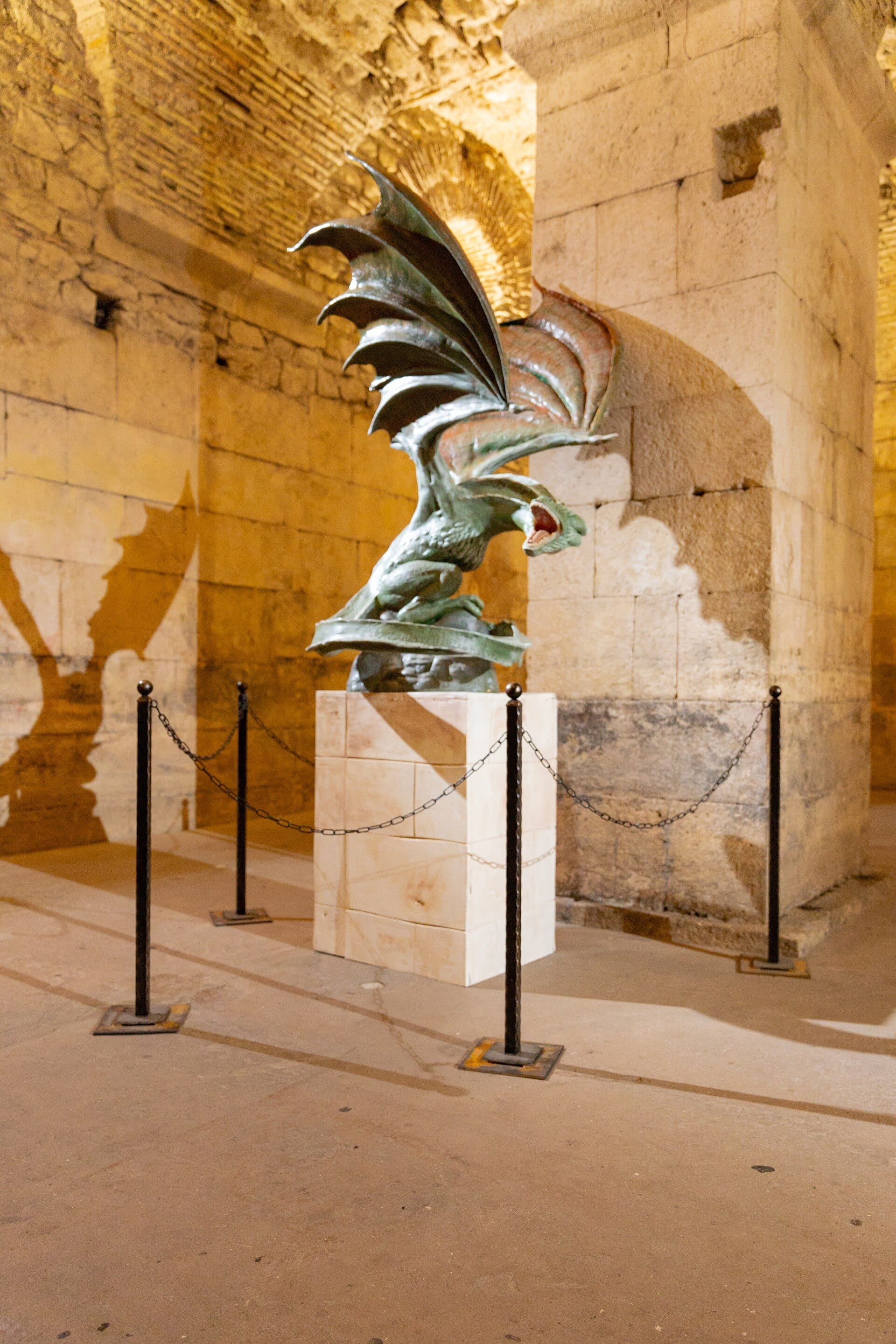
The Game of Thrones Museum Split opened in 2019 as a privately run, commercial attraction tied directly to Split's real role in the HBO series. Diocletian's Palace, the UNESCO-listed Roman complex at the heart of the city, served as the filming location for Meereen, the slave city ruled by Daenerys Targaryen in seasons four through six. The museum leans hard into that connection, presenting five themed rooms that move through the show's major locations: Meereen (with an obvious nod to Split itself), King's Landing, Winterfell, and a Weirwood tree chamber. It is not an official HBO production or licensed exhibition in the traditional sense, but rather a fan-oriented pop-up style space that has found a permanent home in the old town.
At under an hour from entry to exit, this is not a deep-dive institution. It is closer in format to an immersive photo experience than a traditional museum with curated scholarly content. The distinction matters for managing expectations: if you arrive hoping for detailed production history, behind-the-scenes filmmaking context, or rare archival material, you will likely leave underwhelmed. If you arrive hoping to stand next to a life-size Jon Snow statue and photograph a dragon skull, you will have a perfectly good time.
ℹ️ Good to know
Opening hours and admission prices have varied across sources and seasons. As of 2026, hours were commonly listed as 10:00 AM to 5:00 PM, with some sources indicating daily opening and others noting closure on Sundays. Verify the current schedule directly before making it the centerpiece of your afternoon.
Inside the Five Rooms: What You'll Find
The museum is arranged as a linear walk through themed spaces, each designed around a distinct location from the show. The Meereen room anchors the whole experience and is the most contextually relevant to Split: maps, set photography, and display panels explain how Diocletian's Palace was transformed into a fictional slave city. This room tends to resonate most with visitors who have actually walked the palace cellars, because you begin to recognize archways and stone textures from specific episodes.
The character statues are the crowd-pleasing centerpiece. Life-size renderings of Jon Snow, Daenerys Targaryen, Daenerys’s dragons, and other key characters are posed for photographs throughout the rooms. The costume replicas and prop weapons on display are detailed enough to satisfy fans who followed the show closely. A diorama section and dragon models round out the exhibits, with the Weirwood tree installation functioning as the most dramatic visual set piece in the space.
The rooms are compact and the flow is clear, so there is no risk of getting lost or missing anything. Groups move through quickly, which means the space can feel crowded during peak summer hours even though the total floor area is small.
💡 Local tip
Arrive in the first hour after opening (around 10:00 AM) if you want the rooms to yourself for photographs. By midday in July and August, visitor density inside the small space increases noticeably.
Tickets & tours
Hand-picked options from our booking partner. Prices are indicative; availability and final rates are confirmed when you complete your booking.
Split: Game of Thrones walking tour
From 35 €Instant confirmationFree cancellationBlue Cave and Hvar 5 islands tour from Split
From 145 €Instant confirmationFree cancellationKrka national park tour from Split
From 27 €Instant confirmationFree cancellationAll-inclusive Blue Lagoon tour from Split with three islands visit
From 68 €Instant confirmationFree cancellation
The Diocletian's Palace Connection: Why This Museum Exists Here
The museum's location is not arbitrary. Diocletian's Palace is one of the best-preserved late-Roman structures in the world, built at the turn of the fourth century CE as a retirement complex for Emperor Diocletian. Its labyrinthine cellars, arched passageways, and worn stone columns made it an ideal stand-in for Meereen's atmospheric lower city. Production crews used multiple sections of the palace and surrounding old town during filming, particularly the subterranean spaces that can still be visited today.
If the museum sparks your interest in the filming locations themselves, the most rewarding follow-up is a walk through Diocletian's Cellars, which run directly beneath the palace's residential quarters and appear in several key scenes. The cellars are a short walk from the museum, and seeing the actual stone gives the on-screen footage an entirely different weight.
Split's role as a filming location fits into the broader story of Croatia's emergence as a major production destination. For travelers interested in tracing other locations across the country, the Game of Thrones filming locations in Split guide covers the palace sites, surrounding streets, and what was filmed where.
Visiting Logistics: Getting There and Getting In
The museum sits at Bosanska ulica 9, which places it within the dense street network of the old town, a few minutes on foot from the main palace entrances. If you are approaching from the Riva promenade (Split's waterfront), walk north into the palace through the Bronze Gate and follow the internal passages toward the western side of the complex. The address is walkable from both the main bus station and the ferry port in roughly 10 to 15 minutes.
There is no dedicated parking nearby, which is standard for this part of the city. Public transit connections are strong across Split, and the old town is compact enough that walking is the only practical way to navigate once you are inside the palace walls. Comfortable shoes matter: the surrounding streets are cobblestone, and the old town's uneven surfaces can be tiring after a full day.
If you are planning a broader afternoon in this part of the city, consider pairing the museum with the Cathedral of Saint Domnius and the Diocletian's Palace itself, both a short walk away and substantially more historically significant. The museum works best as an add-on rather than a standalone destination.
⚠️ What to skip
An independently hosted website exists for this attraction, but visitors should still rely on verified booking platforms or direct contact for the most current details. Book through a verified third-party platform or check in person at the venue to confirm current hours, pricing, and availability before building your itinerary around it.
Who This Museum Is For (And Who Should Skip It)
The honest answer is that this museum is best experienced by visitors who watched Game of Thrones with genuine investment and want a physical souvenir of Split's connection to the show. The combination of recognizable props, character statues sized for photographs, and the contextual Meereen room creates a genuinely enjoyable 30 to 45 minutes for that audience.
For travelers with no attachment to the series, there is little reason to spend the time or money here. The historical context is thin, the exhibits are commercially motivated, and the surrounding palace offers infinitely more architectural and cultural depth for free. Casual travelers doing a one-day stopover in Split, or anyone who has not seen the show, should skip this entirely and put those minutes toward the Riva, the palace cellars, or a coffee in Narodni trg.
Families traveling with children who are fans of the series will find this manageable and fun, though parents should assess the imagery (dragons, weapons, scenes from the show) against their children's ages. For broader family planning in the city, the Split with kids guide covers which attractions work well across age groups.
Photography and Practical Tips
Photography is permitted throughout the museum, which is part of the point. The character statues are the primary draw for most visitors, and the rooms are designed with photo opportunities in mind. Lighting inside is atmospheric rather than bright, so smartphone cameras with good low-light performance will produce better results than standard point-and-shoot devices. The Weirwood tree installation is the most visually dramatic backdrop in the space.
The museum is small enough that a single visit covers everything. There is no audio guide requirement, no timed entry system as far as current reporting indicates, and no particular route you can get wrong. It is a walk-in experience, linear in structure, and complete in under an hour for nearly all visitors.
Accessibility information is limited in available sources. The entrance is at street level near Diocletian's cellars, but the tight stone streets of the old town and the potential for steps inside the historic building mean that wheelchair users or visitors with significant mobility limitations should contact the venue in advance to confirm access.
Insider Tips
- Visit immediately after the Game of Thrones filming locations walk rather than before it. Seeing the actual palace walls and cellars first makes the museum's Meereen room dramatically more resonant.
- Midday in summer is the worst time to visit. The small rooms heat up and crowd quickly. A morning visit before 11:00 AM gives you the statues and props almost entirely to yourself.
- The museum is short enough that it pairs well with the Diocletian's Cellars, a five-minute walk away. Budget two hours total for both, and the combination makes a coherent thematic half-morning.
- Check the door in person if you arrive and find it closed. Hours have been inconsistently reported online and may differ by season or day of week. A staff member is usually present even when the official hours are uncertain.
- If your group includes non-fans, consider sending them to a nearby café on the Riva while dedicated fans spend 30 minutes inside. The museum does not have enough breadth to hold the interest of visitors with no connection to the show.
Who Is Game of Thrones Museum Split For?
- Game of Thrones fans who want a physical connection to the Meereen filming location
- Travelers combining the visit with a broader walking tour of Diocletian's Palace
- Families with older children or teenagers who watched the series
- Pop-culture travelers interested in on-location film and TV tourism
- Anyone with an afternoon to spare and a curiosity about how Split looked on screen
Nearby Attractions
Other things to see while in Diocletian's Palace & Old Town:
- Cathedral of Saint Domnius
The Cathedral of Saint Domnius began its life as the mausoleum of Emperor Diocletian around AD 305 and was converted into a Christian cathedral in the 7th century, making it the oldest Catholic cathedral in continuous use within its original structure. Rising above the Peristyle at the heart of Diocletian's Palace, it remains an active place of worship, a climb-worthy bell tower, and one of the most layered architectural sites in Europe.
- Diocletian's Cellars (Peristyle Substructure)
Beneath the streets of Split's old town, the Cellars of Diocletian's Palace preserve one of the most complete Roman substructures anywhere in the world. Built around the turn of the 4th century AD to support the emperor's private apartments, these vast underground halls cover over one hectare and feel unlike any museum. This is the actual Roman foundation, open to walk through.
- Diocletian's Palace
Diocletian's Palace is not a museum. It is a functioning neighborhood built inside a Roman emperor's retirement complex, where cafes, apartments, and a cathedral occupy spaces once designed for imperial ceremony. This guide covers what to see, when to go, and how to make sense of one of Europe's most extraordinary living monuments.
- Golden Gate (Porta Aurea)
The Golden Gate, known in Croatian as Zlatna Vrata and originally called Porta Aurea, is the northern entrance to Diocletian's Palace and the grandest of its four gates. Free to visit at any hour, it connects the ancient palace to the road that once led to the Roman city of Salona, and stands today as a remarkably well-preserved late Roman fortified gateway.