Cathedral of Saint Domnius: Inside the World's Oldest Cathedral
The Cathedral of Saint Domnius began its life as the mausoleum of Emperor Diocletian around AD 305 and was converted into a Christian cathedral in the 7th century, making it the oldest Catholic cathedral in continuous use within its original structure. Rising above the Peristyle at the heart of Diocletian's Palace, it remains an active place of worship, a climb-worthy bell tower, and one of the most layered architectural sites in Europe.
Quick Facts
- Location
- Peristyle, Diocletian's Palace, Split Old Town
- Getting There
- Walk 10 min from Split ferry port or bus station; no public transit enters the Palace walls
- Time Needed
- 45–90 minutes (longer if you climb the bell tower)
- Cost
- Combined ticket covers cathedral, bell tower, and select palace sites (approx. €10–15 in 2026; verify on-site)
- Best for
- History lovers, architecture enthusiasts, photographers, and anyone visiting the Palace
- Official website
- visitsplit.com/en/527/cathedral-of-saint-domnius
What Makes This Cathedral Unlike Any Other
The Cathedral of Saint Domnius, known locally as Sveti Duje or Sveti Dujam, holds a distinction no other church on earth can claim: it was originally built as the personal tomb of a Roman emperor. Emperor Diocletian commissioned his mausoleum around AD 305 as the architectural centerpiece of his massive retirement palace on the Adriatic coast. Within a few centuries of Diocletian's death, early Christian communities converted the structure into a cathedral, dedicating it to Saint Domnius, the Bishop of Salona who had been martyred under Diocletian's own persecutions in AD 304. The irony is not lost on historians: the emperor who ordered the killing of Christians now lies memorialized in what became a house of Christian worship.
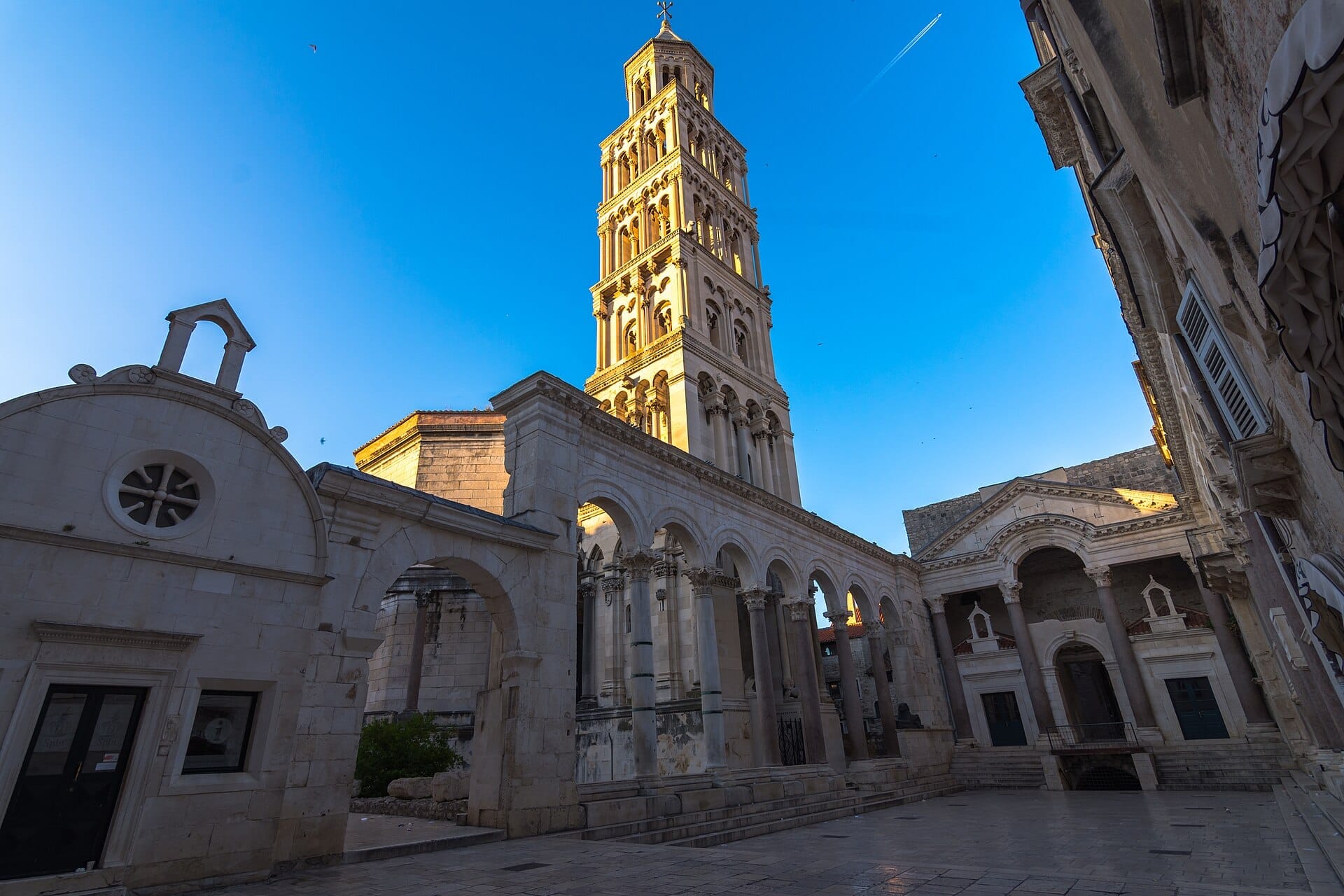
This layering of history is visible at every turn. Roman stonework sits directly beneath medieval carvings. A 13th-century wooden choir echoes inside a 1,700-year-old octagonal shell. The bell tower, added incrementally between the 12th and 15th centuries, rises 57 to 60 meters, making it the tallest in Dalmatia. What you are looking at is not a reconstruction or a ruin. It is a building in continuous, uninterrupted use.
💡 Local tip
This is an active cathedral. Sunday Mass and the feast day of Saint Domnius (May 7) bring processions through the Peristyle and into the church. If you happen to be in Split on May 7, the atmosphere is worth adjusting your itinerary for.
The Peristyle: Approaching the Cathedral
You approach the Cathedral through the Peristyle, the grand colonnaded courtyard at the center of Diocletian's Palace. The Peristyle was Diocletian's ceremonial gathering space, and it still functions as the social heart of the old town today. In the early morning, before the tour groups arrive, the square is nearly silent. The low Adriatic light catches the rough limestone columns, turning them a warm amber, and you can stand at the Egyptian granite sphinx (one of several Diocletian imported from Egypt around 300 AD) and feel the full weight of what you are standing in.
By mid-morning, the Peristyle fills quickly. Cafe tables go up, menus come out, and the columns become backdrop for photographs. This is still worth experiencing, but if your priority is contemplation or good photography without crowds, arrive before 9:00 AM.
The Peristyle connects naturally to the broader experience of Diocletian's Palace, which extends in every direction and contains centuries of accumulated urban life within its Roman walls.
Tickets & tours
Hand-picked options from our booking partner. Prices are indicative; availability and final rates are confirmed when you complete your booking.
Blue Cave and Hvar 5 islands tour from Split
From 145 €Instant confirmationFree cancellationKrka national park tour from Split
From 27 €Instant confirmationFree cancellationAll-inclusive Blue Lagoon tour from Split with three islands visit
From 68 €Instant confirmationFree cancellationGuided kayaking tour with snorkeling stops from Split
From 50 €Instant confirmationFree cancellation
Inside the Cathedral: Roman Bones, Christian Flesh
Stepping through the cathedral's entrance portal, you cross into what was once the vestibule of Diocletian's mausoleum. The interior is circular within an octagonal shell, as Roman mausolea of the imperial period typically were, with a domed drum rising above. The original Roman cornice is intact, carved with portrait medallions and hunting scenes. Stand at the center of the nave and tilt your head upward: what you are looking at has not fundamentally changed since the 4th century.
The 13th-century carved walnut choir stalls are among the oldest surviving examples of Romanesque woodwork in Dalmatia. The altar of Saint Domnius, housed in a Gothic ciborium from 1427 by sculptor Bonino of Milan, frames a silver reliquary containing the saint's remains. The altar of Saint Anastasius, carved by Juraj Dalmatinac in 1448, is considered one of the finest examples of late Gothic relief work in the Adriatic region. Juraj Dalmatinac, the Croatian-Italian sculptor, is also responsible for much of Šibenik Cathedral, another UNESCO-listed structure north of Split.
The sacristy treasury is accessible as part of your ticket and contains reliquaries, vestments, and illuminated manuscripts spanning several centuries. The objects are not dramatically displayed, but the quality of the medieval goldsmithing is exceptional. Budget an extra ten minutes here.
ℹ️ Good to know
Modest dress is required inside the cathedral, as it remains an active place of worship. Shoulders and knees should be covered. Light scarves are available at the entrance for those who need them.
The Bell Tower Climb: Split From Above
The freestanding bell tower beside the cathedral was constructed in stages over three centuries, beginning in the 12th century, and the architectural seams between its building phases are visible to any attentive eye: the lower sections are heavier and more Romanesque, while the upper portions grow lighter and more ornate as Gothic influence arrived. The tower was partially dismantled and rebuilt in the early 20th century after structural deterioration.
The climb itself is not for the faint of heart or those with vertigo. The staircase is steep, narrow, and open to the elements in the upper sections. There are no elevators. The steps are uneven stone worn smooth by generations of visitors. But the reward at the top is a panoramic view over the red-tiled rooftops of the old town, across the Riva promenade to the Adriatic, and up to Marjan Hill on the city's western edge. On clear days, the islands of Brač and Šolta are visible on the horizon.
On a broader visit, combining the bell tower with a walk along the Riva promenade below gives you a satisfying contrast between bird's-eye perspective and street-level atmosphere.
⚠️ What to skip
The bell tower is not accessible to wheelchair users or those with significant mobility limitations. The narrow spiral staircase has no handrail for the final section and requires agility. Children under about 8 years old may find it difficult.
When to Visit and How to Manage Crowds
The Cathedral of Saint Domnius is one of the most visited sites in Croatia, and it shows. During July and August, the Peristyle and cathedral entrance queue can stretch through the colonnade by 10:00 AM. The interior becomes difficult to absorb when it is packed with tour groups moving in opposite directions. If you are visiting in summer, the single most effective strategy is arriving at opening time. The morning light through the cathedral's windows is also dramatically better before noon.
Shoulder season (May, June, September, October) offers a noticeably calmer experience. October in particular sees excellent light, cool temperatures, and visitor numbers that allow you to actually stop and read the altar carving details without someone stepping on your heels. The cathedral is open year-round as an active church, though visiting hours for tourists may be reduced in winter months. Verify current hours at the entrance or on the visitsplit.com listing before making early plans.
For a broader orientation to timing your visit, the guide on the best time to visit Split covers seasonal trade-offs across the whole city.
Practical Details for Your Visit
The cathedral sits at the Peristyle, inside the Palace walls, which means the closest you can get by vehicle is the ring road just outside the Palace gates. From the main bus station or the ferry terminal, the walk to the Golden Gate (northern entrance) or the Bronze Gate (southern entrance, facing the Riva) takes around 10 minutes on foot. There is no dedicated parking inside the walls.
Tickets are sold at the site. The combined ticket typically covers the cathedral interior, the bell tower, Diocletian's Cellars beneath the Palace, and sometimes additional Palace structures. Prices are approximately €10–15 for the full combination as of 2026, but should be verified at the ticket office. The Diocletian's Cellars are directly below the Palace and worth including in the same visit.
Photography inside the cathedral is generally permitted without flash. The tower provides the best exterior photography of the Peristyle; shoot from the top in the morning when the light comes from the east. A wide-angle lens (or wide mode on a phone camera) is useful inside the cathedral interior, where the octagonal drum creates a compelling vertical composition.
Who Should Reconsider This Attraction
If you have already visited Rome's Pantheon, Ravenna's mausoleums, or several major Romanesque cathedrals, some of the architectural context here will feel familiar rather than revelatory. The interior is relatively small compared to major European cathedrals, and the treasury, while historically significant, is modest in scale. For travelers with only a few hours in Split and no particular interest in religious architecture or Roman history, spending the full ticket price may not represent the best use of time. The Peristyle itself, however, is free to enter and worth seeing regardless of whether you go inside the cathedral.
Travelers looking to optimize limited time in the city might use the Split walking tour guide to sequence the cathedral alongside other key sites without doubling back.
Insider Tips
- Buy your combined ticket early in the morning. Queues at the ticket window form quickly after 9:30 AM in summer, and the ticket booth can run out of timed entry slots for the tower.
- The Egyptian granite sphinx in the Peristyle is over 3,500 years old, predating the Palace itself by more than a millennium. Diocletian brought several from Egypt; this is one of the best-preserved originals remaining.
- If the cathedral is closed for a service when you arrive (typically Sunday mornings and feast days), wait it out. Watching a Mass end and the congregation spill out through Roman columns into the Peristyle is one of the more quietly extraordinary things you can witness in Split.
- The bell tower steps are slippery after rain. Wear shoes with grip, not sandals or smooth-soled footwear, especially in shoulder season when morning showers are common.
- The best exterior photograph of the bell tower and cathedral facade together requires backing up into the Peristyle as far as possible toward the southern colonnade. Most visitors plant themselves directly in front and miss the full composition.
Who Is Cathedral of Saint Domnius For?
- History and archaeology travelers who want to stand inside an intact Roman imperial structure
- Architecture enthusiasts interested in Romanesque, Gothic, and Roman layers in a single building
- Photographers seeking the combination of ancient stonework, rooftop panoramas, and morning light
- First-time visitors to Split, for whom this is the single most concentrated expression of the city's identity
- Travelers combining a visit with a walking tour of Diocletian's Palace and the surrounding old town
Nearby Attractions
Other things to see while in Diocletian's Palace & Old Town:
- Diocletian's Cellars (Peristyle Substructure)
Beneath the streets of Split's old town, the Cellars of Diocletian's Palace preserve one of the most complete Roman substructures anywhere in the world. Built around the turn of the 4th century AD to support the emperor's private apartments, these vast underground halls cover over one hectare and feel unlike any museum. This is the actual Roman foundation, open to walk through.
- Diocletian's Palace
Diocletian's Palace is not a museum. It is a functioning neighborhood built inside a Roman emperor's retirement complex, where cafes, apartments, and a cathedral occupy spaces once designed for imperial ceremony. This guide covers what to see, when to go, and how to make sense of one of Europe's most extraordinary living monuments.
- Game of Thrones Museum Split
Tucked into the Old Town at Bosanska ulica 9, the Game of Thrones Museum Split offers five themed rooms filled with props, costumes, and life-size character statues. It's a compact, fan-focused stop that makes most sense when paired with a walk through the very palace walls that stood in for Meereen on screen.
- Golden Gate (Porta Aurea)
The Golden Gate, known in Croatian as Zlatna Vrata and originally called Porta Aurea, is the northern entrance to Diocletian's Palace and the grandest of its four gates. Free to visit at any hour, it connects the ancient palace to the road that once led to the Roman city of Salona, and stands today as a remarkably well-preserved late Roman fortified gateway.