Pazar Market (Green Market): Split's Living Daily Ritual
Pazar is Split's main open-air market, running every morning along the eastern wall of Diocletian's Palace. Free to enter, packed with local vendors by 7 AM, and usually winding down before early afternoon — it offers a sharper, more honest picture of daily life in Split than almost any other stop in the city.
Quick Facts
- Location
- Ul. Stari Pazar 8, Split — east wall of Diocletian's Palace, near Split bus station
- Getting There
- 5–10 minute walk from the Riva promenade; exit Diocletian's Palace through the Silver Gate and turn east
- Time Needed
- 30–60 minutes for a casual visit; longer if you plan to shop and browse
- Cost
- Free entry; individual stall prices vary by vendor
- Best for
- Food lovers, early risers, budget travelers, and anyone wanting to see local Split rather than tourist Split
- Official website
- visitsplit.com/en/517/pazar
What Pazar Market Actually Is
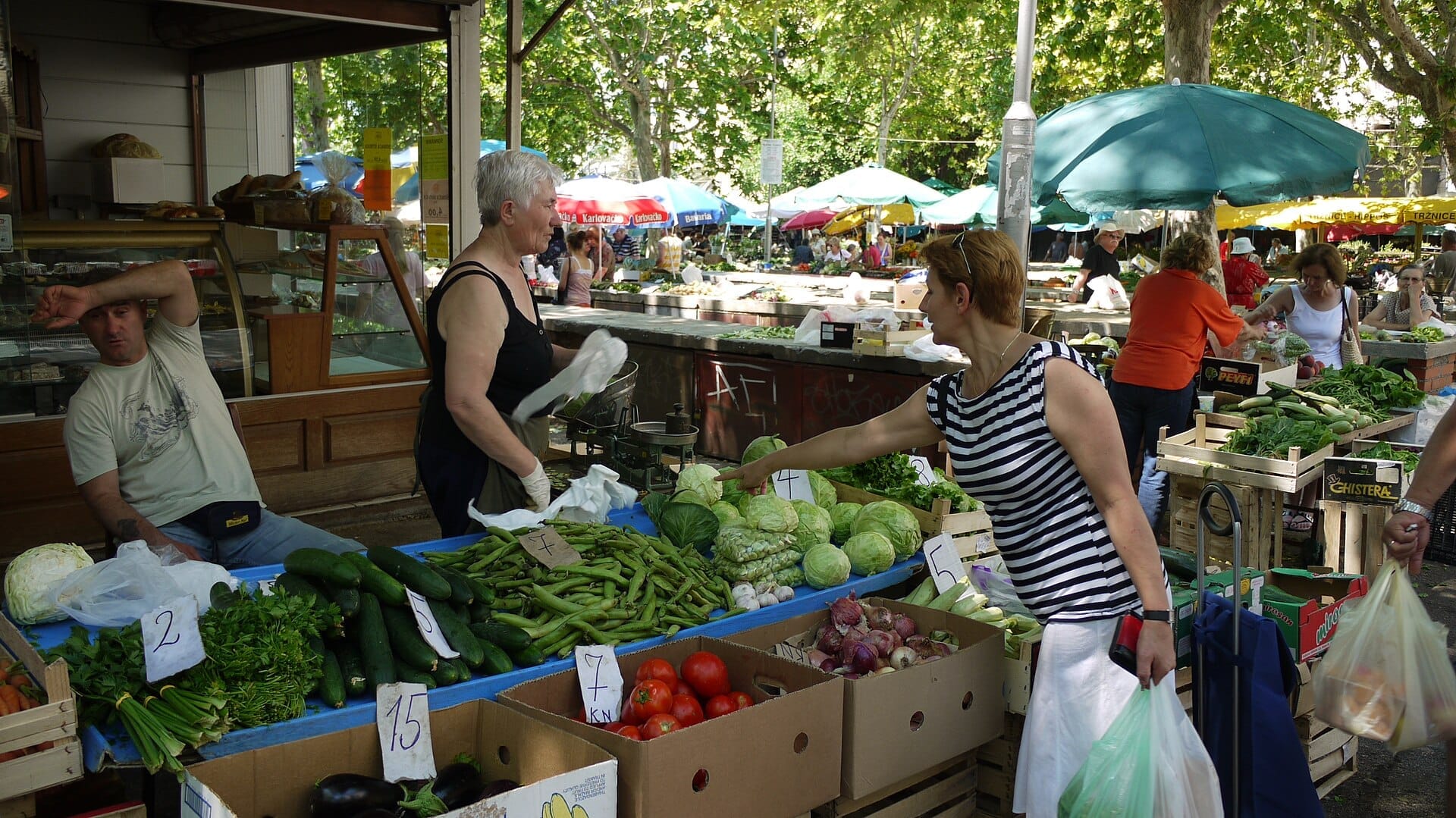
Pazar — officially the Green Market, though almost everyone uses the Croatian name — is Split's primary open-air produce market. It occupies a long stretch of ground directly beside the eastern wall of Diocletian's Palace, one of the best-preserved late Roman monuments in Europe. The juxtaposition is one of the more quietly remarkable things about Split: century-worn stone on one side, a row of market stalls stacked with figs, tomatoes, and lavender bundles on the other.
The market runs daily from the early morning hours through to early afternoon, generally quieting down by around 1:00–2:00 PM, though activity peaks hard in the first few hours of the morning. This is not a tourist market retrofitted for photo opportunities. It functions as a working neighborhood market where local residents come to shop for the week, older vendors bring produce from their own land, and the transactions happen quickly and without ceremony.
💡 Local tip
Arrive between 7:30 and 9:00 AM for the best combination of full stalls, reasonable crowds, and vendors in good spirits. By 11:00 AM on warm days, produce quality has dropped and the atmosphere is thinner.
The Layout and What You'll Find
The market fans out along the street running parallel to the palace's eastern facade, extending south toward St. Dominic's Church and the area near the main bus station. There is no single entrance gate or structured pathway; you move through it organically, weaving between stalls, pausing when something catches your attention.
Seasonal produce dominates: figs, grapes, and stone fruits in late summer; root vegetables and citrus through autumn and winter; fresh herbs year-round. You'll also find honey from the Dalmatian hinterland sold in unlabeled jars, lavender products (sachets, oils, soaps), dried figs, olive oil, and homemade liqueurs like rakija. A fish market operates nearby on the western side, completing the daily shopping loop for Split households.
Clothing stalls and household goods appear toward the outer edges, and the selection ranges from practical work clothes to the kind of cheap beachwear that every coastal market seems to accumulate. If you're only here for food, staying closer to the palace wall side keeps things more focused.
ℹ️ Good to know
Prices at Pazar are typically lower than supermarkets for seasonal produce and far lower than the souvenir shops in the palace. Lavender sachets and local honey make practical, inexpensive gifts.
Tickets & tours
Hand-picked options from our booking partner. Prices are indicative; availability and final rates are confirmed when you complete your booking.
Blue Cave and Hvar 5 islands tour from Split
From 145 €Instant confirmationFree cancellationKrka national park tour from Split
From 27 €Instant confirmationFree cancellationAll-inclusive Blue Lagoon tour from Split with three islands visit
From 68 €Instant confirmationFree cancellationGuided kayaking tour with snorkeling stops from Split
From 50 €Instant confirmationFree cancellation
The Setting: A Roman Palace as Backdrop
Pazar's position is inseparable from its character. The eastern wall of Diocletian's Palace rises directly above the stalls — thick Roman stone in pale limestone that turns warm ochre in morning light. Diocletian began constructing the palace around 295–300 AD as his retirement complex, and it remains one of the largest and best-preserved examples of late Roman architecture in the world. The market has operated in this vicinity for centuries, though its current location dates from a period of urban expansion when it was relocated from Fruit Square inside the old town.
Standing at a stall buying a handful of figs while looking up at walls that have stood for 1,700 years is the kind of unremarkable moment Split delivers constantly. The palace is so woven into daily life here that locals barely register it, which is itself the point.
If you want to understand how the palace functions as a living neighborhood rather than a preserved relic, combining a Pazar visit with a walk through the Diocletian's Cellars gives you both ends of that experience in under two hours.
When to Visit and How It Changes Through the Morning
The market is technically open from around 6:00 AM, but the first serious wave of local shoppers tends to arrive between 7:00 and 8:30 AM. This is when vendors are fully set up, produce is at its freshest, and the ambient noise reaches its peak: conversations in Croatian, the thud of crates, the soft argument over a price, the occasional motor scooter threading through.
By 10:00 AM on summer mornings, the heat begins to build and the character shifts slightly. Tourists start appearing in larger numbers, drawn over from the palace or the Riva. Vendors become a little more promotional toward non-local visitors. The produce selection begins to thin as the better items sell out.
From noon onward, the market winds down noticeably. Many stalls pack up before the official 2:00 PM closing time, particularly on hot days or after a busy morning. If you arrive after 1:00 PM expecting a full market experience, you'll be disappointed.
⚠️ What to skip
On Sundays and public holidays, the market still operates but with fewer vendors and reduced hours. Check locally if you're planning a visit on a holiday.
Practical Navigation and Accessibility
Getting to Pazar requires no special planning. From the Riva promenade, walk east along the waterfront and then curve north around the palace perimeter — around 10 minutes on foot. From inside the palace, exit through the Silver Gate (east side) and you'll find yourself essentially at the market's edge. The bus station is immediately south, which means if you're arriving into Split by bus, Pazar is often the first real neighborhood thing you encounter.
The ground is uneven in sections — a mix of worn stone, concrete, and packed earth — so mobility aids may find certain areas difficult. There are no designated accessible pathways through the stalls, and the morning crowd density can make navigation with a pram or wheelchair challenging, particularly between 8:00 and 10:00 AM. The outer edges of the market, where it borders the main road, are more navigable.
Photography is generally unproblematic for overall market shots, but ask before photographing individual vendors directly. Many are fine with it; some are not, particularly older vendors who treat the market as a workplace, not a backdrop.
Honest Assessment: What This Is and Isn't
Pazar is not a designed experience. There is no curation, no signage in English explaining what you're looking at, no audio guide. For travelers who need their attractions packaged, this will feel underwhelming. For those who travel to understand how a city actually functions day-to-day, it's one of the most efficient windows into Split's rhythms that exists. Pair it with a morning coffee at a cafe on the palace perimeter and you've spent an hour that most tourists miss entirely. It fits naturally into any walking tour of Split that starts in the old town.
Travelers on a tight schedule who have only a day or two in Split may reasonably prioritize the palace interior, the cathedral, and the waterfront over the market. But for anyone following a 3-day Split itinerary, an early morning Pazar visit is one of those practical additions that makes a trip feel fuller without costing time or money.
Budget travelers should note that buying fruit, bread, and local products here for a self-catered breakfast or picnic is significantly cheaper than buying from shops near the palace or along the Riva.
Insider Tips
- Bring cash in small denominations. Most vendors don't accept cards and many prefer exact change, especially for smaller purchases. Coins and 5–10 EUR notes move transactions along faster.
- The honey sold in plain unlabeled jars is typically produced in the Dalmatian hinterland or islands. Ask the vendor where it's from — many are selling from their own hives and will tell you more than you'd expect.
- If you're buying lavender products, the sachets near the palace wall tend to be locally made rather than mass-produced imports. Squeeze them before buying — fresh lavender has a sharp, immediate scent; older or synthetic product smells flat.
- The fish market operates nearby on the western side of the palace, opening similarly early. If you have access to a kitchen, combining both markets in one morning loop gives you everything needed for a full Dalmatian meal.
- On weekday mornings in shoulder season (April, May, October), the market is notably quieter and the vendor-to-shopper ratio is far more relaxed. If you want genuine conversation with sellers, these mornings are the window for it.
Who Is Pazar Market For?
- Food travelers and self-caterers who want locally sourced produce, honey, and olive oil at market prices
- Early risers looking for authentic morning atmosphere before the palace crowds arrive
- Budget travelers seeking inexpensive fresh food and practical local gifts
- Photographers interested in documentary-style market scenes against a Roman palace backdrop
- Families who want a low-cost, low-pressure morning activity that connects children to real local life
Nearby Attractions
Other things to see while in Diocletian's Palace & Old Town:
- Cathedral of Saint Domnius
The Cathedral of Saint Domnius began its life as the mausoleum of Emperor Diocletian around AD 305 and was converted into a Christian cathedral in the 7th century, making it the oldest Catholic cathedral in continuous use within its original structure. Rising above the Peristyle at the heart of Diocletian's Palace, it remains an active place of worship, a climb-worthy bell tower, and one of the most layered architectural sites in Europe.
- Diocletian's Cellars (Peristyle Substructure)
Beneath the streets of Split's old town, the Cellars of Diocletian's Palace preserve one of the most complete Roman substructures anywhere in the world. Built around the turn of the 4th century AD to support the emperor's private apartments, these vast underground halls cover over one hectare and feel unlike any museum. This is the actual Roman foundation, open to walk through.
- Diocletian's Palace
Diocletian's Palace is not a museum. It is a functioning neighborhood built inside a Roman emperor's retirement complex, where cafes, apartments, and a cathedral occupy spaces once designed for imperial ceremony. This guide covers what to see, when to go, and how to make sense of one of Europe's most extraordinary living monuments.
- Game of Thrones Museum Split
Tucked into the Old Town at Bosanska ulica 9, the Game of Thrones Museum Split offers five themed rooms filled with props, costumes, and life-size character statues. It's a compact, fan-focused stop that makes most sense when paired with a walk through the very palace walls that stood in for Meereen on screen.