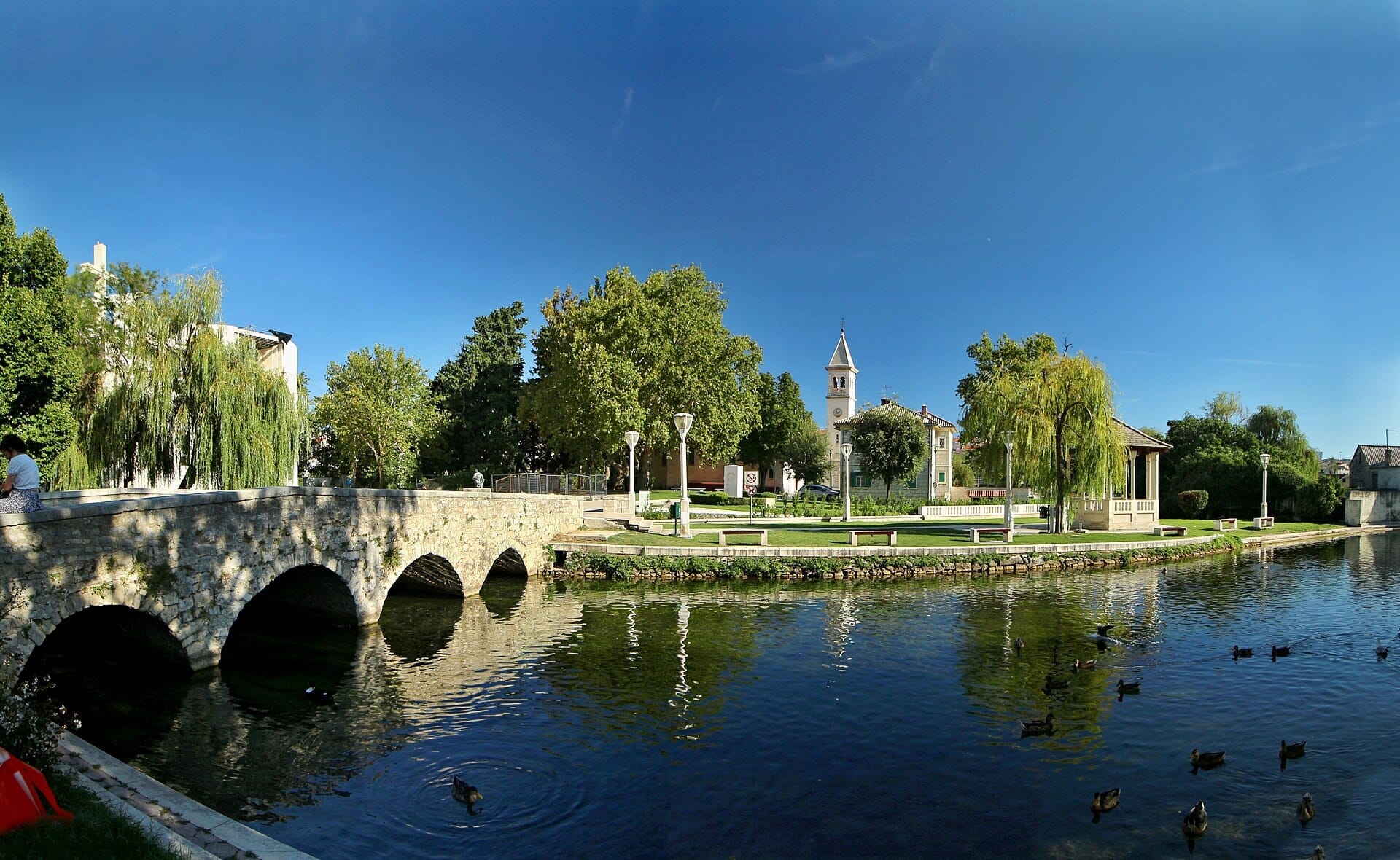
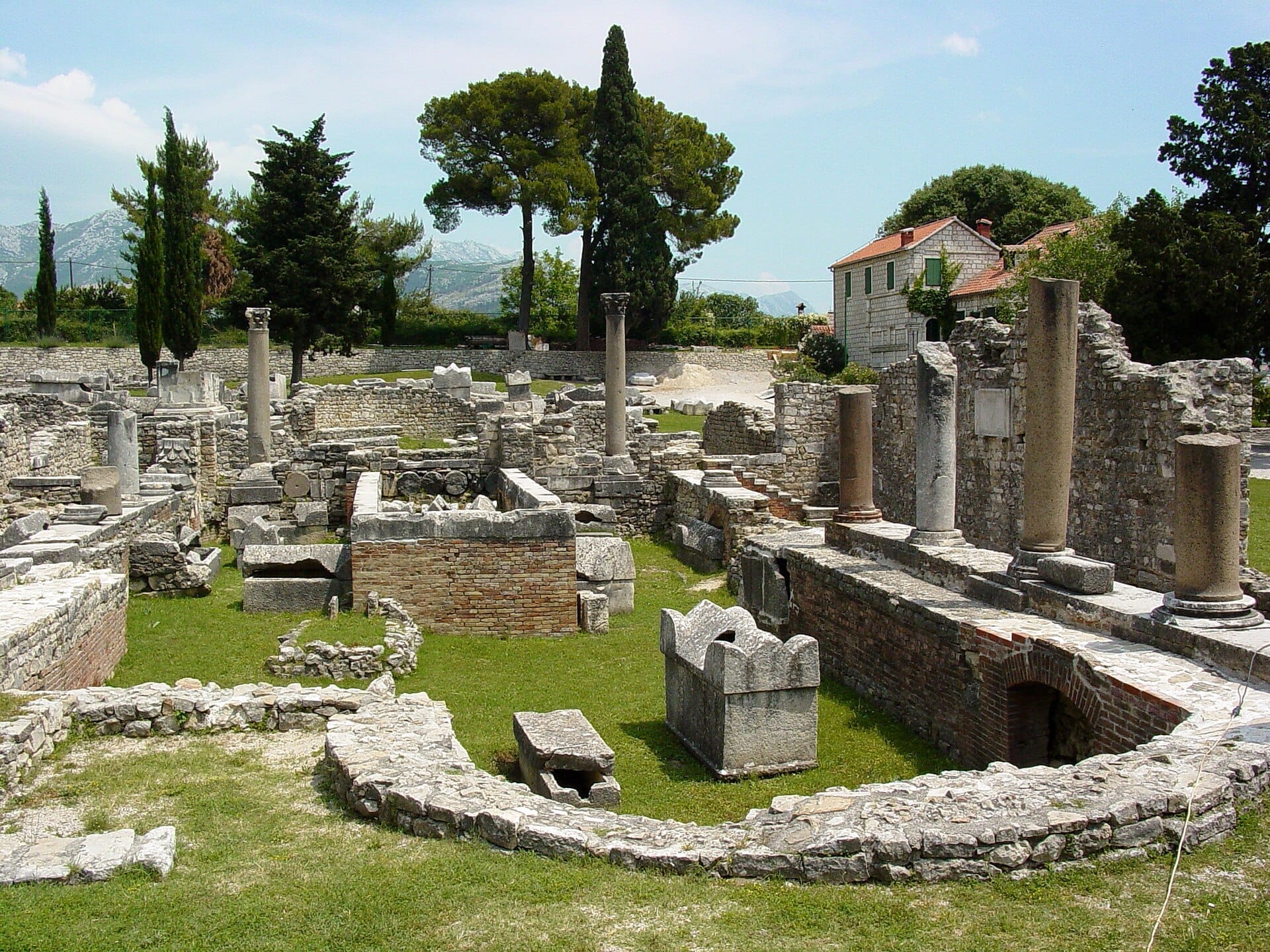
Solin is a living Croatian municipality built on top of one of the most important Roman cities in the ancient world. The ruins of ancient Salona stretch across the modern town, and the Jadro River that supplied the old city with water still runs cold and clear past the archaeological park today.
Five kilometers northeast of Split city center, Solin is where Roman Dalmatia actually began. Before Diocletian built his retirement palace on the coast, Salona was the provincial capital, a city of up to 60,000 people whose amphitheater, city walls, and Christian cemeteries still stand in various states of ruin inside what is now a quiet Croatian municipality.
Orientation
Solin sits roughly 5 to 6 kilometers northeast of central Split, at the base of the Mosor mountain range where the flat Kaštela Field opens toward the Adriatic. With a population of around 30,000, it is a proper municipality in its own right, though it functions as part of the wider Split metropolitan area, the second-largest urban agglomeration in Croatia.
The Jadro River, called Rika locally, forms part of the historic boundary between Solin and Split to the south. Fed by springs further upstream toward Klis, the river runs cold and notably clear year-round alongside the archaeological park, giving the ruins a backdrop that catches most visitors off guard. The same water source supplied ancient Salona's aqueduct and continues to supply parts of Split today.
The ancient street grid of Salona, laid out along an east-west decumanus and a north-south cardo, still influences the orientation of streets across this part of Dalmatia. The street Zrinjsko-frankopanska in Split follows broadly the same alignment that Roman planners established nearly two millennia ago. When you walk through the ruins, you are tracing a grid that shaped the region's geography long after the city itself fell.
Geographically, Solin borders Diocletian's Palace and Split's old town to the south, and sits roughly 10 kilometers by road from Klis Fortress on the ridge above. From the ruins of Salona on a clear day, you can see Klis on the skyline. These three sites form a coherent historical arc spanning Roman, early Christian, and medieval Dalmatia, and a well-timed day can cover all three.
Character and Atmosphere
Solin is not a tourist town and makes no particular effort to look like one. Walk through its residential streets and you pass hardware stores, local cafes with handwritten menus in Croatian, and children on bikes taking shortcuts through the older parts of town. There are no souvenir kiosks clustered around the archaeological site, no restaurants with laminated picture menus angling for the cruise-ship crowd. The ruins sit inside a real working municipality, and that context is part of what makes the place feel different from most major Roman sites in the Mediterranean.
Early morning at the Salona archaeological park has a quality that is difficult to describe without sounding excessive. The site opens gradually to the day: light catches the upper sections of the amphitheater walls before it reaches the ground level, and the only sounds are birdsong and the distant movement of the Jadro River through the vegetation that has slowly reclaimed the spaces between old stone. By mid-morning in summer, organized tour groups from Split begin to arrive by bus, but the site covers enough ground that it absorbs visitors without ever producing the shoulder-to-shoulder compression you find inside the Diocletian Palace on a hot July afternoon.
By afternoon, the heat settles hard over exposed limestone. Most day-trippers have come and gone by this point, and the ruins take on a different quality: quieter, more austere, the white stone radiating warmth back at you. Late afternoon light is particularly useful for photography, especially along the surviving sections of the city walls and at the Manastirine necropolis, where low sun catches the carved surfaces of old sarcophagi and inscription fragments.
The modern town itself carries the complicated texture of somewhere that has long been more industrial than scenic. There are brownfield zones, areas of irregular housing development that expanded rapidly in the post-war decades, and stretches of the coast that are effectively cut off from public use by older infrastructure. The municipality has made reconnecting residents and visitors to the seafront and the Jadro River valley a stated urban planning priority, but much of that work is still in progress. Do not come expecting a tidy heritage town. Expect something more honest.
What to See and Do
The central reason to come to Solin is Salona,Salona Roman ruins, one of the most significant archaeological sites in Croatia and among the largest Roman urban remains on the eastern Adriatic coast. Ancient Salona served as the capital of the Roman province of Dalmatia and likely held a population of 50,000 to 60,000 at its peak, making it one of the major urban centers in the Roman world outside of Italy itself. The city's decline came quickly: a catastrophic Avar and Slav invasion in the early 7th century AD destroyed Salona, and its surviving population fled south to shelter inside Diocletian's coastal palace, effectively founding modern Split in the process.
The site covers a large area and rewards moving through it deliberately rather than rushing. The amphitheater, constructed in the late 2nd century AD, could seat around 15,000 to 18,000 spectators. Its curved outer wall still stands to a considerable height on the northern side, and you can walk its perimeter to get a sense of the sheer scale involved. Inside, the seating cavea has mostly collapsed, but the structural logic of the building remains legible.
The Manastirine site, just north of the main ruins, contains the remains of a large early Christian basilica and a cemetery where Christian martyrs were buried before Christianity became the official religion of the Empire. The inscriptions here are among the most moving objects in the entire site, plain stone markers from a period when the faith was still dangerous. The Tusculum, a small museum building within the grounds, holds sculptural fragments and inscription panels recovered from excavations, providing some context for what you are looking at outside.
The city walls of Salona once enclosed roughly 40 hectares. Walking even a partial circuit of the surviving sections gives a clearer sense of the city's scale than any description can provide. The eastern and northeastern stretches are the best preserved, and near the eastern gate the remains of a Roman theater and several early Christian churches sit close together, showing how the late Roman city reorganized its public spaces as religious priorities shifted.
💡 Local tip
Arrive before 9:30am in summer. The site gets direct sun quickly and has almost no shade. Wear sturdy shoes as the terrain is uneven and paths alternate between packed earth, loose gravel, and exposed limestone. Bring more water than you think you need.
Beyond the ruins, the Jadro River offers a straightforward and pleasant walk along its lower banks, particularly near the old mills that once used the river's flow for grinding grain. The water is clear enough to see the riverbed in most sections, and noticeably cold even in August, which makes the walk a useful break from the heat of the stone-heavy site.
Salona amphitheater: late 2nd century AD, capacity around 15,000 to 18,000 spectators
Manastirine necropolis: early Christian martyrs' cemetery and basilica remains
Tusculum: small on-site museum with inscriptions and sculptural finds
City walls: eastern and northeastern sections best preserved
Roman theater and late-antique churches near the eastern gate
Jadro River walk: old mill sites, clear cold water, good for a mid-visit break
Eating and Drinking
Solin has no dining infrastructure built around tourism. There are local konobas, traditional Croatian restaurants, and cafes spread through the residential areas, but they operate primarily for local workers and residents. English menus are rare. This is not a problem so much as a feature: the food tends to be straightforwardly Dalmatian, honestly priced, and free of the markup that attaches itself to anything within walking distance of a major Roman ruin in a Mediterranean country.
The standards here are grilled fish, lamb, and peka dishes: meat and vegetables slow-cooked under a cast iron bell covered in embers, a technique you encounter throughout Dalmatia but which has a particular credibility in somewhere like Solin where the restaurant is not performing it for tourists. Local bread and olive oil from inland Dalmatia appear without fanfare. Wine is typically from Split-Dalmatia County, with plavac mali dominating as a red and posip appearing as a white.
The practical reality is that most visitors to the Salona ruins eat lunch back in Split, and that is a reasonable approach. The bus ride back is short. If you plan a longer stay and want to eat in Solin, look for konobas in the town center rather than on the main road connecting Solin to Split, where options tend to be more functional than interesting. Coffee culture is taken seriously across Croatian towns of any size: an espresso at a local cafe mid-morning fits naturally into a visit.
⚠️ What to skip
There are no food or drink facilities inside or directly adjacent to the Salona archaeological site. The nearest cafes and shops require a short walk into the town center. For a half-day visit, bring snacks and at least one liter of water per person.
Getting There and Around
The most straightforward way to reach Solin from central Split is by local bus. Several Promet Split bus lines connect the main bus terminal and stops throughout the city with Solin, running frequently throughout the day. The journey takes around 15 to 20 minutes in normal conditions, though traffic on the main coastal road heading northeast from Split can be slow in peak summer. Tickets are inexpensive and can be purchased from the driver or at Promet Split kiosks. For full details on navigating the broader Split region by public transport, the getting around Split guide covers routes, costs, and practical logistics.
Travelers with a rental car can reach Solin in under 15 minutes from the Split city center via the main road heading northeast. Parking near the archaeological site is available and generally easy to find outside peak summer weekends. A car also makes the Solin-plus-Klis combination significantly easier to execute, as the bus route up to Klis from Solin requires a connection and adds time.
Within Solin, the archaeological site is walkable from the town center, but the ruins themselves spread over a considerable area. Moving between the amphitheater, the forum zone, and the Manastirine necropolis involves walking on unpaved paths across uneven ground. There is no internal site transport and no tuk-tuk or golf cart option. Budget a minimum of two hours for a thorough visit; three hours is more realistic if you want to read the site properly.
Solin pairs naturally with Klis Fortress on the ridge above, about 10 to 11 kilometers by road. The fortress is visible from the ruins below, and standing at its ramparts looking back down over the Solin valley reframes the geography in a way that makes the Roman city's position make immediate sense: controlling the junction of the mountain pass and the coastal plain was the entire point. The two sites work well in sequence, and the drive between them takes under 20 minutes.
💡 Local tip
If combining Solin and Klis in a single day, visit Solin first in the cool of the morning, then head uphill to Klis for the afternoon. The return to Split from Klis is quick downhill, and the light on the Solin valley from the fortress walls in late afternoon is worth timing for.
Solin in Context: Day Trips and Historical Combinations
Solin makes most sense visited as part of a day organized around the ancient history of the Split region, which holds a remarkable concentration of Roman-era sites within a compact geographic area. Diocletian's PalaceThe Cathedral of Saint Domnius in central Split, built partly from materials quarried near Salona, becomes architecturally and historically clearer once you have stood inside the ruins of the provincial capital that preceded it. The palace was essentially built by an emperor who grew up in this region, using stone from the city next door, to retire within sight of where his career began.
The Archaeological Museum Split holds the largest collection of artifacts recovered from Salona excavations, including sculptures, inscriptions, everyday objects, and funerary monuments that give human scale to what are otherwise open-air walls and foundations. Visiting the museum before or after the site itself deepens the experience considerably. The museum is located in central Split, easily combined with a morning at the ruins.
For travelers building a wider itinerary across the region, the day trips from Split guide covers the full range of options from national parks to islands. Solin is one of the closest and most historically significant day trips available from Split, requiring no ferry booking, no long drive, and no particular planning beyond confirming the site opening hours before you go.
For travelers specifically interested in Roman and early Christian history, Solin also connects logically with the Cathedral of Saint Domnius inside Diocletian's Palace, which was originally the emperor's mausoleum and is directly connected to the martyrdom of Bishop Domnius of Salona in the 3rd century AD. The cathedral stands on the theological and historical fault line between Roman imperial religion and early Christianity, a story that begins in Solin.
ℹ️ Good to know
Opening hours and entry fees for the Salona archaeological site vary seasonally and can be affected by ongoing conservation work. Verify current information at solin-info.com before visiting. The site is occasionally partially closed in sections during active excavation periods.
Where to Stay
Solin is not a practical base for most visitors to the Split region. Accommodation options are limited and the hospitality infrastructure that travelers typically rely on, from reliable restaurant coverage to well-marked transport connections, is thin. The overwhelming majority of people visiting the ruins stay in Split and treat Solin as a half-day or full-day excursion. That is the right call for most itineraries.
For guidance on where to base yourself across the broader Split area, the where to stay in Split guide covers neighborhoods, price ranges, and what type of traveler each area suits. Staying near Diocletian's Palace gives you easy bus access to Solin in the morning while keeping you central for everything else Split offers.
That said, there is a specific kind of traveler for whom a private apartment in Solin makes genuine sense: someone who wants to spend extended time at the ruins across multiple mornings, or who is drawn to the Jadro River valley and the quiet rhythm of a Croatian town that is not performing for visitors. Private apartments do appear on the major booking platforms. The quiet is real, the prices are lower than central Split, and the trade-off is that you will need to commute for most meals and activities.
Quick Verdict
TL;DR
Solin is essential for anyone seriously interested in Roman history: the ruins of Salona are among the most significant and least crowded major Roman sites in the region.
Best visited as a half-day or full-day trip from Split, combined with Klis Fortress and the Archaeological Museum for a complete historical picture.
Not a tourist town: no souvenir shops, few English menus, no polished heritage quarter. That authenticity is part of the appeal.
Go early in summer: the site has almost no shade, and pre-10am visits are significantly cooler and quieter than mid-morning arrivals.
Not recommended as a base for most travelers, but a worthwhile detour for anyone spending more than two days in Split.
Three days in Split is enough to cover the Roman palace that doubles as a living neighborhood, hike the forested hill above the city, and reach one of Croatia's best day trip destinations. This guide gives you a realistic, sequenced plan with specific timings, honest cost breakdowns, and clear advice on when to go and what to avoid.
Split sits on one of the most beach-rich stretches of the Adriatic, with options ranging from sandy city bays to remote island coves. This guide covers the best beaches in Split itself, plus the top island and coastal spots reachable on a day trip.
Split rewards travelers differently depending on when they arrive. This guide breaks down every season, from the shoulder-season sweet spots of June and September to the realities of peak summer and the quiet appeal of winter, so you can choose the right time for your trip.
Split sits at the centre of some of the most spectacular island waters in the Mediterranean. Whether you want to float inside a glowing sea cave, swim at a legendary beach, or explore a remote island with excellent local wine, this guide covers every boat tour worth booking from Split's piers.
Split is one of the best-positioned cities in the Mediterranean for day trips. Within two hours you can reach cascading national park waterfalls, medieval island towns, ancient Roman ruins, and secluded Adriatic beaches. This guide covers the top destinations worth leaving the city for, with practical advice on getting there.
Krka National Park is the most practical major day trip from Split: under 90 minutes away, no ferry schedules, and waterfalls that justify the early alarm. This guide covers every transport option, the Lozovac vs. Skradin entrance debate, current swimming restrictions, and how to time your visit to avoid the worst of the summer crowds.
Plitvice Lakes is one of the most dramatic natural landscapes in Europe, and it's doable as a day trip from Split if you plan correctly. This guide covers every transport option, the true cost breakdown, seasonal timing, and what separates a good tour from a rushed one.
Split rewards the budget-conscious traveller generously. Most of the city's greatest attractions cost nothing at all, from wandering a 1,700-year-old Roman palace to hiking a forested hill above the Adriatic. Here are 12 genuinely free things to do in Split.
Split and Klis stood in for the slave city of Meereen in seasons 4 and 5 of Game of Thrones. This guide breaks down every filming location, what each site looks like in real life versus on screen, and how to plan an efficient half-day covering both.
Everything you need to know about getting around Split, Croatia — from Split Airport (SPU) to the city center, navigating the Old Town on foot, catching ferries to the islands, and reaching national parks by bus. Practical costs, seasonal warnings, and zero fluff.
Hajduk Split is more than a football club — it is the heartbeat of Dalmatia. This guide covers everything you need to attend a match at Poljud: ticket prices, booking platforms, stand selection, matchday logistics, and how to fit a fixture into your Split itinerary.
Split rewards those who wander past Diocletian's Palace. From a cliff-edge sunset terrace to Roman ruins swallowed by meadows, these are the places locals love and guidebooks overlook.
Split is Croatia's second-largest city and one of the Mediterranean's most compelling destinations. But is it worth visiting, and for how long? This guide cuts through the hype with specific advice on timing, realistic expectations, and what the city does better than anywhere else in the Adriatic.
Split is the undisputed hub for island hopping in Croatia, with direct ferry connections to Brač, Hvar, Vis, Korčula, Mljet, and beyond. This guide covers every practical detail: which islands are actually worth your time, how to book ferries before they sell out, the best seasonal windows, and how to build a realistic multi-island itinerary without wasting half your trip at port.
Split, Croatia rewards couples who look past the ferry crowds and party reputation. A 1,700-year-old Roman palace you can wander at dusk, a pine-forested hill with island views, and ferry access to Hvar within an hour — this guide covers how to experience the best of Split as a couple, including when to go, where to eat, and which day trips are actually worth your time.
July and August are the most intense months to visit Split, Croatia. Scorching heat, Adriatic waters at their warmest, packed beaches, major festivals, and ferry connections firing on all cylinders. This guide breaks down exactly what to expect and how to make the most of it.
Split, Croatia in winter is a genuinely different destination from its summer self. Fewer crowds, lower prices, and the same UNESCO-listed palace walls — but with real trade-offs around island access, restaurant closures, and unpredictable rain. This guide gives you the full picture.
Split, Croatia runs on a late-night schedule that catches most visitors off guard. This guide breaks down how the evening actually works, from afternoon beach clubs to Old Town bars, rooftop cocktails, and the boat parties that define summer nights on the Adriatic.
Split, Croatia is one of the Mediterranean's most rewarding cities for budget-conscious travelers. This guide breaks down real daily costs, the best free attractions, where to eat without the tourist markup, and exactly when to visit to cut accommodation costs by up to 50%.
Split, Croatia is genuinely safe for most travelers, but that doesn't mean risk-free. This guide covers the real threats, from pickpockets in Diocletian's Palace to overcharging scams, so you can visit confidently and without unnecessary worry.
Three realistic ways to travel from Split to Dubrovnik, each with different trade-offs. This guide breaks down ferry schedules, bus operators, driving logistics, and seasonal factors so you can book the right option for your trip.
Everything you need to know about the Split to Hvar ferry crossing: which operators run the route, how long it takes, what tickets cost, and how schedules shift dramatically between summer and winter. Includes booking tips and common mistakes to avoid.
Split's old town is one of Europe's most remarkable urban spaces, where a 4th-century Roman emperor's retirement palace became a living city. This self-guided walking tour covers the full route, key landmarks, practical timing, and honest advice on what's worth your time.
Split, Croatia is one of the Adriatic's most rewarding family destinations, blending a UNESCO Roman palace, sandy-bottom beaches, and easy island day trips into a trip that works for all ages. This guide covers the best family attractions, seasonal planning, day trip logistics, and honest tips on what to skip.
Split is one of the Mediterranean's most layered cities: a Roman palace you can sleep inside, a hill park above a working harbor, and ferry connections to some of Croatia's finest islands. This guide covers the best things to do in Split, from UNESCO-listed history to practical day-trip logistics, with honest advice on what to skip.
Ultra Europe is one of Europe's biggest electronic music festivals, held every July in Split, Croatia. This guide covers dates, tickets, the venue, what to expect from Destination Ultra island events, and practical tips for first-timers.
Dalmatian cuisine is one of the most distinct regional food cultures in Croatia — built on olive oil, fresh seafood, and slow-cooked meat dishes with roots going back centuries. This guide breaks down exactly what to eat in Split, dish by dish, with context on ingredients, seasonality, and where to find the real thing.
Not all of Split's neighborhoods are created equal. This guide breaks down the four main areas where visitors stay, who each one suits, what to expect on price, and what nobody warns you about before you book.