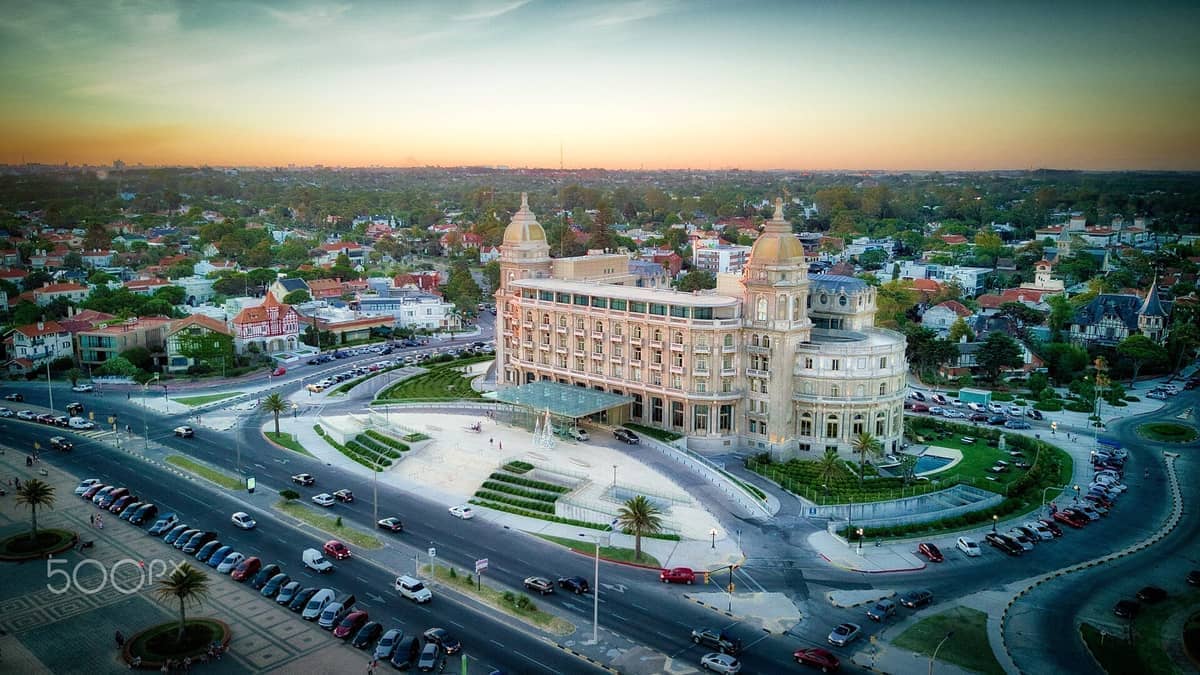
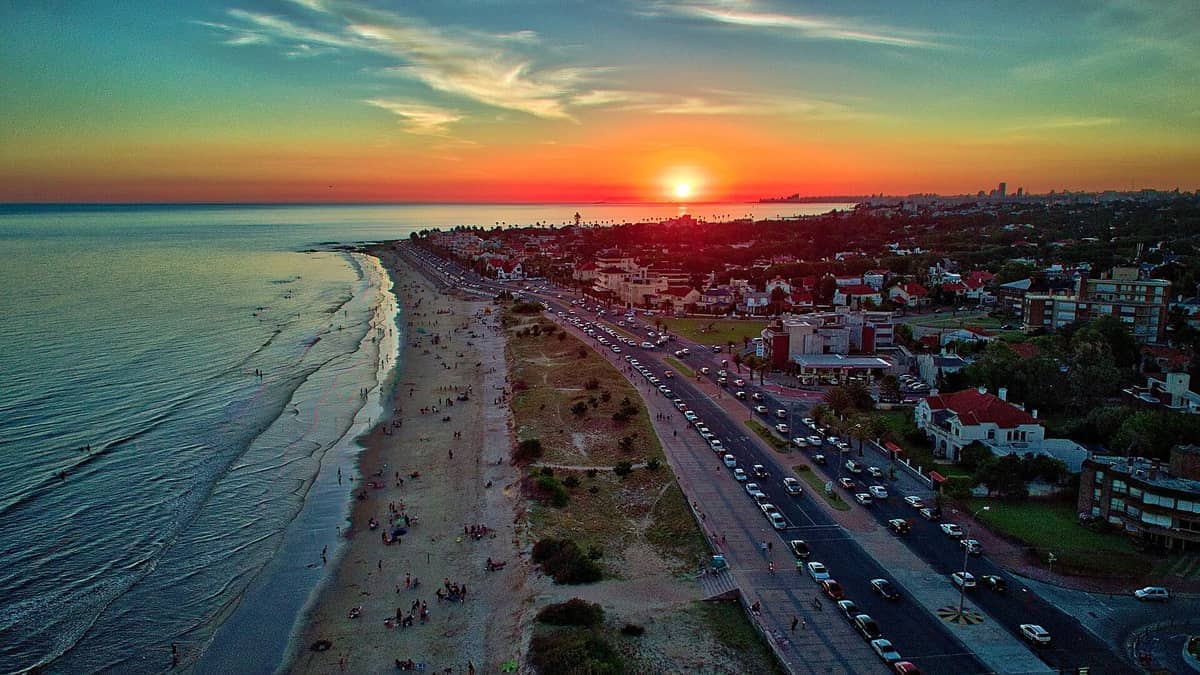
Carrasco is Montevideo's quietly affluent eastern coastal neighborhood, known for its wide tree-lined avenues, garden-city residential streets, historic Hotel Carrasco, and a long stretch of Rambla promenade. It sits at the far eastern edge of the city, close to the international airport, and feels worlds apart from the noise and density of Centro or Ciudad Vieja.
Carrasco is where Montevideo exhales. This southeastern coastal barrio, historically developed as a seaside resort for the city's upper classes, still carries that unhurried, residential quality: broad streets shaded by mature trees, grand early-20th-century houses set behind garden walls, and a sweeping coastal promenade that sees far more joggers and dog-walkers than tourists. It is not the neighborhood you go to for nightlife or markets. It is the one you choose when you want Montevideo on a slower, quieter register.
Orientation
Carrasco occupies the far southeastern corner of Montevideo, within Municipio E. Its western boundary runs along Avenida Bolivia, which separates it from Punta Gorda. To the north lies Carrasco Norte, and to the east the neighborhood meets the Canelones Department border, placing it effectively at the city's geographic edge. The southern boundary is the Río de la Plata coastline, traced by the Rambla.
The distance from Carrasco to Plaza Independencia, the symbolic center of Montevideo, is roughly 18 to 20 kilometers by road, which puts it at the far end of the city's coastal arc. This matters practically: Carrasco is not a base you choose for easy access to Ciudad Vieja or Centro. It makes most sense for travelers arriving or departing from Carrasco International Airport, which sits just beyond the neighborhood's eastern edge in the adjacent Canelones Department, or for those who specifically want a low-key, residential coastal experience.
Thinking about the wider city layout helps. The coastal strip runs from Ciudad Vieja westward through Centro, then east through Parque Rodó, Pocitos, and Punta Carretas before arriving at Carrasco. Each neighborhood along this coast has its own density and character, and Carrasco is the quietest, most spacious of them all.
Character & Atmosphere
Walking through Carrasco is unlike walking through almost any other part of Montevideo. The streets are wide, often canopied by mature plane and eucalyptus trees that filter afternoon light into something dappled and soft. Houses are set back from the pavement behind hedges and garden walls, many of them built in the early to mid-20th century in eclectic or rationalist styles. There is an almost suburban quality to the streets, though the term undersells the architectural ambition of the grander properties.
In the mornings, the neighborhood is notably quiet. You hear birds before you hear traffic. Residents walk dogs along the Rambla as the river light comes in low and flat from the east. A few cafés and bakeries open early along the main commercial stretches near Avenida Italia and Avenida Rivera, but the neighborhood never produces the café-clinking, market-shouting energy of more central barrios. The pace is deliberate and unhurried.
By afternoon, particularly in summer, the beach and Rambla draw a more animated crowd: families, teenagers, and residents from neighboring barrios who cycle or drive out for the calmer, less crowded beach relative to Pocitos. The light on the river in the late afternoon turns honey-colored and the water surface takes on a copper sheen, especially in autumn and spring. Evenings in Carrasco are genuinely quiet. Restaurants in the neighborhood tend to close earlier than those in Pocitos or Punta Carretas, and foot traffic on most streets drops away significantly after 9 pm.
ℹ️ Good to know
Carrasco has a significant concentration of foreign embassies and consulates, which contributes to its international residential character and explains some of the security presence you may notice on certain streets.
This is not a neighborhood that performs for visitors. There are no souvenir shops, no concentrated tourist attractions, and very little of the street-level entertainment that defines more central areas. That is either a relief or a reason to stay elsewhere, depending on what you are looking for.
What to See & Do
The undisputed centerpiece of Carrasco is the Hotel Carrasco, now operating as the Sofitel Montevideo Casino Carrasco & Spa. This building, a grand early-20th-century structure set directly on the Rambla, was originally constructed as a casino and resort hotel in 1921. It fell into disuse for decades and was restored and reopened in 2013. Even if you are not a guest, walking past or stopping for a drink in the hotel's bar to see the interior is worth the detour. The architecture combines French neoclassical influences with the scale typical of Uruguay's early-republic ambitions.
The Rambla de Montevideo reaches through Carrasco, and this section of it is among the most peaceful stretches of the entire 22-kilometer coastal promenade. Walking or cycling eastward from Punta Gorda into Carrasco, you notice the crowds thin and the views across the Río de la Plata open up. On a clear day, the river here looks more like open sea than an estuary.
Playa Carrasco, the neighborhood's beach, is wide, relatively uncrowded compared to Playa Pocitos, and backed by parkland rather than apartment towers. The water quality and the calmer social atmosphere make it a preferred spot for local families with young children. In summer it fills to a comfortable capacity, never the shoulder-to-shoulder experience of Pocitos at its peak.
Walk or cycle the Rambla between Punta Gorda and Carrasco for the quietest stretch of the coastal promenade
Visit the exterior and grounds of the Sofitel Hotel Carrasco, one of Montevideo's most architecturally significant early 20th-century buildings
Spend a morning or afternoon at Playa Carrasco, particularly good for families and those who want a calmer beach than Pocitos
Explore the residential garden-city streets north of the Rambla for a sense of early 20th-century Montevideo urbanism
Look for the embassy district around the main avenues for an unusual concentration of consular architecture
💡 Local tip
The Rambla in this section is excellent for cycling. Bike rental services are available in more central neighborhoods like Pocitos or Punta Carretas, and the route east to Carrasco along the coast is flat and straightforward.
Eating & Drinking
Carrasco's food scene is small, quality-focused, and calibrated to the tastes and income levels of the residents who live here. You will not find cheap parilladas or street empanadas on every corner. What you find instead is a tight cluster of good restaurants, a few well-stocked wine bars, and cafés that take their coffee seriously.
The commercial activity concentrates along Avenida Italia and Avenida Alfredo Arocena, the main axes that bring life to what is otherwise a predominantly residential neighborhood. Here you will find bakeries open from early morning, some of the better delicatessens in the eastern city, and restaurants that lean toward contemporary Uruguayan cuisine and Mediterranean-influenced cooking rather than traditional parrilla.
The Sofitel Hotel Carrasco has its own bar and dining spaces, which are accessible to non-guests and represent the upscale end of eating in the neighborhood. For anyone interested in how Uruguayan wine culture has developed, this is a reasonable place to explore the list. The Montevideo wine scene skews toward Tannat-based reds and increasingly interesting white wines from coastal producers, and the better Carrasco restaurants reflect this.
Budget travelers should be honest with themselves about Carrasco's limitations. Eating cheaply here requires knowing where to look. The neighborhood is not structured around affordable dining, and a meal in a sit-down restaurant will generally cost more here than for equivalent food in Pocitos or Punta Carretas. Supermarkets and small provisions shops along the main avenues are the practical option for self-catering.
⚠️ What to skip
Most restaurants in Carrasco close relatively early by Montevideo standards, and options diminish significantly on weekday evenings outside of summer. If you are staying here, plan meals accordingly or be prepared to take a bus or taxi to Pocitos or Punta Carretas for evening dining.
Getting There & Around
Carrasco is well connected to the rest of Montevideo by bus, though the journey from central neighborhoods takes time. The DE1 differential bus line connects Ciudad Vieja and Carrasco, passing through the coastal neighborhoods along the way. Line 105 connects central Montevideo with the Barra de Carrasco area. Lines 21, 214, C4, DM1, and 713 also serve the neighborhood, with stops along Avenida Alfredo Arocena and nearby streets. Journey times from Plaza Independencia are 40 to 60 minutes depending on traffic and the specific route.
For a full picture of how to navigate Montevideo's bus network and other transport options, the getting around Montevideo guide covers routes, payment, and practical logistics in detail. The STM card (Sistema de Transporte Metropolitano) is the standard way to pay for buses and allows transfers within a time window.
Ride-hailing apps including Uber operate in Montevideo and are a practical option for trips between Carrasco and the city center, particularly late at night when bus frequency drops. Taxis are also available, operating on metered fares. The ride from Carrasco to Centro typically takes 25 to 40 minutes by car, depending on traffic.
The proximity to Carrasco International Airport (IATA: MVD) is one of the neighborhood's most practical advantages. The airport, technically located in Ciudad de la Costa in Canelones Department, sits just east of the neighborhood boundary. Travelers with early morning flights or late arrivals may find it genuinely useful to stay in Carrasco rather than attempting the longer journey from central Montevideo. Taxis and remise services make the airport-to-Carrasco connection in under 15 minutes.
Within Carrasco itself, walking is the natural way to move between the beach, the Rambla, and the main commercial avenues. The neighborhood is flat and navigable, though distances between points can be substantial given the low-density residential layout. Cycling is an excellent option, particularly for exploring the Rambla westward toward Punta Gorda or Punta Carretas.
Where to Stay
Carrasco is a logical base for a specific type of traveler: those who want quiet, coastal accommodation away from the city's noise; those transiting through the airport; or those who prefer residential neighborhoods to tourist-facing hotel districts. The accommodation options here are fewer than in Pocitos or Punta Carretas, and they tend toward the higher end of the price spectrum.
The Sofitel Montevideo Casino Carrasco & Spa is the anchor property and the obvious choice for travelers who want a landmark hotel experience on the Rambla. Beyond that, the neighborhood has smaller boutique-style guesthouses and apartment rentals rather than a large volume of mid-range hotels. Serviced apartments can be a good option for stays of several days, particularly for those who want to self-cater given the neighborhood's limited budget dining.
For travelers wanting to stay near Carrasco but with better access to the rest of the city and more dining options, the area around Punta Carretas or Pocitos offers a good compromise: still residential in character, but with significantly more café and restaurant density and shorter bus connections to the historic center. The where to stay in Montevideo guide gives a full comparison of the city's neighborhoods for accommodation.
ℹ️ Good to know
Carrasco is one of Montevideo's safer neighborhoods by general socioeconomic indicators, which is one reason some travelers prefer it for accommodation. That said, normal urban precautions apply anywhere in the city. Check current conditions through updated local advisories before your trip.
Is Carrasco Right for You?
Carrasco suits travelers who know what they want from a neighborhood stay and are not looking for the city's conventional tourist attractions. It is not a compromise between locations, it is a deliberate choice. If you want early morning beach walks without crowds, tree-lined streets without exhaust fumes, and the particular calm of an affluent residential area that has simply never oriented itself toward tourism, Carrasco delivers that consistently.
If your primary goal is to cover Montevideo's cultural and historical highlights efficiently, staying in Centro or Ciudad Vieja will save you significant time and transport cost. The distance from Carrasco to the Plaza Independencia or the Mercado del Puerto is real and it adds up across a short trip.
First-time visitors to Montevideo spending only two or three days in the city will likely get more value from a more central base. Carrasco rewards those who return to Montevideo already knowing the city, or those who want a longer coastal stay and can afford to treat central trips as occasional excursions rather than daily routines.
TL;DR
Carrasco is Montevideo's most prestigious coastal neighborhood: low-density, tree-lined, and genuinely quiet compared to the rest of the city.
Key draws are the Rambla, the relatively uncrowded Playa Carrasco, and the architecturally significant Sofitel Hotel Carrasco on the seafront.
Best suited to travelers who want peaceful, upscale residential accommodation or who are transiting through Carrasco International Airport.
The food and nightlife scene is limited and skews expensive; budget travelers should factor in higher costs or plan to eat in neighboring barrios.
Not the right base for first-time visitors wanting to explore Montevideo's historic center efficiently, given the 40-60 minute bus journey to Ciudad Vieja.
Forty-eight hours in Montevideo is enough to cover the historic old town, the waterfront Rambla, world-class museums, and some of South America's best grilled meat. This itinerary cuts the noise and tells you exactly what to do, when, and how to get there.
Montevideo has a stronger museum scene than many visitors expect. From a major collection of pre-Columbian art to a museum dedicated to Carnival as a living tradition, these are the best museums in Montevideo for first-time visitors and returning travelers alike.
Montevideo is a genuine year-round destination, but each season offers a different experience. This guide breaks down the weather, crowds, prices, and key events month by month so you can choose the timing that fits your trip.
Colonia del Sacramento is Uruguay's most visited colonial town, and it's reachable from Montevideo in under three hours by bus. This guide covers transport options, timing, what to prioritize once you arrive, and the common mistakes that turn a great day trip into a rushed one.
Montevideo sits at the centre of one of South America's most underrated travel regions. Within three hours by bus, you can reach a UNESCO colonial town, Uruguay's glamorous beach resort, and some of the Southern Cone's most interesting wineries. This guide covers every realistic option for day trips from Montevideo, with transport breakdowns, seasonal advice, and practical logistics.
Montevideo rewards travelers who know where to look. From always-free museums and colonial plazas to 22 kilometers of waterfront promenade, this guide covers the best free experiences in the Uruguayan capital, organized by neighborhood and type.
Montevideo runs on buses. No metro, no tram, no underground — just an extensive STM network covering the whole city, plus taxis, Uber, and a reliable airport bus from Carrasco. This guide breaks down every option with current fares, route logic, and straightforward advice on what actually works.
Montevideo is Uruguay's capital and its most-visited city, attracting about 876,000 foreign tourists in 2025 alone. But is it worth a detour on your South America trip? This guide breaks down what the city genuinely offers, who it suits, and what to skip.
Montevideo's skyline tells the story of a city that built ambitiously across several decades. From the Palacio Salvo's eclectic tower to the Neoclassical grandeur of Teatro Solís, this guide covers the key buildings, the best walking routes, and how to actually get inside them — with clear advice on tours, timing, and what to skip.
Uruguay takes its beef seriously, and nowhere is that more evident than in Montevideo's parrilla restaurants. This guide covers the culture behind asado, where to find the best grills across the city, what to expect on the menu, and honest pricing so you know what you're getting into before you sit down.
Montevideo has more than twenty named beaches stretching along the Río de la Plata, from lively Pocitos near the city center to the tranquil sands of Carrasco. This guide covers water quality, the best beaches for swimming versus walking, seasonal crowd patterns, and how to get there.
Candombe is Montevideo's most distinctive cultural practice: an Afro-Uruguayan drum tradition inscribed on UNESCO's Intangible Cultural Heritage list since 2009. This guide covers where to hear it, when to go, what to expect at the Desfile de Llamadas, and how to engage respectfully with a living community practice.
Montevideo hosts one of the longest Carnival seasons in the world, running from late January through early March. This guide covers the key events, ticket prices, neighborhood tablados, cultural context, and practical logistics to help you experience it properly.
Montevideo is one of South America's most livable capitals, with reliable infrastructure, a stable political climate, and a quality of life that few cities in the region can match. This guide covers everything remote workers need: Uruguay's digital nomad permit, the best neighborhoods to base yourself, coworking options, cost of living, and the practical details that most guides skip.
From the sprawling Sunday chaos of Tristán Narvaja to the relaxed crafts stalls of Villa Biarritz, Montevideo's flea markets and street fairs are some of the best in South America. This guide covers every major market, exact schedules, what to expect, and how to get the most out of each one.
Montevideo is one of South America's most football-obsessed cities, home to two of the continent's oldest clubs and a stadium that hosted the first World Cup final. This guide covers every major venue, how to buy tickets, what to expect at a clásico, and the practical details that make the difference between a great experience and a frustrating one.
Montevideo's nightlife runs on tango, candombe, and craft beer rather than superclubs. This guide breaks down the best neighborhoods, venues, and what to expect from the city's after-dark culture, with practical prices and timing.
Montevideo is more affordable than its reputation suggests. With free museum days, a reliable bus network costing around US$1.50 per ride, and a coastline that charges nothing for entry, the Uruguayan capital rewards travelers who plan smart. This guide breaks down exactly how to keep costs low without sacrificing the best the city has to offer.
Montevideo is one of South America's more livable capitals, but that doesn't mean it's risk-free. This guide breaks down the real safety picture — crime statistics, neighborhood-by-neighborhood risk levels, what official travel advisories say, and practical tips that actually make a difference on the ground.
Uruguay's flagship grape Tannat has put South American wine on the map, and Montevideo is your best base for exploring it. This guide covers the top wineries, urban tasting rooms, seasonal timing, and honest pricing so you can plan a wine experience that suits your budget and schedule.
Montevideo is one of South America's most relaxed capitals for family travel. From the boat-filled lake at Parque Rodó to the Rambla's long coastal path, the city offers low-cost, walkable experiences that work well across a wide range of ages. This guide covers the best activities, practical logistics, and practical advice for visiting Montevideo with kids.
A Punta del Este day trip from Montevideo is one of Uruguay's most popular excursions, and for good reason. With buses running every 20-60 minutes from Terminal Tres Cruces and a journey of around two hours each way, it's entirely doable as a same-day visit. This guide covers transport logistics, costs, what to do with limited time, and the honest trade-offs.
Montevideo rewards travelers who go beyond the surface. This guide covers the best things to do in Montevideo, Uruguay, from free rooftop viewpoints and major museums to asado markets, carnival culture, and a day trip to Colonia del Sacramento. Practical, specific, and clear about what's worth your time.
Ciudad Vieja is Montevideo's historic peninsula neighborhood, packed with colonial architecture, key museums, and some of the best food in the city. This guide covers the full self-guided walking tour route, stop by stop, with practical details on timing, costs, and what to skip.
Montevideo's food scene is built on beef, but it goes much further than that. This guide covers the essential dishes, best markets, honest price breakdowns, and where to eat well across every neighborhood, from the historic port to the coastal rambla.
Choosing where to stay in Montevideo makes a bigger difference than most travelers expect. This guide breaks down the city's key neighborhoods by character, price range, and who they suit best, so you can book with confidence.