Plaza Independencia: Montevideo's Grand Civic Square
Plaza Independencia sits at the threshold between Montevideo's historic old town and its modern downtown, serving as the symbolic and geographic heart of the Uruguayan capital. Free to enter at any hour, it rewards visitors with landmark architecture, the underground mausoleum of national hero José Artigas, and a front-row seat to daily Montevideo life.
Quick Facts
- Location
- Boundary of Ciudad Vieja and Centro, Montevideo
- Getting There
- Multiple bus lines stop nearby; walkable from Ciudad Vieja or Centro
- Time Needed
- 30–60 minutes for the square itself; allow more to explore surrounding buildings
- Cost
- Free, open 24 hours daily
- Best for
- Architecture lovers, history buffs, first-time visitors to Montevideo
What Is Plaza Independencia?
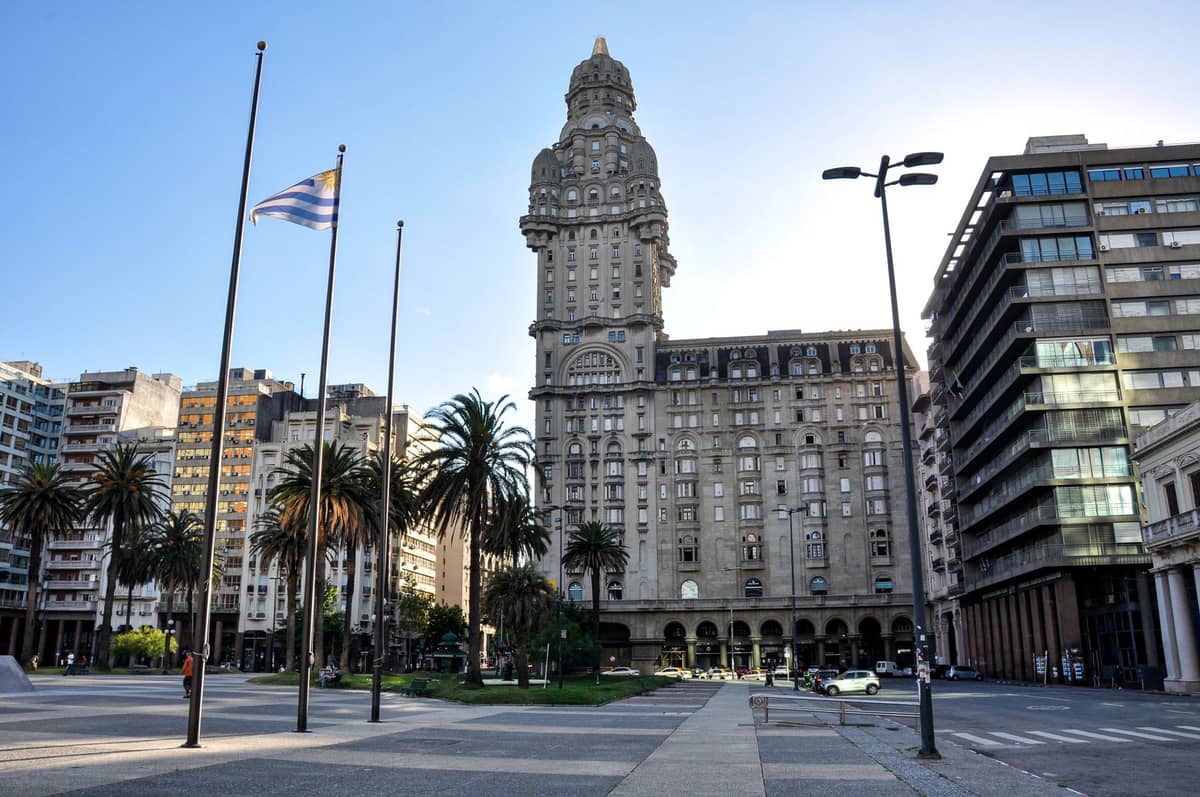
Plaza Independencia is Montevideo's principal public square: a wide, flat expanse of paving and greenery that marks the eastern edge of the Ciudad Vieja peninsula and the western entry point into the Centro district. Created in 1836 and attributed to military engineer José M. Reyes, it has served as the civic anchor of the Uruguayan capital for nearly two centuries. Unlike smaller neighborhood plazas that feel residential and quiet, this square reads as a stage, with monumental architecture on three sides and the Río de la Plata city behind you.
The square is named for Uruguayan independence, formally declared in 1825, and it carries that symbolic weight visually. The focal point is a large equestrian statue of General José Gervasio Artigas, the founding father of Uruguayan national identity. Beneath the statue lies his mausoleum, accessible by a staircase and guarded by two soldiers. For context on how this square fits the wider historic district, see the walking tour of Ciudad Vieja, which starts at the Puerta de la Ciudadela just steps from the plaza's western corner.
💡 Local tip
The mausoleum beneath the Artigas statue is typically accessible during daytime hours. Check for a soldier changing-of-the-guard ceremony if you visit around set times — it draws small crowds and is worth watching.
The Architecture Surrounding the Square
Plaza Independencia earns much of its visual authority from the buildings that ring it. On the southeast corner stands the Palacio Salvo, a 27-story tower completed in 1928 that was, for a time, the tallest building in Latin America. Its Gothic-influenced upper floors and layered facades are best appreciated from the square at mid-distance, where you can take in the full height without craning your neck.
On the opposite side sits the Palacio Estévez, a 19th-century neoclassical building that once served as the seat of the Uruguayan executive government. Its cream-and-white facade and arched windows provide the kind of old-world European civic grandeur that made South American capitals look to Paris and Madrid for inspiration. The building's role has since changed, but its presence anchors the square's historical character.
The Teatro Solís occupies a position just off the square on Buenos Aires street. One of South America's oldest and most distinguished opera houses, it adds cultural weight to the plaza's immediate surroundings. If you plan to visit inside, check schedules separately at the Teatro Solís page. The combination of these three structures, plus the Puerta de la Ciudadela at the western entry, gives the plaza a compressed architectural timeline spanning roughly 150 years.
Tickets & tours
Live prices and dates from our booking partner. If you book, we may earn a commission at no extra cost to you.
Guided Tour with Wine Tasting Experience at Bouza Winery
From 68 €Instant confirmationFree cancellationAirport to Hotel or Hotel to Airport Transfer in Montevideo
From 47 €Instant confirmationFree cancellationTasting and Lunch at Bodega Pizzorno in Montevideo
From 115 €Instant confirmationFree cancellationPunta del Este full-day guided tour from Montevideo
From 47 €Instant confirmationFree cancellation
How the Square Changes Through the Day
Early morning, roughly 7–9 a.m., the plaza is calm. A few commuters cross it diagonally taking shortcuts between bus stops and offices. Pigeons work the paving around the benches. The light at this hour hits the upper tiers of the Palacio Salvo directly, making photography of the building's facade relatively easy before the sun shifts.
By mid-morning and into the afternoon, the square fills with a mix of office workers on breaks, school groups brought to see the Artigas mausoleum, and tourists working through a Ciudad Vieja walking itinerary. Street vendors appear on the perimeter. The square is fully exposed, meaning there is little shade, and in summer months (December through February) the heat reflected off the stone paving becomes noticeable. Bring water if you plan to linger.
Late afternoon is the most photogenic time. The Palacio Salvo's upper stories catch warm southern-hemisphere light, and the bench areas fill with locals sitting before the evening commute. After dark, the square takes on a different character: the buildings are illuminated, the statue of Artigas is lit from below, and the scale of the space reads more dramatically without daytime foot traffic diluting it. The square is safe and used at night, though it quiets significantly after 10 p.m. on weekdays.
⚠️ What to skip
The square is fully open with no shade structures. In summer heat, the stone paving amplifies the temperature noticeably. Visit before 10 a.m. or after 5 p.m. on hot days.
The Artigas Mausoleum: What to Expect Inside
The mausoleum is reached via a short staircase descending beneath the central statue. Inside, the remains of José Artigas, who died in 1850 in exile in Paraguay and whose body was returned to Uruguay in 1977, are interred in a simple but solemn chamber. The space is modest in size, cool compared to the open square above, and lit in a way that emphasizes the ceremonial function of the site.
Two armed soldiers stand guard at the entrance during daytime hours, a tradition that underscores how seriously Uruguayan national identity is tied to Artigas. Visitors are expected to be quiet and respectful. Photography policies inside the mausoleum should be confirmed on arrival, as these can vary. The descent takes a few minutes and requires no ticket.
Practical Information for Visitors
The square is largely wheelchair accessible at surface level, with mostly level paving and gentle approaches from all sides. It has no admission fee and no opening hours restriction, though the mausoleum access is limited to set daytime opening hours (typically mid-morning and mid-afternoon). There are benches throughout the square, public lighting at night, and kiosk vendors on the perimeter selling drinks and snacks during business hours.
Getting to the square is straightforward. Numerous city bus lines stop on 18 de Julio Avenue, which runs east from the plaza, making it reachable from most parts of the city. From Ciudad Vieja's interior, it is a short walk east along Sarandi or Ituzaingó. If you are coming from further afield, the guide to getting around Montevideo covers bus routes and transport options across the city.
For photography, a wide-angle lens or a phone with a wide mode is genuinely useful here: the Palacio Salvo requires distance to capture properly, and the square is large enough that standard focal lengths miss the compositional relationship between the statue, the building, and the sky. Mornings and golden hour before sunset are the most reliable for clean shots without harsh overhead shadows.
ℹ️ Good to know
The square sits exactly on the boundary of Ciudad Vieja and Centro. Walking west from here takes you into the colonial old city; walking east along 18 de Julio Avenue takes you into the commercial and governmental Centro district.
Who Will Enjoy It, and Who Might Not
Plaza Independencia is one of the few places in Montevideo that genuinely justifies its position on every visitor itinerary, not through spectacle but through coherence: the scale, the history, and the architecture all reinforce each other in a way that is rare. First-time visitors doing a two-day city loop should plan to start here before heading into Ciudad Vieja. For a structured approach, the things to do in Montevideo guide integrates the square into a broader city plan.
That said, if you are primarily seeking green space, local markets, or beach culture, the square will feel more like a transit point than a destination. It is paved and open, not a park. The experience is fundamentally urban and civic. Visitors expecting a lush plaza with gardens will be disappointed, and on hot summer afternoons the lack of shade makes extended time here uncomfortable. Those with limited time who have already visited similar South American civic squares may find the experience less novel than Montevideo's other, quieter attractions.
Connecting Your Visit to the Broader City
The plaza works best as a starting point rather than a standalone destination. From the western end, the Puerta de la Ciudadela marks the entry into the old fortified city, and from there the colonial street grid of Ciudad Vieja opens up with museums, cafes, and the waterfront market.
Walking east from the plaza along 18 de Julio Avenue leads toward the Palacio Legislativo and other civic landmarks in Centro. The entire route is flat and walkable. For travelers interested in Montevideo's layered architectural history, the Montevideo architecture guide provides detailed context on the building styles visible from the square and throughout the city.
Insider Tips
- The best single photograph of the Palacio Salvo is taken from the western end of the plaza near the Artigas statue, using the statue as a foreground anchor. This framing is rarely shown in standard travel images but captures the spatial relationship between the monument and the building.
- If you want to see the mausoleum without a crowd, arrive right when it opens in the morning. Midday school groups can make the small chamber feel congested.
- The kiosks on the southern edge of the square sell mate gourds and thermoses alongside the usual tourist items, and prices are typically lower than those in souvenir shops on Sarandi pedestrian street.
- Walking north from the square along Juncal Street for two or three blocks brings you to a quieter section of Ciudad Vieja that sees far fewer tourists, with local lunch spots that have no English menus and noticeably lower prices.
- The illuminated nighttime view of the Palacio Salvo from this square is worth returning for after dinner, particularly on clear nights when the upper tower reads sharply against the sky.
Who Is Plaza Independencia For?
- First-time visitors to Montevideo wanting a central orientation point with historical context
- Architecture enthusiasts interested in Art Deco and neoclassical South American civic buildings
- Photographers seeking Montevideo's most recognizable urban compositions
- History travelers drawn to Uruguayan independence and José Artigas' legacy
- Travelers self-guiding a Ciudad Vieja walking itinerary who need a logical starting point
Nearby Attractions
Other things to see while in Ciudad Vieja:
- Catedral Metropolitana de Montevideo
The Catedral Metropolitana de Montevideo, also known as Iglesia Matriz, is the mother church of the Archdiocese of Montevideo and the spiritual anchor of the city's oldest square. A neoclassical basilica with three naves, a transept, and a dome on a cylindrical drum, it stands opposite the Cabildo on Plaza de la Constitución and is free to enter.
- Mercado del Puerto
Mercado del Puerto is the gastronomic heart of Montevideo's Ciudad Vieja, a 19th-century iron-and-glass market hall packed with traditional parrillas, smoke-filled air, and the kind of asado culture that defines Uruguay. Entry is free, the food is serious, and the atmosphere is unlike anything else in the city.
- Museo Andes 1972
Museo Andes 1972 is a compact but deeply affecting memorial museum in Montevideo's historic Ciudad Vieja, dedicated to Uruguayan Air Force Flight 571 and the extraordinary survival story that followed the 1972 Andes crash. Across three levels and 400 square metres, original artifacts, audiovisual material, and survivor accounts transform one of the twentieth century's most gripping human dramas into something quiet, personal, and hard to forget.
- Museo de Arte Precolombino e Indígena (MAPI)
Tucked into a colonial street in Ciudad Vieja, the Museo de Arte Precolombino e Indígena (MAPI) presents thousands of years of indigenous American art with clarity and care. It is compact, thoughtfully curated, and free on Monday mornings — making it one of the most rewarding cultural stops in Montevideo for travelers who want substance over spectacle.
Planning a trip? Discover personalized activities with the Nomado app.