Puerta de la Ciudadela: Montevideo's Last Colonial Gate
Standing at the threshold between Plaza Independencia and Ciudad Vieja, the Puerta de la Ciudadela is one of the few surviving fragments of Montevideo's 18th-century Spanish fortifications. Entry is free, access is round-the-clock, and the stone archway rewards visitors who take a moment to understand what it once guarded.
Quick Facts
- Location
- Plaza Independencia at the eastern end of Sarandí, Ciudad Vieja, Montevideo
- Getting There
- Multiple bus lines stop at Plaza Independencia; walkable from Centro via 18 de Julio Ave
- Time Needed
- 15–30 minutes to observe and photograph; combine with Plaza Independencia for 1 hour
- Cost
- Free – open-air public monument, no ticket required
- Best for
- History lovers, architecture enthusiasts, photography, walking tours
- Official website
- www.descubrimontevideo.uy/documentos/puerta-de-la-ciudadela
What You're Looking At
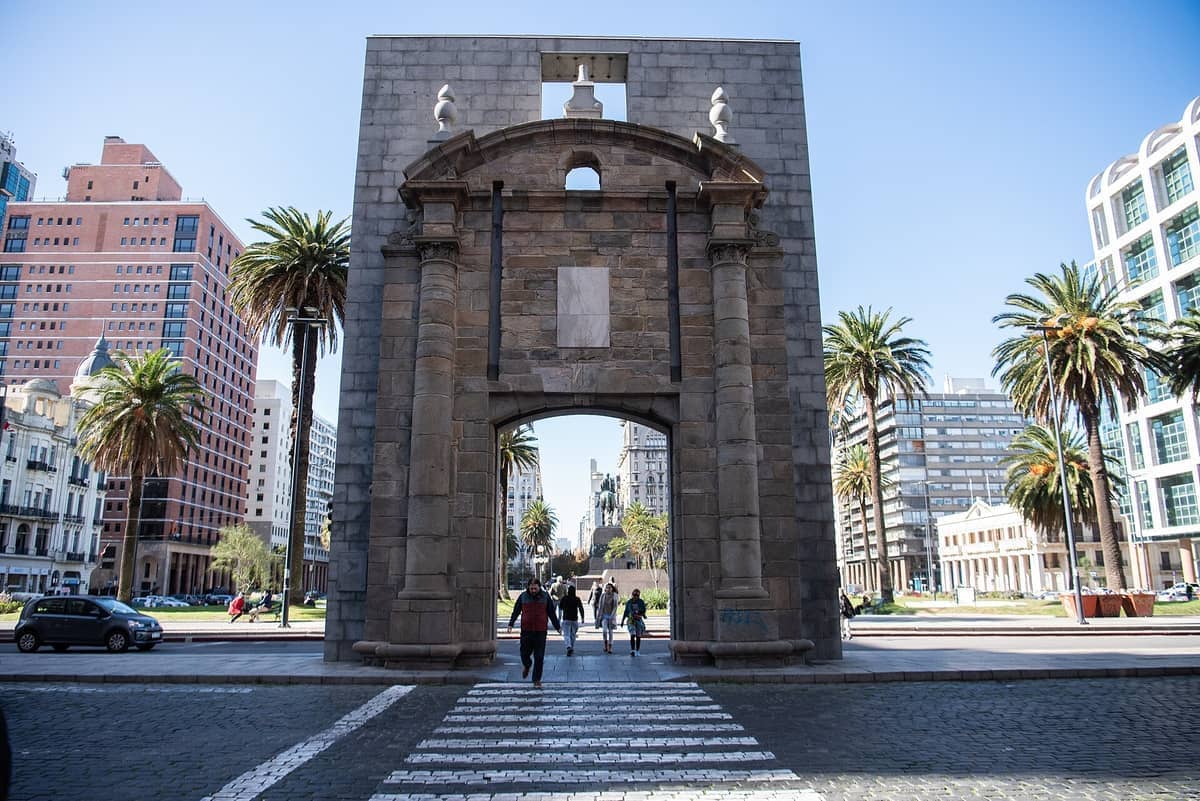
The Puerta de la Ciudadela, which translates literally as the Gateway of the Citadel, is a stone archway that once served as the main entrance to Montevideo's colonial fortification system. It sits at the western edge of Plaza Independencia, precisely where the old city wall separated the fortified colonial town from the open countryside beyond. Today that boundary is symbolic rather than functional, but the gate itself is real, solid, and genuinely old in a city where very little from the Spanish colonial era survived the 19th-century urban expansions.
The structure dates to the 18th century, when Spanish colonial authorities built a citadel to defend the strategically important port settlement on the Río de la Plata. The entire fortification complex was gradually demolished as Montevideo grew outward in the 1800s and later 19th century, and the current Puerta de la Ciudadela is a reconstructed fragment reinstalled near its original position, now standing as the most visible remnant of those defenses. That alone gives it weight beyond its modest physical dimensions: it is less a monument than a survivor.
ℹ️ Good to know
The gate is accessible 24 hours a day as an open-air public monument. There is no admission fee, no ticket booth, and no guided entry system. Simply walk up to it.
The Experience on the Ground
Approaching from Plaza Independencia, the gate appears at the far western end of the square, framed by the broad pedestrian walkway that runs through the plaza. The archway is built from dressed stone and presents a formal, symmetrical facade with a central barrel-vaulted opening flanked by pilasters. The scale is deliberately imposing for a pedestrian gate: it was designed to project authority as much as to control movement.
Walking through the arch takes only seconds, but the contrast is immediate. On the plaza side, you have the open expanse of one of Montevideo's most trafficked public spaces, with the Artigas mausoleum at its center and the bulk of the Palacio Salvo rising to the east. On the Ciudad Vieja side, the gate opens onto the narrow colonial grid of Sarandí street, where the scale suddenly drops and the atmosphere shifts to something quieter and more textured.
That transition, from the broad republican plaza to the compressed colonial street plan, is the gate's real story. It marks the edge of two different urban eras. For more on how this street fits into the old town, the Ciudad Vieja walking tour guide traces the full pedestrian route through the neighborhood.
Tickets & tours
Live prices and dates from our booking partner. If you book, we may earn a commission at no extra cost to you.
Guided Tour with Wine Tasting Experience at Bouza Winery
From 68 €Instant confirmationFree cancellationAirport to Hotel or Hotel to Airport Transfer in Montevideo
From 47 €Instant confirmationFree cancellationTasting and Lunch at Bodega Pizzorno in Montevideo
From 115 €Instant confirmationFree cancellationPunta del Este full-day guided tour from Montevideo
From 47 €Instant confirmationFree cancellation
How the Experience Changes Through the Day
Early morning, before 9am, the gate stands in relative quiet. The stone catches the low eastern light well, and the lack of crowds makes this the best window for photography without strangers in frame. The plaza behind you will already have a few joggers and coffee vendors setting up, but the archway itself is rarely occupied.
Midday brings the most activity. Office workers cut through the arch as a pedestrian shortcut between Plaza Independencia and Sarandí street. Tour groups pause here for explanations from guides. The stone radiates warmth on summer days (December through February can reach 27–28°C), and the shade under the vault offers a brief cool pause. In winter, wind funnels through the arch with some force, and the pale winter light flattens the stone's texture.
Evening visits have their own quality. By 7–8pm in summer, the sky behind the Palacio Salvo turns deep blue and the gate is lit from below by plaza lighting. The foot traffic thins. Street musicians sometimes play near the plaza benches within earshot, and the combination of warm stone, low light, and ambient sound from the square makes for the most atmospheric version of the visit. In winter, nights fall earlier and the area empties faster, so evening visits are better suited to warmer months.
Historical Context: Why This Gate Matters
Montevideo was founded as a Spanish colonial military outpost in 1724–1730, chosen for its natural harbor and strategic position on the Río de la Plata estuary. The citadel was central to that military purpose: a fortified enclosure that defined the physical limits of the early town and protected it from the landward side. The gate was the formal point of entry, the place through which everyone arriving from the surrounding territory had to pass.
As the city grew through the 19th century following Uruguayan independence in 1828, the walls gradually became an obstacle to expansion rather than a defense. They were demolished in stages over several decades, and the land they occupied was absorbed into the growing street grid. Plaza Independencia itself was carved out of part of the old fortified perimeter. The decision to preserve the Puerta de la Ciudadela while tearing down everything else around it was a deliberate act of historical memory, unusual in a city that otherwise swept away most of its colonial fabric.
This historical continuity is part of what makes Ciudad Vieja worth spending real time in, not just passing through. The neighborhood still holds an unusual concentration of colonial and early-republican architecture relative to the rest of Montevideo. The Montevideo architecture guide covers the broader context of how the city's built fabric evolved across different eras.
What to Look At: Architectural Details
The gate's facade rewards close attention. The stonework is the first thing to examine: the voussoirs forming the arch are cut with precision, and the overall composition follows Spanish colonial military architecture conventions, functional but given formal treatment through pilasters and a defined cornice line. The stone itself has the patina of genuine age, with weathering patterns that no restoration has fully smoothed away.
Look at the upper section of the facade, above the arch opening. There is decorative stone carving in that zone, and the overall proportions of the gate reflect the 18th-century concern with projecting institutional weight through symmetry and mass. Compare this to the buildings immediately around it on the Ciudad Vieja side, many of which date from the late 19th or early 20th centuries, and the gate's age becomes legible in the material and compositional language alone.
💡 Local tip
Photography tip: Shoot from the Ciudad Vieja side looking back through the arch toward Plaza Independencia. The framing pulls in the Palacio Salvo in the background, giving you colonial foreground and 1920s Art Deco behind in a single image. Morning light from the east illuminates this composition best.
Practical Walkthrough: Getting There and Around
The Puerta de la Ciudadela sits at the western edge of Plaza Independencia, Montevideo's central public square. Arriving by bus, numerous lines run along Avenida 18 de Julio, which feeds directly into the plaza from the east. The gate is a short flat walk from any stop along that avenue. Taxis and ride-hailing services drop passengers at the plaza perimeter without difficulty.
The gate is the natural starting point for exploring Ciudad Vieja on foot. From here, Sarandí street runs west as a pedestrian artery through the old town, passing Plaza Matriz and continuing toward the waterfront. The entire walk from the gate to the far end of Ciudad Vieja near the port takes around 20–25 minutes at a relaxed pace, with many stops possible along the way.
Accessibility: The gate is at ground level with no steps, and the surface of Plaza Independencia is paved. The approach from the plaza is flat and wheelchair-accessible. The Ciudad Vieja streets immediately beyond the gate have standard urban paving, generally manageable but uneven in some older sections. No specific accessibility infrastructure has been documented at the monument itself.
If you plan to combine this visit with other sites, the nearby Palacio Salvo on Plaza Independencia and the Teatro Solís just off the square make logical additions that add no significant walking distance. Budget roughly half a day to see the gate, the plaza, and a couple of blocks into Ciudad Vieja comfortably.
Who Should Recalibrate Their Expectations
The Puerta de la Ciudadela is a fragment, not a full monument. Visitors expecting a grand fortress complex, an interior to explore, or an interpretive museum will find none of that here. It is a single archway in an urban setting, and its power is historical and contextual rather than spectacular. Travelers whose interest in colonial history is limited may find 10 minutes here sufficient and should not feel obligated to linger.
It is also worth noting that the gate sits in a city plaza that is always active. If you are looking for a solitary or contemplative encounter with history, midday visits during weekdays will feel commercial and crowded by Montevideo standards. The gate does not have the drama of the region's larger historical sites, and it would be misleading to rank it alongside, say, the entirety of Colonia del Sacramento's old quarter. It is one layer in a richer city, not a destination in isolation.
Insider Tips
- Stand on the Ciudad Vieja side of the arch and face back toward Plaza Independencia between 7:30–8:30am on a clear morning. The Palacio Salvo catches the early light and the plaza is empty enough to feel like a different city.
- The gate is the logical zero-point for a self-guided Ciudad Vieja walk. Start here, head west along Sarandí, and let the street guide you rather than working from a fixed itinerary — the colonial grid is compact enough that you cannot get seriously lost.
- If you visit during Carnival season (typically February), the gate and Plaza Independencia become part of the larger festive atmosphere in the surrounding streets. The combination of the lit-up plaza and candombe drumming from nearby Barrio Sur can be heard from here in the evenings.
- Street vendors near Plaza Independencia sell cold drinks and snacks throughout the day. Stock up before heading deeper into Ciudad Vieja, where options thin out on the quieter western blocks near the port.
- The gate is free, but consider pairing the visit with the Museo Histórico Cabildo, which is within a short walk and provides indoor historical context that the gate itself cannot offer.
Who Is Puerta de la Ciudadela For?
- History and architecture travelers who want to understand Montevideo's colonial origins
- Photographers looking for a compositional anchor that combines colonial and early-20th-century architecture in one frame
- First-time visitors using the gate as the starting point of a Ciudad Vieja walking circuit
- Travelers on a budget who want meaningful sightseeing at zero cost
- Anyone combining Plaza Independencia with a deeper exploration of the old town
Nearby Attractions
Other things to see while in Ciudad Vieja:
- Catedral Metropolitana de Montevideo
The Catedral Metropolitana de Montevideo, also known as Iglesia Matriz, is the mother church of the Archdiocese of Montevideo and the spiritual anchor of the city's oldest square. A neoclassical basilica with three naves, a transept, and a dome on a cylindrical drum, it stands opposite the Cabildo on Plaza de la Constitución and is free to enter.
- Mercado del Puerto
Mercado del Puerto is the gastronomic heart of Montevideo's Ciudad Vieja, a 19th-century iron-and-glass market hall packed with traditional parrillas, smoke-filled air, and the kind of asado culture that defines Uruguay. Entry is free, the food is serious, and the atmosphere is unlike anything else in the city.
- Museo Andes 1972
Museo Andes 1972 is a compact but deeply affecting memorial museum in Montevideo's historic Ciudad Vieja, dedicated to Uruguayan Air Force Flight 571 and the extraordinary survival story that followed the 1972 Andes crash. Across three levels and 400 square metres, original artifacts, audiovisual material, and survivor accounts transform one of the twentieth century's most gripping human dramas into something quiet, personal, and hard to forget.
- Museo de Arte Precolombino e Indígena (MAPI)
Tucked into a colonial street in Ciudad Vieja, the Museo de Arte Precolombino e Indígena (MAPI) presents thousands of years of indigenous American art with clarity and care. It is compact, thoughtfully curated, and free on Monday mornings — making it one of the most rewarding cultural stops in Montevideo for travelers who want substance over spectacle.
Planning a trip? Discover personalized activities with the Nomado app.