Plaza Matriz (Plaza de la Constitución): Montevideo's Historic Heart
Plaza Matriz, officially Plaza de la Constitución, is the oldest square in Montevideo, sitting at the center of the colonial Ciudad Vieja district since 1726. Free to visit at any hour, it combines genuine historical weight with a living neighborhood atmosphere, from antique market mornings to quiet midweek afternoons flanked by the Metropolitan Cathedral and the Cabildo.
Quick Facts
- Location
- Ciudad Vieja, Montevideo (Juan Carlos Gómez 1362, 11000)
- Getting There
- Multiple city bus lines serving Ciudad Vieja; walkable from Plaza Independencia (10 min on foot)
- Time Needed
- 30–60 minutes for the square itself; 2–3 hours if combining with Cathedral and Cabildo
- Cost
- Free; the square itself is accessible 24 hours, year-round
- Best for
- History enthusiasts, architecture lovers, Saturday antique hunters, photography
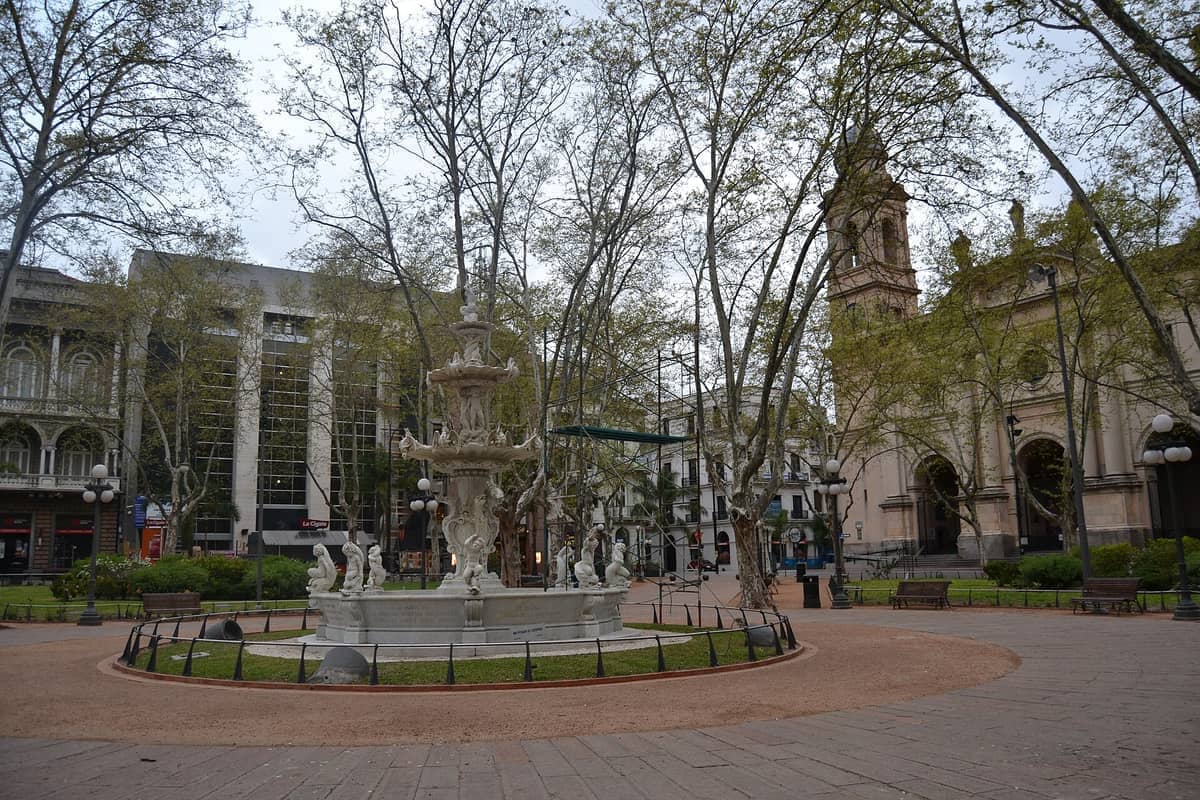
What Plaza Matriz Actually Is
Plaza Matriz, whose full official name is Plaza de la Constitución, is not simply a square with a fountain. It is the founding public space of Montevideo, the point around which the entire city was organized when the Spanish established the fortified town of Ciudad Fortaleza de San Felipe y Santiago de Montevideo in 1726. Every colonial city in the Spanish Americas was built outward from a central plaza mayor, and this is Montevideo's. That origin gives the space a gravitational quality that newer, more polished squares around the city simply do not have.
The name Plaza de la Constitución was given after Uruguay swore its first constitution here on 18 July 1830, commemorating the young republic's legal foundation. Locals, however, have always called it Plaza Matriz, named after the Iglesia Matriz, the Metropolitan Cathedral that fronts the square's eastern edge. Both names are in common use and both are correct.
ℹ️ Good to know
The square is open 24 hours, free of charge, with no ticket or registration required. It is flat, paved, and accessible for wheelchairs and strollers.
The Architecture Framing the Square
The buildings that define Plaza Matriz are the reason most architecture-minded visitors come here. On the eastern side stands the Metropolitan Cathedral of Montevideo, the Iglesia Matriz, the oldest church in the city. Its neoclassical facade, completed in the early nineteenth century, anchors the square with considerable weight. The twin towers frame the plaza's skyline from almost any angle.
On the southern side sits the Cabildo, the former colonial council building and one of the few remaining structures from the Spanish administrative period. Today it functions as a museum, the Museo Histórico del Cabildo, housing artifacts from Uruguay's colonial and independence eras. The pairing of these two buildings, a church and a civic hall, directly across from each other, is a deliberate expression of how colonial power was organized: spiritual authority on one side, temporal authority on the other.
For a broader sense of how this colonial core fits into Montevideo's layered urban fabric, the Montevideo architecture guide traces the city's building history from the colonial period through Art Deco and modernist periods.
💡 Local tip
For photography: the Cathedral facade catches the best light in the mid-morning, roughly 9–11 AM, when the sun is to the east and illuminates the stonework directly. Afternoon light flattens the facade considerably.
Tickets & tours
Live prices and dates from our booking partner. If you book, we may earn a commission at no extra cost to you.
Guided Tour with Wine Tasting Experience at Bouza Winery
From 68 €Instant confirmationFree cancellationAirport to Hotel or Hotel to Airport Transfer in Montevideo
From 47 €Instant confirmationFree cancellationTasting and Lunch at Bodega Pizzorno in Montevideo
From 115 €Instant confirmationFree cancellationPunta del Este full-day guided tour from Montevideo
From 47 €Instant confirmationFree cancellation
How the Square Changes Through the Day
Early morning, roughly 7 to 9 AM, Plaza Matriz belongs to commuters cutting through on their way to offices in Ciudad Vieja. The surrounding streets smell of coffee drifting from nearby cafes, and the sound is primarily footsteps on old stone paving and the occasional bus pulling away two blocks over. The fountain at the center trickles steadily. At this hour the square feels less like a tourist attraction and more like an ordinary piece of city infrastructure, which is part of its appeal.
By mid-morning on weekdays, a mix of pensioners, office workers on breaks, and visitors from the nearby hotels fill the benches. Street vendors occasionally set up along the perimeter. The pace is slow and the atmosphere is conversational. Weekday afternoons can be quiet to the point of feeling underpopulated, particularly in winter when the southern latitude makes 3 PM feel like late evening light. This is not a criticism, it is simply the rhythm of Ciudad Vieja outside of peak weekend hours.
Saturday mornings transform the square entirely. A regular antique and collectibles market, the feria de antigüedades, takes over the paving stones with stalls selling old books, coins, ceramics, Soviet-era cameras, leather goods, and a range of genuinely eclectic objects. This is arguably the best single time to visit Plaza Matriz. The market draws a local crowd as much as a tourist one, which keeps the atmosphere from feeling performative.
💡 Local tip
Arrive at the Saturday antique market before 10 AM if you are looking for specific items. By midday, the best finds are gone and the crowds thicken significantly.
Historical Weight: From Plaza Mayor to Constitutional Symbol
The square dates to 1726, when Spanish settlers were organized under the direction of Bruno Mauricio de Zabala to establish a permanent fortified settlement on the Río de la Plata. As was standard practice in Spanish colonial urban planning, guided by the Laws of the Indies, the new town was laid out in a grid with the plaza mayor as its center. Government buildings, the parish church, and commercial activities all concentrated around this central space.
The constitutional moment of 1830 added a layer of meaning that the square carries to this day. Uruguay's first constitution was publicly proclaimed here, and the renaming to Plaza de la Constitución was a deliberate act of political symbolism, marking the transition from colonial administration to independent republic. The fountain in the center of the square, installed in the nineteenth century, bears further symbolic elements relating to civic life and national identity.
Understanding this square in isolation misses part of its significance. It sits at the heart of the Ciudad Vieja district, which contains the densest concentration of Montevideo's colonial and early republican heritage. The Ciudad Vieja walking tour covers the surrounding streets in detail and is the most efficient way to absorb the full historical context.
What to Do Around the Square
The square itself requires perhaps twenty to thirty minutes if you are simply walking through, reading the historical markers, photographing the Cathedral facade, and sitting by the fountain. To make the visit worth a dedicated journey, combine it with the adjacent attractions.
- Museo Histórico del Cabildo (south side of the square): Uruguay's colonial history told through documents, period furniture, and artifacts. Check current opening hours directly with the museum before visiting.
- Metropolitan Cathedral (east side): entry is generally free (donations appreciated); the interior has notable neoclassical details and is significantly cooler than the street in summer, making it a practical as well as architectural stop.
- Mercado del Puerto (7-minute walk): the city's famous covered iron-frame market, primarily for lunch. Parilladas (grills) are most active from midday onward.
- Saturday antique market: the square's own weekly market is reason enough to time your visit for a Saturday morning.
If the market is your main goal, note that Montevideo also has a strong flea market scene across several neighborhoods, worth knowing if you are in the city on multiple days.
Practical Details and Honest Assessment
Getting to Plaza Matriz is straightforward. From Plaza Independencia, the walk through Ciudad Vieja takes about ten minutes heading west along Calle Sarandi, a partially pedestrianized street lined with shops and the occasional street musician. Multiple bus lines serving Ciudad Vieja stop within a block or two of the square. Taxis and ride-hailing services can drop you directly on the adjacent streets.
Weather affects the experience more than most guides acknowledge. Montevideo's winters (June through August) bring grey skies and temperatures that can drop to 8 or 9 degrees Celsius. The square is fully exposed, with limited shade structures, and strong winds from the Río de la Plata estuary make it feel colder than the thermometer suggests. A mid-winter visit at 8 AM is a genuine test of dedication. The flip side: summer mornings (December through February) before 10 AM are genuinely pleasant, with warm light and manageable temperatures before the midday heat arrives.
The square is flat and paved throughout, with no steps required to access any part of it. The Cathedral has some wheelchair access at ground level, though interior movement may be limited. This is one of the more accessible historic spaces in the city center.
⚠️ What to skip
Plaza Matriz can feel sparse and slightly neglected outside of Saturday mornings and peak summer months. If you are expecting a lively, restaurant-lined European-style piazza, you may be underwhelmed. Manage expectations accordingly: this is a working-class city's historic square, not a curated tourist set piece.
If you are planning a broader visit to Montevideo's historic core and want a framework for prioritizing attractions, the guide to things to do in Montevideo provides a ranked overview calibrated to different traveler types.
Insider Tips
- Saturday before 10 AM is definitively the best time to visit. The antique market is in full swing, the Cathedral is open, and the light on the buildings is still coming from the east. By 11 AM, the combination of crowds and flattened light makes the square feel less special.
- The street Calle Sarandi, which connects Plaza Matriz to Plaza Independencia, is pedestrianized for most of its length and has good cafes. Walk it rather than taking a taxi between the two plazas.
- Step inside the Cabildo museum even if you have limited time for its collection. The interior courtyard gives you a clear sense of the scale of colonial administration and is rarely photographed.
- In summer, the Cathedral interior offers genuine relief from the heat. It is open to visitors outside of Mass hours and entry is free.
- Look at the paving stones closely rather than just the facades. The pattern and wear of the stones underfoot is one of the most tangible physical links to the nineteenth-century city that survives in the open air.
Who Is Plaza Matriz For?
- History and colonial architecture enthusiasts who want to understand Montevideo's founding geography
- Antique and vintage collectors visiting on a Saturday morning
- Photographers working early morning or mid-morning light in winter or spring
- Travelers doing a self-guided Ciudad Vieja walking tour who want to anchor their route at the oldest point in the city
- Budget travelers: the square, the Cathedral, and a bench in the sun cost nothing
Nearby Attractions
Other things to see while in Ciudad Vieja:
- Catedral Metropolitana de Montevideo
The Catedral Metropolitana de Montevideo, also known as Iglesia Matriz, is the mother church of the Archdiocese of Montevideo and the spiritual anchor of the city's oldest square. A neoclassical basilica with three naves, a transept, and a dome on a cylindrical drum, it stands opposite the Cabildo on Plaza de la Constitución and is free to enter.
- Mercado del Puerto
Mercado del Puerto is the gastronomic heart of Montevideo's Ciudad Vieja, a 19th-century iron-and-glass market hall packed with traditional parrillas, smoke-filled air, and the kind of asado culture that defines Uruguay. Entry is free, the food is serious, and the atmosphere is unlike anything else in the city.
- Museo Andes 1972
Museo Andes 1972 is a compact but deeply affecting memorial museum in Montevideo's historic Ciudad Vieja, dedicated to Uruguayan Air Force Flight 571 and the extraordinary survival story that followed the 1972 Andes crash. Across three levels and 400 square metres, original artifacts, audiovisual material, and survivor accounts transform one of the twentieth century's most gripping human dramas into something quiet, personal, and hard to forget.
- Museo de Arte Precolombino e Indígena (MAPI)
Tucked into a colonial street in Ciudad Vieja, the Museo de Arte Precolombino e Indígena (MAPI) presents thousands of years of indigenous American art with clarity and care. It is compact, thoughtfully curated, and free on Monday mornings — making it one of the most rewarding cultural stops in Montevideo for travelers who want substance over spectacle.
Planning a trip? Discover personalized activities with the Nomado app.