Palacio Salvo: Inside Montevideo's Most Iconic Building
Completed in 1928, Palacio Salvo anchors Plaza Independencia with its 95-metre tower and ornate facade. Guided tours take visitors through the grand hall, up through the building's layers, and into a small tango museum. Here is everything you need to visit with confidence.
Quick Facts
- Location
- Plaza Independencia 848, Ciudad Vieja, Montevideo
- Getting There
- Multiple city bus lines stop at Plaza Independencia; walkable from all of Ciudad Vieja
- Time Needed
- Around 60–75 minutes for a guided tour
- Cost
- UYU 400 per person for the municipal guided tour (verify before visiting)
- Best for
- Architecture enthusiasts, history lovers, photographers, first-time visitors
- Official website
- www.descubrimontevideo.uy/palacio-salvo
What Palacio Salvo Actually Is
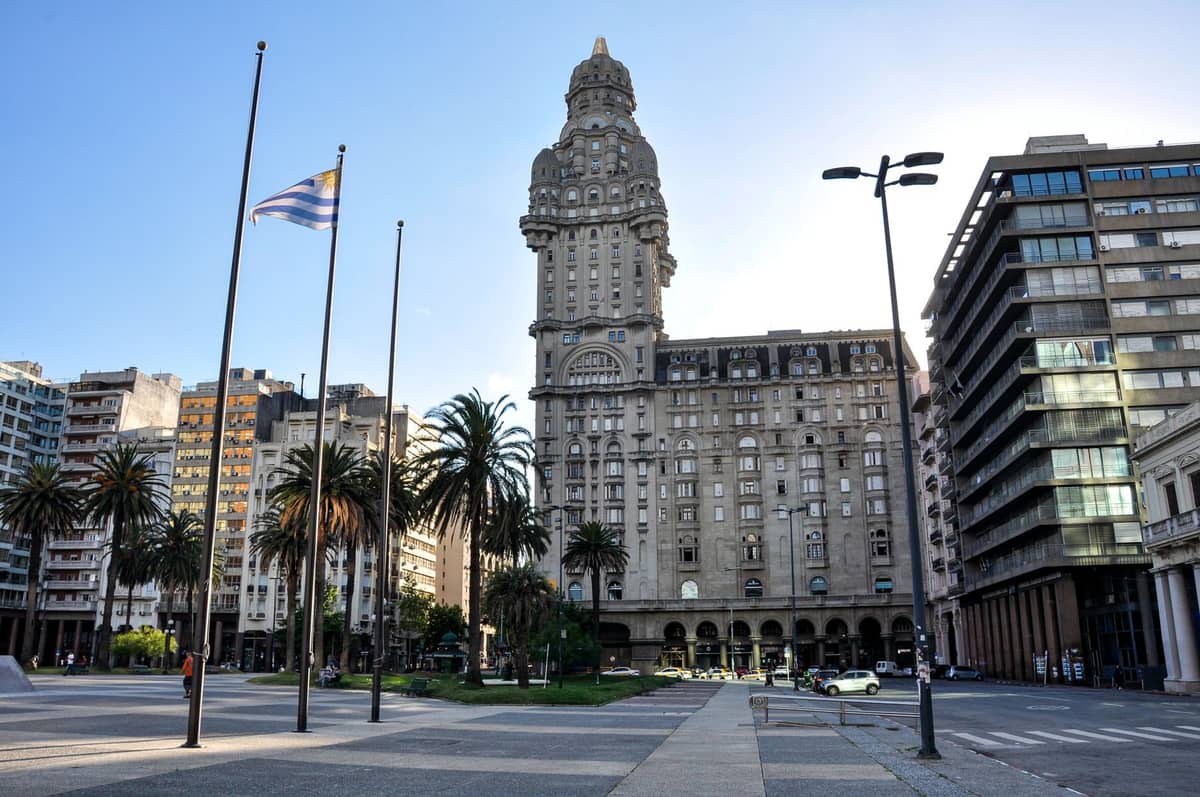
Palacio Salvo is not a palace in the aristocratic sense. It is a mixed-use tower completed in 1928, combining apartments, offices, and commercial spaces beneath a lighthouse-shaped cupola that still dominates the Montevideo skyline from almost any angle. Designed by Italian-Argentine architect Mario Palanti and standing approximately 95 metres tall to the roof (rising to about 105 metres including its beacon), it held the distinction of being among the tallest buildings in Latin America at the time of its inauguration. That record is long gone, but the building's cultural weight has only grown.
The building sits at the eastern edge of Plaza Independencia, the ceremonial square that marks the boundary between Ciudad Vieja and the Centro district. That position alone makes it unavoidable: whether you approach from the old town's cobbled streets or from the broad Avenida 18 de Julio, Palacio Salvo is the punctuation mark at the end of the view. Most visitors see the exterior for free just by walking past. The organized guided tour, priced at UYU 400 per person as of early 2026, is how you get inside.
💡 Local tip
English-language guided tours run Monday to Friday at 11:00 and 15:00, and on Saturdays at 12:00 and 13:00, in line with the municipal schedule. Visiting hours are Monday to Friday 10:00–13:00 and 13:30–17:00, Saturday 10:00–13:00, and Sunday 11:30–14:00; confirm current times by emailing palaciosalvooficial@gmail.com or calling +598 98 456 370 before you go.
The Architecture: What You Are Actually Looking At
Mario Palanti designed Palacio Salvo with an aesthetic that defies easy categorisation. The lower storeys recall Italian Renaissance palazzo design, with heavy stone arches and decorative columns at street level. As the building rises, it transitions through Art Nouveau and eclectic Baroque references before tapering into an octagonal tower and finally the distinctive lantern cupola. The result reads as chaotic to some eyes and thrillingly ambitious to others. There is no neutral reaction.
At street level, the main hall facing Plaza Independencia is the tour's starting point. The grand lobby retains original decorative elements: ornate plasterwork, wrought-iron details, and a sense of scale that makes clear this was designed to impress on first contact. The building was commissioned by the Salvo family, Uruguayan businesspeople of Italian descent, and it was conceived as both a commercial venture and a statement of civic ambition at a moment when Montevideo was one of South America's wealthiest cities.
Palanti also designed Palacio Barolo in Buenos Aires, which shares several design motifs with Palacio Salvo. The two buildings are sometimes described as sister structures, linked by Palanti's recurring interest in Dante's Divine Comedy as architectural allegory. Whether you find that reading convincing or overstated, it provides useful context for the building's layered vertical composition. For more on the architectural era that produced buildings like this, see the Montevideo architecture guide.
Tickets & tours
Live prices and dates from our booking partner. If you book, we may earn a commission at no extra cost to you.
Guided Tour with Wine Tasting Experience at Bouza Winery
From 68 €Instant confirmationFree cancellationAirport to Hotel or Hotel to Airport Transfer in Montevideo
From 47 €Instant confirmationFree cancellationTasting and Lunch at Bodega Pizzorno in Montevideo
From 115 €Instant confirmationFree cancellationPunta del Este full-day guided tour from Montevideo
From 47 €Instant confirmationFree cancellation
The Guided Tour: What Happens Inside
The tour, officially titled 'De las columnas a la cúpula' (From the columns to the cupola), runs approximately 60 minutes and departs hourly throughout visiting hours. Groups meet at door 848 on Plaza Independencia. From the main hall, guides take visitors through the building's interior history, pointing out original architectural features that survived the structure's long commercial life.
One unexpected stop is a small museum dedicated to La Cumparsita, the tango composition by Matos Rodriguez that was first performed in Montevideo in 1917. Tango is often associated almost exclusively with Buenos Aires, but Uruguay's claim to the genre is serious, and the museum makes that case with modest but genuine documentation. It takes perhaps 10 minutes to absorb and is included in the tour price.
The ascent through the building uses a combination of stairs and elevator. The view from the upper floors and cupola area is the reward: on a clear day you can see across Plaza Independencia, along the Rambla toward the Río de la Plata, and deep into the Centro and Ciudad Vieja roofscape. The cupola level itself is compact, so large groups can feel crowded. If you are particular about photography, arriving for the first tour of the day generally means smaller group sizes.
⚠️ What to skip
Full wheelchair accessibility has not been confirmed by official sources. Contact the organizers directly before visiting if mobility is a consideration.
The View from Outside: The Plaza Independencia Experience
Even visitors who skip the interior tour will find Palacio Salvo worth their time simply as a subject for extended observation. Plaza Independencia is a working civic square, not a pedestrianised tourist precinct. In the morning, office workers cut through it at pace. By mid-morning, tour groups cluster around the mausoleum of José Artigas at the square's centre, and the surrounding benches fill with people reading or eating lunch brought from nearby cafes. The Palacio Salvo facade functions as a backdrop to all of it.
Early morning light hits the building's eastern face well, making the carved stone detailing easier to read than at midday when the sun is overhead. Late afternoon, especially in summer, can produce good warm-toned photographs from the western side of the square. Overcast days often produce surprisingly clean, shadow-free images of the facade. Rain makes the stone darken and the carved details stand out more sharply.
If you are doing a broader walking tour of the old city, Palacio Salvo works naturally as an endpoint rather than a starting point: approach from Puerta de la Ciudadela through Plaza Matriz and along Calle Sarandí, so the building reveals itself gradually as you exit the old town. The Ciudad Vieja walking tour guide lays out this route in detail.
Practical Walkthrough: Getting There and What to Bring
Plaza Independencia is one of Montevideo's main transit hubs, served by a large number of bus lines connecting Centro, Ciudad Vieja, and coastal neighborhoods. The square is also within comfortable walking distance of most Ciudad Vieja accommodations. Taxis and ride-hailing services (including Uber, which operates in Montevideo) can drop you directly on the plaza perimeter.
The official address for guided tour entry is Plaza Independencia 848. Look for the main arched entrance facing the square rather than the side-street doors. Payment for tours is made on-site; bring Uruguayan pesos as card acceptance is not guaranteed. The tour price of UYU 400 is modest, but as with all prices in Uruguay, it is subject to periodic adjustment, so treat any specific figure as a starting point for verification.
Wear comfortable shoes. The ascent involves stairs at various points even if an elevator covers part of the route. There is no particular dress requirement. In winter (June to August), temperatures can drop to around 8 to 14 degrees Celsius, so a layer is worth carrying. In summer, the upper floors can be warmer than the street level.
ℹ️ Good to know
Photography is generally permitted inside the building on guided tours, but tripods are impractical given the group pace. A phone camera or compact camera is sufficient for the interior; bring a wider lens option if you want to capture the full facade from the plaza.
Honest Assessment: Is the Tour Worth It?
The exterior of Palacio Salvo is genuinely extraordinary and costs nothing to see. The interior guided tour adds context, history, and access to the upper floors, but the experience depends significantly on your guide. Visitor reviews note wide variation in guide quality and enthusiasm. The English-language tours run on a fixed schedule and are not always available outside posted hours, so plan around them specifically if language is a concern.
The tango museum inside is a pleasant surprise but brief. The cupola view is good rather than spectacular: Montevideo is a low-rise city and the Río de la Plata is visible, but this is not a panoramic observation deck in the conventional sense. Visitors hoping for a 360-degree bird's-eye view may find the Mirador de la Intendencia, which offers a rooftop terrace over the city, a more satisfying option for pure views.
For architecture and history enthusiasts, the tour is worthwhile at UYU 400. For travelers primarily interested in the view, compare it with the free Mirador de la Intendencia before committing. Those doing a full day in the old city will find Palacio Salvo fits naturally into the itinerary without dominating it. See the complete Montevideo attractions guide for context on how it compares to other sights.
Visitors with very limited mobility should note the accessibility uncertainty and contact organizers in advance. Those traveling with young children may find the 60-minute structured tour more demanding than rewarding for the group. People who dislike guided group formats and prefer self-directed exploration will find more satisfaction in the plaza and facade than in booking the tour.
Insider Tips
- The first tour of the day (typically around 10:00 on weekdays) usually has the smallest group size. Arriving just before the hour and buying your ticket promptly is the best way to avoid the mid-morning clusters.
- The building is partially residential and commercial, so do not enter doors other than 848 on Plaza Independencia. Side entrances lead to private areas and are not part of the visitor circuit.
- If you want a photograph of the full building from street level without tour groups in the foreground, the western side of Plaza Independencia early on a weekday morning gives you a relatively clear sightline before foot traffic builds.
- The La Cumparsita tango museum inside is small but genuinely informative about Uruguay's contested claim to the genre. Ask your guide specifically about Matos Rodriguez if they do not cover it in depth; it is one of the more distinctive things the building contains.
- Saturday morning is one of the quieter windows for the week. Tours run 10:00 to 13:00 on Saturdays, with limited Sunday access as well; if your schedule is tight, Saturday at 10:00 is a reliable option that avoids weekday business traffic on the plaza.
Who Is Palacio Salvo For?
- First-time visitors to Montevideo wanting to understand the city's architectural and cultural identity
- Architecture enthusiasts interested in early 20th-century eclecticism and the work of Mario Palanti
- Tango history buffs who want to explore Uruguay's side of a story usually told from Buenos Aires
- Photographers looking for a technically complex and visually distinctive building subject
- Travelers doing a full Ciudad Vieja day who want structured context before exploring independently
Nearby Attractions
Other things to see while in Ciudad Vieja:
- Catedral Metropolitana de Montevideo
The Catedral Metropolitana de Montevideo, also known as Iglesia Matriz, is the mother church of the Archdiocese of Montevideo and the spiritual anchor of the city's oldest square. A neoclassical basilica with three naves, a transept, and a dome on a cylindrical drum, it stands opposite the Cabildo on Plaza de la Constitución and is free to enter.
- Mercado del Puerto
Mercado del Puerto is the gastronomic heart of Montevideo's Ciudad Vieja, a 19th-century iron-and-glass market hall packed with traditional parrillas, smoke-filled air, and the kind of asado culture that defines Uruguay. Entry is free, the food is serious, and the atmosphere is unlike anything else in the city.
- Museo Andes 1972
Museo Andes 1972 is a compact but deeply affecting memorial museum in Montevideo's historic Ciudad Vieja, dedicated to Uruguayan Air Force Flight 571 and the extraordinary survival story that followed the 1972 Andes crash. Across three levels and 400 square metres, original artifacts, audiovisual material, and survivor accounts transform one of the twentieth century's most gripping human dramas into something quiet, personal, and hard to forget.
- Museo de Arte Precolombino e Indígena (MAPI)
Tucked into a colonial street in Ciudad Vieja, the Museo de Arte Precolombino e Indígena (MAPI) presents thousands of years of indigenous American art with clarity and care. It is compact, thoughtfully curated, and free on Monday mornings — making it one of the most rewarding cultural stops in Montevideo for travelers who want substance over spectacle.
Planning a trip? Discover personalized activities with the Nomado app.